
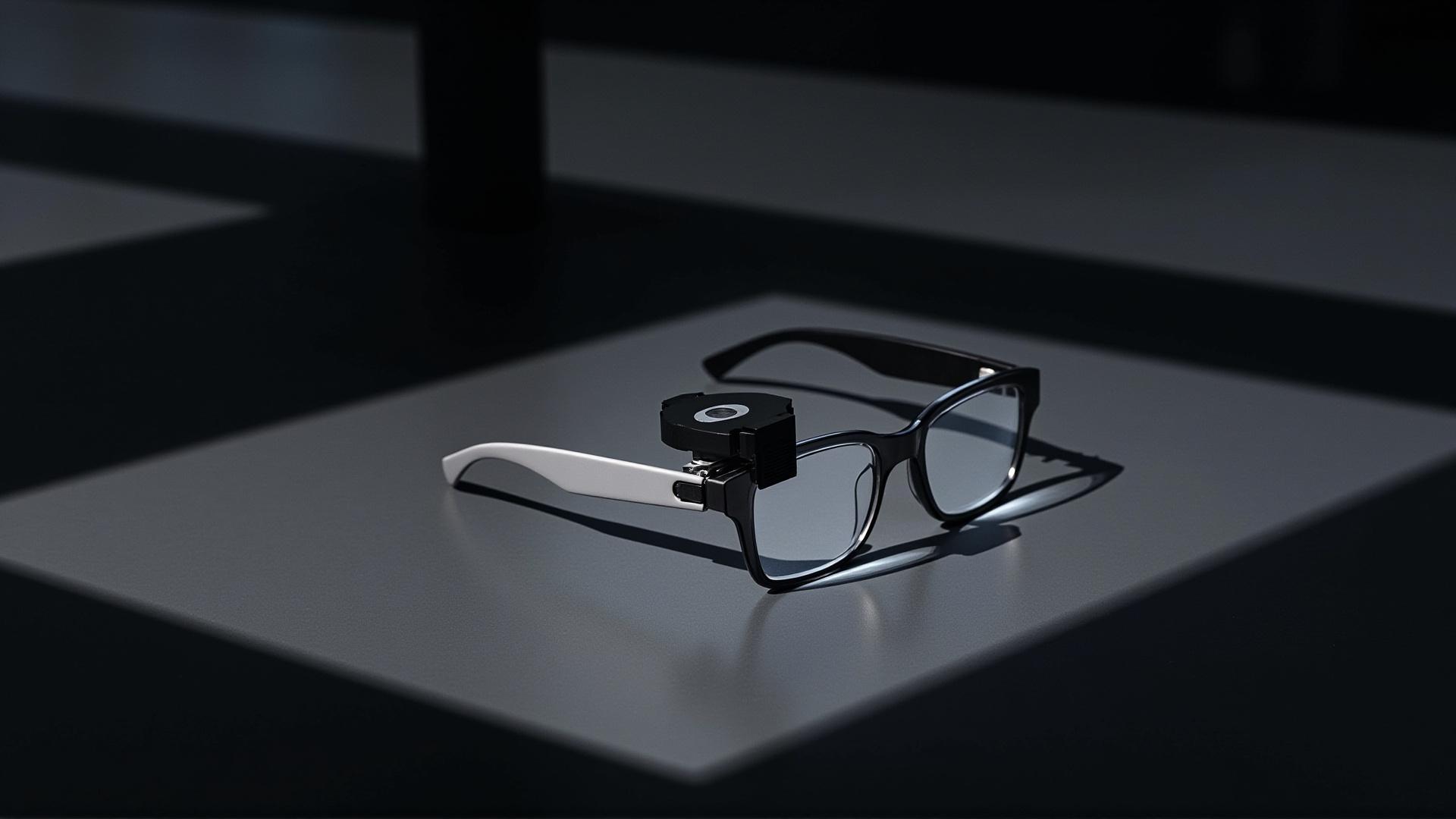
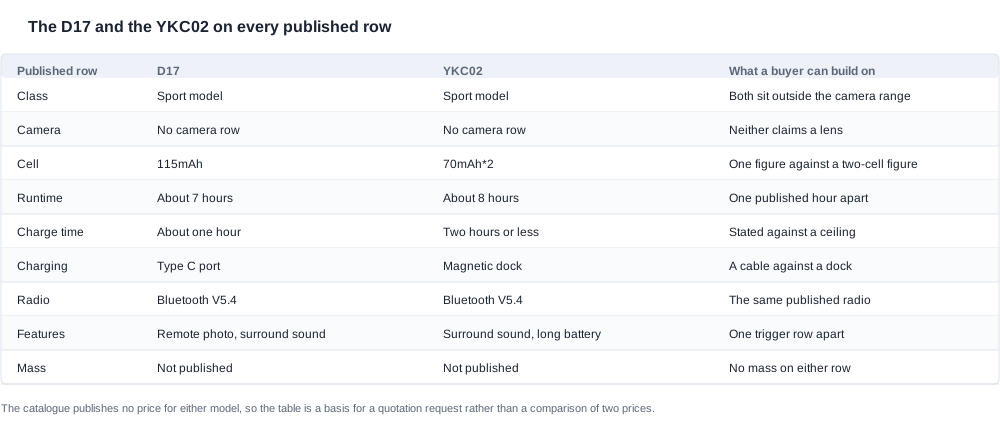
Two sport models, no camera row on either, and a short list of published differences that a buyer will notice immediately: the D17 publishes a 115 mAh cell, a remote photo trigger and a charge time of about one hour, while the YKC02 publishes a two-cell 70mAh*2 figure, a long battery life line, roughly eight hours of rated use and magnetic charging.
A price positioning that cannot be published is still a useful thing to think about, provided it is framed correctly. It is not a statement about where the two models sit in a price ladder, because the catalogue publishes no price for either of them and we will not invent one. It is a statement about the structural features a supplier's figure will have to reflect, and about the request that has to be made before two figures can be set side by side.
D17 smart glasses vs Ykc02 price positioning without a price list
What we will not publish, and what replaces it
We publish no unit price, no price band, no landed cost, no margin and no price structure for any model in the catalogue. We do not describe the range in tiers, and we do not rank the models against each other commercially.
There is a reason beyond commercial caution. A published price becomes a reference point that is quoted back at a negotiation, and a reference point that is not connected to a real quotation cannot be reconciled. A buyer given a price and then handed a different one on an invoice has been given a document that cannot be defended in a cost review.
What replaces it is the structure. A supplier can tell a buyer what a configuration costs against a stated quantity band, a stated packing and a stated destination, and can tell the buyer what sits outside that figure. That is a position, and it is one a procurement team can work with.
The three questions that produce a comparable position
- What is the unit price of this exact configuration at a stated quantity band, to a stated destination with a stated packing? A price without those qualifiers is not a price, it is an opening position.
- What sits outside it? Tooling, branding, packaging customisation, the sample, the dock or the cable, the spare cell, freight, insurance, and any certification work. Each is a separate line with a scope attached.
- What changes as the quantity band moves? The breakpoint structure is where the commercial information actually is, and asking for it before a configuration is fixed is the cheapest question in the whole category.
The questions are identical for both models, and that is what makes a comparison possible at all.
The published differences that will drive the conversation
The D17 publishes Remote Control Photo and Surround Sound. The YKC02 publishes Surround Sound and Long Battery Life. Both publish Bluetooth version V5.4, neither publishes a camera row, and neither publishes a mass.
The two feature sets are not the same product proposition. One model carries a remote trigger, which is an accessory that has to be packed, stocked, replaced and explained. The other carries a long-runtime line, which is a claim about endurance and a two-cell arrangement underneath it.
These published differences are what a supplier's figure will have to reflect, and they are the reason this comparison exists. The rows that are identical on the two models are the radio version, the absence of a camera row and the absence of a mass. The rows that differ are the cell figure, the runtime, the charge time and the charging method, and each of those is a difference in the product rather than a difference in wording. The feature rows differ by one line each: a remote photo trigger on the D17, a long battery life line on the YKC02.

Structural groups, not price tiers
A buyer needs a way to think about how models relate to each other, and the catalogue offers several ways that have nothing to do with price.
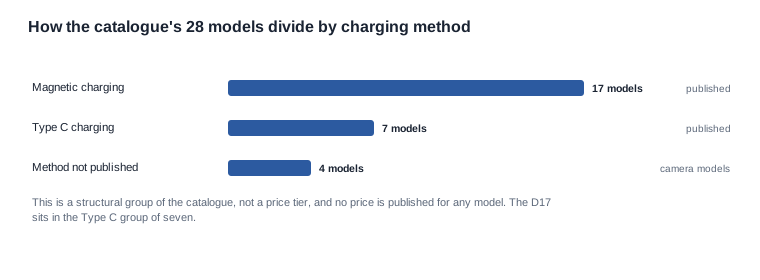
The four structural divisions the catalogue actually supports
By charging method. Seventeen models publish magnetic charging, seven publish Type-C charging, and four camera models publish no charging method at all. The D17 is in the Type-C group of seven; the YKC02 is in the magnetic group of seventeen. This division matters commercially because it decides whether the charging accessory is a commodity or a proprietary item, and that difference shows up in the packing, in the aftermarket supply and in the cost of serving a customer who needs a replacement.
By product class. Eight models are audio models, three are sport models, and eleven are camera models. The D17 and the YKC02 are two of the three sport models, and the third is the ZH12. Class is a structural division, and it is the one that decides which questions are relevant to a programme.
By cell notation. Some models publish a single cell figure, and some publish a two-cell form: 70mAh2 on the YKC02, 90mAh2 on the K01 and the K02, 55mAh*2 on the LC-105 pair, the G07 and the YK12. A two-cell arrangement is a different assembly, a different internal volume and a different accessory set, and it is the kind of difference a quotation reflects without ever mentioning it.
By camera class. Eight models publish an 8 MP class and three publish a 13 MP class. Neither model in this comparison is in either group, because neither publishes a camera row.
Why these are not price tiers
A price tier says something about money. A structural group says something about the product. The distinction is worth keeping sharp, because the two get confused constantly in this category, and the confusion produces a specific kind of error: a model gets described as "the premium one" because it has a bigger cell or a camera class, and nobody has established that the customer will pay more for a bigger cell.
The structural groups are useful precisely because they are verifiable. Each one can be checked against the catalogue, and each one tells a buyer something concrete: which accessory set to expect, which class of requirement the model can serve, which assembly the factory is running, and which kind of documentation the product will need.
A price tier, by contrast, is unverifiable without a price, and we do not publish one. We would rather give a buyer a structure they can check and a request they can send.

The published rows a quotation has to be built on
The four differences, and what each one reaches
The four standard rows below are the ones that differ between the two models. The two feature rows follow in the next part, and the same image carries all six.
The cell arrangement. The D17 publishes 115 mAh; the YKC02 publishes 70mAh*2. A single cell and a two-cell pack are different components, and the difference reaches the bill of materials, the internal volume, the case design and the assembly time. A programme that has quoted a two-cell model and then asked for a single-cell version has changed the configuration, and the figure has to be re-quoted.
The runtime. The D17 publishes roughly seven hours; the YKC02 publishes roughly eight hours. Both are point figures, which is convenient, and neither states a profile. A buyer who wants to write an endurance claim for either model has to obtain the profile first, and the two claims are not interchangeable.
The charge time. The D17 publishes about one hour; the YKC02 publishes two hours or less. One is a stated figure and the other is a ceiling, and they are different kinds of claim. The YKC02's is also the more useful one operationally, because a ceiling tells a planner that the unit will be off the charger within a bounded window, while a stated figure describes a typical cycle.
The charging method. Type-C against magnetic, which is the difference between a cable and a dock, and the difference between a consumable a market can source and a proprietary accessory that has to come from the same supplier.
The feature rows, and what they add to the commercial case
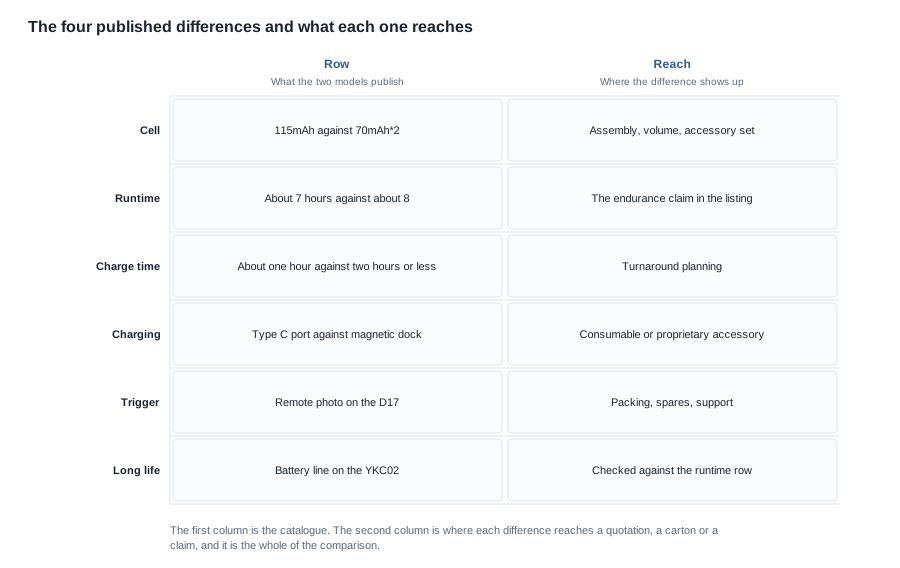
Remote Control Photo on the D17 is an accessory with a lifecycle: it is packed, counted, stocked, replaced and explained. Ask whether it ships in the box, whether it is available as a spare, and whether the same part serves other models. A trigger that is the reason a customer buys the product and is not in the box is a returns problem waiting for a reason.
Long Battery Life on the YKC02 is a claim that has to be checked against the published row rather than added to it. The row is roughly eight hours, the claim is a marketing phrase, and a listing should carry the row. The two-cell arrangement is the more substantive difference, because it is a structural fact with consequences in the assembly and in the accessory set, and it is the kind of fact a supplier's figure will have reflected without the figure ever mentioning cells.
A feature line also has a documentation cost. Every published line has to be described in the listing, in the instructions and in the support script, and each description needs an acceptance answer. The cost of a feature is never only in the hardware.
The configuration question that comes before the price question
A price is quoted against a configuration, and in this pair the configurations differ in ways that are easy to leave implicit. The D17 is a single-cell model with a remote trigger, charged over a Type-C port, with about seven hours of rated use. The YKC02 is a two-cell model with a long-runtime line, charged magnetically, with about eight hours of rated use.
Four things have to be named before any figure means anything, and each of them is a question the catalogue can answer or cannot.
- Which cell arrangement is being quoted. The published notation is the starting point, and the quantity of cells in the unit has to be confirmed against it.
- What the accessory set contains. The cable, the dock, the case, the spare cell, the trigger, the printed material and its language.
- What the packing is. Carton quantity, master-carton dimensions, gross weight, and the printing that is a custom item rather than a standard one.
- Where it is going. The destination and the incoterm decide who carries the risk, and they decide the freight and the insurance line.
A quotation that names all four can be compared with another quotation that names all four. A quotation that names one is a starting point, and a procurement file that treats it as a price will end up negotiating a configuration change and a price change at the same time, which is the worst way to find out about either.
What a supplier's figure has to include for a sport model
Sport models in this catalogue have a specific commercial shape, and it is worth spelling out what a figure for one has to include.
The hardware. The frame, the cell or cells, the radio, the amplifier, the drivers, the control, and the remote trigger on the D17. The accessory set. The charging cable or the magnetic dock, the case, any spare cell, and the trigger as a separate stocked line. The documentation. The packaging artwork, the printed insert and its languages, the conformity file for the destination market, and the transport documentation for the cell. And the quality control position — the incoming inspection regime, the defect definition, and what a batch sample comparison looks like.
Every one of those belongs inside the figure, and every one of them is something a buyer can ask about. The list above is not a list of hidden costs; it is a list of lines to check for in a quotation. A quotation that contains all of them, even as separate lines, is a document that can be compared with another one. A quotation that contains a single number and a product name is a document that can only be accepted or rejected, and the rejection is usually a waste of everybody's time.

Writing a request that makes two offers comparable

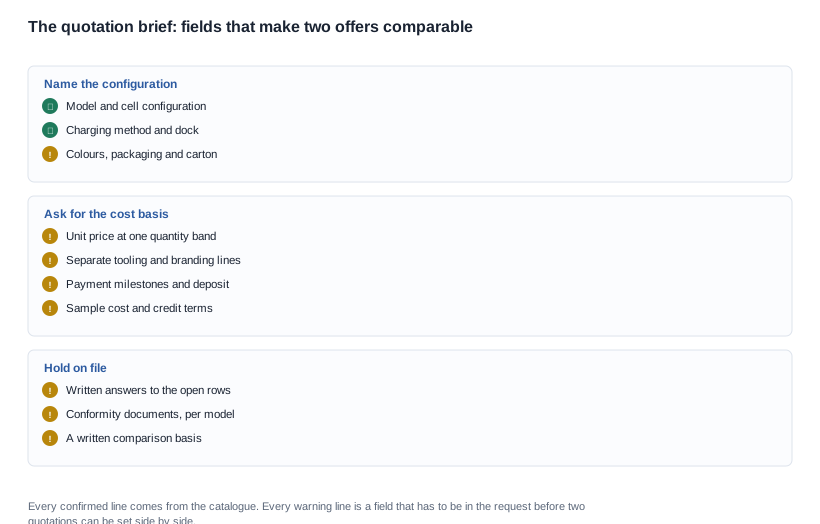
The request, field by field
A request that produces comparable answers names the same fields for both models, in one message.
- Model and cell configuration. The exact model number, and whether the published cell figure is per cell and how many cells ship in the unit.
- Charging method and the accessory set. The method, and whether the cable, the dock, the case, the spare cell and the printed material are in the box.
- Unit price at one stated quantity band, to the stated destination, in the stated packing.
- Separate lines for tooling, branding, packaging customisation, the sample and any certification work.
- Payment milestones, and what the deposit covers.
- Written answers to the open rows, per model: the mass, the dimensions, the control method, the audio arrangement and the conformity documents.
Whether the losing model would have won under the same criteria
Two offers are equivalent when the configuration, the packing, the destination, the documentation set and the payment terms match, and when the open rows are answered at the same level of detail. An offer with a shorter open list is not the same as an offer with a closed one, and the difference has to be carried into the evaluation rather than averaged away.
Write the comparison basis before the quotations arrive. A comparison sheet with fixed criteria and a fixed weighting, completed independently by two people, catches the drift that a side-by-side of two totals cannot. The test of whether the criteria were honest is whether the losing model would have won under the same criteria with a different number in the same cell. If not, the criteria were fitted to a preference.
The total cost of the two configurations
The unit figure is one component of the total cost, and in this pair the accessories are where the difference hides. A magnetic dock is a second line to stock in every market; a Type-C cable is a commodity a market can source. A remote trigger is a spare-parts route; the YKC02's long-runtime proposition has no equivalent accessory.
The open rows are the other component. A configuration that needs a sample, a measurement session, a document request and a compliance review before it can be ordered carries a programme cost that never appears on an invoice, and the D17 and the YKC02 both have one.
A worked request for this pair
The request, in the form it can actually be sent. It is short, it names both models, and it asks for everything at once rather than in a sequence of enquiries.
Configuration: the D17 and the YKC02, each as a single unit configuration, quoted at one quantity band against a named destination and a named packing. For each model, state whether the published cell figure is per cell and how many cells ship. State the charging method and list the full contents of the box, including the cable or dock, the case, any spare cell and the remote control for the D17. Give the unit price as one line, then give tooling, branding, packaging customisation, sample cost and any certification work as separate lines. State the payment milestones and what the deposit covers. Answer these five rows in writing against each model: the shipped mass, the frame dimensions, the control method, the audio arrangement, and the conformity documents that apply in the destination market.
The reason the request is written this way is that a partial request produces a partial answer. Ask for the unit price alone and the answer is a unit price. Ask for the unit price and the configuration and the answer is a comparable figure. Ask for the configuration, the figure and the open rows and the answer is something a purchase order can be written against.
The order of the questions inside the request is also deliberate. The configuration comes first because the figure depends on it, the open rows come last because they take longer, and the conformity question is named in the same message so that it can start its own lead time rather than waiting for the rest of the reply.
What a good reply looks like. Each of the two models comes back with a configuration, a figure broken into its lines, and the five open rows either answered with a figure and a date or explicitly marked as unanswered. That is a document a buyer can build a purchase order from, and it takes one round of correspondence to produce.
What we publish about pricing, and what we do not
What we publish. The configuration of every model: the radio version, the cell figure and its notation, the runtime, the charge time, the charging method, the feature lines, and the camera class where a camera row exists. Those are the facts a buyer can use to build a request, and they are enough to know which configuration is being discussed at any point in a negotiation.
What we do not publish. Any price, any price band, any tier structure, any landed cost, any margin, any minimum order quantity, any lead time, any factory capacity figure and any warranty period. We do not describe the D17 as the cheaper or the more valuable of the two, because the inputs for that statement are not public and a version of it written without them would be an assertion rather than an analysis.
We do not publish a "best value" verdict, and we will not write one. The published rows describe two products with different configurations and different feature sets, and they say nothing about what a customer will pay for either. A value position is a commercial result, and a commercial result belongs to the supplier and the buyer rather than to a catalogue.
Our position is that the request is the instrument. Send us the two models, the quantity band, the destination market and the packing, and we will tell you which published rows have to be in the request, which differences the two configurations genuinely have, and what the evaluation should be measured against. The D17 and ZH12 use-case comparison covers the third model in the sport class, and the comparison framework sets out how the whole pillar relates.


