
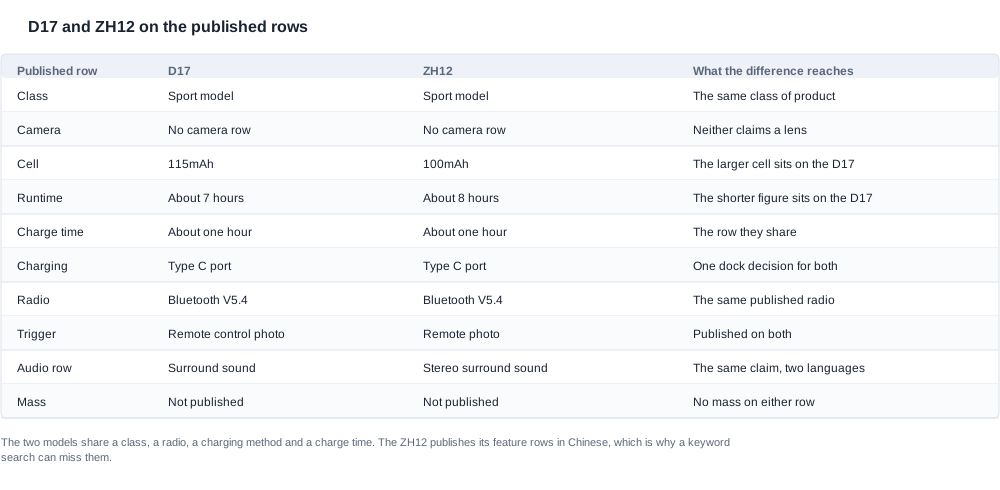
These two models are close enough that the decision is uncomfortable, and that is the useful finding. Both publish Bluetooth version V5.4, Type-C charging, a remote photo trigger, a surround-sound line and a charge time of about one hour. They differ on the cell figure — 115 mAh against 100 mAh — and on an endurance figure that runs the opposite way to the cell: the D17 publishes about seven hours of rated use and the ZH12 about eight.
Most use cases do not separate them on the published rows, and a comparison that pretends otherwise is manufacturing a difference. This article takes the use case as the starting point, maps each one to the published row that speaks to it, and shows which use cases resolve from the catalogue, which need a supplier answer, and which cannot be resolved at all because the row does not exist.
D17 smart glasses vs ZH12 use case fit on the published rows
The rows the two models share, and the two that are not shared
Published on both models: Bluetooth version V5.4, Type-C charging, a charge time of about one hour, a remote photo trigger, a surround-sound line, no camera row, no charging-case line, no mass, no ingress marking, no touch-control line and no per-model conformity row.
Published on one model only: the D17 publishes a 115 mAh cell and roughly seven hours of rated use; the ZH12 publishes a 100 mAh cell and roughly eight hours.
That is the whole of the published difference, and it is worth noticing how little it is. The two models sit in the same class, they charge the same way, they publish the same radio version, they publish the same charge time, they both publish a trigger, they both publish a surround-sound line, and they are both silent on mass, on dimensions, on ingress and on conformity.
The consequence for a buyer is that the use case has to do the work. If a use case does not reach a published row, the two models are interchangeable on the evidence, and the choice becomes a commercial and supply question rather than a product question.
The feature rows, and the language they are written in
The D17 publishes Remote Control Photo and Surround Sound. The ZH12 publishes 遥控拍照 and 立体环绕音.
They are the same two capabilities, written in two different languages, and the consequence is practical rather than editorial. A catalogue search for "surround" returns the D17 and the YKC02 and misses the ZH12 entirely, because its row is in Chinese. A search for "remote" finds the D17 and misses the ZH12's 遥控拍照 in the same way. A buyer who has mapped the family by keyword search alone will believe the ZH12 publishes neither capability, and will write a comparison that is wrong in a way that is invisible in the page it is built on.
The second point concerns the acoustic claim itself. A surround-sound line supports a spatial audio claim in a listing. It does not support a hearing-assistance claim, a clinical claim, or any statement about a person's hearing, and no configuration of this product turns it into one. The same discipline applies to the D11 and the D12, where the D11 publishes a surround-sound line and the D12 publishes none at all despite otherwise identical rows.
The endurance result, and what it does and does not tell you
The ZH12 publishes a longer runtime on a smaller published cell. The D17 publishes about seven hours on 115 mAh, and the ZH12 publishes about eight hours on 100 mAh.
There are several innocent explanations, and the catalogue does not choose between them. A more efficient power design, a different measurement profile, a different load, a different radio behaviour — any of them would produce this result, and the catalogue publishes no profile for either model. So the result is genuine and its cause is not stated, which means it cannot be used as an argument.
What it can be used for is a question. Asking two suppliers what profile sits behind their runtime figure, when the two published figures stand in that arrangement, is a sharp question, because the answer has to explain the inversion. A programme that gets a real answer learns something useful about the measurement, and a programme that quotes the inversion as a performance claim has quoted a fact about the catalogue rather than about the product.
Which rows can carry a use case and which cannot
Three published rows carry a use case on their own: the cell figure, the runtime figure and the charge time. The charging method sits behind all three, because it decides whether the charge happens on a bench between shifts or in a vehicle between users, and both models publish Type-C, so that part of the decision is closed before anyone compares anything. A procurement file can carry the cell figure, the runtime figure, the charge time and the charging method into a specification sheet today, on both models, without asking a supplier a single question.
The rows that cannot carry a use case are worth just as much, because a programme that does not name them will quietly assume them. No mass figure is published for the D17 or for the ZH12. No dimension is published for either. No ingress marking is published for either, and only two models in the whole catalogue carry one. No per-model conformity row is published for either. A use case that turns on any of those has nothing to attach to, and the only honest way to write it is as an open question with a named recipient, not as a line in a specification sheet.
An all-day use case is where the break shows most clearly. A programme that needs a device to stay on a person's head through a long shift needs the mass row before anything else, and neither model publishes one. The runtime row does not stand in for it: a runtime figure is a duty-cycle result and carries no information about the load across hours, so using it as a proxy substitutes a convenient published number for the missing one. The two models cannot even be ranked on this point, because a ranking needs two values and there are none. A buyer should record this as an open row and carry it into the sample programme as a measurement to take, and a shortlist written that way is honest about what it has not yet decided.
Tying a use case to a row, and to the row that does not exist
A use case is worth nothing until it is attached to a published row, and a use case that cannot be attached has to be written as a request instead.
The mapping, use case by use case
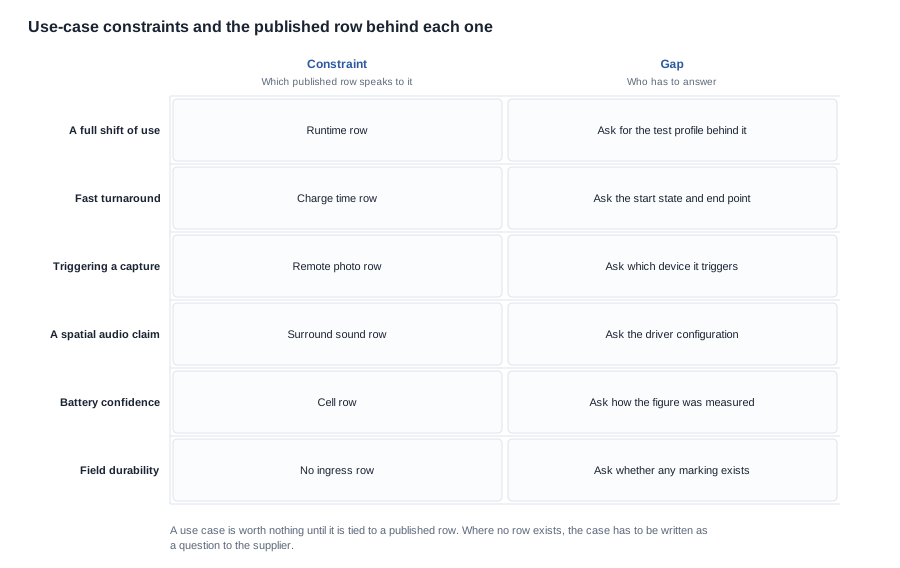
A full working shift. The runtime row speaks to it: about seven hours on the D17, about eight on the ZH12. The gap between them is one published hour, and neither states a profile. A listing that says "a full shift" needs the profile, because a shift of ten hours is beyond either published figure. The question to ask is the profile behind the figure, and the criterion to set is the duty cycle the shift actually contains.
Fast turnaround between people. The charge-time row speaks to it, and it does not separate the models: both publish about one hour. A programme whose use case is turnaround has learned nothing from choosing between these two, and that is a legitimate result. The conditions behind the figure — the start state, the end point — are unpublished on both, and the same cable decision applies to both.
Triggering a capture from a rig or a handlebar. The trigger row speaks to it, and again it does not separate them: the D17 publishes Remote Control Photo and the ZH12 publishes 遥控拍照. What the use case still needs from each model is the identity of the device that gets triggered, and whether the remote ships in the box.
A spatial audio claim in the listing. The surround-sound row speaks to it, and again it does not separate them, although the two models write it in different languages. What a programme still needs is the driver arrangement behind the claim, because a claim has to be supportable in a listing and in a support script.
Battery confidence as a procurement requirement. The cell row speaks to it: 115 mAh against 100 mAh. This is the one use case where the published rows point in a definite direction, and the direction is that the D17 carries the larger published cell. It is a component statement, not a runtime statement, and a programme that wants a runtime needs the profile.
Field durability in rain or wash. This is the use case with no row at all. Neither the D17 nor the ZH12 publishes an ingress marking, and only two models in the entire catalogue carry one. A programme with this requirement cannot resolve it from the catalogue for either model, and the honest output is a request for the ingress position, with the likelihood that the answer is that no marking exists.
How a missing row turns into three questions
A missing row is not a dead end; it is a request that has not been written yet. The discipline is to split it into the smallest set of questions a supplier can answer in writing, each one naming the model it applies to, and to send the same set against both models so the answers stay comparable. Written down in that form, the request also tells the next buyer how to choose between two models that publish almost the same rows.
Take the mass row as the worked example, because it is the one a buyer is asked about first. The three questions to ask are these: what is the mass of the unit as it ships, stated for the D17 and for the ZH12 separately; what that figure includes, and specifically whether any charging case or accessory is counted inside it or added to it; and what the measurement conditions were, whether the number is a nominal value from the production line or a measured value, and on what sample. A supplier who answers all three has given a figure that can go into a specification sheet. A supplier who answers the first alone has given a number that still has to travel through a sample programme and a contract before anyone can rely on it.
Until a written answer arrives, a buyer can do three things and cannot do three others. The buyer can keep the use case open in the record, can put the three questions into the sample order and into the quotation, and can plan the sample programme to weigh each delivered unit, so that a measured value exists even if the published one never arrives. The buyer cannot state a mass in a listing, cannot rank the two models on the point, and cannot close the row from a verbal answer or from a neighbouring model in the same family. A row answered verbally and then marked closed is the most expensive kind of open row, because it surfaces at the point of delivery rather than at the point of ordering.
The routing, and what it shows
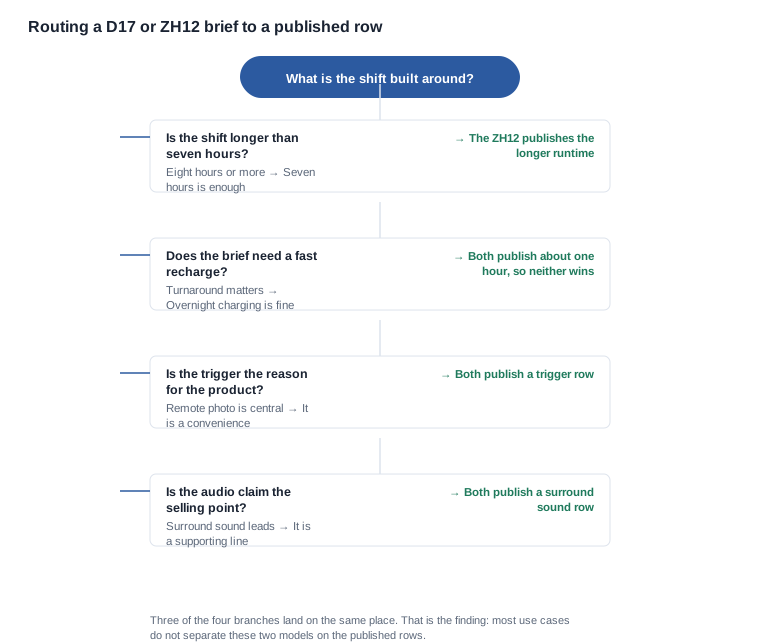
Three of the four branches land on the same place, and that is the finding rather than a failure of the attempt. The shift question points at the runtime row, the turnaround question points at the charge row, the trigger question points at the trigger row, and the audio question points at the acoustic row — and on the trigger and the audio rows, both models publish something.
The branch that does separate them is the battery question, where the D17 carries the larger published cell and the ZH12 the longer published runtime. A programme whose only differentiator is battery confidence has one published difference to work with, and a programme whose differentiator is anything else has none.

A programme sequence that keeps the evidence attached
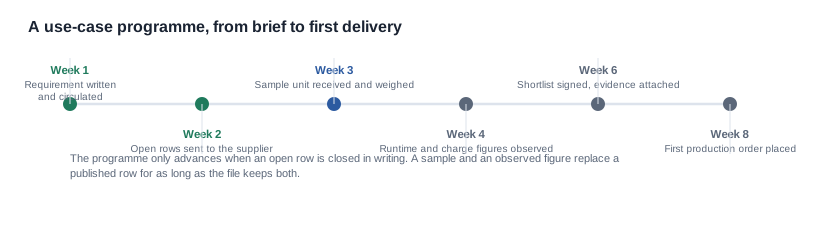
Why a use-case decision needs a sequence rather than a sentence
A use-case comparison reads as a judgement, and a judgement does not survive contact with a programme. The D17 and the ZH12 are close enough that the decision is usually made in a meeting, on a summary, and the summary is usually the one that leaves the file with a reason but no evidence.
The sequence below is the minimum that turns the use case into a decision that can be signed, and it is short because the published rows are short.
- Write the use case as one sentence, with a number in it. "One shift of use, with the device recovered between people" is a use case. "Sport and outdoor" is a category, and a category cannot be tested.
- Attach it to the published row. Every word in the sentence should point at a row. Where it does not, that word becomes a request.
- Send the requests in one message, against both models. The same questions, the same message, and the two models named separately, because a programme-level answer cannot be written into a model-specific file.
- Measure the sample against the criteria, not against the catalogue. A charge cycle from a stated state, a runtime under a stated duty cycle, a mass, and the trigger working against the device it controls.
- Record the outcome with the evidence attached, including the rows that stayed open. An open row recorded as open is a task; an open row quietly dropped is a defect waiting to be found.
- Write the listing from the closed rows only. Everything else in the specification sheet waits for the next round of answers.
The procurement sequence, gate by gate
A use-case comparison becomes real when it is attached to gates that somebody owns. The sequence below is five gates, and each one has a named party, a document and a condition that has to be met before the programme moves on. It is deliberately short, because the published rows are short, and a long sequence built on a thin evidence base produces paperwork rather than knowledge.
Gate one, the sample order. The buyer sends the use-case sentence, the destination market, the channel and the packaging, and receives back the published rows for each model number, the written answers to the open questions, and the sample order terms. Nothing is ordered until every word of the use case is either attached to a published row or carried as a named open question.
Gate two, the sample evaluation. The supplier provides the measurement protocol and the sample configuration in writing. The buyer evaluates the delivered units against the criteria agreed at gate one rather than against the catalogue, works from the same checklist for every unit so that the result can be verified later, and records each measurement with its method attached, so that a later quality control review can see what was measured rather than only what was concluded.
Gate three, the first article. The supplier confirms that the production unit matches the approved sample configuration, and the buyer checks that configuration list against the rows in the catalogue. Any difference is a versioned change with a date attached, not a quiet substitution between the sample and the shipment.
Gate four, the pre-shipment record. The packing list states the configuration per line, the accessories in the box and the cell notation, and the buyer keeps a retained sample with a signed record of it. An open row that has no owner does not ship, because an unowned row at this stage becomes a defect claim that nobody can answer with evidence.
Gate five, the contract. Whatever is still open at this point is written into the agreement as a required disclosure or as a condition of acceptance, and the buyer does not accept delivery against a row that nobody owns. This is also where the commercial terms belong: the unit price, the MOQ, the lead time and the warranty are not published anywhere in the catalogue, and they are what a quotation has to carry in writing before a programme can treat them as known. The due diligence items that come out of this sequence — the open rows, the configuration list, the sample record and the retained unit — are the same items a supplier's own quality control file has to be able to produce on request, and a buyer who has not asked for them early has no way to get them late.
The step that gets skipped
Step three is the one that gets skipped, and skipping it doubles the work. A programme that asks one supplier about one model, then a second supplier about the other, then goes back to the first with a follow-up, has run three rounds of correspondence and still has not compared anything. One message, both models, the same fields, and a request for a written answer against each model number is what makes the two documents comparable.
What a use-case record should contain
Four fields, and no more: the use-case sentence, the published row it maps to, the requests that remain open with a named recipient and a date, and the measurement the sample programme has to make with the result that would change the decision. That record is auditable, and a preference recorded in the same file is not.
What we publish about use cases, and what we do not
What we publish. The class of each model, the radio version, the cell figure and its notation, the runtime, the charge time, the charging method, the feature lines, and the camera class where a camera row exists. For the D17 and the ZH12 that is a set of rows that can be quoted today and mapped onto a use case in a single afternoon.
What we do not publish. We do not publish a price for either model, a mass, a dimension, an ingress marking or a per-model conformity row, and we do not publish a recommendation of either model for a particular use case, because the published rows do not support a recommendation between two products that publish almost identical rows. The one place the rows do point somewhere is the battery question, and that is a component statement rather than a verdict.
The open fields for these two models, and the compliant way to write each one. A buyer who knows which fields are open can plan the sample programme around them, and an unpublished field is not a red flag in itself — it is a red flag only when a listing or a quotation implies a completeness the catalogue does not have.
- Mass and dimensions — Not published. The compliant line is a question to the supplier: what is the shipped mass for each model, and what does that figure include.
- Ingress marking — Not published on either model, and only two models in the catalogue carry one. The compliant line is a request for the ingress position, with the likelihood that the answer is that no marking exists.
- Per-model conformity — no per-model row exists. The catalogue carries a company-level export certification page whose content is images rather than text, and it publishes no certification row for any model. The compliant line is a request for the certificate number, its scope and its model coverage, in writing.
- The runtime profile — Not published. The figures of about seven hours and about eight hours stand without one, so the compliant line is a request for the measurement profile, because a figure without its profile cannot be compared.
- What ships in the box — Not published. It decides whether the remote photo trigger is a working feature or a loose accessory, and the compliant line is a request for the packing list contents per model.
- Price, MOQ, lead time and warranty — Not published. These belong in a quotation, not in a catalogue line, and a procurement file should not treat any of them as known before the quotation exists.
None of these can be committed to a customer before a written answer arrives. A use case that depends on one of them stays open, and the honest commercial response is to say that the field is not published, to name the person who will answer it, and to record the date the answer is expected — not to substitute a plausible value.
We will not make a hearing or medical claim out of a surround-sound row. A spatial audio claim is what the catalogue supports on both models. A hearing-assistance claim, a clinical claim, or a statement about a person's hearing is not supported by either model and is not something we will write. The same applies to the D11 and the D12: a surround-sound line on one of them and not the other is a catalogue fact, and it is not a claim about what anybody can hear better.
Our position is that a use case is a set of requirements, and the catalogue is a set of published facts, and the work is the mapping between them. Send us the use case in a sentence, the destination market, the channel and the packaging, and we will tell you which words in the sentence point at a published row, which do not, and what has to be asked to close the ones that do not. The D17 specification breakdown sets out the D17's row, the comparison framework covers the wider pillar, and the limitations list covers everything the catalogue leaves open.


