

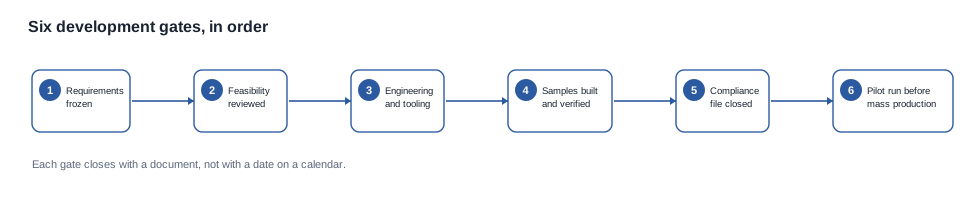
Most people shopping for smart glasses OEM services imagine a single handover: you send a brief, the supplier returns finished units, and everything in between is invisible. The reality is closer to a chain of locked doors, and each door is opened by a document rather than by a date on a calendar. A stage is finished when it produces a document, not when a date arrives.
This is the framework we use for every development programme we run, and it is the framework we expect a serious brand-side buyer to test us against. Six gates, in order: requirements frozen, feasibility reviewed, engineering and tooling, samples built and verified, compliance file closed, and a pilot run before mass production. Below, we walk through what each gate actually does, what paper it produces, and what we deliberately refuse to publish about it.
The reason to care about this structure is simple. In smart glasses sourcing, most expensive mistakes are not technical failures. They are scope failures — a requirement that was never frozen, a claim the hardware cannot support, a component that was substituted on the production line because nobody locked it down in writing. The gate structure exists to catch those before they become your tooling cost, your certification file, or your unsellable inventory.
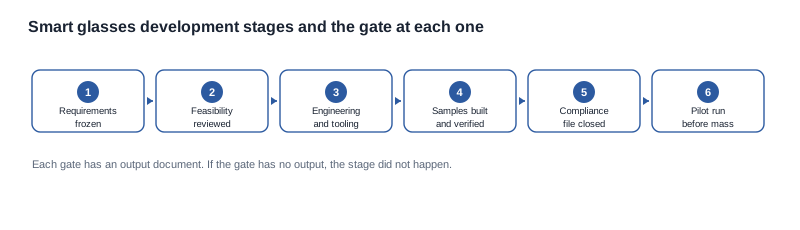
Development process: the gates, in order
The order is not a preference. It is a dependency chain, and each step consumes the output of the step before it.
- Requirements frozen. A signed written requirement document covering target market, the models in scope, configuration, packaging, delivery documentation, and — the part most briefs forget — which claims the product is allowed to make. Without a frozen claim list, every later conversation about marketing copy is a negotiation with no referee.
- Feasibility reviewed. A written answer on whether the request can be built, and what it costs in engineering and tooling. The output of this gate is a boundary, not a yes or no: which parts are commercial off-the-shelf, which parts require engineering work, and the earliest date on which a real answer is possible.
- Engineering and tooling. Tooling completed and verified, plus a firmware build that matches the frozen requirement. This is the stage where the cash goes, and it is the least reversible step in the entire chain. Both points belong in the same conversation with a supplier.
- Samples built and verified. A signed golden sample plus a verification record covering pairing, audio, charging, and any camera function and control behaviour. A golden sample is a reference, not a gift: it is the object that defines what "acceptable" and "not acceptable" mean for every unit that follows.
- Compliance file closed. A declaration of conformity covering the exact model string that will ship, the underlying reports, and the requirements specific to the market it will be sold into. A declaration that covers a product family rather than a single model is not a declaration for your SKU.
- Pilot run before mass production. A production run on production tooling at production volume, inspected against the golden sample. The pilot run is the only gate where substitutions show up, because it is the only gate that runs real production tooling at real volume.
Read that list again and notice what it does not contain. There is no "design" stage and no "launch" stage. Design work happens inside engineering and tooling, because the gate is about what exists, not what was sketched. Launch happens after the pilot run, and it is not part of the development process at all.
The dependency matters in a specific, practical way. If the requirement changes after the compliance file is closed, the paperwork has to change with it, and the paperwork is usually the slowest thing to update. If the requirement changes after tooling is cut, the cost of the change is not just engineering hours — it is the question of whether the existing tooling can be reworked at all. This is why we will not let a requirement change be handled as a verbal instruction at any stage. we will take the change, write it into the requirement document, mark the version, and re-run the gates that the change touches. It feels slow for about a day. It feels catastrophic several weeks later.
There is a second-order point about sequence that buyers rarely see. The pilot run is last, but it is the gate that most often changes the commercial picture. Engineering samples are built with more care, more hand-fitting, and more engineering attention than a production line can ever reproduce. That is not a flaw in the sample process — it is a flaw in the belief that a good sample proves the product will build well. Only a pilot order on production tooling at production volume tells you whether the line can hold the tolerance. We have seen programmes where the sample was excellent and the pilot order needed a process adjustment that nobody had budgeted for. The gate exists to surface that before it becomes a margin problem for you.

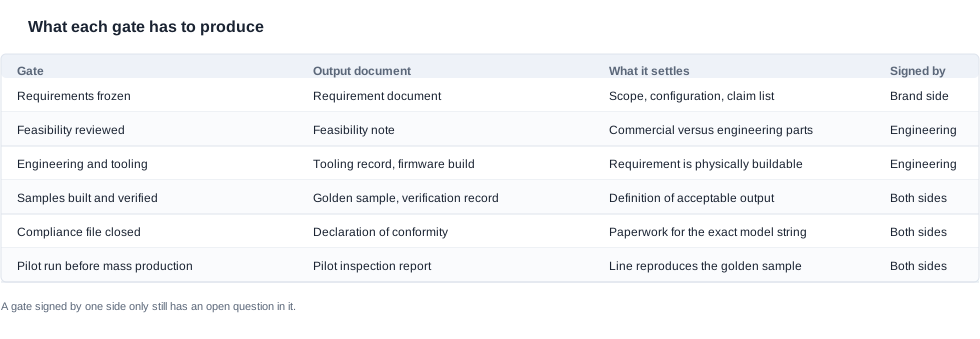
What each gate has to produce
Each gate has a named output. If the output does not exist, the gate has not closed, no matter what anyone says about progress.
| Gate | Output document | What it settles | Who signs |
|---|---|---|---|
| Requirements frozen | Requirement document | Scope, configuration, claim list | Brand side |
| Feasibility reviewed | Feasibility note | Commercial vs engineering parts, earliest answerable date | Engineering side |
| Engineering and tooling | Tooling verification record, firmware build | That the frozen requirement is physically buildable | Engineering side |
| Samples built and verified | Signed golden sample, verification record | What acceptable output looks like | Both sides |
| Compliance file closed | Declaration of conformity for the exact model string | Market-specific paperwork for the shipping SKU | Both sides |
| Pilot run before mass production | Pilot inspection report against the golden sample | That production tooling reproduces the golden sample | Both sides |
The sign-off column matters more than it looks. A gate signed by one side only is a gate with an open question in it. If your supplier produces a feasibility note and nobody at your side has read or acknowledged it, the boundary it describes is not yet a boundary — it is one engineer's opinion.
Two details in the table deserve more attention than most readers give them. First, the compliance gate names the exact model string that will ship. That precision is deliberate: a declaration of conformity that covers a family of products is weaker than the specific model your customers will buy, and if your model string changes late in development, the paperwork needs to change with it. Second, the pilot gate is measured against the golden sample rather than against a specification document, which means the comparison is between an object that exists and an object that exists, not between a product and a description.
There is also a structural point about where engineering work sits. Some buyers expect feasibility review to be a formality that happens before real work starts. It is not. A feasibility review that arrives after tooling has been cut is a description of what was already decided, and it will not say no to anything. The useful version of this gate is the one that arrives early enough to still change the plan — where the answer says, plainly, that a requested feature is commercial, that another requires engineering, and that a third cannot be built at all in the shape requested. We will put that boundary in writing, and we will say plainly which parts of your brief we cannot support as written, rather than absorbing the request and quietly changing the deliverable later.
That kind of answer is easier to give in writing than in a meeting. In a meeting, a difficult answer becomes a negotiation. In a feasibility note, it becomes a boundary. The distinction protects both sides, and it is the single reason we push buyers to request a written feasibility output rather than a call summary.
Two of the six gates carry a commercial clause that should be settled in writing before the gate closes, not after. The first is the engineering and tooling gate: if the programme stops at that point, what happens to the tooling cost? The answer needs to be on paper before tooling starts, because after tooling starts the conversation is materially harder and everyone knows it. The second is the pilot run gate, which is the point at which a pilot order becomes a real commercial commitment. Both of these belong in the purchase order and its annexes, alongside the pricing, MOQ, lead time, incoterms, and warranty terms — the things that are genuinely negotiable between two parties, in contrast to the gate logic itself, which we will not trade away.
The verification record produced at the sample gate is worth describing precisely, because "verified" is a word that gets used loosely. The record covers pairing with a defined set of devices and a defined procedure, audio output and level behaviour, charging behaviour and the connector used, and — where the configuration includes any camera function — capture behaviour and the control inputs that trigger it. Each line has a pass condition and an observed result. A record that says "samples work" is not a verification record; it is an anecdote.
There is one more property of the verification record that buyers often ask about and rarely get: a record of what was deliberately not tested. A configuration without a camera function should say so, because silence in a verification record reads like an omission. The same applies to the tolerance behind a pass condition — an audio output that is simply acceptable is not a tolerance, but an audio output that is consistent with the golden sample within a stated deviation is. Recording the untested areas is what makes the record useful a year later, when someone asks why a particular behaviour was never confirmed.
What we will not publish about a development
We will not publish figures about our production capacity, stage lead times, stage durations, indicative schedules, prices, minimum order quantities, sample fees, warranty terms, certificate numbers, certification status for individual models, factory size, employee numbers, or annual output. None of these are published by us, on this site or anywhere else in our material.
This is not coyness. It is a structural problem with publishing them.
- Capacity numbers age badly. A figure that was accurate when written becomes misleading within a single planning cycle, and a buyer who relies on a stale number has no way of knowing it is stale.
- Lead times are not a property of a supplier. They are a property of a supplier, a configuration, a quantity, a shipping mode, a component availability window, and a customer's own decision pace. A single published number has to flatten all of that, and the flattening makes it wrong for most readers.
- Prices without configuration are noise. A quotation tells a buyer nothing about what they are buying until the configuration behind it is written down. We would rather show you how a quotation is assembled than hand you a number that will not survive your own specification.
- Certification status is per model, per market, and per revision. Publishing a general claim across a catalogue is how a buyer ends up holding a compliance assumption that is not true for the SKU they actually ship. The honest substitute is certification evidence tied to a specific model string, produced inside the compliance gate.
- Warranty terms are an agreement, not a spec. They depend on who bears transit risk, what the channel does with returns, and how long the product is expected to be in service. They belong in a purchase order or a warranty annex, not on a web page that cannot carry the conditions.
If any of these is what you need to make a decision, that is a legitimate and answerable request. It is also a request that has to be answered for your specific configuration and quantity, in a document, at the point in the process where it is real.
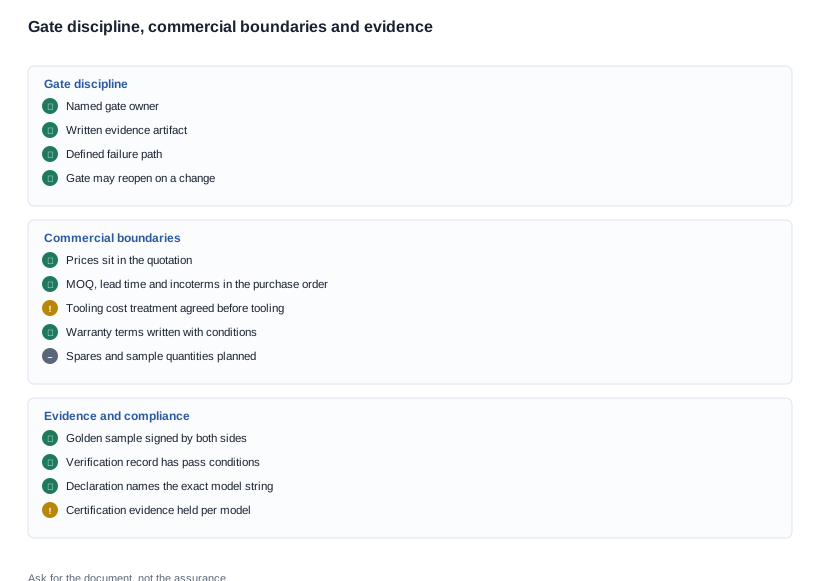
What we will do instead is convert each of these gaps into a question you can put to any supplier, including us. That is more useful to you than a number would have been, because it works even when the supplier is someone else, and because it tells you what to ask the supplier without us writing the answer for you.
It also removes a specific failure mode from the evaluation. Published figures tend to be compared against published figures, which rewards the supplier with the most confident marketing rather than the supplier with the most rigorous process. When every candidate refuses to publish lead time and instead answers your question in a document, the comparison becomes a comparison of documents — which is the thing you actually want to compare.

Questions to ask before the first gate
Before you sign anything, and before you send a brief, these are the questions that expose whether a supplier actually runs a gated process or is describing one. The answers are what you are buying, not the product itself.
- What document closes the requirements gate, and who signs it? If the answer is a call and an email thread, there is no frozen requirement, and every later dispute will be about memory.
- What is in the feasibility output? You want the commercial-versus-engineering split and the earliest answerable date, not a yes.
- What happens to the tooling cost if the programme stops at the engineering gate? This needs to be agreed in writing before tooling starts. Ask what form the answer takes — a percentage, a milestone payment, a credit against a future order — and get it into the agreement rather than leaving it to goodwill.
- Where do the samples come from, and what defines the golden sample? A sample pulled from an early batch is not the same as a signed reference unit. Ask how many units make up the golden set, who signs it, and which production units will later be inspected against it.
- Does the compliance declaration name my exact model string? A family-level declaration does not cover your SKU. Ask to see the model string on the declaration and compare it to the string on your packaging artwork and on your listing.
- What is the pilot order, and what is inspected? A pilot on production tooling at production volume is a different activity from building a handful of units on the same line. Ask what is measured at the pilot inspection and against which reference.
- Which components are locked by part number, and which may be substituted? Substitutions that nobody authorised are the single most common cause of a pilot order failing against a golden sample. If the answer is that everything can be substituted with notice, ask what notice period and what re-verification you get.
- What goes in the quotation and what goes in the purchase order? Prices, MOQ, lead time, incoterms, and warranty terms all have a home, and it should be the purchase order and its annexes — not a web page and not a verbal assurance.
- What are the spares arrangement and the after-sales routing? Sample quantities and spares are two different asks, and programmes that plan for neither usually scramble for both.
The order of these questions matters. Ask the first three before you spend anything. Ask the last three before you sign the purchase order. In between, run the list against two or three candidate suppliers and compare the answers side by side, because a supplier who answers all nine in writing has given you a sample of their documentation quality without you having to commission anything.
If a supplier cannot answer questions one through four clearly, the issue is not that they are unwilling to share figures. It is that their process does not produce the documents, and therefore does not have the boundaries.
For a closer look at the first technical gate, see engineering customisation risk assessment. For the honest limits of what can be engineered, see engineering customisation: what is not possible. For what a quality system should cover on the factory side, see smart glasses OEM quality expectations. When the programme is running and something needs fixing, the practical routing is covered under after-sales support channels.
After the pilot order passes, the programme hands three things to the commercial side: the golden sample, which becomes the reference for incoming inspection; the verification record, which becomes the basis for failure analysis when a customer returns a unit; and the set of locked part numbers, which becomes the basis for what to ask the supplier about any future substitution. The purchase order then carries the commercial terms we have deliberately kept out of this article — MOQ, lead time, incoterms, and warranty — together with the packaging specification and the agreed spares quantity. We will put those terms in one place, in the document that can carry conditions, rather than in a summary that cannot.
If you are evaluating OEM and ODM partners, the practical first step is a requirement document rather than a quotation request. Send us the target market, the models you are considering, the configuration, the packaging intent, and the list of claims you want the product to make — that last list is the one that saves the most rework later, because it is the one that most briefs leave out.
We will respond with a feasibility note that separates commercial parts from engineering parts, states plainly which of your claims we can support, and identifies what certification evidence the compliance file needs for the market you have in mind. Where a request is genuinely impossible, we will say so in writing, because a programme that starts with an honest boundary is cheaper than a programme that discovers the boundary during a pilot order.
One honest caveat belongs here. A gated process is slower at the start than an unstructured one, because the first two gates ask you to make decisions you would rather postpone. The trade-off is that unstructured programmes are faster at the start and considerably slower at the end, because the decisions still have to be made — they just get made late, by the production line, with tooling already paid for. If you are negotiating a price, remember that the gate structure is not a cost adder to be stripped out. It is the reason the price can hold.
The full model is described on the OEM and ODM process page, and the sample stage is set out in more detail in development process sample validation. For the commercial framing around sample quantities, tooling, and purchase orders, start with procurement and samples.
None of this replaces a conversation about your specific programme, and none of it is a promise about your schedule. It is a description of how a gated process runs, and an invitation to hold us to it. Where you want to negotiate these terms, we will put them in the quotation and the purchase order rather than in a summary of one.


