

Two beliefs cause most of the disappointment in an engineering customization programme, and both sound reasonable right up to the point where somebody has to explain a delay. The first is that a supplier should be able to quote a customised unit before anyone has built one. The second is that a sample which worked proves the production unit will behave the same way. Neither survives contact with a real programme, and the useful question is not whether the answer exists but when the answer becomes real.
That reframing is the whole of this page. What follows separates the limits that are published — the ones a buyer can see and has to accept — from the limits that are not published, which is a larger and a softer category. It explains why some answers cannot be written down before a conversation has taken place. It sets out what an honest unknown looks like when it appears in a quotation, which is a document form rather than an apology. And it lists the questions whose answer closes the next stage, so that a programme knows what it is waiting for.
No price, no minimum order quantity, no lead time and no fee of any kind appears here, and the examples in this page are composites built from our published range rather than a named client project.
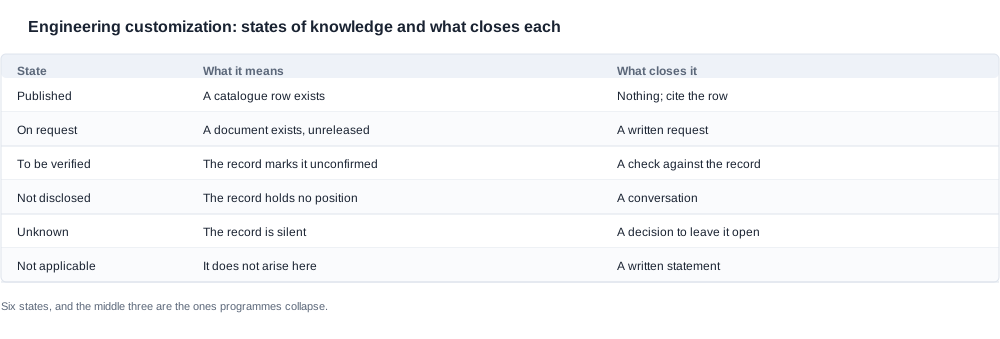
That table is the vocabulary the rest of the page uses. Knowledge arrives in six states, and the mistake a programme makes is treating them as one — usually by collapsing everything into either known or unknown, when in practice most open items sit in the middle and have a named way of closing.
The limits that are published, and the limits that are not
The published limits are the ones a buyer can see, and they are worth stating plainly because a buyer who has read them cannot be surprised by them later.
The range carries no certification line on any model, and CE, FCC and RoHS appear nowhere in the catalogue text. The export certification page is company artwork — ten patent certificates, of which not one is issued against a model designation. Across all twenty-eight entries, nothing in our published material provides a test report, a third-party measurement, a photograph or a video of the physical product.
The specification record is thin in specific places. No row names a frame composition, a temple polymer, a lens substrate, a hinge material or a surface finish. One weight is published in the whole range, and it belongs to the MT6 at 158 g for the glasses body, excluding the folding charging case whose own weight is not printed. The charging method is not printed on four camera entries. The charging case is recorded three ways across the eleven camera models: five entries with a capacity, two with a case and no figure, and four with no case line of any kind. Colour names exist for two entries only. A removable part is published for three. The ingress marking appears on the V06 and the S7 with nothing at all beside it in the way of a third-party report number.
Our internal record is more specific about certification, and it records exactly three states: a claim whose numbers await confirmation of the specific model and certificate identifiers, a claim that carries a note saying no report is held, and no certification information whatsoever. The camera and audio families sit in the first state, the sport family in the first with the additional note about the ingress marking, and the photochromic entry in the first. The children's family sits in the third state, and so does the bone-conduction entry. For the AR entry there is no recorded position. In the children's family one of the two recorded customisation capabilities is marked as still to be verified, and the customisation position for the bone-conduction entry is not disclosed at all.
Those are the published limits. They are firm, they are checkable, and a buyer who plans around them is planning around facts.
The three certification states have consequences that are easy to overlook. A claim whose numbers are pending can be used for planning, because a plan can carry a placeholder, but it cannot support a market-access file, because that file needs the identifiers. A claim recorded alongside a note that no report is held cannot support an external statement at all, however confident the wording sounds. And a position of no information cannot support a planning assumption either, because there is nothing there to assume from. A buyer who treats the three states as one builds a launch plan on the first state and meets the second or the third at the point where the documents are due.
The limits that are not published are a different animal, and the important thing about them is that they are not the same as gaps. A published limit is a boundary. An unpublished limit is a question with no answer yet, and it may have an answer tomorrow. The unpublished limits in this category are: whether a particular change is feasible on a particular model, which the record of customisation routes by family cannot answer on its own; what any change costs, in money and in schedule; what the factory's existing tooling can and cannot accommodate, and what condition it is in; what the factory's component supply looks like at the time of the order; and what the yield of a production route will be.
None of those can be closed from the outside, and none of them is a secret. They are answers that a factory holds and a buyer cannot, because they depend on internal state that changes between one day and the next. The correct response is to ask for them in a form that can be checked, not to assume they are being withheld.
Some questions, though, can be answered on the first call and are routinely left for weeks. Which family a model belongs to in our record. Whether a configuration exists at all in the published range. Whether a published row already covers the requested change. Which documents would have to exist for a given model and destination. These are answerable today, and answering them early removes most of the ambiguity from a programme before a single feasibility question has been asked.
Why some answers cannot be written before a conversation
Three reasons, and they are different in kind.
The first is structural. The answer to most feasibility questions is a function of inputs: the model in front of us, the configuration, the quantity, the destination and the date. Until those are fixed, there is nothing for the answer to be a function of. A supplier asked to answer earlier is answering about a hypothetical, and the hypothetical is theirs rather than yours, which is why an early answer and a later answer are not the same answer and why an early answer is rarely the one that survives.
The second is a question of kind. "Not disclosed" and "not applicable" and "not yet known" are three different statements about three different worlds. An item that has no disclosure means there is no recorded position, which is a statement about our own documentation. An item that does not apply means it does not arise for this case, which is a statement about the case. An item that is not yet known means the answer exists and has not been produced. Collapsing the three is how a programme ends up with a feasibility question answered with a shrug and recorded as a refusal.
The third reason is commercial and it is the one worth internalising. A written "no" is a commitment; a written "cannot say yet" is a process. A supplier who answers "not possible" in writing has given away the commercial position of the programme, and a supplier who answers "not yet" has kept the conversation open. From a buyer's side, that asymmetry makes early answers less reliable rather than more, which is exactly why the answer to most feasibility questions is only worth having against a written configuration.
There is a fourth, more practical point. Some answers can only be produced by making something. Whether a geometry works, whether an assembly closes cleanly, whether a colour matches an approved reference, whether a configuration behaves in the hand — none of these is answerable from a document. The cheapest way to produce them is a unit built for the purpose, which is why a sample round sits earlier in a programme than a quotation does, and why the criteria for that round have to exist before it starts.

What an honest unknown looks like in a quotation
An unknown written badly is worse than an unknown left open, because it reads as an answer and gets relied on. The good version has three columns and a closing condition, and it can be built into a quotation without any sense of apology.
The first column is the item, named specifically enough that it can be closed. "The charging interface for the configuration in question" is an item; "technical details" is not.
The second column is what is known now, with its source. For a published item, that is the catalogue row and its exact wording. For an item held on request, it is the fact that a document exists and what it would have to be requested against. For an item marked unverified in our record, it is that marking, stated as a marking rather than smoothed over. And for an item with nothing recorded, it is that nothing is recorded, which is a true statement and a much better one than an implied refusal.
The third column is what would close it, expressed as a specific event rather than as a hope. "A written request naming the model designation and the destination." "A drawing against which the existing geometry can be compared." "A unit built against the stated criteria." "A quantity and a schedule, which is what the answer depends on." "A date by which the position will be stated."
On top of the three columns, three further details make the entry usable. An owner, because an unknown with no owner is not tracked. A date, because an open item without a date is a permanent one. And a fallback — the assumption to use while the item is open, which is normally the weaker one. The fallback is what keeps a programme running while an answer is pending, and recording it is what stops the two parties from assuming different fallbacks without noticing.
The fallback deserves more attention than it usually gets, because it is the assumption the programme actually runs on. If the fallback for an open feasibility item is the weaker one, the plan being built while the question is open is a plan that survives a no. If it is the stronger one, the plan is contingent on an answer nobody has given, and that contingency has to be visible in the schedule rather than in a footnote.
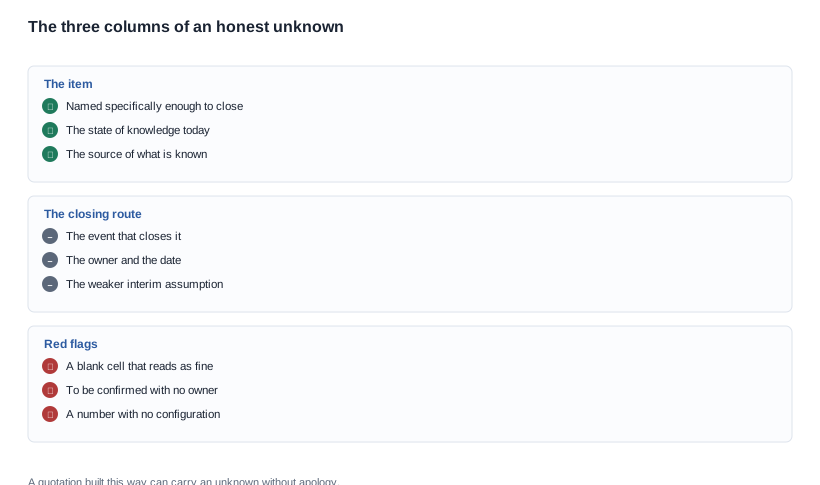
The red flags on that panel are the forms an unknown usually takes when it has been written badly. A blank cell, which reads as nothing to worry about. A note to be confirmed with no owner and no date. An assumption written in the grammar of a fact. Silence treated as agreement. And a number offered without the configuration it belongs to, which is the one that costs the most, because a number is the hardest kind of answer to reopen once it has been relied on.
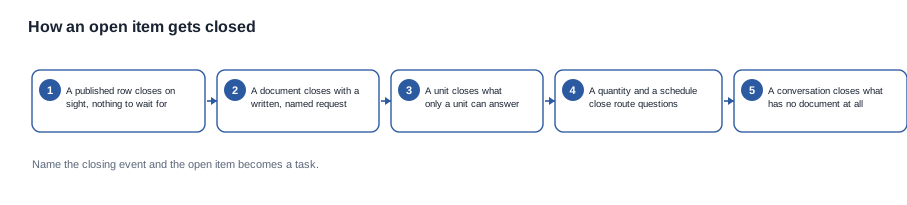
The flow sets out the closing routes in the order they usually run. A published row closes immediately, because there is nothing to wait for. A document closes with a written request. A unit closes the questions that only a physical unit can answer, and it closes them at the cost of a sample round. A quantity and a schedule close the questions that are waiting on a production route. And a conversation closes the questions that were never going to have a documentary answer at all.

Questions whose answer closes the next stage
A programme rarely stalls because nobody knows what to ask. It stalls because it is waiting for an answer without having established that this is the answer that unblocks it. The list below is organised by stage, and each entry closes something specific.
Before a sample can be built, three things must be closed: the configuration, so the unit is the unit that was asked for; the criteria, so the unit can be judged; and the case position where the model is one of the camera entries that publish no case line at all, because the contents of the box cannot be settled afterwards.
Before a quotation can be issued, four things must be closed: the scope, so the two figures describe the same work; the commercial terms, so the numbers can be compared; the destination, because it determines the documentation and labelling scope; and the packaging position, because it determines whether a print run sits inside the order.
Before a batch can be accepted, two must be closed: the acceptance criteria, and the identity of the party who signs. A batch that arrives without a named signing party has been received but not accepted, and the difference between those two states is where the argument lives.
Before a second order can be placed, two must be closed: the reproducibility position — whether the later units are expected to match the first, and what evidence carries that expectation — and the artwork master, so the second run is against the same file rather than a copy that has drifted.
Before launch, three must be closed: the conformity documentation for the exact model designation and destination; the labelling and regulatory text; and the claims review, which covers every external statement about the product, including the ingress marking on the V06 and the S7 and the acoustic statements for the audio models, neither of which can be restated without the evidence behind it.
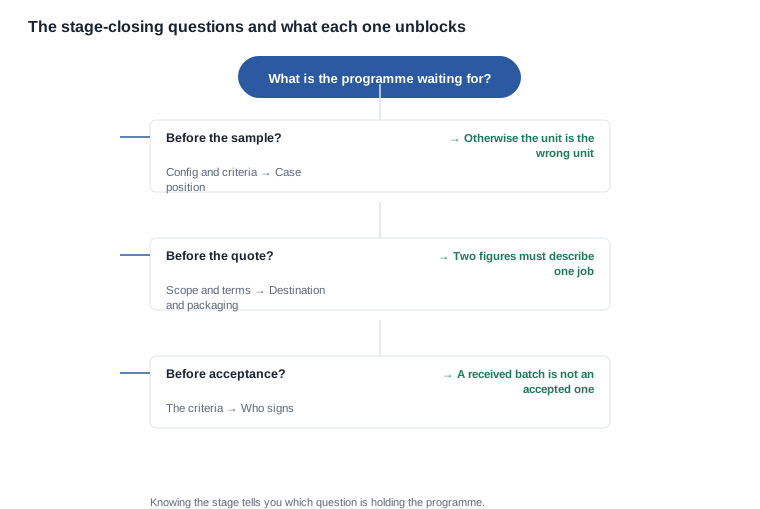
The diagram is a practical instrument rather than a narrative. A programme that names its current stage and the question that closes it has a plan; a programme that has a list of unanswered questions has a backlog. The difference is worth a great deal at the point where a decision has to be made about whether to proceed.
One discipline attaches to the list. Each stage-closing question should be written as a question with a subject and a date, not as a topic. The difference sounds cosmetic and is not: a topic waits indefinitely, while a question with a subject has an owner and an answer that either arrives or does not, and the programme can tell which.
Where CYNRIN stands on engineering customization unknowns
An unknown stated honestly is worth more than an answer given early, and the way to state one is to name the item, say what is known now and where it comes from, and say what would close it. We will do that in writing, with an owner and a date, and we will record the weaker assumption as the interim position so that both sides are working from the same premise.
We will not fill a gap with a plausible figure. No price, no minimum order quantity, no lead time, no sample fee, no warranty period, no cavity count and no tool life figure appears in our published material, and none of them should be inferred from a programme description. Where a figure is needed, it belongs on a quotation against a named configuration.
We will also not overstate what our own records settle. Our catalogue carries no certification line, no test report, no photograph and no video for any of the twenty-eight entries, and nowhere in its text do CE, FCC or RoHS appear; what sits on the export page is a company-level set of ten patent certificates, none of which is issued against a model designation. The ingress marking published on the V06 and the S7 is annotated on the page and carries no third-party report number. The 35 dB figure the bone-conduction entry publishes arrives with no acoustic report at all and supports nothing about hearing, about medical use or about suitability for one particular population. And where our internal record marks a capability as still to be verified, we will repeat that marking rather than translate it into a yes.
For a procurement lead, the method is short. Name the item, cite the source for what is known, name the event that closes it, assign an owner and a date, and write down the weaker assumption while you wait. A programme that does this keeps its unknowns visible without letting them harden into either answers or refusals — and the questions listed above will tell you, at any moment, which one is holding the next stage.
Legible waiting is the thing a programme can actually manage: it can be scheduled, reported and closed. A programme that does not know what it is waiting for simply appears slow, and the programmes that appear slow are usually the ones that have quietly gone quiet.
Related reading
- the recorded routes, family by family
- the obligations an engagement covers and the ones it leaves open
- what a reference unit settles and what it cannot
- the criteria and the signature a batch needs
- how two quotations are put on one basis before they are compared
An unknown named, sourced and given a closing condition is an open item — an unknown left blank is a gap that one day gets filled by somebody making a guess.


