

A risk assessment in a customisation programme is not a longer specification and it is not a pessimistic view of the supplier. It is a structured answer to three questions: what could go wrong in this request, how would we find out, and what do we do about it if it happens. The reason it is worth doing separately is that cost and risk are different axes. A cheap change can carry a serious risk — a name that is wrong on a hundred thousand units is a penny to change and a disaster to discover late. An expensive change can carry almost no risk, because it is heavily verified before it reaches anybody. Sorting requests by cost alone therefore sorts them by the wrong thing.
The output of a good assessment is not a document that frightens the programme. It is a short list of named risks with an owner, a detection method and a pre-agreed response, and it is produced before the commitment is made rather than after the first problem.
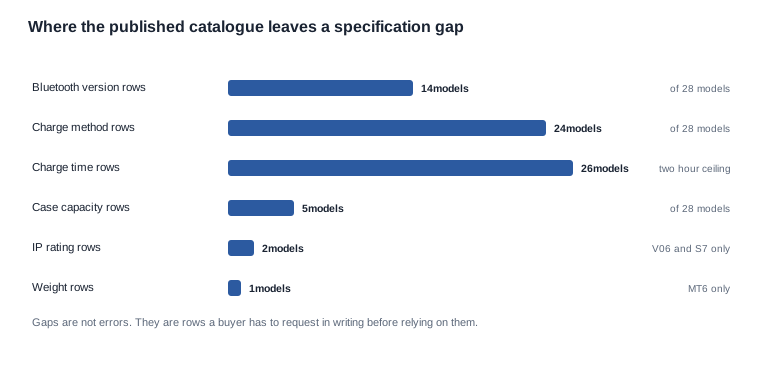
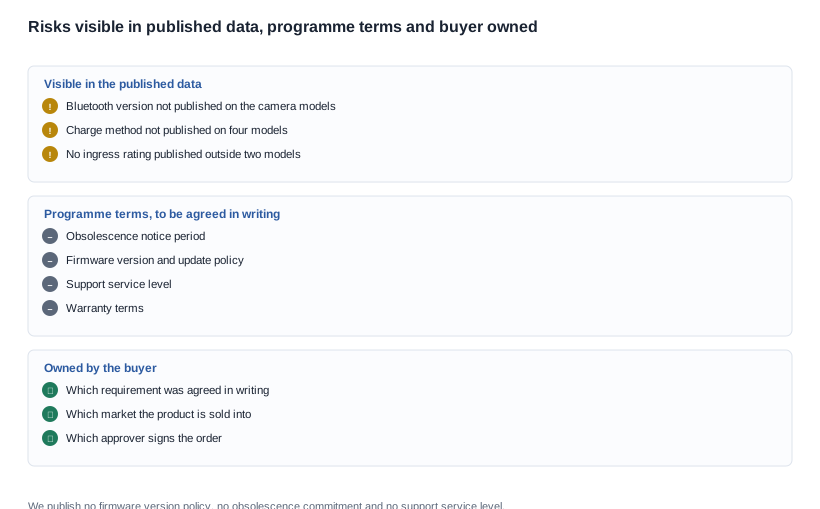
There is one more reason to do this work early. Several of the riskiest items in a smart-glasses customisation programme are invisible in the published data, because the catalogue deliberately does not publish them. We publish no firmware version policy, no obsolescence commitment, no support service-level row and no per-model certification row. A buyer who does not go looking for those gaps will find them later, in a meeting they did not prepare for.
The assessment also has a natural order, and the order is not bureaucratic. Classification comes first because it decides which risks are even possible. Naming comes second because a named risk can be assigned an owner, and an unnamed one cannot. Ownership comes third because the response cannot be agreed until somebody is accountable for triggering it. The response comes last because it is only meaningful once the owner exists. A programme that starts at the last step — arguing about who pays for a rework before anyone has said which risk might produce one — spends its first meeting on the wrong question.
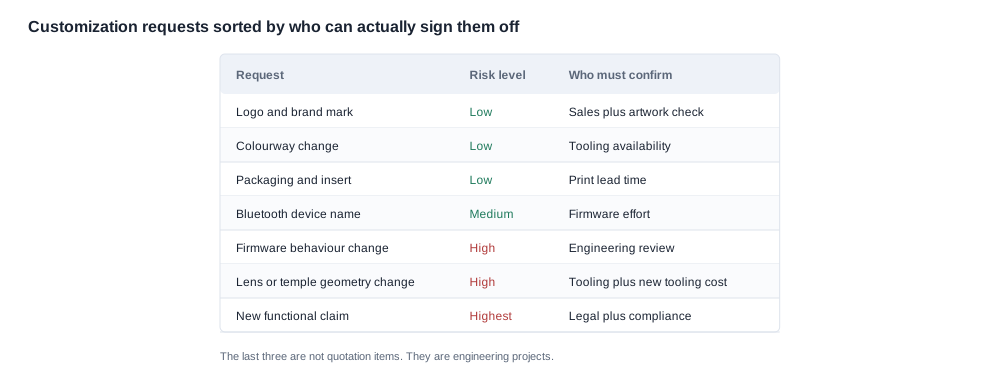
Engineering customization risk assessment: stage one is classifying the request
The first stage of any risk assessment is classification, because the class of a request determines almost everything about its risk profile. Requests fall into three broad groups, and each one has a characteristic way of failing.
Configuration changes alter a value rather than a body: a device name, a startup string, a serial format. The typical failure is not a broken unit; it is a unit that works perfectly and is the wrong product. Configuration failures are cheap to prevent and expensive to discover, because they are usually found by the buyer of your product rather than by the factory, and they are found in a batch rather than in a unit.
Production changes alter a body: a colour, a surface treatment, a printed insert, a packaging structure, an accessory. The typical failure is a batch that does not match the approved sample — a shade outside tolerance, a print registration out, an insert that does not fit. These are detected by inspection against a reference, they are visible in time, and they are usually correctable by rework if the programme has agreed what rework means.
Engineering changes alter behaviour or structure: firmware, the setup experience, a temple geometry, a hinge, a battery, a case. The typical failure is a unit that passes the standard checks and fails the customised requirement, or a unit that works and creates a downstream problem — a different charge behaviour, a changed antenna environment, a case that no longer matches the claim process. These are the requests where the risk assessment earns its cost, because the failure is often invisible at the point of production.
Classification also determines the ownership of risk, which is the part buyers most often get wrong. A configuration failure belongs to whoever supplied the value. A production failure belongs to whoever supplied the material or the file. An engineering failure belongs to whoever signed the specification — and if the specification was never written down, that ownership is unresolvable and the risk sits with whoever has the weakest position in the negotiation, which is usually the brand.
One caution about classification: it must be recorded, not assumed. A request that arrives as a single sentence containing a structural change and two configuration changes is not one request. It is three requests, and the risk register that treats it as one will name the wrong owner for all three.
A second caution concerns the criteria for deciding the class. When a request can reasonably be read two ways, the class with the higher consequence is the safer default, because a configuration reading that turns out to be an engineering change is expensive to discover late, while an engineering reading that turns out to be a configuration change costs only an assessment. Which one of the two readings is correct is usually settled by evidence rather than by argument: the change record, the tooling list and the specification itself will name a part, a tool or a build if one is involved. A buyer who wants to move faster can send the request with their own reading of the class and ask for the supplier's reading alongside the quotation, so that the two are compared rather than assumed.
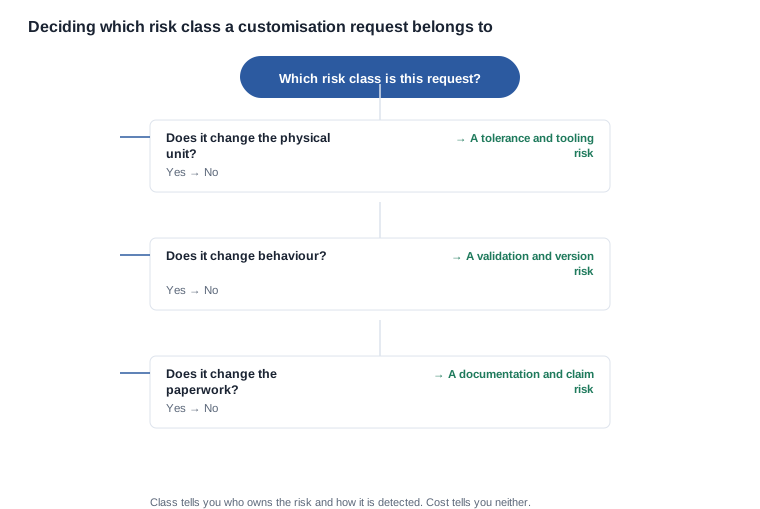

Engineering customization and naming the risk in each engineering line
Once the request is classified, the risk is named per line rather than in general. General statements — "there is a risk that quality suffers" — produce no action. A named risk has four parts: what happens, how it would be detected, who bears the consequence, and what the response is. Here is how the naming works for the lines that most often appear in brand and channel customisation.
The device name and identity. Risk: the wrong name ships, or two names ship in the same period. Detection: inspection of the pairing list on a sample from the batch, and a check that the name on the box matches the name in the unit. Ownership: the supplier of the value, confirmed by the buyer's approval of the exact string. Response: rework of the affected units or replacement, with the affected serial range identified.
The colour and surface. Risk: production shade outside the tolerance band against the approved sample, which is the most common batch failure in this category. Detection: inspection under agreed lighting against the physical reference, not against a photograph. Ownership: the supplier of the material, with the tolerance band agreed in writing before production. Response: rework where possible, credit where not.
The printed programme. Risk: a market insert is missing, a translation is wrong, or the artwork on the box does not match the artwork that was approved. Detection: a packing check per market, with the insert list signed off against the artwork file. Ownership: shared, because the artwork comes from the buyer and the print from the supplier. Response: re-print and re-pack, with the freight borne by the party at fault.
The firmware and the interface. Risk: the shipped build does not match the approved build, or the build behaves differently in the field than in the factory. Detection: the build identifier recorded on every unit and checked against the approved baseline, plus a test record on the production build rather than the development build. Ownership: the supplier of the build, with the buyer approving the written behaviour. Response: a replacement build, which is why a versioning scheme decided early is worth more than any later fix.
The structure. Risk: a changed temple or hinge affects fit, the antenna environment, and therefore the certification position. Detection: mechanical checks plus a radio assessment before the change is released. Ownership: the supplier, but only if the change was assessed before it was made rather than after. Response: the most expensive of the five, because a structural change late in a programme usually means new tooling and a re-assessment.
The paperwork and the claim flow. Risk: the warranty card states a period the agreement does not support, or the regulatory insert does not match the market the product is sold into. Detection: a document review against the market list, at the artwork freeze. Ownership: shared, and this is the line that produces the most awkward conversations because both sides assume the other one read the insert.
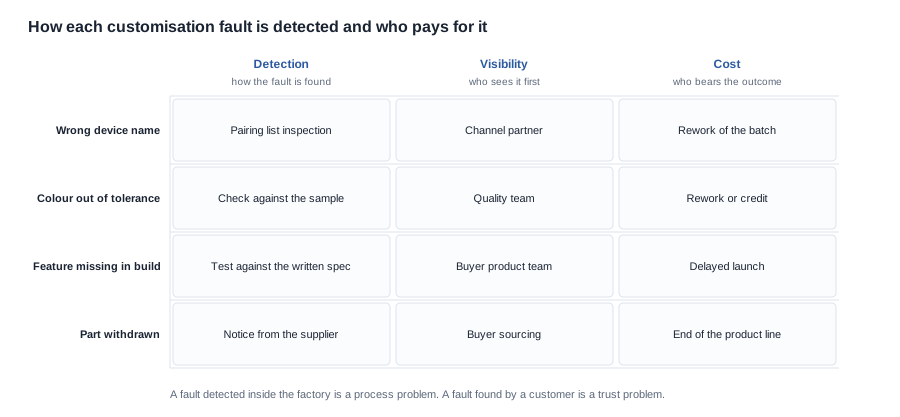
These six lines are also the fastest part of a supplier assessment to read. During due diligence, a request for the named-risk table from a recent customisation programme tells a buyer more than a general quality claim does, because it shows how a supplier names a problem, who it assigns and what it does next. A supplier that can produce that table has a process. A supplier that answers the question with a list of everything it controls has a marketing document, and the difference is worth knowing before the first order rather than during the first incident.

Engineering customization and the question of who is actually signing
A third stage of the assessment is about authority, and it is the stage most often skipped because it does not feel like engineering. It is nevertheless the stage that determines whether an assessment is worth anything, because a risk with no decision owner attached is a note in a document rather than a control.
There are three signatures that matter in a customisation programme, and they are routinely collapsed into one.
The commercial signature. Whoever signs the purchase order commits the organisation to a quantity, a configuration and a price. If that person is a procurement manager, the commitment is commercial and they may not know what the configuration contains. This is fine, provided a second signature covers the specification.
The specification signature. Whoever approves the technical requirement commits the organisation to what the product is meant to be. That is usually a product owner, and they are the person who should sign the requirement set, the feasibility statement and the golden sample approval. The risk to watch is a programme where the product owner is consulted but the purchase order is signed without their agreement on the specification version.
The market signature. For any product sold into more than one country, somebody has to confirm the market list, the languages, the inserts and the regulatory scope. In our own catalogue the market exposure is visible in the accessory structure rather than the software: charging case capacity is published for five models only, KY06 and MT5 have a case with no published capacity, and V03 and V03 Pro, and V06 and S7 have no case row at all, which is an accessory question each of those four has to have answered before an insert can be printed for it. A brand running three camera models across five markets is running a real matrix of insert and accessory combinations, and each combination needs an owner.
The mismatch that causes real trouble is the reverse one: a specification approved by a product owner in one market, then sold into another market by a channel partner without the market signature. The result is a product that is technically correct and commercially wrong in the place it lands, and the detection point is a customer complaint rather than an inspection.
The same reasoning applies when a buyer is running a shortlist of two or three factories against the same requirement. The negotiation is far shorter when both sides work from the same six lines, because the disagreement is about who carries which risk rather than about what each side believes. In a shortlist comparison the risk table is often more discriminating than the price, because two factories can quote the same unit price and hold completely different positions on the risk of a colour batch, a firmware build or a withdrawn part.
There is a fourth party that is often invisible: the party who will answer the phone when a unit fails in the field. If the brand, the distributor and the factory all assume the others handle it, the customer experiences three parties and no answer. The assessment should name that party, and the answer should be written into the claim route.

Engineering customization and what happens when the work fails
Every programme fails somewhere. The difference between a manageable programme and an expensive one is not the failure rate but the response: whether the response was decided while everyone was calm, or whether it is being invented during the incident, with a customer waiting.
There are five responses worth pre-agreeing, and each should have a trigger, a decision owner and a cost rule.
- Rework. The affected units are corrected in place. Trigger: a defect that is cosmetic or correctable and affects a defined serial range. Cost rule: who absorbs the labour and the freight, and whether rework is capped at a stated proportion of the batch.
- Replacement. The affected units are replaced with units from the same build. Trigger: a defect that is not correctable, or a behaviour failure on a build that cannot be corrected.
- Credit. The affected units are kept and the value is credited. Trigger: a cosmetic deviation that is within an agreed tolerance but outside the buyer's preference, which is a decision the buyer should make deliberately rather than under pressure.
- Schedule change. The defect does not stop production but moves the date. Trigger: a failure that requires a re-run of a stage. Cost rule: who carries the delay, and how the delay is communicated to the channels that depend on the date.
- Programme stop. The defect is serious enough that the configuration is wrong. Trigger: a failure that invalidates the requirement rather than the execution. This is the one response that must be available, because a programme that cannot stop is a programme that ships a wrong product.
The most common failure of a risk assessment is that only the first four are defined. Programmes become committed to a date, a channel partner has booked marketing, a retailer has a listing live, and by the time anyone considers stopping, the cost of stopping has become political. Deciding in advance that a stop is available, and who may call it, is what keeps that decision technical.
The negotiation about who pays for a rework is almost always settled in advance and almost never settled during an incident. It is worth writing a simple rule — the party whose input caused the defect carries the direct cost, the supplier carries the cost of its own process failure, and everything else is negotiated case by case — so that during an incident the conversation is about the facts rather than about the principle. The principle argument, held live with a customer waiting, is the most expensive part of a quality failure.
Engineering customization and the risk register a buyer should keep
The last piece is the artefact. A risk register does not need to be large to be useful, and in our experience it is most valuable when it is a single page that a buyer keeps and updates, rather than a document that is produced once for a review and filed.
A working register has one line per risk, and each line carries the same six fields so that nothing has to be interpreted.
- The risk, stated as an event. "The device name on the shipped units differs from the approved string" rather than "naming risk".
- The class. Configuration, production or engineering, because the class tells you who owns it and how it is detected.
- The detection method. The specific check that finds it, and where in the process that check happens.
- The owner. The named party who is accountable for the response, not the party who is convenient.
- The response. The pre-agreed action, triggered by the pre-agreed condition.
- The residual position. Whether the risk is accepted, reduced or transferred, and by whom.
Two categories of risk deserve separate attention in a register for this category of product, because they are the ones a factory cannot resolve alone.
Volume and minimum order quantity risk. A customisation with a low minimum order quantity is expensive per unit; one with a high minimum order quantity ties up the buyer's cash and warehouse. We do not publish minimum order quantities or lead times for any configuration, because both depend on the model, the customisation depth, the tooling state and the plan. The question worth asking is whether models can be mixed to meet a minimum order quantity, and whether the mixed order is one programme or several, because a mixed order that is treated as one programme carries one baseline while a mixed order treated as several carries several. The trade-off is usually favourable for the buyer who can accept a shared configuration across two models, and unfavourable for the buyer who needs every model bespoke.
Lifecycle risk. Part availability, firmware support and the end of the product line are programme terms and are not published by us. A register that lists them as open items with an owner and a review date is honest; a register that omits them is not complete, because the largest risks in a three-year programme are the ones nobody wrote down.
We will run this assessment with a buyer on their own request, against their own configuration, and we will show which lines are ours to carry and which are the buyer's by definition. Send us the request and the base model and we will classify it, name the risk in each line, and state plainly which of those risks we can close with a test and which have to be closed with a written term. If you are comparing factories, ask each of them for the same six lines, on the same configuration, and set the criteria for the comparison before the quotations arrive rather than after.
Related reading
- Where a request runs into a hard limit — what is not possible
- How the stages around a customisation fit together — how the development process works
- Whether two models can share one order — mixing models to meet a minimum order quantity
- What has to be settled for the years after launch — long-term support


