

They survive a certain kind of drop, and the load-bearing word in that sentence is "certain". A pair of glasses put down on a desk is a different event from one dropped onto concrete, and a product dropped inside a sealed carton during a courier journey is a different event again. The published data does not settle any of these questions, and pretending that it does is precisely the failure this question invites.
So let me state the published position first, because it is short and because it is the honest answer. Only two models in our range carry an ingress marking, the V06 and the S7, both at IP54, and no third-party test report number is published for either. IP54's second digit means protection against water splashing in any direction; it says nothing whatsoever about impact. The frame weight is published for one model in the entire catalogue, the MT6 at 158 g for the glasses alone, explicitly excluding its foldable 1200 mAh case, and it is not published for the rest of the range. No drop test, impact test or vibration figure is published for any model.
That is not a non-answer. It is an answer about where the evidence is, and it points at a method: this page sets out the variables that decide whether a unit survives a drop, the failure modes to look for, what you can test yourself on a sample, and what to ask a supplier so that the answer is a report rather than an assurance.
Do they survive being dropped: the variables that decide it
Four variables determine the outcome, and a claim that names none of them is not a claim.
The surface. A drop onto carpet, onto a desk, onto a tiled floor and onto concrete are different impact events by a large margin. A product that survives the first three and fails on concrete is performing normally, and a supplier offering a generic "drop resistant" is describing a test they chose themselves.
The orientation. This matters more than the height for a product with this geometry. A glasses frame dropped on its front face puts the whole impact onto the lens and the front — and on the camera models the front is where the camera module sits. Dropped on its side, the load goes into the temple and the hinge. Dropped on the back, it goes into the temples again. The hinge is the joint in a frame and the temple is the longest lever, so those are where the failures concentrate, and they concentrate there whether or not the lens cracked.
The height and the number of drops. A single drop from pocket height onto a hard surface and a drop from a metre onto concrete are not comparable, and neither are one drop and twenty. A statement like "from a specified height, onto a specified surface, for a specified number of drops" is a checkable claim. We publish no figure of that kind for any model, which is why the first question to ask a supplier is the height and the surface rather than the conclusion.
The condition of the unit. A drop onto an already-cracked lens, onto a lens at a different temperature, or onto the charging contacts is a different event from a drop onto a sound unit at room temperature. Two of those conditions are worth separating for this category specifically: a unit that has already been dropped once is being dropped twice, and the charging interface is a small, exposed, flat surface that is easy to land on.
There is a fifth variable that is not in anybody's test protocol and that decides the physics: the mass. The same height and the same surface produce more impact energy in a heavier product, and this is precisely why the single published weight in the catalogue — the MT6 at 158 g for the glasses alone — is more than a curiosity. You cannot compare the impact behaviour of one model with another from our published data, because you do not have the weights. Any comparison a buyer wants to make on this variable has to be requested per model.
The practical consequence for a shortlist is worth making explicit, because it changes what you are choosing between. If your channel is drop-exposed — an outdoor product, a kids product, a promotional giveaway, a rental fleet — then the product selection itself is part of the durability answer, and the criteria you should be shortlisting on are the ones this category can actually evidence. The presence of a charging case adds a second object to the package and a second thing to fail. A product with a front-mounted camera has a more sensitive front face than one without, because the front carries an optical path as well as a frame. A magnetic charging interface behaves differently under impact from a recessed Type-C port. None of that is a drop rating, and none of it may be presented as one, but all of it is a legitimate criterion when you are choosing which model to take to a drop test in the first place — and the trade-off is always the same shape: the more a product has mounted on it, the more there is to lose in an impact.
What "do they survive being dropped" means once it becomes a claim
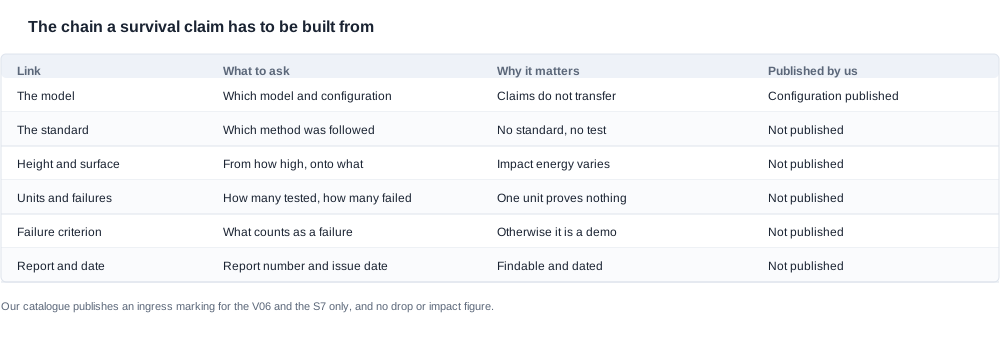
A durability claim is a chain, and it is only as strong as its weakest link. Seven links, in the order a buyer should demand them:
- Which model, in which configuration.
- Which standard the test followed — a test with no standard is an anecdote.
- Which height and surface, and how many drops.
- How many units were tested, and how many failed.
- Which failure criterion was applied — a drop test with no definition of a failure is a demonstration.
- Whether the tested unit was in the production configuration, with the same cell and the same case.
- The report number and the date, so the document can be found again.
If any link is missing, the sentence "they survive being dropped" is doing no work. That is the practical test: ask the seven questions in order and the answer either has structure or it does not.
Two specific traps in this category, both of which come from the same source — a marking or a word that looks like evidence and is not.
IP54 is a water-splash marking. Our sport tier carries the ingress marking on the V06 and the S7, with no report number published for either, and a marking is not a report in any case. The second digit describes water splashing in any direction; the first describes the limit on solid particle ingress. Neither says anything about a drop onto concrete, and the two are conflated constantly because the same product line carries both a sport marketing story and an ingress marking. The IP ratings for smart glasses page sets out what the marking means and exactly where it appears, which is a short list.
Words are not data. "Drop-proof", "shatterproof", "military grade", "ruggedised" — none of these appear in our published data for any model, and none of them can be supported by an ingress marking. A buyer who wants to use one of them in a listing needs a report that says so, in those terms, for that model.
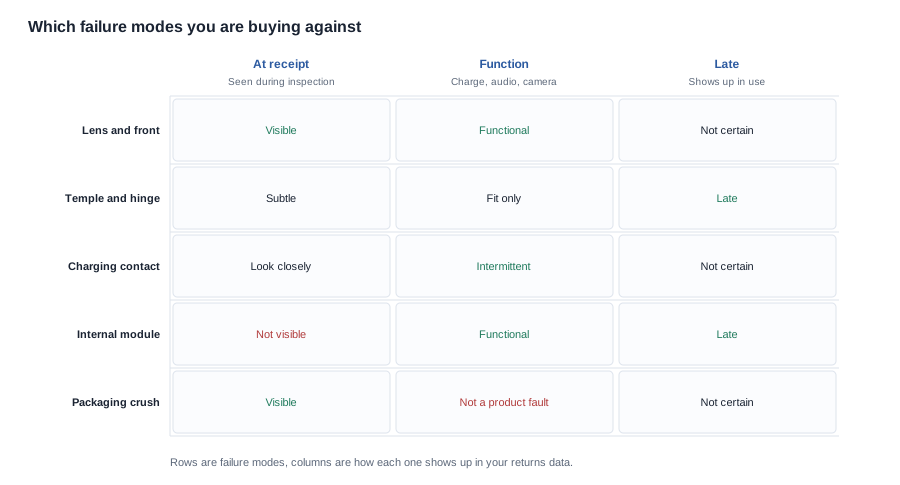
And then the distinction that saves a lot of wasted effort: the product dropping and the parcel dropping are different events. Most shipping damage is not a product being dropped. It is a carton being crushed in a stack, a corner taking an impact against a pallet edge, or a box being handled roughly in a sorting facility. The product inside may never leave the box at all. That matters because the packaging is the variable you control, while the drop resistance of the product is the variable you have to ask about — and conflating them leads to a buyer paying for a ruggedised product when the real problem is a carton.
The same distinction runs through the commercial side of the question, and it is where the negotiation actually sits. A drop that happens in a customer's home and a carton that gets crushed in a warehouse are both "damage", and both arrive as a claim — but they have different evidence, different causes and different costs, and a supplier who cannot tell them apart will either accept claims they should decline or decline claims they should accept. When you negotiate the warranty and the damage-claim position, you are in practice negotiating this distinction. The clause that does the work is one that separates damage in transit, which the carrier and the packaging address, from damage in use, which the product specification addresses, and that states what evidence each one requires. Get that clause written and the drop question stops being a recurring argument; leave it vague and every damaged unit becomes a negotiation.

The failure modes that decide do they survive being dropped
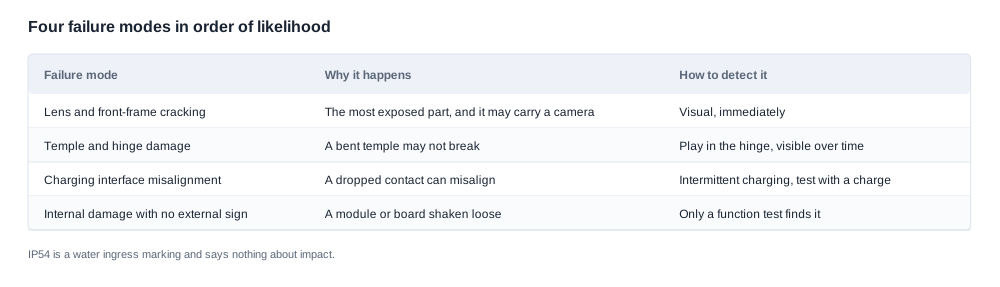
Ordered by how often they turn into a return, in our experience of the category rather than from a published test programme.
Lens and front-frame cracking. The lens is the most exposed part of the product and the part with the least tolerance, and on the eleven camera models the front also carries the camera module, so a crack there is a crack in an optical path and in a sensor housing at once. On the V03 Pro, which publishes photochromic lenses with three colour options, and the V06, which publishes four colours, the lens is also a variable-tint component, and a damaged lens is not a cosmetic issue on those two models.
Temple and hinge damage. A bent temple may not break, and a hinge that develops play is often invisible in a photograph. This is the failure that becomes a returns driver a year later rather than at receipt, and it is the one that a visual inspection at the factory misses. It is also the one that a customer notices first in daily use, because a frame that has lost its fit is a frame that gets returned.
The charging interface. This one is specific to how our catalogue is built, and it is worth separating. Magnetic charging is published for 17 models and Type-C for 7, with the method not published for the CY03, the CY05, the L1 Pro and the MT6. A magnetic charging contact is a small exposed flat surface; a Type-C port is a recessed cavity. They fail differently, and the magnetic interface's failure mode is a misalignment that produces intermittent charging — which presents to the customer as a fault and to the supplier as user error. A misaligned magnetic contact is also easy to see and easy to test with a charge, which is why it belongs in your own sample testing.
Internal damage with no external sign. A camera module or a mainboard shaken loose by an impact that left no visible mark. This is the most expensive failure and the hardest to detect, and it is the one that makes a drop test worth running on units rather than trusting the appearance of a unit. It is also the failure that the words "the customer dropped it" are used to describe, which is why the evidence question in the next section is not pedantry.
A fifth case belongs with the others rather than after them, and it is a category rather than a component: the kids models — the A05, the A06 and the A07. For that range, dropping is the normal event rather than the exception, the buyer is usually a parent rather than the end user, and the lens and the frame are being asked to survive a treatment they will never get a written warning about.
What a buyer can test and request for do they survive being dropped
There is more here than most buyers expect, because the testing you can do yourself is genuinely informative and it is cheap. Work through both lists, in order.
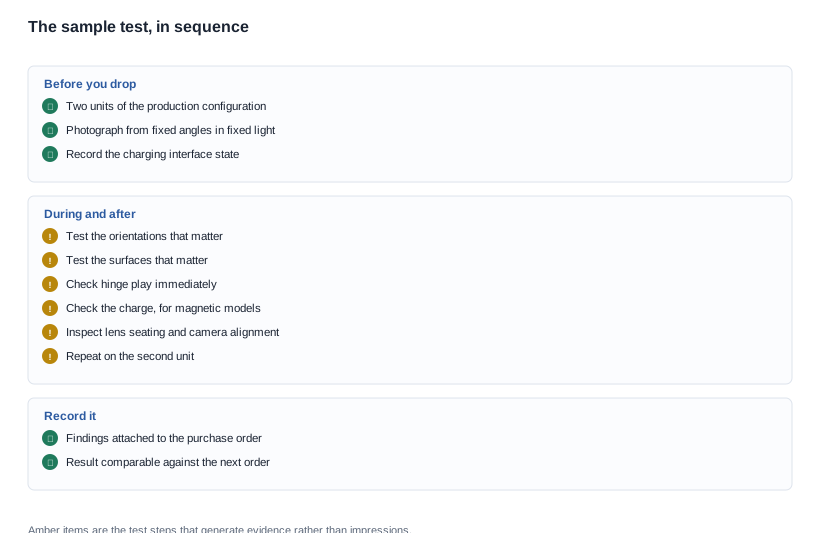
What you can do on a sample, without a report:
- Drop units yourself, in the orientations that matter, on the surfaces that matter. Two units minimum, so that a single anomaly is visible as an anomaly. Photograph before and after, from the same angle, in the same light. This produces evidence rather than impressions, and it takes an afternoon.
- Check the charging interface immediately afterwards. For a magnetic-contact model, look for the contact faces being out of alignment and then test the charge — an intermittent charge after a drop is a finding, not a mystery.
- Check the hinge for play straight away. A hinge that moves after a drop is a hinge that will keep moving, and the customer will report it as a comfort problem long before they report it as damage.
- Inspect the lens for star cracks and the front for camera alignment. On the camera models, check that the lens is still seated and the module is not loose in its housing.
- Repeat on a second unit. The purpose of the second unit is to separate "this product is weak here" from "this unit was unlucky".

What to request from a supplier, in the order that eliminates a non-answer fastest:
- Which standard, which height, which surface, how many drops. Start here — a test with no standard is an anecdote and everything after this question is wasted.
- How many units were tested and how many failed. A single successful unit proves nothing about a production population.
- Was the tested unit in the production configuration, with the same cell and the same case? A test on a different configuration is a test on a different product, and configuration changes are routine.
- What was the failure criterion, in terms someone else could apply? If the criterion is "no visible cracks", you know exactly what you are buying.
- Is there a report number and a date, and can the report be provided for the model you are ordering?
Ask for all five in one message. A supplier who answers four of them has told you the fifth is the problem, which is a useful answer.
One thing to do with the results, whether they came from your own testing or from a report: record them as a specification note attached to the purchase order, in the same way you would record a firmware behaviour or a packaging approval. That turns a one-off observation into a comparable baseline for the next order, and it is what makes a warranty conversation in month six possible. The durability engineering for sports and cycling brands page covers how brands in that category build this into their own engineering practice, and the sport smart glasses range is the right starting point if the application is athletic rather than general.
And a note on how this sits in your due diligence, because it is a different kind of check from the others you are running. The certification checks ask whether a document exists. The factory checks ask whether the operation is real. The drop question asks something narrower and more uncomfortable: whether the supplier is willing to be specific about a performance it has not published. A supplier that answers the five questions with heights, surfaces, unit counts and a failure criterion has demonstrated something about its own engineering culture that a certificate never does. A supplier that answers with "our products are durable" has answered nothing, and that is a legitimate finding on a shortlist — not disqualifying, but it is a data point about how the rest of its answers will look.
What we publish and do not publish about do they survive being dropped
We publish the ingress markings exactly as the catalogue states them, and we will not convert IP54 into a claim about impact resistance or into the word waterproof, because the marking describes protection against water splashing and nothing else. We will also be direct that no drop test, impact test or vibration figure is published for any model in the range, and that the frame weight — the variable that most affects impact behaviour — is published for one model only, 158 g for the MT6 glasses alone and excluding its foldable case.
Two catalogue facts that shape this answer and that are easy to get wrong from the outside. The V06 and the S7 are named for sport, and both belong to the eleven camera models rather than to the sport range; the sport range itself is the YKC02, the D17 and the ZH12, and the YKC02 publishes 2 × 70 mAh as a sport model rather than an audio one. So the models carrying the ingress marking are camera products, and a buyer reasoning from model names alone will put the marking on the wrong SKU in the listing. That is a labelling error with a compliance dimension, and it is worth checking before a print run rather than after.
What to say to a customer, then, is the published specification and nothing more: the ingress marking where one exists for that model, the weight where one is published, the charging interface, the battery capacity and the charge time — and, where a test report exists, the report with its number and its date. If you want a durability claim in your listing, the honest route to it is to run the test, document it, and publish what you found, including the failures. That is a stronger position than a borrowed claim, because it is checkable.
If you want to negotiate the commercial side, these are the lines worth putting on the table with a supplier:
- Whether a drop test can be commissioned for your configuration, and what it costs and how long it takes. This is a test request, not a product change, and it is usually cheaper than a redesign.
- The evidence requirement for a damage claim, and whether the supplier distinguishes transit damage from in-use damage.
- The warranty period with a stated response time, and who pays the freight on a replacement.
- Whether spare units can be supplied separately from the sale units, so that a replacement does not require a new packaging run.
- What happens to a unit that fails your own test — quarantined, replaced, or returned. This is the clause that makes your own testing possible rather than awkward.
Two negotiation rules apply to all five. Certification cost and test lead time follow the process and the testing body rather than the negotiation, so do not spend your negotiating time there; spend it on the acceptance criteria, the evidence requirement and the replacement terms, which are where the money actually moves. And whichever one of the five you lead with, the criterion is the same: the clause has to say what evidence is required, because a warranty that does not define evidence is a warranty that will be argued rather than applied.
And the practical mitigation that is genuinely in your control: packaging. A carton that survives the distribution network protects a product that might not survive a drop, and most shipping damage is crushing and corner impact rather than a product being dropped. The shipping damage claims discussion sets out the evidence side of that, and the evidence is the part that decides whether a claim is paid.
Tell us the models and the environment they will be used in, and we will say which published figures apply and what evidence you would need to request.
Related reading
- Sport smart glasses range
- IP ratings for smart glasses
- Shipping damage claims process
- Sports and cycling durability engineering
Tell us the models and the environment and we will say which published figures apply and what evidence you need.


