

Every manufacturer enquiry that arrives in our inbox opens with some version of the same question, and it is almost never about geography. Nobody is trying to work out where Shenzhen is. They are trying to work out whether there is a counterparty on the other end of the quotation, whether the documents they will be asked to sign come from the same organisation that will build the goods, and whether the liability that the law attaches to selling those goods lands somewhere they can actually name.
That is the real content of the question. An address is the cheapest available proxy for it — free to ask, quick to answer, and easy to check against a public register. Which is exactly why it gets asked first, and exactly why it settles so little.
Do you want a registered address, or do you want a premises you can ship to?
These are three different things and most buyers arrive using one word for all of them.
A registered address is a legal attribute. It is the address a company nominates on its public filings, and it is where official correspondence from a registry, a tax authority or a court is directed. In many jurisdictions it is a consultancy office, a law firm's service address, or a space in a serviced building, and it may contain no stock, no machines and no people who touch your order. That is not misconduct. It is an ordinary commercial arrangement, and it is completely normal for a group to register at one address and operate from another.
An operating address is where the goods are physically made, packed, labelled and handed to the carrier. This is the address that has to appear on the shipping instructions, on the packing list, on the certificate of origin and on the commercial invoice, because it is the address the freight actually departs from. It is also the address your claim is returned to, your auditor travels to, and your third-party inspection agency attends at.
A correspondence address is where email, quotes and technical correspondence go, and it is frequently a third address again — a shared services desk, an export sales office, or a mailbox belonging to a colleague in another city.
A serious supplier will be comfortable telling you which of the three is which, and will not be confused by the question. A supplier who cannot distinguish them, or who gives you one address for all three when they are obviously different, has either not thought about the distinction or is hoping you will not look.
The practical test is not whether the address is impressive. It is whether the address is loadable. Can a pallet of finished goods physically leave from that address? Is there a goods-in door, a loading bay, and space to hold a full container? Does the address on the invoice match the address on the shipping instruction, or does the shipment leave from somewhere the invoice never mentioned?
In a Shenzhen export cluster this distinction is not academic. It is common for a manufacturing entity, an export-trading affiliate and a brand-owning company to sit inside the same industrial park, sometimes in adjacent buildings, sometimes sharing a gate. When we are asked which entity builds the order, which entity signs the purchase order and which entity issues the invoice, the honest answer can be that these are three different companies with a shared operation behind them. That is a legitimate structure. It is also something you need to know before the first shipment rather than after it.
One more thing worth putting in the same email: whether the site can receive a freight shipment addressed to it. A great many legitimate exporters in this category use a forwarder as the shipper of record and never post a single carton through their own door. Again, not a red flag in itself — but it changes who is physically holding your goods, and it changes the answer to a warranty return.
A buyer we spoke to last year described the failure precisely, and it is worth repeating because nothing about it looked unusual. The quotation, the invoice and the packing list all named the same company. The address was real, the phone number was answered by a professional in a good office, and the sample that arrived was excellent. What nobody had asked was whether that company built anything. The goods were assembled at a partner site, packed at a third party, and the company that had invoiced the buyer held no process capability at all. It had bought the ability to serve the order, on a lead time it did not control, and it had passed the address check cleanly. A buyer who had asked "which site builds my order, and can I visit it" would have found the answer in a single email. That is the practical difference between an address check and a supply-chain check, and it is why the two should never be treated as substitutes.

Do you know which legal entity signs the purchase order?
An address check is really an entity check, and the entity is what a contract attaches to.
The names you will meet in a single supplier conversation are typically three: the company whose name is on the factory gate, the company that issues the pro forma invoice and the commercial invoice, and the company that is named on the conformity documentation. In a small operation all three are the same. In a larger group they are frequently not, and the differences are perfectly normal. What is not normal is a supplier who cannot tell you, or who changes the answer between the quotation and the purchase order.
There is a specific set of documents to pull and lay side by side, and it takes less than ten minutes:
- The pro forma invoice or quotation — note the legal name and the registration details in the header or footer.
- The commercial invoice that will accompany the shipment — note the same two things again.
- The packing list — the shipper and consignee blocks.
- The technical documentation and the declaration of conformity — the manufacturer named there.
- The payment instructions — the name of the account holder, the bank and the currency.
Five documents, one table, and a column that says whether the entity is the same in every row. The purpose is not to catch a supplier doing something wrong. It is to establish, before you wire money, which entity you are contracting with and which entity will be on the hook when the batch is wrong.

The fifth row is the one that generates the most productive conversation. A payment instruction naming an entity other than the invoice entity is a recognised trade practice in some cross-border arrangements, where an offshore or third-country collection account is used deliberately. It is also the single most common structure in which a buyer discovers, months later, that the counterparty they believed they were dealing with is not the party that made the goods. Ask it plainly, ask for the answer in writing, and if the answer involves a third party collecting on your behalf, understand clearly that your contractual counterparty and the party actually building your product are two different organisations with a relationship you have not yet seen documented.
There is a trade-off here that experienced buyers weigh deliberately rather than reflexively. A group with a manufacturing entity, an export entity and a brand entity has useful properties: the manufacturing entity may hold the process capability, the export entity may hold the market licences and the tax position, and the brand entity may hold the intellectual property. Separating them can be good structure. It can also mean that when something goes wrong, each entity can point at the other. The question that resolves it is not about which structure is better in the abstract; it is about which one you are buying from, and whether the contract with that one actually reaches the one that builds.
For a buyer building a shortlist, this is often the most efficient single question on the list, because the answer is short, factual and immediately comparable between suppliers. Send it to three suppliers at once and the responses will be more revealing than three rounds of product questions.

Do you need an address inside the European Union, or a named person there?
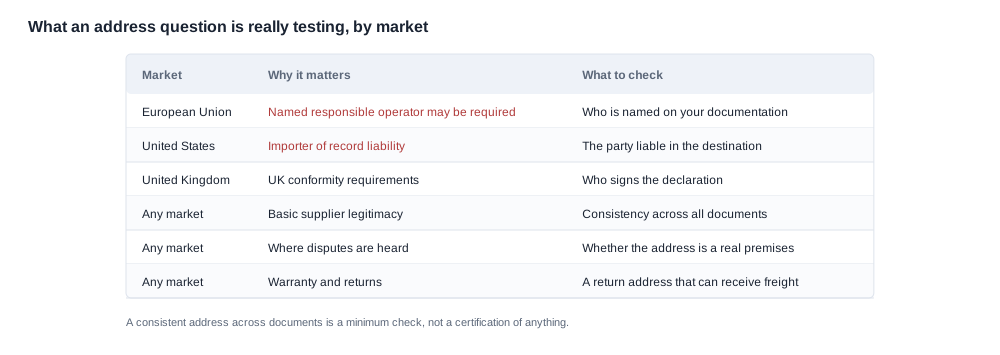
This is where the address question stops being about legitimacy and becomes about the law, and it is where the two are most often confused — including by suppliers answering you.
In the European Union, the General Product Safety Regulation requires that, where a consumer product made outside the Union is placed on the Union market, a named person or entity established within the Union is identified on the product and in the accompanying documentation, and performs the tasks the regulation assigns to that role. The role is commonly called the EU responsible person or the authorised representative. We have covered the mechanics of it in more detail on our GPSR obligations page.
The distinction that matters commercially is this: the requirement is for a named party performing a set of obligations, not for an address. An address proves somebody receives mail in a country. The role requires somebody to hold the technical documentation, to answer a market surveillance authority, to implement a corrective action when a product is found unsafe, and to cooperate on a recall. A forwarding service that accepts mail and passes it on satisfies none of that, and a supplier who offers you "our European address" in answer to the responsible-person question has not answered the question.
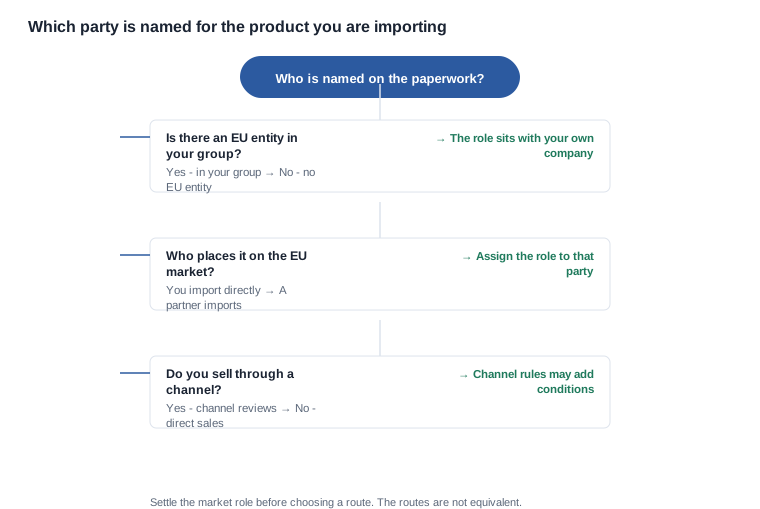
There are three different answers to give, and they belong to different points in the chain:
- A group entity in the Union. If your own company is established in a member state, you are the manufacturer in the eyes of the regulation and no separate role is needed. This is the cleanest route and it costs nothing, but it is only open to buyers who already have a presence in Europe.
- A representative appointed in writing. A named party in the Union takes the role on your behalf under a mandate. This is the route most non-European brands take, it is a service with a cost, and the cost varies with the provider and with how much of the work they actually take on.
- A distributor or channel partner holding the role. Where the party placing the product on the market in the Union is itself established there, the obligation can sit with them. This is a genuine route rather than a workaround, but in a multi-layer distribution chain it is easy to be wrong about which party actually places the product on the market.
The question that settles it is short: who is the party placing this product on the Union market in each market you sell into? Answer that, and the routes open to you narrow to one or two, and the conversation with your supplier becomes specific instead of philosophical.
The United States works the same way with a different name. The party identified as importer of record carries liability in the destination country, and deciding who that is before the first shipment is a commercial and tax decision with legal consequences attached. It is routinely left unresolved until a customs query arrives, at which point the options are expensive.
None of this is a reason not to buy from an Asian manufacturer. It is a reason to know, before you commit to a delivery date, exactly which name will be on the documents when the container lands.
It is also a reason to resist a specific and very common piece of supplier shorthand. The phrase "we have a European partner" appears in a large share of the conversations we are copied into, and it can mean three quite different things. It can mean the supplier has a genuine legal entity in the Union that performs the role and signs for it. It can mean the supplier has a distribution arrangement with a European reseller who holds the role. It can also mean the supplier has a forwarding address and a service agreement, which is not the same thing at all. None of these is automatically a problem. The problem is that the sentence does not tell you which one you are getting, and the difference between them determines whether the technical documentation reaches the party that needs it when a market surveillance authority asks for it.
The same ambiguity exists on the other side of the world, and it is worth drawing the comparison because the two are frequently confused. In the United States the importer of record is a tax and liability designation: it takes on the duty, it accepts the entry, and it carries the consequence of what the goods turn out to be. In the European Union the responsible person is a safety and documentation designation: it holds the technical file and performs the corrective-action tasks. They are not the same role, they are not satisfied by the same arrangement, and a buyer who has a comfortable answer for one of them has not automatically got an answer for the other. Ask both, separately, in writing.
If your business sells into more than one jurisdiction, this stops being one question and becomes a matrix: for each market, who is the party placing the product on the market, and who holds the named role there. Working that matrix before you build the commercial structure is far cheaper than working it after a listing has been rejected by a channel that wanted a document you did not know was required.
The United Kingdom, for its part, has its own conformity route following the transition away from CE recognition, and somebody has to sign the declaration under it. A supplier who can only speak about the European Union may still be perfectly capable of supporting a UK launch, or may not be. It is a fair question to ask in the same email as the rest, and the answer is more discriminating than it sounds.

Do you have ten minutes to check consistency across documents?
Here is the protocol we would run ourselves, and it is the one we would suggest a buyer run on any supplier — including on us.
The first step is to assemble the documents that already exist in a normal exchange. You do not need to ask for anything unusual to do this. A quotation, a pro forma invoice and a specification sheet are usually enough to start, and by the time a sample is in discussion you will have the packaging artwork, the label copy and the draft declaration as well.
The second step is the comparison. Write out the legal name as it appears on each document. Do not normalise it, do not assume a trading name is a shorthand for a registered name, and do not treat a missing company number as a small detail — it is the one field that ties a name to a legal person.
The third step is the public check. Company registries differ by jurisdiction in what they publish and in how long the information takes to appear, but a registration number, a registered name and a status can usually be confirmed. In some jurisdictions the registry is searchable only by name and the results are noisy; in others the number is decisive. The value of this step is not proof — it is the elimination of a supplier that does not exist.
The fourth step is the physical check. Does the operating address accept freight? Is it consistent with any evidence you have already seen, such as a company stamp on a certificate, a packaging artwork file, an email signature or a photograph in a video walk-through?
The fifth step is the role check, and this is the one most people skip. Before you send anything, write down the name that will appear in the destination market as the party responsible for the product, and confirm that the supplier agrees with your list. Write it into your own purchase documentation if you can.
Because most of what you will find is variation rather than fraud, it helps to know in advance which differences you can absorb. In our experience, these are ordinary and require no more than a note:
- The registered name is in Chinese characters and the invoicing name is an English trading name, with the registration number present on the invoice and matching the registry.
- The manufacturer named on the technical documentation is a different company from the exporter, because the brand entity, the manufacturing entity and the export entity sit inside one group.
- The address on the invoice is a serviced office and the shipment departs from the industrial site, and the supplier states both without being pressed.
- The payment instruction names an account in a third jurisdiction, and the supplier explains the arrangement plainly in one sentence.
These are the differences that cost you ten minutes. The ones below are the differences that should stop the process and start a question, and the pattern they share is that no amount of pressing produces a specific answer:
- The supplier cannot say which entity will sign the purchase order, only that "we will send you the paperwork".
- The operating site changes between the quotation and the packing list, and the change is explained as an upgrade to capacity.
- The registration number is on the invoice but not on any other document, and the company name on the carton artwork does not appear anywhere in the file.
- The answer to "who is the importer of record in the United States" is a question back to you.
The difference between the two lists is not severity. It is specificity. A specific answer to an awkward question is fine; a vague answer to a simple one is the warning sign.
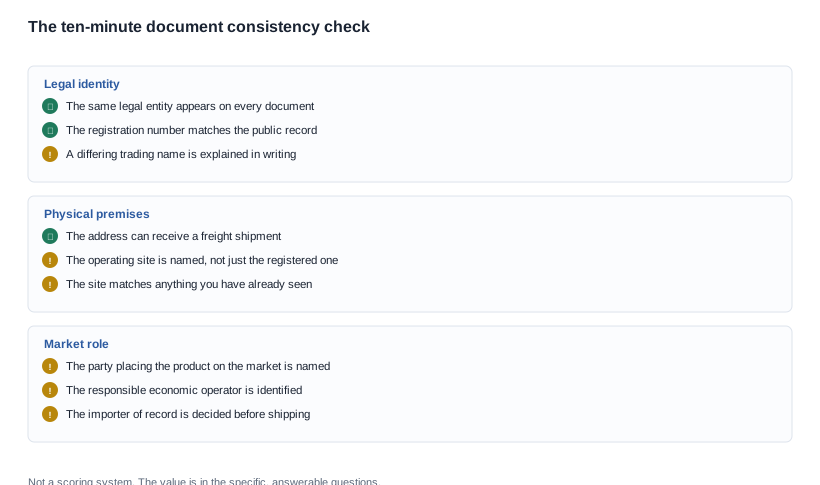
The checklist above is deliberately short, and it is deliberately not a scoring system. The temptation with a checklist like this is to turn it into a pass mark and to treat a supplier who ticks most of the boxes as safe. Resist it. The value of this exercise is in the specific, answerable questions, not in a total.
Do you think a verified address means the supplier is verified?
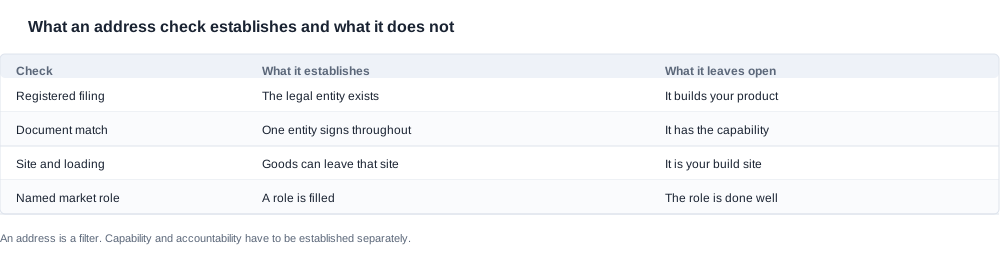
It does not, and this is the point at which most address-based due diligence ends too early.
An address establishes existence. It does not establish capability, and it does not establish accountability. A one-person trading company and a factory running four hundred people both have an address, and in most cases the smaller one has a cleaner public record. What the address check actually does is remove a category of supplier that you never wanted in the first place — the one that does not exist, or exists only as a forwarding address for a shell — and it forces a first conversation about entity structure that many buyers would otherwise skip. That is real value. It is simply not a verdict.
The questions that actually move the outcome are the ones an address cannot answer, and there are four of them. Who physically builds your order, and at which site. Who owns the tooling and who can modify it without your approval. Who is the contractual party that will be liable when a batch fails at your end-of-line test. And who answers the phone at eight in the evening in your time zone when a container is sitting at the port and you need a decision.
The second of those is the one that quietly determines whether a buyer is dependent on a supplier, and it is the one most often left unwritten. The third is the one that determines whether a warranty claim is a transaction or an argument. The first is the one most likely to be answered differently by two suppliers that look identical from the outside, which is why we have written about it at length in our factory versus trading company material.
The right use of the address check, then, is as a filter rather than a conclusion. Use it to remove the impossible, use the entity comparison to decide who you are contracting with, and use the market-role question to make sure the liability lands where you can name it. Then spend the real audit budget — the site visit, the factory video walk-through, the specification test, the reference request — on the things that only a real operation can answer. The due diligence you can do in ten minutes is genuinely worth doing. It is just the cheapest part of the job, and it is the part most likely to create false confidence if you let it stand in for the rest.
There is a version of this that buyers use to sound thorough without doing the work, and it is worth naming because it is common. It consists of asking a long list of questions, treating the length of the list as the diligence, and then scoring the answers on how they feel. The questions we would put at the top of a real shortlist are fewer and harder:
- Which legal entity am I contracting with, and which legal entity will be named as the manufacturer on the technical file?
- Which site builds the order, and may I see it on a video call before I commit?
- Who owns the tooling, and what does it cost to change it later?
- Who is the party responsible for the product in each market I sell into, and do you agree with my list?
- What happens to this relationship if my channel asks me to move production to a second supplier in year two?
Notice that none of those is about the address. Notice also that they are all answerable in writing, in a short reply, and that a supplier who answers all five clearly has told you more about how the relationship will go than any amount of inspection of a business card. The value of a good shortlist is not that the items scored well; it is that the surviving supplier answered the hard questions without evasion, and that you now know which one it is.
On our own position, we will be straight with you about what our documentation does and does not establish. We are a Shenzhen-based manufacturing business, our registered details appear consistently on our own documents, and those details are available for verification on request. We do not publish our address on this page, because a published address on a marketing page is a weak signal and a real one is available the moment you ask. What an address would not tell you about us anyway is which site builds your order, who owns the tooling on it, and who carries the obligation when something goes wrong. Those are the questions worth putting to us, and they are the questions we would rather answer than the one that is easiest.
Related reading
- Checking a factory rather than a trader — factory vs trading company
- The regulation behind the named-party role — GPSR obligations for EU sales
Send us your due-diligence checklist and we will answer the harder questions in writing, including the ones our own address cannot settle.


