

The short version: a repeat order is usually a better order, and the reasons have almost nothing to do with the number you order. What changes between the first order and the fourth is the amount of work that has already been done, and the price follows that work rather than the volume.
Which means the useful answer to this question is not a discount table. It is a description of the mechanisms, because those mechanisms are the same in every supplier in this category, and they are the thing you can negotiate, audit and plan around even when the numbers themselves stay in a quotation.
We publish no unit prices, no break points, no minimum order quantity, no payment terms and no lead times. Those are terms rather than facts, and a published break point that does not apply to your configuration is worse than no break point at all, because you will build a budget on it. What we do publish is the structure of how volume pricing works, and the questions that force a supplier to show their working.
Do you have a published tier table, or only a quotation?
Only a quotation, and we want to be precise about why rather than defensive about it.
A tier table in this category is a grid. Along one axis, a quantity band — five hundred units, one thousand, five thousand. Along another, a configuration — a standard build or a branded build, a standard colour or a custom colour, a stock configuration or one with firmware changes. Each cell holds a unit price. It is a useful artefact when it exists, and the reason it is useful is that it makes the relationship between quantity and price explicit, so a buyer can model the cost of a forecast.
But the table is only true at the moment it is written, and a table written in one quarter is wrong by the next one in ways that are invisible from outside: component costs move, the production schedule changes, a colourway is discontinued, a new platform is launched, a currency moves. So the table is a snapshot of an internal costing model, and a snapshot of an internal costing model is exactly as reliable as the date printed on it.
The honest alternative is that a buyer gets a quotation for their own configuration, at their own volume, on a stated date, and gets the shape of the volume relationship explained. A single-price quotation is the weak version of this. A quotation that shows the break points, names what each break point is triggered by, and says which costs fall away on a repeat is the useful version, and it is available from any competent supplier in this category.
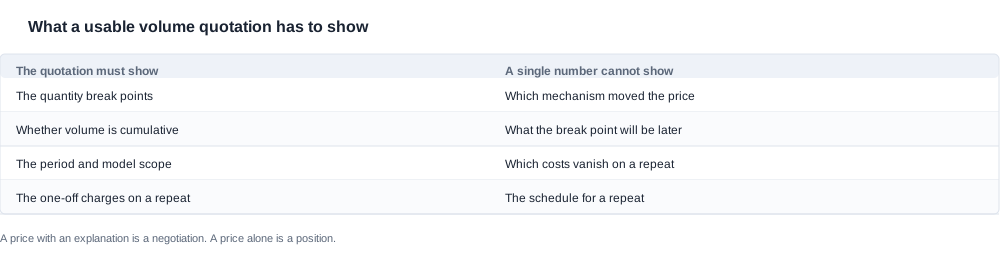
Notice what is on the right-hand column of that table. A buyer who receives a quotation with the first column filled and the second empty has been given a number, not a structure, and the difference becomes visible in the third order rather than the first. This is a reasonable thing to ask for before the first order, and it costs nothing to ask: show me the break points for this configuration, and tell me which of them apply if I come back at the same volume three months from now.
The framework of how minimums and volume interact is set out under smart glasses MOQ, and the cost side of it under procurement pricing. We also have a longer treatment of the tier mechanics in smart glasses wholesale pricing tiers. What none of those will give you is a number for your programme, and that is not an oversight.
There is a second reason a published table is often worse than none, and it is a commercial one rather than an administrative one. A table invites a buyer to ask for the cell rather than to ask the question. "What is your price at five thousand units?" is a cell. "At five thousand units, what changes?" is a structure, and it is the only one of the two that survives a component price move, a schedule change or a currency movement. A buyer negotiating on the structure can tell when a quote has moved and why. A buyer negotiating on a cell is negotiating on a number that was true on a date that has already passed.
The practical request is therefore two-part, and it is worth making both parts at once. First: the quotation for my configuration at my volume, dated. Second: the movement in that quotation as volume rises across three named bands, and the reason for each movement. Any supplier who can produce the second part has an internal costing model they understand well enough to explain. Any supplier who cannot has a single price and a sales contact who does not have access to the model that produced it.

Do you want the unit price explained, or just quoted?
Ask for the explanation. A price without an explanation is a position; a price with an explanation is a negotiation, and the two behave very differently once you are ordering again.
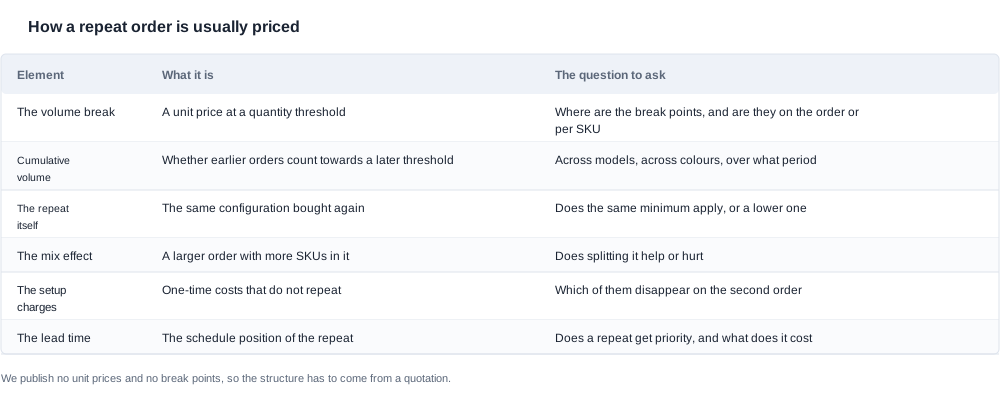
There are six mechanisms at work in almost any volume quote in this category. They are worth knowing individually, because they respond to different actions on your side and they fail in different ways.
- The volume break. A unit price at a quantity threshold. This is the one everyone expects, and on a repeat it is the mechanism that is already satisfied — you crossed the threshold on order one, and order three at the same volume crosses it again. There is usually no new saving to extract here, which surprises people who assume each order re-earns the discount.
- Cumulative volume. Whether your earlier orders count towards a later threshold. This is the mechanism worth the most attention, because the answer varies enormously between suppliers and the direction of the error is always the same: a buyer assumes accumulation, the supplier does not apply it, and the order the buyer expected to be the cheapest arrives at the standard price.
- The repeat itself. Some suppliers apply a lower minimum to a repeat of an identical configuration, because the qualification work is already behind them. Others treat a repeat exactly like a first order for minimum purposes. Both are legitimate, and the difference is worth several thousand units of commitment if you are planning a large first order and small repeats thereafter.
- The mix effect. A bigger order with more configurations in it is not automatically a better order. Every additional colour and every additional model carries its own floor and its own place on the production schedule. Splitting a quantity across two colours and keeping it in one order can be cheaper than consolidating the quantity and spreading it across two.
- The setup charges. Tooling, first-article approval, packaging setup, the documentation work. These are one-off by nature, and they are the strongest financial argument for a repeat order and the strongest argument for concentrating a programme on as few configurations as possible.
- The schedule position. A repeat usually gets a better place in the production sequence, because the qualification stages have been passed. In a seasonal business this is worth more than a small unit-price movement, and it is the one mechanism that no amount of negotiation can substitute for.
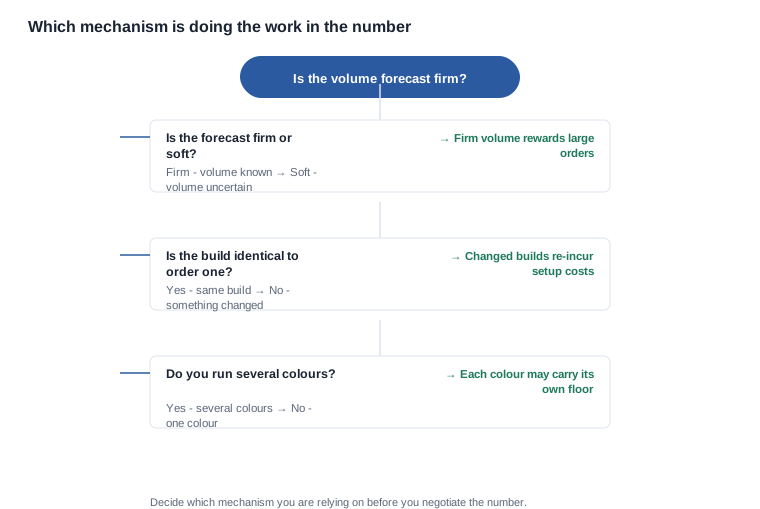
Notice the shape of that decision tree. The mechanisms are not independent — they interact — and the practical question is not which one applies but which one you are relying on. A buyer whose forecast is firm should be relying on the volume break and the schedule position, because those compound. A buyer whose volume is uncertain should be relying on the repeat discount and the amortisation of setup charges, because those do not require a forecast to be correct.
A worked illustration of the mix effect, because it is the mechanism most often misunderstood. Consider a brand that needs a thousand units of one model in a single black colour, and that also wants a second colour for its retail launch. There are two ways to buy it.
Option one: one order, a thousand units, one colour. Option two: one order, five hundred black and five hundred of the second colour, in the same order and the same delivery.
Which is cheaper? Not obviously option two, and possibly more expensive. The second colour typically carries its own minimum, its own line on the production schedule and its own packaging setup, so splitting the quantity across two colours may push the total below the level where the tooling and setup amortise. On a first order, option one is frequently the better commercial structure even though it is the less attractive commercial outcome. On a repeat, the picture inverts: the tooling and packaging are already paid for, the second colour's setup has been done once, and the marginal cost of the second colour is much closer to its variable cost — so the split order becomes the better structure at that point.
The general rule that falls out of this is worth more than the example: the value of splitting an order across configurations rises with each order you have already placed, because the fixed costs fall away. A buyer who negotiates on the first order as though the second order will have the same structure is negotiating against themselves.

Do you get a better price on the second order of the same build?
Sometimes, and the mechanisms are specific enough to be worth separating out.
On a genuine repeat — the same model, the same configuration, the same colour, the same packaging — the following have usually already been paid for and are usually not paid for again: the tooling, the first-article approval, the packaging plate and print setup, the firmware and app build, the technical documentation work, and the initial samples. That is the bulk of the one-off cost in a first order for a branded programme, and its absence is the single largest reason a second order of the same build is cheaper per unit than the first, often by more than the unit price change alone.
What is not usually free on a repeat, and which buyers regularly forget: new packaging artwork if the artwork changes, a new colour if the colour changes, a new certificate scope if the model variant changes, and the re-run cost of anything that is batch-specific, such as a serial-number range or a traceability scheme. If a repeat order is not truly a repeat, it inherits the one-off costs of whatever did change, and the savings evaporate without anyone having done anything wrong.

The schedule effect deserves a sentence of its own. A repeat of a configuration that has already been built once can typically be scheduled more tightly, because the long-lead and qualification stages are behind it. Where you are working against a seasonal deadline, this is frequently worth more than the price, and it is a mechanism that you can ask about directly: if I place a repeat of the same build in November, how does it compare with a new configuration of the same volume?
There is a trade-off here that we think is under-discussed. Concentrating volume into fewer, larger orders maximises the amortisation of setup charges and improves the schedule position, but it increases the inventory risk per order and makes a forecasting error more expensive. Splitting into more, smaller orders reduces the inventory risk and reduces the amount of setup work that can be amortised. Neither is a better practice. The right answer depends on the reliability of your demand and on how much working capital you are willing to have sitting in a warehouse, and it is worth making that decision explicitly rather than letting it be made by whichever order the sales team happens to need first.
There is a second, less obvious cost to treating every repeat as a fresh negotiation, and it is worth naming because it compounds quietly. Each time you re-tender a configuration, you hand the supplier a chance to re-quote the whole thing, including the parts you already paid for. The packaging setup that was free on order three is not free on order four if order four is treated as a new brief. The tooling that was amortised across three runs is amortised across one again. A supplier who treats a repeat as a new brief is not necessarily acting in bad faith — a busy sales team genuinely thinks this way — but the effect on your unit cost is real, and the fix is procedural rather than adversarial: put the repeat status in writing on the purchase order, reference the original quotation and the golden sample, and state which elements are unchanged.
This is also the moment where a buyer's own internal discipline matters more than the supplier's goodwill. Keep a file per configuration containing the signed quotation, the approved golden sample, the artwork files, the firmware version and the batch records. On a repeat, that file is what allows you to say "nothing has changed except the quantity", and it is what lets a good supplier quote a repeat quickly. The buyers who get the best repeat terms are usually the ones who made the first order easy to repeat, and that is a documentation task, not a negotiation tactic.

Do you accumulate volume across orders, models or colours?
This is the single question that produces the largest financial difference on a repeat programme, and it is the one most often left unanswered because it does not occur to a buyer until the second or third order.
The mechanics are not complicated. A supplier's costing system aggregates volume somewhere — across all orders, or within a contract, or within a calendar year, or within a model code, or within a colour. The number of axes in that aggregation is the whole question. A buyer who assumes four axes are aggregated and is actually getting one has a unit price that is materially higher than planned, on precisely the order they planned to be the cheapest.
The four axes to ask about separately are:
- Across orders in time. Do the quantities of my last three orders count towards the threshold on my next one, and over what period — calendar year, contract term, or the life of the relationship?
- Across model codes. If I buy a model from the same platform, does that volume count towards the same break point, or does each model code have its own ladder?
- Across configurations. Does a stock build and a branded build of the same model aggregate, or are they separate?
- Across colours. Does a second colour in the same order count towards the same threshold, or does each colour have its own floor?
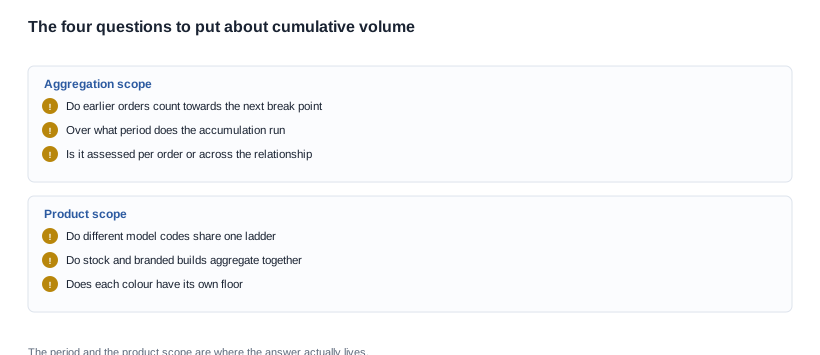
The wording that gets a usable answer is specific. Does my total purchase volume across all orders count cumulatively towards the quantity break, or is each quotation assessed on its own? If cumulative, over what period and across which models? A supplier who answers "yes, cumulative" without qualification has not answered, because the period and the model scope are where the answer actually lives.
There is also a reason to want accumulation to be narrow rather than broad, and buyers sometimes assume that broader is always better for them. If a supplier aggregates across everything you buy, then a small trial order of a model you will never repeat can move you into a bracket, and you may find that your next order is priced on the assumption of a volume you did not want. Narrow aggregation protects you from being quoted against a forecast you did not make. Broad aggregation rewards you for consolidating your spend. Which one you want depends on whether your buying is planned to be consolidated, and the answer to that is a fact about your business rather than about the supplier.
Do you know which costs a repeat order actually removes?
Here is the summary we would want a buyer to be able to give back to us after a first order, because a buyer who can list the items has already done the negotiation.
The five questions to put in the first negotiation, before you place an order:
- What are the quantity break points for my configuration, and are they assessed per order or cumulatively?
- If cumulatively, over what period and across which models, configurations and colours?
- Which of the one-off setup charges are charged again on an identical repeat, and which are not?
- What is the minimum order quantity for a repeat of an already-built configuration, and is it lower than for a new configuration?
- What changes in the schedule for a repeat compared with a new build at the same volume?
The fifth question is the one we would add to a list of your own, because it is the one that surfaces an answer with information in it. A supplier who quotes a repeat lead time that is the same as a first order has not considered the schedule position, and a supplier who cannot answer it at all has not run enough repeats to have a number.
The practical position we can take on our own side is this. We do not publish a tier table, a minimum order quantity, a lead time or a payment schedule, because every one of those is a term that depends on a configuration and a date, and publishing a general figure would be a figure that is wrong for most of the programmes we actually run. What we will do is quote a specific configuration at a specific volume, show which of the six mechanisms is doing the work in the number, and tell you what a second order of that same configuration would remove and what it would not. If that is more than you get elsewhere, it is a fair basis for a shortlist, and it is the same basis we would want to be judged on.
It is worth saying what a good volume negotiation looks like from our side of the table, because it is a different conversation from the one most buyers are used to. It is not a haggle over a unit price. It is a structured exchange about four things: what is fixed and what moves with volume, what the accumulation rules are, what the repeat removes, and what the schedule does. Once those four are settled, the unit price is arithmetic rather than negotiation, and the remaining conversation is about the risk allocation — who carries the cost of a component move, who carries a short-ship, who carries a late delivery against a promotion date.
Those three risks are where the real value sits at the end of a volume negotiation, and they are the three most often left unstated. A quotation that fixes a unit price for a year without saying what happens when a component costs more is not a firm price; it is a promise that one side of the table will come back to you. Conversely, a volume agreement that names the mechanism, the period and the risk allocation is worth more to a buyer than a lower number with none of those, and it is a much better thing to take to a credit committee.
The tier structure we publish is in smart glasses wholesale pricing tiers, the payment and settlement side is under smart glasses payment terms, and the minimum-quantity framework is under smart glasses MOQ. Send us a configuration and a volume and we will show you the four answers above in writing before any number is on the table.
Related reading
- The volume mechanics — smart glasses MOQ
- How the price is put together — procurement pricing
- The payment side — smart glasses payment terms
Send us the configuration and the volume and we will show you which mechanism is setting the number and what a second order of the same build would remove.


