

Tooling ownership is the question in an OEM project with the clearest financial consequence and the most frequently left unanswered. The answer is rarely about the mould itself. It is about what happens in year three, when you want to change a temple shape, when a channel asks you to move the order to a second supplier, or when you simply stop selling the product and find out that you need the thing that makes it.
Ask the question at the start, get it in writing, and the later conversations are short. Leave it out, and it surfaces at the worst possible moment — when you need the tooling most and no one can act quickly.
Do you own the mould, or do you rent access to it?
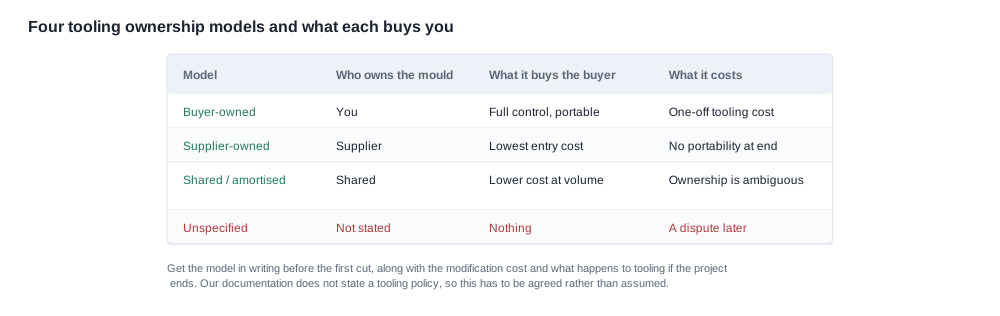
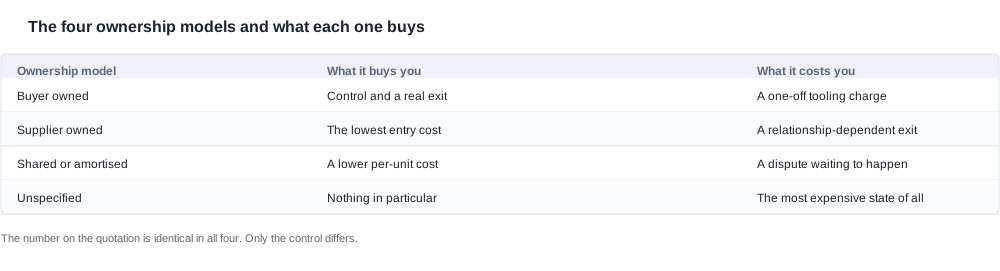
There are four arrangements in common use, and only one of them is unambiguous. Buyers tend to assume the question has a yes or a no answer; it has four, and they buy genuinely different things.
Buyer-owned. You own the mould from the first cut. You pay a one-off tooling cost and in exchange you have control: you can modify it, you can take it to another factory, and you are not negotiating for its release at the end of the project. For anything you intend to sell for more than a couple of years, this is the model that protects you, and it is also the model that most protects a buyer who has a relationship with more than one factory.
Supplier-owned. The supplier retains the mould and you pay per unit. This is the lowest entry cost and it is a legitimate choice for a short product life or a speculative order. What it is not is an exit. If the relationship ends badly, the mould stays where it is and your ability to continue production depends on the supplier's goodwill. For a first order on a model you are testing, this is often the right answer. For a platform you are building a brand on, it is a decision you will regret, and the regret arrives at the worst time.
Shared or amortised. The mould cost is spread across the order and ownership is genuinely ambiguous. Sometimes the supplier keeps it, sometimes you do, and the document that says which is the quotation — if the quotation says anything at all. This is the model that produces disputes, because both parties believe they remember the same conversation and remember it differently.
Unspecified. Nobody has written it down. This is the most common state in this category and the most expensive one, because the disagreement surfaces at the worst possible moment.
The thing worth noticing in that table is the third row from the bottom. A supplier that offers buyer-owned tooling with a modification policy is a supplier offering a genuinely better arrangement than a supplier that offers buyer-owned tooling with an approval requirement. Ownership without a modification policy is a half-measure that gives you the legal right and no practical freedom, and the difference between the two is exactly the difference between owning an asset and owning a claim.
There is also a version of supplier-owned that is better than it sounds, and buyers should know to ask for it. Some suppliers will transfer the mould to the buyer at the end of a committed volume, or sell it at cost once the amortisation is complete, or hold it in a buyer's name from the first cut while the supplier keeps the day-to-day responsibility for maintenance. The point is that supplier-owned and buyer-owned are not the only two outcomes; a negotiated structure that gives the buyer an option at a known price is often better than either, because it prices the exit rather than arguing about it later.
A fourth thing is worth saying about buyer-owned tooling, because it is the one buyers most often get wrong in their own favour. Owning the mould gives you the legal right to the object, and it does not give you the right to have the product made by anyone other than the supplier who made it. In a competitive supply landscape — where a second factory is quoting the same product, or where a customer asks you to nominate an alternative source — the practical question is not "can I have the mould" but "can I have the mould, the process settings, the fixtures, the material specification and the inspection criteria, and will the supplier cooperate in transferring them". A buyer who has paid for the mould and has not addressed the know-how has bought half an exit, and will find that out in the one week of the year when they most need it.
That is also why a supplier who volunteers a transfer pack is worth a premium over one who does not. It is a small piece of work — a document, a set of parameters, a set of judgement notes — and it is the difference between a mould on a pallet and a production line that another factory can actually run.

Do you have four models, or one unclear sentence?
The reason this question deserves more attention than it gets is that the four models look identical on the surface. A quotation that says "tooling cost: 12,000" and nothing else is compatible with all four arrangements. The number is the same in each case. What differs is who owns the physical object afterwards, and that is not visible anywhere in a price.
Buyers notice this late, and the discovery usually follows a pattern. The first signal is a small operational friction — a request to change a colourway that takes longer than it should, because the supplier needs to check something internally before they can act. The second is a commercial one: a quotation for a repeat order that carries a tooling line on it, when the buyer believed the tooling was theirs and had already paid for it once. The third, and the most expensive, is the discovery that the mould the buyer wanted to move to a second factory cannot be moved, because the second factory does not have the process settings, the fixtures or the knowledge to run it, and the supplier is the only party that has ever run it.
That third point is the one that changes how you should read the ownership clause. A mould is not a standalone asset. It is a mould plus a set of process parameters, a set of fixtures, a set of judgements and a body of knowledge. "You own the mould" does not mean "you can produce the part", because the knowledge is usually with the supplier. Which is why the deeper question is not who owns the object but who holds the know-how, and whether that is contractually addressed.
For a buyer building a shortlist, the practical criteria for comparing suppliers on this point are unremarkable and rarely applied:
- Does the quotation state the ownership position in words, or is it inferred from the price?
- If buyer-owned, is the modification policy stated, and who approves a change?
- If supplier-owned, is there a stated point at which ownership can transfer, and at what price?
- What happens to the mould if the project is discontinued — and is there a storage period and a storage charge?
- Is the knowledge question addressed at all: would a second factory be able to run the tool, and does the contract help with that?
A supplier who answers all five has a real tooling policy, whatever the document says. A supplier who answers none has a price list, and the price list will not help you in year three.
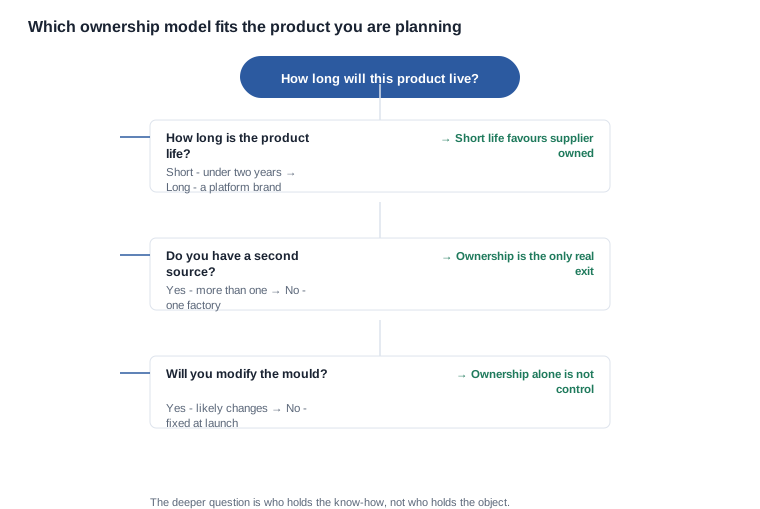
The decision tree above is a starting point rather than a rule, and the two branches at the bottom are the ones that matter commercially. If the product is a platform you will build a brand on and you have more than one potential manufacturing source, buyer-owned is the only model that gives you a real choice. If the product is a short-life seasonal item, supplier-owned is cheaper and the exit cost is bounded by the size of the programme, which is often the right trade-off.

Do you know who pays for the next modification?
Ownership is the headline. The modification policy is what actually determines whether ownership is worth anything, and it is the clause that is almost always missing.
Here is the situation. You own the mould. Two years in, a channel asks for a different temple shape, or your own design team decides the ear tip needs to move, or a component becomes unavailable and needs substituting. Ownership without a modification policy leaves you owning an object you cannot change without the original supplier's permission and at their price. You have the asset and none of the control, which is the worst of both models.
A workable modification clause answers four things:
- Who initiates and who approves. Is it automatic for defined changes, or does every change need a written approval, and who signs it?
- Who pays, and when. Tooling changes are usually quoted per change, but the treatment of the underlying mould — does the mould revert to the original, or is it superseded — needs stating.
- What happens to the golden sample. A modification changes the approved reference. If the sample is not formally superseded, the factory is building to an obsolete standard and the buyer's quality gate has quietly stopped working.
- What the change does to the other documents. A shape change can move the weight, the dimensions, the packaging artwork, the labelling, and possibly the certification scope. A modification clause that only covers the mould is incomplete, because a mould change is rarely just a mould change.
The fourth of those is the one with the most expensive tail. A buyer who changes a component on the advice of an engineer has changed the physical product, and the product's documentation, the packaging, the label copy and the product page all have to follow. If the modification policy only mentions the tool, the mismatch surfaces at a listing, at a customs check, or in a customer complaint, and it surfaces in the least convenient week of the programme.
The same reasoning applies to a packaging change, and packaging is where buyers are most likely to make a change without thinking of it as a modification at all. The carton artwork is tied to the product's physical dimensions, which are tied to the moulded parts, which are tied to the tool. A buyer who changes the printed carton without changing the product has usually created a mismatch between the label artwork and the goods, and one who changes the product without changing the carton has created a customs and handling problem. A modification clause that covers the tool, the artwork, the labelling and the documentation as one linked change is the version that actually works.
There is a negotiation point here that experienced buyers use and inexperienced ones do not. The modification price is rarely the interesting number. The interesting number is the turnaround — how long from request to a changed part running on the line — because a modification that takes six weeks to implement in a peak season is worth more than one that costs half as much. Ask for both, and ask for the approval path rather than only the cost, because an approval path with a named decision-maker is usually faster than a cheap one with a committee.
There is a second modification question that is separate and just as consequential, and it is about the supplier's own supply chain rather than about you. If a component inside the product is substituted — for continuity of supply, for cost, or because the original becomes unavailable — does that require your approval? A well-written programme has a notification obligation with a defined trigger and a defined response window, so that a substitution does not silently become a variant. The published data in our own catalogue illustrates how much variation can exist inside a single model family: charging method is magnetic on seventeen models, Type-C on seven, and not published at all for the CY05 and the L1 Pro, and the MT6 and the CY03; the charging case capacity is published for five models with two more having a case whose capacity is not published; the frame weight is published for one model in the entire range. A product with that much variation across the family is a product where a substitution is easy to make and hard to notice.

Do you have a written exit clause, or do you have a hope?
The end-of-project clause is the one that gets written in a hurry, and it is the one that matters most, because the end of a project is exactly when nobody is paying attention.

Four things have to be in that clause, and it is worth being precise about each one.
A defined retrieval window. How long after the last order do you have to collect the mould, and what happens after that. A reasonable clause gives a window — often measured in months rather than weeks — and a defined process. Without one, retrieval becomes a negotiation conducted at exactly the moment you have no leverage.
A defined storage arrangement. If the supplier holds the tooling after the last order, how long, at what cost, and on what terms. A supplier that keeps tooling indefinitely and charges nothing is not being generous; it is holding your exit in a polite kind of escrow. Conversely, a supplier that charges a modest, published, per-year storage fee is offering you a service and telling you the price, which is a perfectly reasonable commercial arrangement and much better than a surprise charge discovered during retrieval.
A transfer mechanism. How the mould physically leaves, who pays for the transport, and what condition it is expected to be in. Moulds are heavy, and a mould left to degrade in a corner of a workshop because nobody arranged collection is a real and common outcome.
A condition and maintenance standard. A mould that has been stored without maintenance may need work before it will run. A clause that says the tool is returned "in its current condition" with no reference to maintenance makes the transfer a fresh negotiation about money that could have been settled in advance.
There is a harder version of the exit problem, and it is the one that should influence the decision at the start rather than at the end. If the real reason you want ownership is the option to move production, then ownership is necessary but not sufficient. A second factory receiving your mould also needs the process settings, the fixtures, the material specifications, the inspection criteria and the judgement that lives in the first factory's people. Some of that can be written into a transfer pack, and a supplier who is willing to produce one is materially more helpful than one who hands over a piece of steel.
The trade-off in all of this is straightforward. A buyer who insists on ownership at the start incurs a higher entry cost and a slightly less cooperative supplier, and buys optionality. A buyer who accepts supplier ownership pays less at the start and buys a relationship-dependent exit. For a product with a two-year life and a small commitment, the second is rational. For a product that might still be in your catalogue in five years, and that you might want to produce from a second source, the first is the only version of this decision that survives a supplier change.
Do you want tooling terms in the quotation or in the catalogue?
On our own documentation, our position is straightforward: we do not have a published tooling policy, and we are not going to invent one for an article. Tooling terms with us are something to be agreed in the quotation for a specific project, because they are project-specific, and a general policy published on a website is not contractual and is not the mechanism that will move the mould.
What we can tell you today is what the tooling would actually be used for on our platforms, and that is documented. Across the audio, camera and sport classes, the customisable points are the logo, the frame colour, the packaging and the temple shape. For the audio and sport classes, the lens material and the lens colour are also customisable, and for the sport class the lens configuration is. The Bluetooth device name and the system customisation are available on the audio class, and the remote control on the sport class. For two entries in our range — the bone conduction platform and the AR entry — no customisation capability is disclosed at all, and if your project needs tooling changes, those two are not currently candidates on the strength of our published documentation.
That list is a genuinely useful input to the tooling conversation, because it tells you how much mould work a given model is likely to involve. A change of logo on a frame is largely a marking and finish question. A change of temple shape is a tooling question with a new mould. A change of lens material is a procurement question with a possible tooling implication. The clearer your sense of which of those you are going to ask for, the less ambiguity there is in the ownership clause, because you will know what the mould is and is not for.
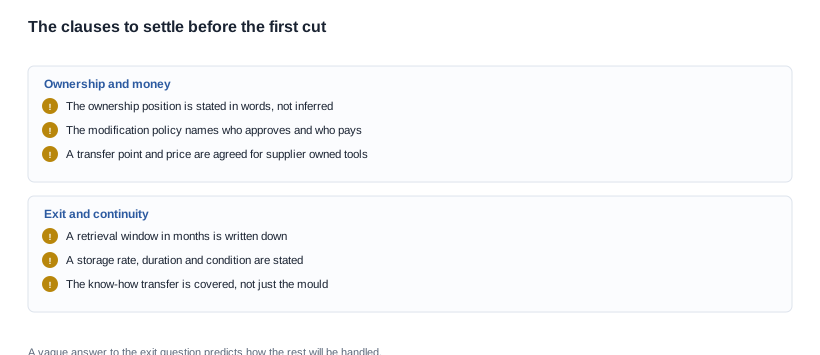
The way to raise it in a first conversation is to avoid the question that gets a defensive answer. "Do you own the tooling" invites a yes or a no that tells you very little. A better framing is a set of four statements to be reflected in the quotation:
- we intend to fund the tooling; confirm that in the quotation;
- state who owns the tool after the first run;
- state who pays for each modification we might need later;
- state what happens to the tool if we discontinue the product, including a retrieval window and a storage arrangement.
That fourth one usually gets a straight answer, and a supplier who answers all four plainly has told you something about how the rest of the relationship will be handled. If the answer to the fourth is vague, that is worth weighing against the rest of the relationship rather than treating as a detail.
The broader commercial framework is under smart glasses oem, the cost consequences of the changes themselves are in customization cost factors, and the handover failures we see most often are in smart glasses oem risk factors. Seeing the mould room yourself is covered in factory vs trading company, because the state of that room is the best available evidence of what will happen to your tool when it is in there.
Related reading
- What changes on the mould and what it costs — customization cost factors
- Where this sits among handover failures — smart glasses oem risk factors
- Seeing the mould room yourself — factory vs trading company
Tell us the modification you might need later and we will put the ownership and modification terms into the quotation.


