

It adds real weight, and the honest part of the answer is that our published catalogue does not let anyone say how much. That is not a dodge. It is the state of the record, and it is more useful to you than a plausible number would be, because a plausible number is the thing that ends up on a product page and then in a customer's hand.
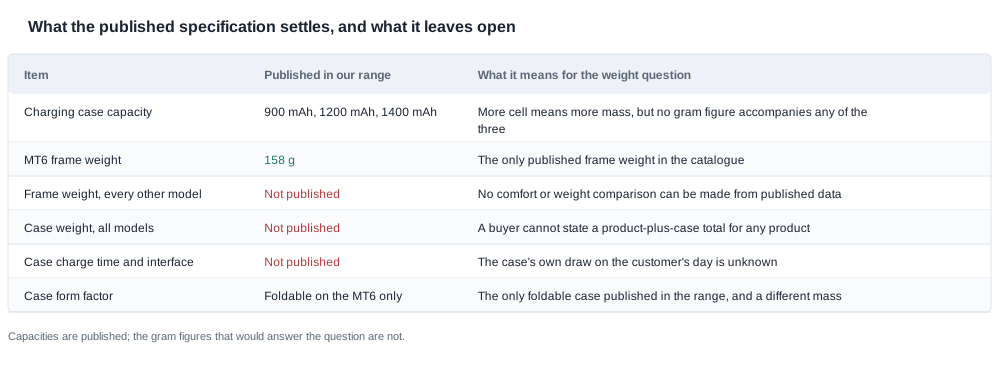
Here is the position in full. The catalogue publishes a charging case capacity for five models: L1 Pro and CY05, and CY03 — each at 1400 mAh, L2 Utral at 900 or 1400 mAh, and MT6 with a 1200 mAh foldable case. It publishes a weight for exactly one model in the entire range: MT6, at 158 g for the glasses only, explicitly excluding its own case. It publishes no case weight for any model, including MT6. It publishes no frame weight for any model other than MT6. So for every configuration in this catalogue except one, the total weight of the product plus its case is not derivable from published data.
That gap is the answer to the question. The direction is certain — a case contains a cell, an enclosure and electronics, and it adds mass. The magnitude is not published, and we are not going to publish a number we cannot measure on a finished unit.
What follows is the method: which four factors decide the answer, which case configurations exist, how the weighting differs depending on whether you are a brand, a distributor or an e-commerce seller, and what to demand from a supplier before you commit to a quantity. Our charging approach guide covers the charging side of the same decision, and our case review checklist is the document to use when you are comparing two suppliers' cases side by side.
Does charging case add much weight: the four things that decide it
When a supplier gives you a case weight, it is a figure for one specific configuration, and that configuration has four moving parts. Ask about all four, because two of them can move by more than the difference between the largest and smallest published capacity.
One: the cell. The cell is the single largest component of the case's mass, and it scales with capacity. Our published capacities are 900 mAh, 1200 mAh and 1400 mAh. Going from 900 to 1400 mAh is a meaningful change in the mass of the largest item inside the case, and it is also a change in volume. If you are comparing the L2 Utral's 900 mAh configuration against its 1400 mAh configuration, you are comparing two different objects, and any weight figure must be stated against the correct one of the two.
Two: the enclosure. A case has to survive a drop, a bag being sat on, and a jacket pocket. That means shell material, wall thickness, hinge or lid geometry, and a closing mechanism that does not spring open in a bag. None of that is published for any model in this range, and it is not published anywhere else in the industry either, which is why case weights quoted in listing copy tend to be either the bare shell or a rounded figure nobody checked.
Three: the electronics inside the case. A charging case contains contact pads, a charging circuit, a charge indicator, and its own cell. Depending on the design it may also contain a second cell for a second full charge of the glasses, or it may top up once only. The catalogue does not publish the case's own charge interface or its own charge time for any model, and that omission matters more than the weight does, because it decides whether the case extends the day or merely delays the problem. The product charge times published across the range are 2 hours or less for twenty-six models, with only D17 and ZH12 publishing about one hour — and those are figures for the glasses, not for the case.
Four: whether the customer carries it at all. This is the factor that decides whether the whole question is worth the negotiation time. A case that sits on a desk contributes weight to a bag once a week. A case that lives in a jacket pocket contributes weight on every trip, and it competes for space with the thing it is protecting. The weight is the number buyers quote; the space is the number they feel.
Four configurations behind the question does charging case add much weight
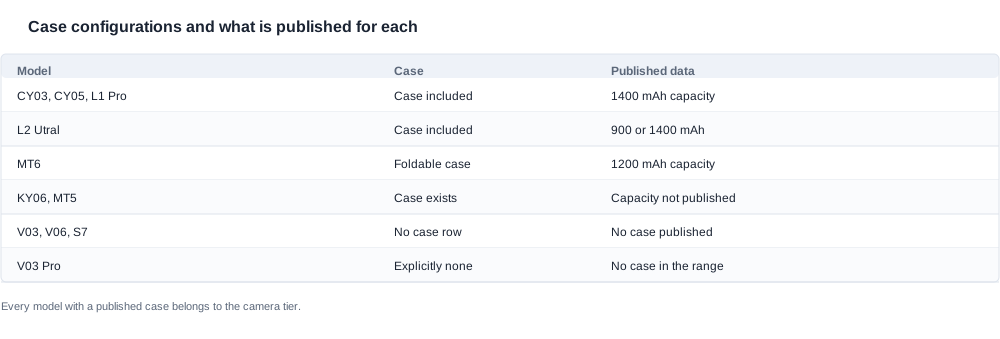
The published case landscape in this catalogue is narrow and specific, and it is worth stating exactly because buyers often assume a case is available across a range when it is not.
- CY05 and CY03, and L1 Pro each publish a case at 1400 mAh. These are the largest published case capacities in the range, and they sit at the top of the camera tier, where the published product runtimes are about five to eight hours from 220–290 mAh cells.
- L2 Utral publishes two options, 900 mAh and 1400 mAh. That is not a data-entry ambiguity; it is a genuine choice between a lighter, smaller pack and a heavier, longer-lasting one, and it is the most useful negotiation lever in the whole case question. You can offer the customer a price point, a pack size or a weight class and let the case option carry the difference.
- MT6 publishes a 1200 mAh foldable case. It is the only foldable case published in the range, which makes it a different industrial design with a different mass, a different tolerance question and a different failure mode than the clamshell cases elsewhere. Do not use it as a proxy for the others, and do not let a supplier use it as one.
- KY06 and MT5 have a case that exists, but the capacity is not published. These are the due diligence items: the configuration is real, the figure is missing, and a buyer who needs the number has to ask for it specifically.
- V06 and V03, and S7 have no case row in the catalogue, so there is no published case configuration to quote for them. V03 Pro is the explicit case: the catalogue records that it has no case. That one is a fact you can state on a product page without hedging.
Two cross-cutting facts colour all of the above. First, every model with a published case belongs to the eleven-model camera tier. No audio model, no kids model and no sport model in this catalogue has a published case row. If your programme is built around the eight-model audio range or the three kids models, a case is a development request, not a catalogue option, and it should be scoped as one. Second, the charging method is not published for CY03 and L1 Pro, and CY05 or MT6 — which is four of the five models with a published case. Where the charging method is published it is magnetic on seventeen models and Type-C on seven. For a case programme, that means the interface question is open precisely on the models where the case exists.
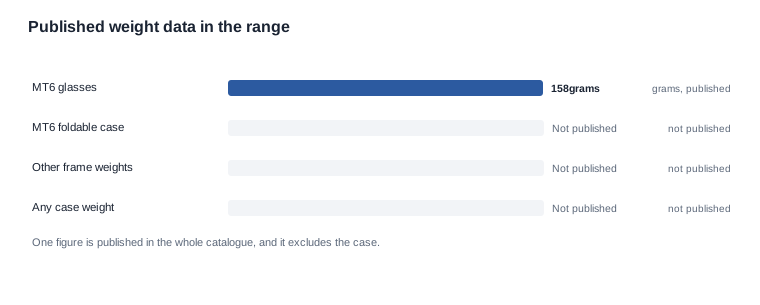
The chart above is the whole published weight position in one picture, and the empty bars are the point. One figure exists — 158 g for the MT6 glasses — and it explicitly excludes the 1200 mAh foldable case that MT6 also publishes. Every other weight in the range is unstated.
How the answer to does charging case add much weight changes by channel
The same physical question lands differently depending on how the product reaches a customer, and a shortlist built without separating these will produce a case decision that is right for one channel and wrong for the others.
For an e-commerce seller, the weight question is about the customer's perception and the courier's calculation. Two numbers matter: the actual weight, which is what a customer feels, and the volumetric weight, which is what the courier charges, and which is driven by the case's external dimensions rather than its grams. A bulky case raises shipping cost on every unit without making the product feel better. There is also a returns argument: a case that is too large for a handbag generates returns that a lighter but slimmer case would not. Our sport range is the useful comparison here — with no published case across YKC02, D17 and ZH12, and D17 and ZH12 publishing about one hour of charge time rather than the 2 hours or less published elsewhere, the sport buyer is served by a different charging proposition entirely.
For a brand with a private label, the case becomes your industrial design. That means the enclosure, the hinge, the lid seal, the printed logo and the packaging are all yours to specify and yours to approve, and every one of those choices changes the mass. It also means a tolerance conversation and a golden sample, because a case that closes differently from unit to unit becomes a customer complaint that has nothing to do with the glasses. The case weight is therefore one of the numbers you should be agreeing at the specification stage rather than discovering at the pre-shipment check.
For a distributor, the case is usually a separate line in the box, which means it is a separate SKU with its own unit cost, its own stock, and its own freight weight per unit shipped. The negotiation here is about whether the case is bundled at a fixed cost or sold at a margin, and about whether the distributor carries the bulk of the volume, which is what makes a heavier case affordable for them and not for you.
For a channel partner selling into a gift or corporate programme, the question changes again. A gift box that is oversized raises packaging costs and often triggers a size tier in fulfilment. A case that reads as premium raises perceived value but not always at a proportionate cost. The criteria here are cost per unit and perceived value, and the trade-off is different from every channel above.
Establishing does charging case add much weight before you commit a quantity
The way to settle this is not to argue about a figure. It is to make the supplier produce one, on a specific unit, with a stated boundary. Here is the request list, in the order that gets the best answers:
- The case weight in grams, measured on a finished unit. Ask whether the figure includes the cell, the charging cable and the retail packaging. A case weight quoted with the cable is a different number from the case weight alone, and the distinction is often a couple of dozen grams.
- The frame weight in grams, on the same basis. Without both figures you cannot state a total, and a listing that says "product weight" when it means glasses only is a listing that will generate a complaint.
- The external dimensions of the case, in millimetres, for the configuration you intend to ship. This is the number that decides the bag, the pocket and the volumetric shipping weight, and it is the number most often missing.
- The case's own charge time and interface. Neither is published for any model in this range. A case that takes a long time to refill is a case that fails on a Monday morning, whatever the capacity says.
- Whether the case can top the glasses up more than once, and how the case behaves when a pair of glasses is left in it at full charge. This is the question that determines whether the case is a genuine extension of the day or a single recharge in a different box.

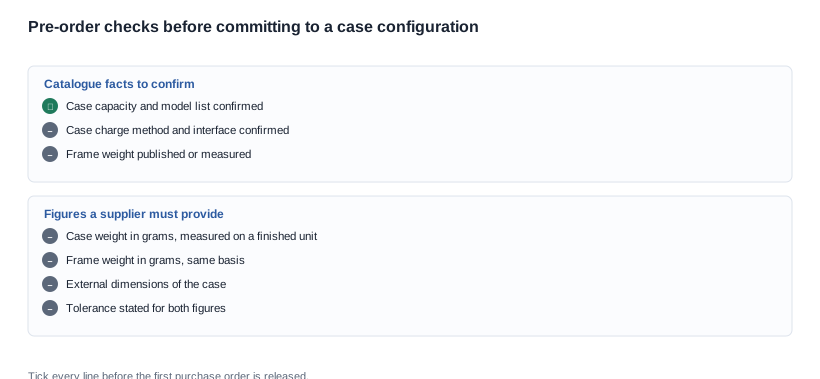
Two verification habits make the difference between a quoted figure and a trustworthy one. The first is asking whether the figure is a nominal design weight from a drawing or a measured weight from a finished unit, because the gap between the two is where customer complaints live. The second is asking what the tolerance is — a case weight stated as a single number without a tolerance is a number from one sample, and a supplier with a mature quality process will state a range without being asked twice.
Then run the check on the first production batch yourself. Weigh a finished unit and a finished case on a scale you control, put the case in the bag the customer will use, and measure the box against the volumetric threshold your fulfilment partner works to. This costs half an hour and it is the only way to know whether the packaging and freight assumptions in your business case survived contact with the actual goods. Which one of the two L2 Utral case configurations you ship is a trade-off you should only make after you have both in your hand.
Two commercial points belong in the same conversation, because a supplier who treats a case question as purely technical is not giving you the whole picture. The first is the quotation. If the case is quoted as a separate line, you can negotiate it as a separate line — comparing a case cost against a case cost — instead of hiding it inside a bundle price you cannot interrogate. The second is the MOQ. A case with a custom enclosure, a custom logo and a custom colourway is a tooling conversation, not a unit-price conversation, and a supplier who quotes a case at your opening MOQ without stating whether the MOQ is for the case or for the whole set is giving you a number you cannot use. Ask which model the MOQ applies to and which model it applies to the case.
The sample policy matters here in a way it does not for a simple product. A pre-production sample of the glasses tells you almost nothing about the case, so a supplier offering a free sample of the glasses has not sampled the thing you are negotiating. If you need the case in hand before the order, say so in the request and expect the sample to be a separate, paid item. A supplier who treats a case sample as part of a standard sample policy is offering you a policy for a different product.
Finally, a note on warranty and on the audit trail, because a case is a wear part. Lenses get scratched, lids get cracked, hinges work loose after a year of being in a bag. If the warranty position in your supply agreement does not distinguish the case from the glasses, you will spend the first year of the relationship arguing about a cracked lid on a component that was never designed to take a drop. Ask how the case is covered, ask what the acceptance criteria are for a returned case, and ask for the sample policy in writing.

Putting does charging case add much weight into a specification and a listing
Most case weight problems are actually specification problems. A product page that says "weight: 158 g" when 158 g is the glasses on one model and the case is not included in the figure produces a complaint that has nothing to do with weight — it produces a customer who believes you described a different product. The fix is to decide, in the specification, which of four numbers you are publishing and to label it.
- Frame weight, on the glasses alone, measured on a finished unit.
- Case weight, on the case alone, measured on a finished unit, with a stated tolerance.
- Packed weight, on the retail box as it ships, which is the number a fulfilment centre actually handles and the number an insurance value should be based on.
- Total in the box, which is the sum of the first two and the only figure a customer should ever be asked to compare against another product.
Label every one of them. A listing that publishes all four has removed an entire category of returns, and the cost of measuring four numbers once is trivial compared with the cost of a month of mis-specified freight.
There is also a commercial argument for making the case a deliberate commercial object rather than an accessory that happens to be in the box. For a channel partner, a case is a second line on the invoice and a second opportunity to differentiate a listing that is otherwise identical to three competitors. For a brand, a case with a distinguishable form factor, a printed logo and a visible status indicator is a defensible piece of the retail proposition, and the tooling and tolerance work that makes it defensible is a negotiation you should have early, not a favour to ask for at the end.
And it is worth putting the case weight into the freight calculation before it is quoted. On a DDP or FOB basis the case moves the per-unit shipping cost in a way that the glasses alone do not, because it adds both actual weight and volume, and on a packed-volume basis it can change which fulfilment tier the order sits in. Ask for the packed dimensions and the packed weight per configuration, and price the two case options separately rather than averaging them. Which one of the two options you take into the market should be a decision taken with the freight model open, not after it.
What the catalogue publishes about does charging case add much weight today
The position, stated plainly so that you can quote it in a negotiation with any supplier, ours included.
Published: the charging case capacity for five models — CY05, L1 Pro and CY03 — each at 1400 mAh, L2 Utral at 900 or 1400 mAh, MT6 at 1200 mAh foldable; the existence of a case for KY06 and MT5; the absence of a case row for V06 and S7, and V03; the explicit absence of a case for V03 Pro; the charging method where published; and one frame weight, 158 g for the MT6 glasses, excluding its foldable case.
Not published, for any model: case weight, frame weight for any model other than MT6, case external dimensions, the case's own charge time, the case's charging interface, and the number of top-ups a case can deliver.
We will not print case weights on this website, because a weight that is not measured on a finished, shipped configuration is a marketing claim rather than a specification, and we have seen the category suffer from that. What we will do on request is confirm which configurations include a case, confirm the published capacity for each, confirm whether the case is included in the box or optional, and provide a measured case and frame weight for a production configuration as a quotation item once the configuration is fixed — so that it enters your specification and your listing as a measured figure rather than an estimate.
If you want the case question settled for your programme, send us the model, the configuration, whether the case is in the box or a paid option, the channel, and the freight method. We will tell you which case configurations exist for that model, what the catalogue publishes about each, and what has to be measured before anyone can write a weight on a product page.
Related reading
- Bluetooth audio glasses range
- Choosing the right charging approach
- Charging case review checklist
- Sport smart glasses range
Send the models and the capacities and we will tell you what is published about each.


