

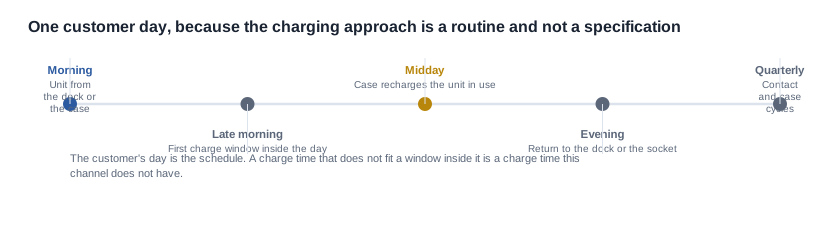
Choosing a charging approach is a decision about the customer's day, and the published data in this category describes the charger rather than the day. That is why the choice so often lands on the wrong row: a buyer compares charge times when the decision actually turns on the interface, the accessory chain, and what the customer has to do every evening. Charge time is the last of those three, not the first.
So the conclusion first.
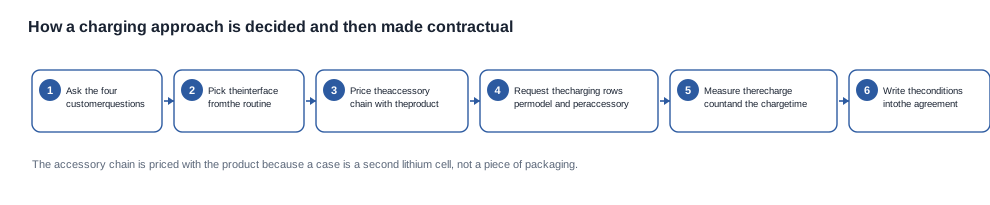
Ask the customer four questions before comparing a single specification. When and where they charge, whether they already own the right cable, whether they carry the product away from a socket, and how many people use it. Those four answers determine the approach, and each of them is a fact about a routine rather than a fact about a product.
Price the accessory chain with the product, not after it. A charging case is a second lithium cell. It has to be declared for transport, it carries its own minimum order quantity, it adds weight and freight to every unit shipped, and it is a second object the customer can lose. A Type-C product ships a standard cable that costs almost nothing. The difference between those two propositions is invisible in a unit price and visible in your accessory cost per hundred units.
Treat every charge-time figure as conditional until you know the starting point. Our published figures are "two hours or less" for most of the range and approximately one hour for two models. The starting state is not published for any model, and a charge time without a starting point is a claim rather than a specification.
Do not describe a case as a bonus. A case converts a morning into a day, and the number that says so is the recharge count, which is a measurement on a sample rather than a figure in a catalogue.
Smart glasses charging: the published rows, and what they are worth
The published set across the range is: charge times, charging interfaces, cell configurations and case capacities. The cell configurations run from 40 mAh on the children's models to 290 mAh on the camera models, with dual cells published at 55, 70 and 90 mAh per side and single cells at 100 and 115 mAh. Case capacities are published at 900, 1200 and 1400 mAh for part of the camera range.
The interface split is the first useful thing in that data, and it is a near-unanimous decision. Type-C is published on the D17 and the V03 Pro, the D11 and the D12, and the L2 Utral and the ZH12, and on the bone conduction entry. Magnetic charging covers seventeen models, and the MT6 and the L1 Pro, and the CY03 and the CY05 publish no charging interface at all. That is a category with one default and a handful of exceptions, and a buyer needs to know which side of the default their requirement falls on before anything else, because the interface decision propagates into the packaging, the freight, the customer's cable habit, the ingress position and the accessory line all at once.
The second published fact is that two models charge in approximately one hour while the rest publish two hours or less. That looks like a small difference on paper and it is not small in the customer's day. A one-hour charge fits a lunch break, a shift change, or a gap between two appointments. A two-hour charge fits an evening. A channel that sells on fast turnaround — a gift buyer, a same-day fulfilment model, a retail assistant who needs the unit live before the customer leaves — is a different channel from one that sells on overnight charging, and the two require different units. The buyer who designs the routine around the average gets neither.
The third published fact is the one that gets under-noticed, and it is a category fact rather than a model fact. In this product form factor, the charging interface is an opening in the enclosure. A Type-C port is a hole in the frame, and a magnetic contact is a hole in the frame with a different geometry. Both interact with whatever ingress position the model carries, and both are part of the configuration that any protection marking attaches to. A buyer who treats the interface as a convenience decision and later adds a protection requirement has two changes to make instead of one, and the second one arrives after the tooling.
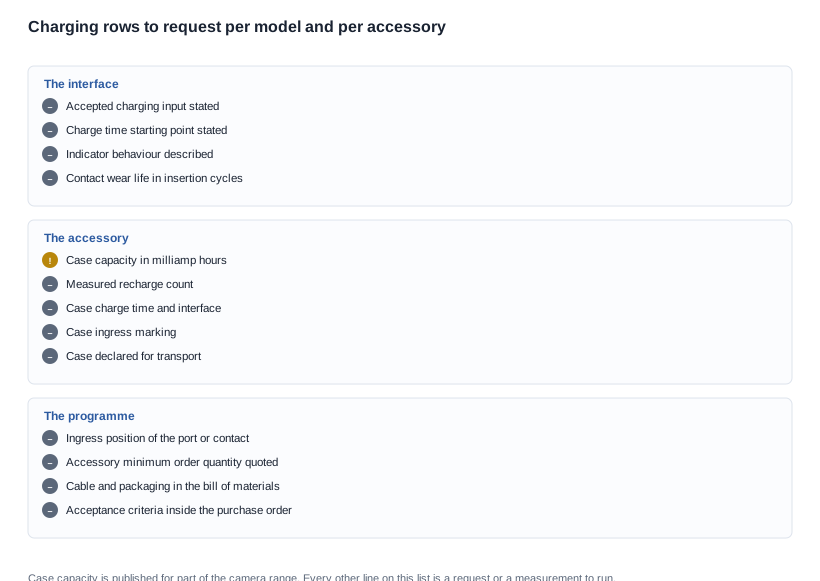
Here is what is not published for any model, and it is a short list: the charging input current and voltage, the charge-time starting point, the charge indicator behaviour, the case's own charge time and interface, the case's ingress marking, the contact's wear life, and the runtime condition behind the rated use.

Four approaches, and the customer question that separates them
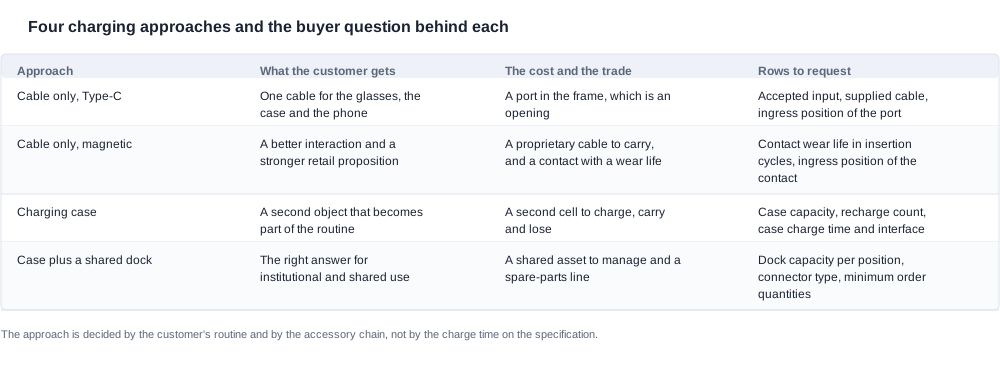
The four approaches are worth setting out as a table with the customer question attached, because the approaches are not really technical options. They are four different assumptions about how a person's day works, and each one is right for a different routine.
A Type-C cable only. The simplest customer proposition and the lowest manufacturer cost, and the one that suits institutional and shared use where the customer already owns standard cables. The cost is a port in the frame, which is an opening. The rows to request: the accepted charging input, the cable supplied in the box, and the ingress position for the port.
A magnetic cable only. A better interaction and a stronger retail proposition, and a real cost in the accessory line: a proprietary cable the customer must carry, a contact that is a wear item, and an opening in the frame. The rows to request: the contact's wear life in insertion cycles, the supplied cable, and the ingress position for the contact.
A charging case. A second object that becomes part of the routine, and the strongest proposition for a retail product where the customer wants to pick the product up and use it. The published case capacities in our range make the case a meaningful second battery rather than a storage box. The cost is a second thing to charge, a second thing to carry and a second thing to lose. The rows to request: the case capacity, the measured recharge count, the case's own charge time and interface, and the case's ingress position.
A case plus a shared dock. For institutional use, where a rack with the right cables is a better answer than twenty individual cases. The cost is a shared asset that has to be managed and a spare-parts line that has to be stocked. The rows to request: the dock's capacity per position, the connector type, and the minimum order quantities for both the dock and the cases.
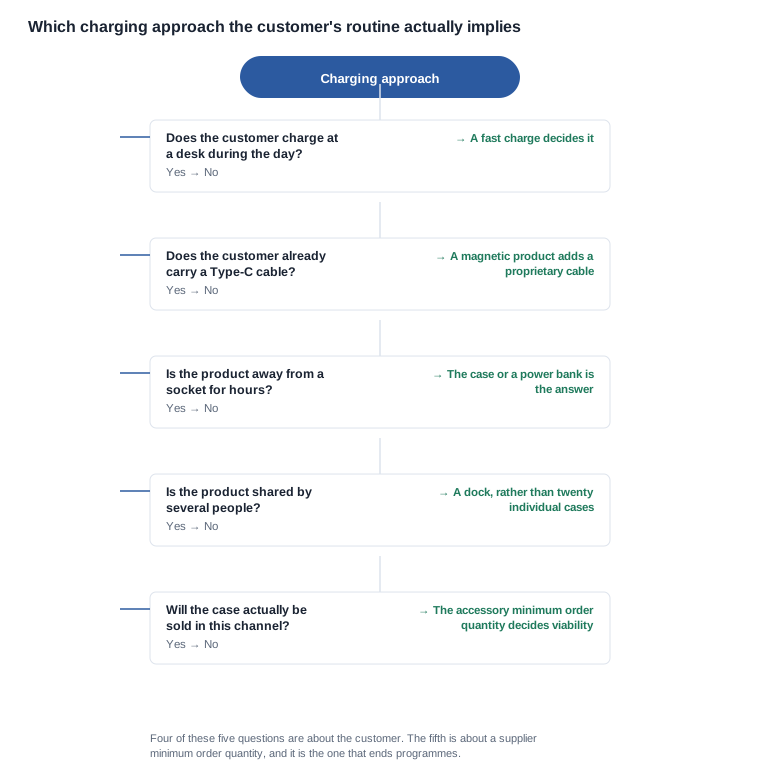
The five questions that separate them are worth listing on their own, because four of the five are about the customer and the fifth is about the supplier, and the fifth is the one that ends programmes.
- Does the customer charge at a desk during the day, or only overnight? This decides whether a fast charge matters at all.
- Does the customer already carry a Type-C cable everywhere? This decides whether a magnetic product is adding convenience or adding an object to carry.
- Is the product away from a socket for hours? This decides whether the case or a power bank is the answer.
- Is the product shared by several people? This decides between individual charging and a dock.
- Will the case actually be sold in this channel? This decides whether the accessory minimum order quantity makes the proposition viable at your volume.
Question five is the one worth putting in the request for quotation before the order, because the accessory minimum order quantity is frequently larger than the product minimum order quantity, and a case-based proposition that cannot be ordered at your volume is not a proposition.
The accessory chain, priced with the product rather than after it
This is the section that changes the commercial outcome, and it is the one most often skipped because it does not feel like a product decision.
A Type-C product ships a cable. A magnetic product ships a contact and a proprietary cable. A case product ships a second lithium cell in every unit. At volume, that is often a larger commercial difference than the unit price, and it lands in three separate places in the P&L rather than in one.
It lands in freight. Every unit carries the accessory, and the accessory has its own weight and volume. A case adds a meaningful fraction to the shipping weight of a small, light product, and the shipping cost of a small product is disproportionately sensitive to the volume it occupies.
It lands in compliance. A second lithium cell in the box is a second cell to declare for transport. The battery transport documentation is a requirement rather than a preference, and a box that contains a cell the paperwork does not describe is a shipment that can be held. The requirements are set out under battery transport.
It lands in the accessory minimum order quantity. This is the one that decides viability. The case is frequently a separate SKU with its own minimum, and that minimum is frequently higher than the product's. A brand that decides the case after the product has already committed to the product discovers that the accessory cannot be ordered at its volume, and the fallback — a case with a different capacity, or a case from a different supplier, or no case — changes the proposition it has already written.
The same logic applies to the cable on a magnetic platform, which is a consumable. A proprietary cable is a stock line, a replacement SKU, a price to publish and a support question when a customer's cable stops working. It is not a large number, but it is a number that appears in the accessory cost per hundred units and in the year-two support contact rate.
The measurement that resolves the whole question is the recharge count: how many times a unit can be recharged from the case before the case is empty, measured on a sample under a stated protocol. It is not published for any model, and it is the single number that converts a case from an accessory into a proposition. The arithmetic looks trivial and the real answer depends on where you stop and at what state of charge, which is exactly why it has to be measured rather than derived.
A worked decision: a shared-unit channel
The following is a hypothetical sourcing exercise, written to show how the questions are used rather than to report an outcome.
Assume a services company outfitting a forty-person team, buying in one order, running a twelve-hour shift on shared units that live in a charging tray at the desk rather than in anybody's pocket. The binding constraint is the total cost per unit over the year, and the procurement manager has a budget that does not stretch to a case per person.
Step one: the four customer questions. The units charge at a desk during the shift, the team already owns standard cables, the units never leave the desk, and the units are shared. Three of the four answers point the same way, and the fourth — the shared use — is the one that decides the approach.
Step two: the approach. A Type-C cable only, with a shared dock or tray at the desk, and no case. The proprietary cable of a magnetic platform would be forty cables to issue, track and replace, and it would solve a problem the customer does not have, because the units never leave the desk.
Step three: the shortlist against the published rows. Type-C is published on the V03 Pro and the D12, the D17 and the D11, and the ZH12 and the L2 Utral, and on the bone conduction entry. Two of those publish approximately one hour to charge, which fits a shift change, and the rest publish two hours or less, which fits a lunch break. The criteria narrow the field before a single sample is ordered.
Step four: the measurements. The buyer asks the questions to ask: the accepted charging input, the charge-time starting point, the indicator behaviour and the ingress position for the port, plus the dock's capacity per position and the connector type. The recharge count is dropped from the list, because there is no case, and that removes the single most expensive measurement in the category from the programme.
Step five: the commercial structure. The minimum order quantity for the dock and for any spare units becomes a line in the request for quotation, because the dock is the accessory and the accessory minimum is the one that can end the programme. The criteria for accepting the delivered units are written into the purchase order: the charge time from the stated starting point, and the indicator behaviour on every unit in the tray.
The result is a programme with one accessory, one shared asset and no consumable line. How to choose the approach was settled by four questions about a routine, and the specification only narrowed what was left.

Where a charging programme goes wrong
Six failure patterns, each written as symptom, root cause and prevention.
The charge time was compared without the starting point. The symptom is a customer who charges from a partial state and concludes the claim is false. The root cause is that the condition was never published or requested. The prevention is to ask, and to publish the figure with its condition.
The interface was chosen from the specification rather than from the customer's habit. The symptom is a customer who owns one cable everywhere being handed a product that needs a proprietary one. The root cause is that the customer routine was never asked. The prevention is the four customer questions, first.
The case was treated as a storage box. The symptom is a customer who expects a day of use and gets a morning. The root cause is that the recharge count was never measured. The prevention is to measure it on the sample, with the stopping point written down before the reading.
The contact's wear life was ignored. The symptom is a product that stops charging after a year of daily use, and a support line item that grows with the installed base. The root cause is that the wear life is not published. The prevention is to ask for it in insertion cycles, and to price the spare into the accessory line.
The ingress position was not checked for the port or the contact. The symptom is a product sold as splash-resistant that fails at the charging interface, which is the most damaging possible failure for that claim. The root cause is that the interface was treated as a detail. The prevention is to ask for the ingress position of the specific configuration, including the accessory, and to test the interface first in the protocol.
The charging case was omitted from the accessory plan. The symptom is a product that cannot be sold into the channel it was designed for, because the accessory minimum order quantity makes it uneconomic. The root cause is that the accessory chain was decided after the product. The prevention is to price the case and the dock with the product.
The commercial structure follows from the accessory chain. Negotiable and worth the negotiating time: the unit price and the volume tiers; the accessory set and its minimum order quantities per SKU, which is the line that decides whether a case-based proposition is workable at your volume; the packaging specification; the delivery splitting; the payment nodes against inspection; the warranty period with a stated response; the return terms; and the terms of a pilot order. Quotable but not negotiable: certification cost and lead time, which follow the process and the testing body; and tooling, which is often amortised across the first order while certification cost is per product family — ask which one you are being quoted, because the two are frequently bundled into a single line that hides which is which.
What to put in the agreement, and what to leave out.
Into the agreement: the published rows for the configuration ordered; the charging input and the charge-time starting point; the indicator behaviour; the contact's wear life; the case capacity, its own charge time and its ingress position; the accessory set with its minimum order quantities; and the warranty period with a stated response.
Left out: any charge-time claim without a starting point, any recharge count that was derived rather than measured, and any ingress claim for an accessory that has no marking of its own.
What we can answer from the published rows today
Stated plainly: the charging approach is a decision about the customer's day, and the published data in this category describes the charger rather than the day. We will not publish a charging input, a charge-time starting point, an indicator behaviour, a contact wear life, a case charge time or a case ingress marking for a model where the company has not provided one, and we will not present a charge time without its condition.
What we can do today is narrow the field quickly. The published rows tell you the interface, the charge time, the cell configuration, the case capacity where it is published, and the case configuration where one exists. Between them they eliminate most of the range for a customer whose charging routine is already known, and they tell you which platforms can serve a fast-charge channel and which cannot.
What we cannot do is tell you how many times a unit recharges from a case, how long a contact lasts in insertion cycles, or what a charge time looks like from a partial state. Those are three measurements, and all three are cheap to take on a sample and expensive to discover in the field.
Three things to do this week.
- Answer the four customer questions in writing, one line each, before comparing any specification. If a line cannot be answered, that is a channel that has not been defined yet.
- Request the charging rows per model and per accessory in one list. The starting point and the recharge count are the two that expose whether the supplier measures comparably.
- Send us the customer routine, the channel and the volume. We will tell you which approach the routine implies, which of our models carry it, which published rows apply, and which rows still need closing before the proposition can be written.
The charging solutions and interfaces page carries the published set, the comparison method is in comparing charging options, and the misreadings worth discarding are in charging myths to discard.
Related reading
- The published set and the interfaces — charging solutions and interfaces
- The comparison approach — comparing charging options
- The misreadings worth discarding — charging myths to discard
Tell us the customer routine, the channel and the volume, and we will tell you which approach fits and which rows still need closing.


