

Smart glasses battery life: the verifiable runtime
Why the runtime is checked by the customer and by nobody else
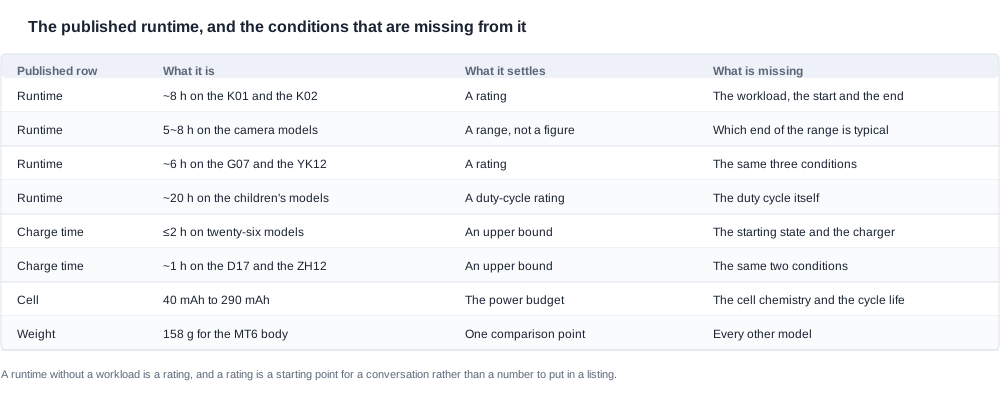
Every other published figure in this catalogue needs a laboratory, a bench or a document to verify. The runtime does not. A customer charges the product, uses it through a day, and knows by the end of the afternoon whether the number in the listing was true. That makes the runtime the figure with the shortest distance between a claim and a customer's own opinion, and it is why the conditions behind it matter more than the number itself. Our catalogue publishes a runtime for all twenty-eight models, and it publishes it without a workload, without a starting state and without a termination rule, which means a rating is not yet a promise. The commercial work is to decide what the brand will actually state, to write the workload into the acceptance criterion, and to keep the listing and the warranty saying the same thing. Do not compare two runtimes until you know what each one was measured under, and do not read a two-hour charge time as a two-hour shift change.
The three decisions that bring a power question to a buyer
The reader is a brand-side product owner, a channel buyer assembling a range, or a product manager trying to decide which of two models to put in front of a customer who will only check one thing. The situations are recognisable.
The first is a range decision in which the runtime is the deciding criterion. A buyer has a channel that works long shifts, and the models on the table publish runtimes that are close enough to look like a judgement call and different enough to change the outcome. The second is a listing review, where a figure has been copied into the product page and nobody can say what it was measured under. The third is a returns analysis in which a cluster of complaints describes the product running out mid-session, and somebody needs to establish whether the product is underperforming or the expectation was set by a number taken from a different workload.
What the buyer is afraid of is specific. It is a published runtime that turns out to be a best case measured on the lightest workload, and a returns rate that appears eight weeks after launch. It is a charge time that was read as an availability window and turned into a scheduling assumption that the operations team built a roster around. And it is a warranty that says nothing about a unit that ran flat, which is a warranty that leaves the factory and the brand arguing about a number neither of them defined.
Your standing in the chain is what sets the scope of what you control. A brand owner controls the listing, the claim register and the acceptance criterion, and therefore controls most of the exposure. A channel buyer controls the purchase order, so the workload, the protocol and the pass condition have to be written into it. A distributor who holds a brand across several territories has to be sure the same model is not sold as an all-day product in one place and a casual one in another, because a rating without a workload invites exactly that difference.

The published runtimes, and the three conditions they are missing
The catalogue publishes a runtime for every model, and the values fall into a small number of bands. The three children's models are published at around twenty hours, which is a duty-cycle figure. The audio models sit at around eight hours, around seven hours or around six hours. The camera models are published either as a range of five to eight hours or as a range of six to eight hours, and the electrochromic and bone conduction entries are published at around seven hours.
The bands are not a ranking, and treating them as one is the most common error in this category. Three conditions are missing from every published runtime, and each of them changes what the number means.
The workload. A runtime is a function of what the product is doing while it runs. Continuous audio playback, intermittent use, a phone call with the product as a hands-free device, a camera running in short bursts, and a screen lit throughout are five different workloads, and no two of them produce the same result from the same cell. The catalogue does not state which one produced any published figure, which is a reasonable position for a catalogue and an unusable one for a buyer. The threshold to hold is a duration with a stated workload attached, and a workload a supplier will repeat on a sample.
The starting state. A runtime is measured from a full charge, and the useful question is how full. A cell that has been left for a week is not a full cell in the way the bench measurement assumes, and a product that spends its life in a warehouse or on a shelf is a product whose first customer experiences a slightly different number. A buyer who sells into a channel with long shelf times should ask what the runtime is after storage, because that is the number their first customer will see.
The termination rule. A runtime ends when the product stops, and the interesting question is what it does in the last few minutes. Does it warn, does it drop the active function, does it preserve the recording, does it save the file? On a camera model, a product that switches off mid-capture produces a lost file, and a lost file is a return. That behaviour is a specification, and it is not published.
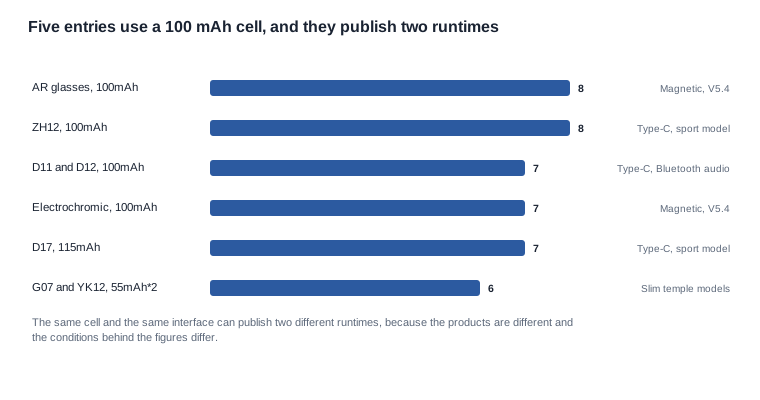
One warning applies to every comparison a buyer makes here, and the catalogue makes the point itself. Five entries in the range use a 100 mAh cell: the AR glasses entry, the D11, the D12, the ZH12 and the electrochromic entry. They publish two different runtimes, around seven hours and around eight hours, and the interface differs between them as well. The cell is the same; the products are not. This is the clearest available demonstration that a runtime figure describes a product under a condition, not a cell.
The label consistency issue is worth a second paragraph, because it is the sort of thing that produces a wrong number without anybody noticing. On the D17 and the ZH12 pages the charge-duration label carries a charging time of around one hour, with the runtime under a separate label. On the V03 and the KY06, and the MT5 pages, that same label carries a runtime of five to eight hours and six to eight hours, with the charging time of two hours or less under a different label. A buyer reading by label rather than by position will take the wrong number out of the catalogue. The protection is simple and it is not a document: confirm for each model which of the two published durations is the charging time and which is the runtime.
Why a charge time is not a shift-change time
The charging figures are the most tempting number in the catalogue and the most easily misused. Charge time is published for all twenty-eight models: twenty-six are quoted at two hours or less, and the D17 and the ZH12 at around one hour. It is a complete and useful data set, and it is not what a buyer with a roster problem needs.
The reason is that three pieces of information are missing. There is no starting state, so two hours might describe a cell taken from flat. There is no termination criterion, so the two hours is not a definition of full. And there is no statement about whether the product can be used while it is charging, so the charging window is not necessarily a window in which the product is unavailable. A buyer who reads a two-hour charge time as a two-hour recovery has assumed a starting state, a termination rule and an availability position, none of which is published and all three of which are true or false in a specific way for a specific product.
The same logic applies to a charging case, and it is a mistake that is easy to make because the capacity is published. A 1400 mAh case appears on the CY05 and the L1 Pro, and the CY03; the L2 Utral is published with a 900 or a 1400 mAh case; the MT6 has a 1200 mAh folding case. The KY06 and the MT5 have a case whose capacity is not published. The capacity is a quantity of charge, and the number of full device charges it delivers is a derived figure that depends on the case's own efficiency, the temperature, the age of the cells and the workload. A buyer who divides one by the other and puts the result in a listing is publishing a derived number as though it were a published one, and the derived number is the one most likely to be wrong in the field.
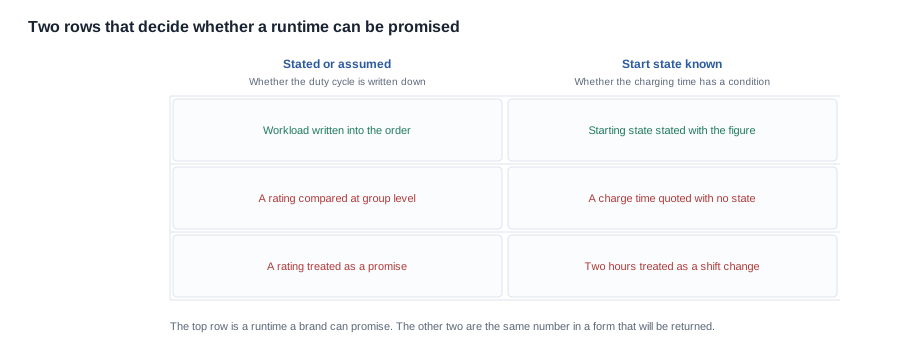
The commercial consequence is that the two figures a buyer wants are the two that are hardest to derive. The runtime tells you how long the product works. The charge time tells you how long the product takes to become usable again. What the buyer actually needs is the gap between them, which is the operational reality of a roster, and that gap is not a published row in any of the twenty-eight entries. It has to be measured, and it has to be written.

Nine questions that turn a runtime rating into an acceptance criterion
- What is the published runtime for this exact model and this exact variant?
- What workload produced that figure, and can the same workload be repeated on a sample?
- What is the runtime after the product has been in storage, and for how long?
- What does the product do in the last minutes before it stops, and is that behaviour written down?
- What is the charge time from a stated state, and what is the termination criterion?
- Can the product be used while it is charging, and does that hold for the case as well?
- For a case configuration, how many full device charges does the case actually deliver, measured rather than divided?
- What is the behaviour of the product and of the case at low battery, and what does the warranty say about it?
- What changes if the firmware, the power profile or the cell supplier changes, and who has to be told?
Questions two and five are the pair that make the comparison possible. Two suppliers quoting a runtime are quoting two different measurements until the workload is stated, and the workload is the one piece of information a supplier can always supply and rarely does.
Question three is the one that catches a buyer who has not thought about their own channel. A product that sits in a warehouse for six weeks is a product whose first customer is not getting a full bench figure, and in a channel with long shelf times or long shipping times, that customer is the first review the product will get.
Question seven is where the derived number gets caught. Ask for the measured count of full device charges from the case, in a stated condition. It is a small test and it is the difference between a published capacity and a usable specification.
Question nine is the change-control question, and it is the one that connects this article to the rest of the programme. A power profile, a firmware release or a cell change all move the runtime, and each of them invalidates a figure that has been published, quoted in a listing and repeated in a sales script.

The failures that arrive when a rating is published as a promise
The listing figure taken from a best case. The symptom is a returns cluster from customers whose day is heavier than the benchmark. The root cause is that the workload was never stated. The control is the workload in the acceptance criterion, and a listing that says the condition beside the number.
The charge time read as a recovery window. The symptom is an operations routine built around a two-hour changeover that does not happen in two hours. The root cause is that the starting state and the termination rule were assumed. The control is to state both, and to treat the gap between runtime and charge time as a measured operational number rather than an arithmetic one.
The derived case figure published as a published one. The symptom is a customer running the case down faster than the listing implies. The root cause is a division instead of a measurement. The control is a measured count of full charges in a stated condition.
The low-battery behaviour discovered by a customer. The symptom is a lost capture or an interrupted call, and a return described as a fault. The root cause is that the termination behaviour was never specified. The control is to write it down, publish it and align the support script with it.
The runtime that changed with a firmware release. The symptom is a batch whose endurance differs from the approved sample, with no hardware change. The root cause is that no change notice was required. The control is a pinned firmware version and a change-notice clause.
The storage figure that the first customer found. The symptom is a first review that does not match the listing, in a channel where the product sits before it is sold. The root cause is that the runtime was quoted from a bench figure. The control is to ask what the figure is after storage and to state it where it is relevant.
Battery expectations like these are ordinary in this category, and not one of them is grounds for changing supplier. Each one is a condition, a measurement or a clause, and every one of them is cheaper to write in the order than to correct in a returns report.
What we publish about power, and what we ask you to confirm
The commercial terms of a power decision are settled in three places: the workload, the acceptance criterion, and the wording. Everything else is smaller.
What moves in a negotiation is worth naming. The workload definition is negotiable, and a written workload is worth more to a brand than a unit price concession because it is the only thing that makes a runtime defensible. The acceptance protocol and its pass condition are negotiable, and they are what converts a rating into a standard you can refuse a lot against. The charge protocol, the case test and the storage test are negotiable, and they are the three tests most often skipped. The change-notice period is negotiable, and it is the clause that protects a published figure from a silent update. The claim wording is negotiable in the sense that a narrower claim is always available.
What does not move is the cell, because it is a hardware commitment, and a different cell is a different product with a different runtime and a different transport scope. The charging interface is a platform fact and not a per-order variable. The published runtime for a given model is a measurement, and pressing on it produces a different measurement rather than a different number. Conformity cost and time for the cell and the charger are fixed per product family, and the transport documentation for a fitted cell is a fact rather than a negotiation.
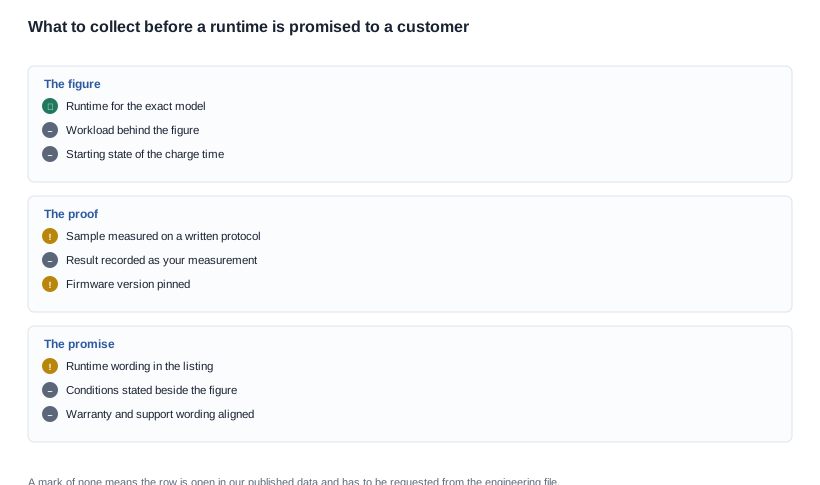
The documents worth collecting before the deposit are: the published runtime for the exact model and variant, the workload behind it, the charge time with its starting state and its termination criterion, the availability behaviour during charging, the measured number of full charges from any supplied case, the low-battery behaviour, the runtime after a stated storage period, the cell specification, and the transport documentation for the fitted cell.
The clauses worth writing into the purchase order are: the runtime for the exact model with its workload, the acceptance protocol and its pass condition attached to the order, the charge time with its conditions, the case as a separate attribute with its own measured figure, the low-battery behaviour, a pinned firmware version, a change-notice obligation covering firmware, power profile and cell, and a warranty scope that is explicit about a unit that stopped because the published figure was exceeded rather than because it failed.
On our own side, the boundary is this. We publish the cell capacity, the runtime and the charge time for every model in the range, the charging interface for the twenty-four models that carry one, and we publish the case capacity where the catalogue states one. We do not publish the workload behind any runtime, the termination behaviour, the low-battery behaviour, the availability behaviour during charging, the number of full charges a case delivers, the cell chemistry, the cycle life of a cell, or a weight for any model other than the MT6, where the glasses body is published at 158 g including the 265 mAh cell and the camera and excluding the 1200 mAh folding case. We will not publish a derived figure as though it were a published one, and we will not present a group figure as a model figure, because both errors are cheap to make and expensive to find after a launch.
Send the models, the quantities, the workloads your customers actually have, and the markets, and we will tell you which configurations exist, which of the power rows our published data settles, and exactly what has to be measured to close the rest. The battery life and power page carries the published rows, the limitations and drawbacks article covers where published figures and field behaviour diverge, the battery life myths page sets out the assumptions a buyer should stop making, and the supplier verification article is where the measurement protocol is set out in full.
Before you order, the power checklist is short: the runtime for the exact model, the workload behind it, the charge time with its conditions, the case as a separate attribute, the low-battery behaviour, the storage figure, and the acceptance protocol. How to compare two quotations on runtime is to lay those rows out in the same order before any number is compared, because the trade-off between a cheaper cell and a claim a customer can check unaided is invisible until the rows sit side by side. The red flags worth naming are a runtime with no workload, a charge time with no starting state, and a case figure that was divided rather than measured. Those three are the usual pitfalls, and which model a brand ends up selling is usually decided by which of them it refused to accept at quotation stage.
Related reading


