

A brand-side buyer does not usually open an engineering customization programme with a full specification. It opens with a question. The question is often simple, phrased in a meeting on a call, and answered in the same conversation: can you do this, how long, how much, who owns it, and are you sure it works. The trouble is that the answer given in the meeting is rarely the answer that survives the programme. Something has to turn a conversation into a boundary, and a boundary into a document, and a document into a build that can be inspected and shipped.
This article works through the questions that come up repeatedly at the start of an engineering customization programme in smart glasses, in the order they tend to arrive, and gives the substance behind each answer. It is written for the person who has to sign the purchase order, and for the channel procurement manager who has to answer for the goods after they land.
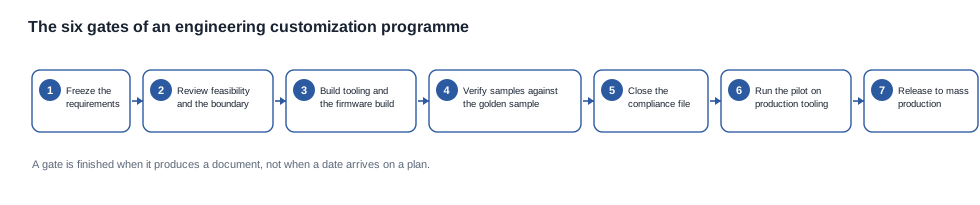
The framework used throughout is the same one we apply to engineering customization work: six gates, in order. Requirements are frozen, feasibility is reviewed, engineering and tooling are completed, samples are built and verified, the compliance file is closed, and a pilot run happens before mass production. Each gate produces a document. A gate is not finished because a date arrived on a plan; it is finished because a named artefact exists, is signed, and can be pointed at.
Engineering customization: can the request be built
The first question is the one most often answered carelessly. A buyer describes an idea — a specific optical configuration, a control gesture, a housing shape, a battery target, a regional language pack, a packaging format — and asks whether it can be built. A careless answer is a yes. It creates a shared belief that the programme exists, and every later difficulty is then read as the supplier failing to deliver rather than as a boundary never drawn.
The useful answer is a boundary, not a yes or a no. It says what is inside the achievable envelope, what sits outside it, what would have to change for the outside part to come in, and what that change costs in engineering effort and tooling. It also says which parts of the request are already solved by an existing platform configuration and which parts require new work.
So a feasibility answer looks like this: this control scheme is achievable on the existing platform without new firmware branches; this housing geometry requires new tooling for the front enclosure and cannot be produced from existing moulds; this battery target can be met on the current cell but requires a different charging circuit board, which is new tooling as well as new engineering; this certification pathway depends on how the final radio configuration is fixed, so it cannot be stated until the radio module is chosen.
None of those statements carries a schedule or a price here, and that is deliberate. Capacity figures, stage lead times, indicative schedules, price, MOQ, lead time, sample fees, warranty terms, certificate numbers, certification status per model, factory size, employee count, annual output, customer names, order volumes and cost percentages are not published by us. That is not a way of being coy about them. It is a way of making sure the boundary you agree is a technical boundary, not a number that quietly becomes a commitment someone else has to honour. When a number matters, it belongs in a quotation against a frozen requirement, with incoterms, MOQ, lead time and warranty written down, and it is then negotiable. A boundary is not negotiable in the same way, because it describes what the engineering can do.
One more part of the feasibility answer is usually the most valuable part and the least often requested: the list of things the supplier will not do, and why. Sometimes the reason is that the request conflicts with another frozen requirement. Sometimes it is that the region or the channel cannot carry the claim. Sometimes it is simply that the trade-off would push the product in a direction nobody actually wanted. Writing that down early is cheaper than discovering it at the pilot run.
We will produce that list even when it is unwelcome, and we will mark it as part of the feasibility answer rather than as a separate note, because a list that lives outside the document is a list that gets lost. If the answer to the first question of a programme is a boundary, then the boundary has to be visible to the people who are funding the programme, not only to the engineers who drew it.
What counts as engineering work
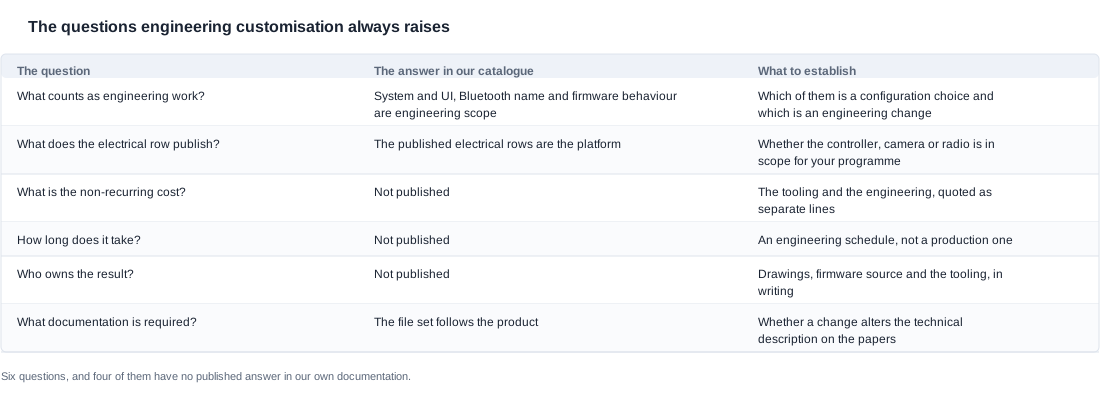
Buyers use the word customisation for two different things, and the mix between them determines how long a programme runs, how much of it is engineering, and how much of it is risk. The distinction matters enough that it should be settled in writing before anybody starts.
A configuration choice is something already available in the platform: a colourway, a lens option, a logo treatment, a language pack, a cable in the box, a choice of packaging size from an existing range. Configuration choices are assembled. They are selected from options that have already been designed, verified, and documented. The main work is selecting and confirming them, and the main risk is selecting one that is later unavailable or that does not match the final claim.
Engineering work is anything that changes how the product is designed, built, tested, or proven. That includes new firmware branches, new hardware revisions, new tooling for an enclosure or a circuit board, new assembly steps, new test fixtures, new verification records, and anything that changes the evidence needed for the market the product will ship into. Engineering work is developed, and its output is a build that must be verified before it can be described as acceptable.
The practical test is whether the change can be picked from a list or has to be created. If it can be picked, it is a configuration choice and it can be closed by a selection. If it has to be created, it is engineering work and it will produce documents of its own.
There is a third category that causes confusion: customisation that looks like configuration but is not. A firmware version that differs from the standard build only in logo, boot screen and default language still needs a build reference, a verification record, and a declaration of conformity that names the exact model string that will ship. It looks like a pick, but it is a build. The difference in effort is small; the difference in paperwork is not.
Buyers who understand this split make better trade-offs. A request that is mostly configuration can be closed quickly and cheaply, and the effort can be spent where it produces a difference the customer will notice. A request that is mostly engineering should be scheduled as engineering, with the gates respected.
The distinction is worth putting into the requirement document as a list, because the list is what protects both sides later. A workable form is:
- Each requested change is classified as a configuration selection or as an engineering item, in the requirement document.
- Each engineering item is assigned an owner on both sides — a named person at the supplier and a named person at the brand.
- Each engineering item names the artefact it produces: a drawing revision, a firmware build reference, a test record, or a tooling approval.
- Each configuration selection names the option set it is drawn from, so that "we picked the other one" is a choice rather than a change.
- Items that cannot be classified without further information are flagged as open questions at the feasibility gate, not carried silently into tooling.
Step five is where most programmes save themselves. An unclassified change that reaches tooling is a change with a mould behind it, and the trade-off at that point is no longer yours to make. We will hold a review of this classification list before the tooling invoice, because reclassifying a change from engineering back to configuration is cheap at that point and effectively irreversible afterwards.
Buyers also benefit from naming, in the requirement document, which changes are explicitly out of scope for this programme. Scope creep in an engineering programme almost always arrives as a small, reasonable-sounding addition that nobody classified. "While you are in there" is a sentence that ends a margin.
We will also say plainly, in the requirement document, which of these decisions are closed and which are open, because an open decision recorded as open is a manageable item and an open decision recorded as closed is a surprise that arrives with a mould attached. Every open item in the list carries a name and a date on which it will be answered. That is the whole mechanism, and it costs nothing to set up.

What the buyer has to supply
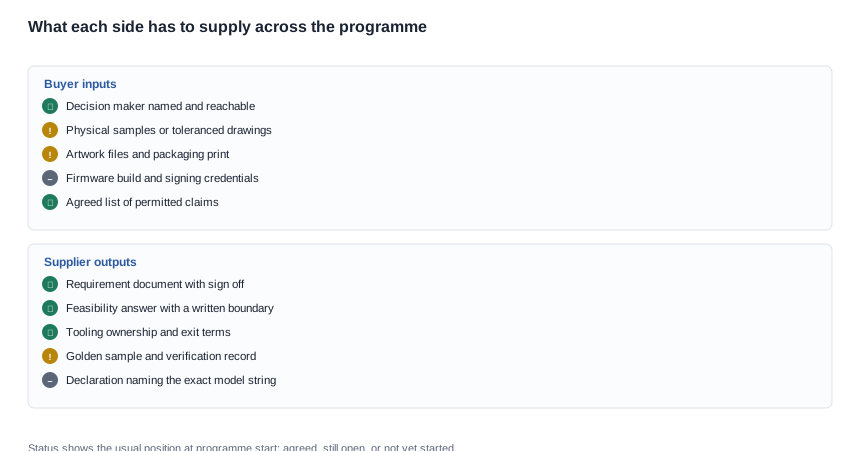
An engineering customization programme stalls more often for missing buyer inputs than for supplier capacity. The supplier can build a lot, but it cannot invent the things that only the brand knows.
The first item is the decision-maker's availability. Not the decision-maker's patience, and not a single approval at the start — the availability of a specific person, on a defined schedule, for the length of the programme. Engineering customisation generates questions that are cheap to answer when a decision-maker is reachable and expensive when they are not. Every unanswered question becomes an assumption, and assumptions become rework. If your organisation is likely to change its mind twice, say so at the start and factor that into the plan rather than discovering it during tooling.
The second item is samples. If you want a configuration to match something, the something has to be supplied in a form that can be measured: physical units, or drawings with tolerances, or photographs plus written notes. A verbal description of a surface finish is not a specification, and two people will read it differently.
The third item is artwork and identity. Logos, packaging graphics, print colour references, regulatory markings for the target market, and the language of the target market. Artwork is normally needed earlier than buyers expect, because it travels on the product and on the packaging, and both are downstream of the tooling decision. Artwork supplied late compresses the packaging approval into the same window as everything else.
The fourth item is firmware and credentials. If your brand brings its own application, firmware components, cloud service, or device provisioning flow, the supplier needs the buildable artefacts, the signing credentials, and the test accounts — and it needs them in a form the supplier's engineers can actually build. A repository URL without access is not a handover. If the brand owns the account system, the credentials need an owner and a renewal path; expired credentials during a verification cycle look exactly like a failed product.
The fifth item is the claim set. The brand knows what the product is for and what it wants to say about itself. The supplier knows what the evidence will and will not support. These two have to meet. If the claim set arrives after the samples are built, the samples may have to be rebuilt, and the cost of that is borne by the build that was already paid for.
We will tell you, in writing, which inputs we are still waiting on and what each missing input is blocking. That list is short and it is not a complaint about the buyer. It is the same logic as the classification list: an input that has been named can be chased, and an input that has not been named simply becomes a delay that nobody can explain at the end. If a decision-maker is genuinely unavailable for a period, we will mark the affected items as blocked rather than as pending, so that the commercial consequences can be discussed openly instead of absorbed into a later invoice.

What the answers look like in writing
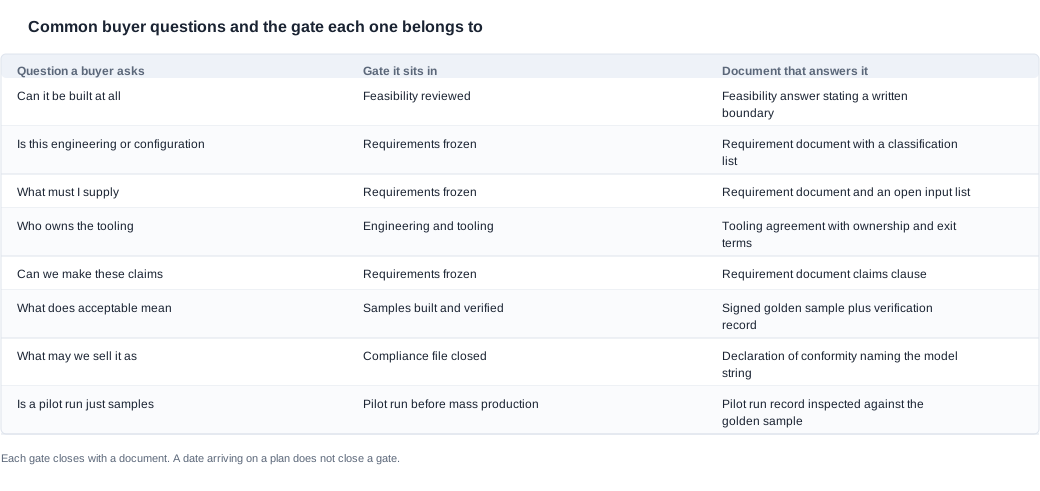
Everything above converges on one practical point: in an engineering customization programme, the deliverable of a conversation is not agreement, it is a document. Different gates produce different documents, and each one answers a different class of question.
The requirement document answers what the product is. It states the target market, the models in scope, the configuration, the packaging, the delivery documentation, and — this is the part that gets left out and then causes trouble — which claims the product is allowed to make. A claim that no one is willing to write down is a claim nobody may publish. If it cannot be written into the requirement document, it does not go on the box, the listing, the brochure, or the sales deck. That rule is not caution; it is the difference between marketing and a claim the compliance file cannot carry.
The feasibility answer answers what is possible and where the boundary is. It is the gate that tells you whether the request, as written, is a build.
The tooling agreement answers who owns the tool and what happens to tooling cost if the project stops. Tooling is the least reversible step in the whole programme: once a mould exists, it exists, and it exists whether or not the project continues. So the agreement needs to say what happens to the cost of the tooling if the programme is stopped — whether it is amortised into the unit price, whether it is borne by the brand, whether it is transferred, and whether the tool stays with the supplier and becomes available for a later run of the same project. Suppliers who will not answer this question plainly are telling you something about how they will answer it when it matters. We will insist on this being written down before the tooling invoice is raised, because it is the one commercial term in the programme that cannot be renegotiated once the steel is cut.
The firmware build reference answers which build is the product. A firmware build matching the frozen requirement, identified by a reference the buyer can quote in a purchase order and the supplier can reproduce.
The golden sample answers what acceptable looks like. A signed golden sample plus a verification record covering pairing, audio, charging, any camera function, and control behaviour. The golden sample is not a marketing unit and not a gift. It is the reference against which a pilot run is inspected, and it is the thing that makes "it works" an objective statement rather than an opinion. Its importance comes from what it settles: the sample defines acceptable and not acceptable, so later arguments about whether a unit is faulty are not arguments about preference.
The declaration of conformity answers what the product is allowed to be sold as. It must cover the exact model string that will ship, the underlying reports, and the market-specific requirements. A declaration covering a product family rather than a single model is not a declaration for your SKU. That single sentence has rescued more than one launch delay. We will treat a family-level declaration as insufficient for a specific SKU, and we will say so at the requirement stage rather than at the audit.
Component substitution is the question that sits underneath all of these documents, and it deserves a direct answer of its own. Substitution happens for ordinary reasons: a supplier is notified that a component is being discontinued, a supplier moves to a second source, a cost review proposes an alternative, or a part becomes hard to obtain. The trigger is rarely dramatic. What matters is what happens to the documents afterwards, because the golden sample was built with a specific component in it and the declaration names a specific configuration.
The rule that protects a brand is straightforward: a substituted component triggers a re-verification against the golden sample and a check of whether the declaration of conformity still covers the product as changed. If the substitution is invisible to the verification record and to the evidence behind the declaration, it can be treated as a like-for-like change and the documents do not need to move. If it changes anything the verification covered — audio behaviour, camera function, control behaviour, charging, or anything that appears in the market-specific requirements — then the golden sample must be reissued and the declaration reviewed before more units ship. We will not ship a substitution into a pilot order on the basis that it looks equivalent; "looks equivalent" is exactly the judgement that a written verification record exists to replace.
There is a second substitution question that buyers raise: substituting the brand's own firmware or application component for an equivalent supplied by the manufacturer. That is a configuration choice in the strict sense only if the platform supports it and the change is documented. If the brand's component is being replaced because it failed a requirement, that is engineering work and it reopens the requirement document.
The distinction between a pilot run and an engineering sample run is the other question buyers most often blur. An engineering sample run is a development activity: it exists to answer questions, and the units are debugged, examined, discussed, and often partially destroyed in the process. Its purpose is knowledge, and its units are not a delivery. A pilot run is a production activity: production tooling, production volume, production configuration, no bespoke build steps, no exceptions. Its purpose is evidence that the production system reproduces the golden sample, and its units are a delivery — or very nearly one.
The practical test is whether anything about the units could be different from what the market will receive. If a unit has been hand-assembled, hand-flashed, hand-adjusted, or built from a non-production fixture, it is an engineering sample no matter how many were made. If the only difference between the pilot run and a subsequent commercial order is quantity, then the pilot run is a pilot order and should be priced, scheduled and documented like one, with a purchase order and the same MOQ, incoterms and warranty terms as the order that follows.
Buyers often ask whether the pilot run can be skipped to save time. Sometimes it can, and the trade-off is real: you accept a later discovery of a production-only problem in exchange for a shorter path to volume. What is not acceptable is skipping the pilot and skipping the inspection against the golden sample. One is a trade-off you can negotiate; the other is simply an undocumented product.
Now — the honest part. Certification status per model is not published by us. Our catalogue body lists twenty-eight models, of which eight are audio, three are sport, eleven are camera, three are for children, and three carry no model number. Bluetooth version is published for fourteen of them and not published for the eleven camera models plus three others. Remote control shutter is published only on two specific sport models. An ingress rating of IP54 is published on two specific models only. And CE, FCC, RoHS, RED and EN 18031 appear nowhere in the catalogue body at all; the one catalogue export page we have is an image page showing ten patent certificates — eight design patents and two utility models — with no per-model certification rows. So if you need to know the certification position of a specific model, ask. Ask which reports sit behind a declaration, which model string each report names, and which market-specific requirements are covered. This is the certification evidence question, and it is the single most useful entry in what to ask the supplier before any tooling is raised. It is a question a real answer will engage with directly: which reports, naming which models, covering which market, valid for which configuration. An answer that only points at a page of patent certificates has not answered it. A patent certificate shows a design was granted; it is not a market access document for a radio, a battery, or a charging system, and the two should never be conflated in a supplier conversation.
The pilot run record answers whether production reproduces the golden sample. A production run on production tooling at production volume, inspected against the golden sample. A pilot order is not a development run; the difference is that a pilot order comes off the same tools, in the same configuration, at the same rate the market will consume, and gets inspected as a unit against the reference unit.
And the thing that comes after — support after the order — is a question that deserves a written answer too. What is the spares position, how are spares ordered, what happens when a batch turns up with a defect that the golden sample did not predict, who owns the corrective action, and how does a change to the requirement get folded back into the document set rather than becoming a verbal understanding between two engineers. We will ask for this to be written down in the same place as the other answers, because support is where undocumented assumptions are discovered.
The pattern is consistent across all six gates. Each gate closes with a document, each document answers a specific question, and each question has a right answer that is factual rather than reassuring. Buy the process, not the promise. A supplier who cannot produce the documents for gates they have passed has not passed them, however good the samples look. And a supplier who produces them promptly, in writing, with the trade-offs visible, is worth negotiating hard with on the things that genuinely are negotiable — price, MOQ, lead time, incoterms, packaging, spares, warranty, the terms of a pilot order and the shape of the purchase order. The right frame for that conversation is that you are free to negotiate the commercial terms, and you are not free to negotiate the evidence. A lower price against an unchanged document set is a good outcome. A higher price against a weaker document set is a bad trade at any price, and it is the trade that shows up later as a withdrawn claim, a delayed launch, or a customs question nobody can answer.
For a structured view of the same material, the engineering customization pillar covers the programme shape, and the related articles on customization options and their certification impact, the customization options checklist, and the risk factors in ODM development set out how each of these answers changes what a buyer should watch.


