

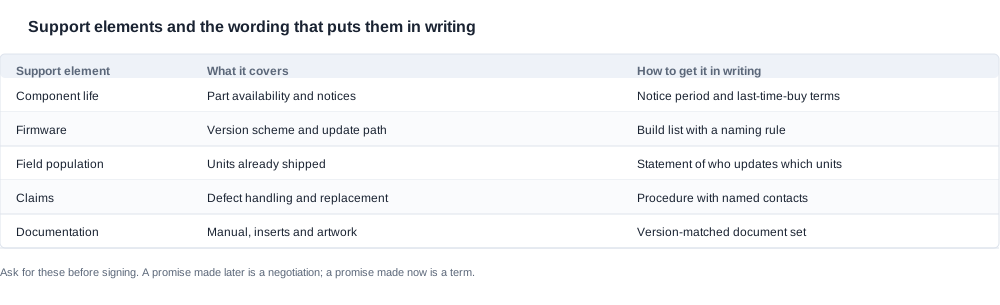
The support terms for a customised product should be settled at the point of signing, not discovered after launch. This is the conclusion first, because it is the part buyers most often get wrong and most often regret. A buyer can negotiate unit price, minimum order quantity and packaging with great energy, then close the agreement without ever asking what happens in year two when a component is withdrawn, when three firmware builds are running in the field, or when a distributor rebrands the product and the support line starts answering for two different brands.
Nothing about that is exotic. It is what happens to every finished physical product eventually. The difference with a customised product is that the buyer has more decisions than they would have had with an off-the-shelf item, because they changed the name, the colour, the packaging, the interface or the structure, and each change adds a population that somebody has to look after.
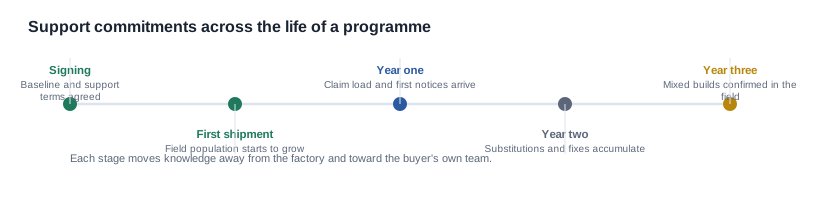
What CYNRIN publishes about this is honest and short: we publish no firmware version policy, no obsolescence commitment and no support service-level row. Those are not in the catalogue because they are not universal. They are decided per programme. That leaves the buyer with a practical task, which is to know the five things that have to be settled, what evidence to ask for, and what to do about the ones that stay open.
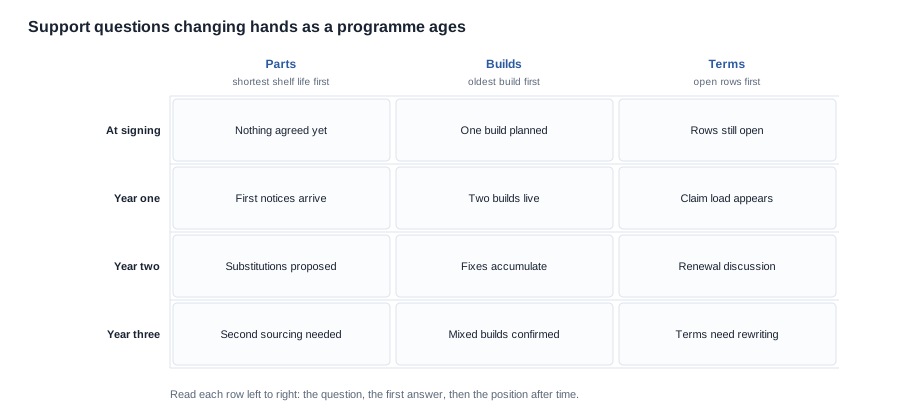
There is a second half to the conclusion, and it is about the buyer's own organisation rather than the supplier. A customised product has to be supported by somebody, and after launch the only people who understand the configuration are the people who built it and the people who wrote the specification. If the buyer's product team cannot describe the behaviour of their own branded product accurately, then every support conversation will eventually route back to the factory, and every route back to the factory is a cost. Settling the five decisions at signing is therefore not only about what the supplier promises; it is about how much of the knowledge the buyer keeps.
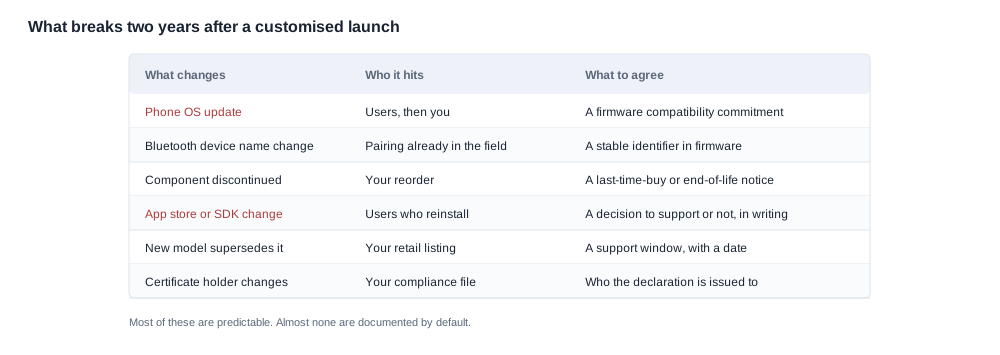
The five decisions also interact, and it is worth noting how. A short component life and an open-ended update policy are individually manageable and jointly expensive, because the units in the field that can no longer be updated are exactly the units that will be hardest to service when a part is substituted. That is why the first two items on the list are decided together, and why a buyer who wants a long support horizon should look for a component plan before asking for a generous firmware commitment.
Engineering customization: five decisions to settle before the first order
These are the five items that determine whether support after launch is manageable. They are ordered by how quickly they become painful, and none of them is about price.
- The component life and the notice you will receive. How long the key parts are expected to be available, how much warning you get if that changes, and what a last-time-buy looks like in commercial terms. Component life is not published, so it has to be asked for and written down.
- The firmware version scheme and the update path. Whether builds are numbered, whether the scheme is published to you, who is permitted to release a build, and what happens to units already in the field when a build changes behaviour.
- Who owns each layer of the stack. Hardware, firmware, the interface layer, the packaging and the documentation. A buyer's product team and a distributor's support line can both believe the other side owns the layer that just failed.
- What the second brand on the product means. If a distributor sells the product under their own name, does the factory support that name, that documentation and that claim flow, and how does that differ from supporting your own brand.
- The commercial rows that will not be published. Price, minimum order quantity, lead time, warranty, certificate numbers, support response times, obsolescence terms. Each one is either committed in writing with a date or accepted as open. Leaving them blank is a decision too, and usually the wrong one.
A programme that has answered all five in writing has an ordinary commercial life. A programme that has answered none of them will have a difficult second year, and the difficulty will arrive as a series of small unrelated problems rather than as one large complaint.
The fifth item deserves emphasis because it is the one buyers assume is settled. We do not publish a warranty term, a response time, a minimum order quantity, a lead time or a unit price. We are not withholding them out of coyness; they depend on the model, the volume, the configuration and the programme date. The mistake is to let an unquoted row become an unquoted assumption, because an assumption made at the order desk and an assumption made in the contract dispute differently.

Engineering customization and the component life of a finished product
Every finished product has a bill of materials, and every bill of materials contains parts with a shelf life. In smart glasses that typically means the audio or camera module, the battery cell, the chipset, the charging case electronics, hinges and structural parts, and the packaging inserts that are usually treated as if they last forever and do not.
Two published rows in our own catalogue illustrate the problem better than an abstract argument. The charging case capacity is published for five models only: CY03 and CY05, and L1 Pro — each at 1400 mAh, L2 Utral at either 900 or 1400 mAh, and MT6 as a 1200 mAh foldable case. KY06 and MT5 have a case but no published capacity, and V06 and S7, and V03 have no case row at all, with V03 Pro explicitly shipping without a case. A buyer who stocks MT6 alongside V03 Pro is shipping two different accessory stories from one brand, and the accessories are the part of a smart-glasses programme that most often causes a return.
The battery itself is a live question. Camera models in the range carry batteries between 220 mAh and 290 mAh, with a rated runtime of about five to eight hours and no published test condition, so a replacement cell has to be specified against the device it belongs to rather than against a generic figure. The weight case is the same: only MT6 publishes a weight, 158 grams for the glasses alone and excluding its foldable case, which means the accessory and the wearable together cannot be inferred from the catalogue row.
So what should a buyer ask for in writing? The following list is what we would put on a request, and it is the same list that makes two suppliers comparable.
- A component or critical-part list for the specific model and configuration, at the level the buyer actually needs, with the manufacturer or part family identified where disclosure is allowed.
- A stated availability expectation for each critical part, and a notice period if that expectation changes.
- A last-time-buy mechanism, including the volume at which it would be triggered and what happens to the buyer's order after it is triggered.
- A substitution rule, including who approves an alternative, what evidence is provided for the substitute, and whether the buyer has a veto.
- A part-identification approach, so a returned unit can be traced to a build and a batch rather than guessed at.
- A statement on accessories, because a case or a battery that is unavailable leaves the wearable unusable no matter how good the electronics are.
None of those rows is published by us, and the honest answer from any supplier that has them is that they are programme terms. The reason to ask early is timing: a component notice that arrives in month three of a launch is a supply problem, and the same notice that arrives during the design stage is a design choice.
Accessories deserve a separate paragraph because they are systematically underestimated. A charging case is a product with its own battery, its own electronics, its own firmware and its own end of life, and a buyer who treats it as a box in the carton will be disappointed. The published rows in our catalogue show how uneven this area is: five models have a published case capacity, two more have a case with no published capacity, three have no case row at all and one, V03 Pro, is explicitly documented as shipping without a case. That is a deliberate product portfolio decision rather than a gap, but it means a brand running several camera models has several accessory stories to maintain, and each one has to be documented, stocked and explained in the manual.
The printed inserts sit in the same category. A regulatory insert, a warranty card and a multi-language quick start are all consumables with print minimums, and they are frequently produced in the smallest quantities in the whole programme. A buyer who has agreed a long product life should agree how those inserts are replenished, because a product that cannot ship with its paperwork is a product that cannot ship.
Engineering customization and the firmware already sitting in the field
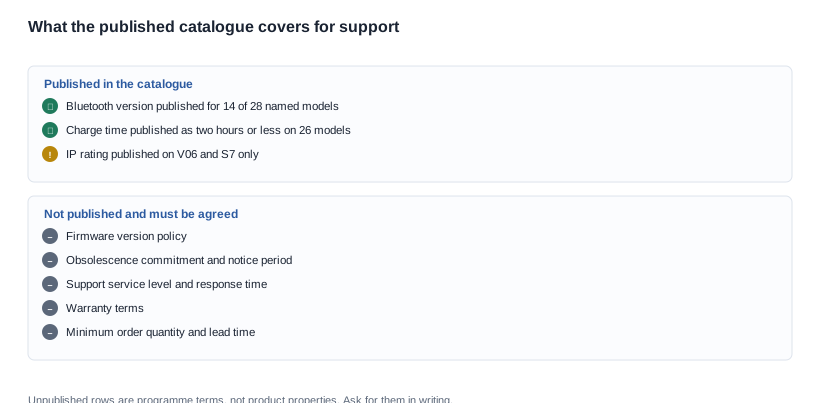
Firmware in the field is a separate population from firmware on the bench, and the two are managed differently. A build on the bench has one tester and one configuration. A build in the field has been through shipping, customs, a distributor, a retailer, a customer's house and a customer's pocket, and it may be paired with a phone, an operating system version and a network that nobody in the factory controls.
Three decisions have to be made while you still have the luxury of making them.
The version scheme. Whether there is a scheme at all, whether it is visible to you, and whether it is stable across models. A scheme such as a build number that combines a product line, a release sequence and a date is not exotic, but the important part is not the format, it is whether the factory and the buyer are reading the same number the same way. A buyer whose own product team cannot map a build to a behaviour cannot answer a customer question, and a distributor who cannot either will escalate to you.
The update path. Whether the product updates over the air, by cable, or not at all, and who performs the update when it is the end customer's responsibility. The trade-off here is real and worth stating plainly: an update path that is generous in capability is a support cost, because it means more versions in the field; a path that is closed is cheaper to support but leaves a security weakness in place for years.
The mixed population. Once two builds with different behaviour are live, a support question stops having a single answer, and the practical question becomes how a mixed population is handled. Does the factory support both builds, or only the current one? Is the older build still updatable to the newer one, and is that update available to units in the field or only to units in a warehouse?
The compliance dimension makes this sharper rather than more complicated. Radio-equipment cybersecurity requirements, described through the EN 18031 harmonised standards for secure communication, encryption, secure storage, user consent and the handling of identified vulnerabilities, mean that a firmware programme needs a defined route for how a vulnerability is assessed, communicated and remediated. We publish no firmware version policy, and we publish no per-model certification row, so this cannot be answered from our catalogue. It has to be a written commitment about how vulnerabilities reach the buyer and the end customer, and by whom.
The practical symptom of getting this wrong is not a security incident. It is a support line that cannot reproduce the customer's problem because the unit in front of it runs a build the team no longer recognises.
Three questions keep a field population manageable, and they are worth asking before the first build rather than after the third.
- How many builds of my product are supported at once, and who decides when a build is retired?
- Can a unit in the field be moved to the current build, and is that done by the factory, by the distributor, or by the end customer?
- When a build is retired, what happens to units still running it — repair, replacement, or parts only?
The answers do not need to be generous. A programme with one supported build and a clear replacement policy is easier to run than a programme with three builds and an open question, and for most brands the second is the better trade.

Engineering customization and the second brand on the same product
A channel programme routinely produces two branded versions of one product: yours and your distributor's. The hardware may be identical or near-identical, but the firmware name, the packaging, the documentation, the claim route and the contact on the box are not. This is where support arrangements get muddy, and it is worth separating the questions before a programme starts rather than after the first misrouted claim.
The first question is scope. If the factory produces a distributor-branded unit, is it a distinct build, or the same build with a different name on it? The answer decides almost everything downstream, because a distinct build means a distinct version, a distinct golden sample, a distinct set of documentation and a distinct claim flow, while a renamed build means that the two populations are functionally identical and the only difference is what the box says.
The second question is who the factory supports. If a distributor's unit develops a fault, does the claim go to the factory, to the distributor, or back to you? The workable arrangements are the ones where the factory supports the hardware and the brand owner supports the customer relationship, with the routing agreed in advance. The unworkable arrangement is the one where each side assumes the other is handling it.
The third question is the firmware and the documentation. A distributor-branded unit carries a different name, and a firmware update built for your brand may not be the right build for theirs. Whether separate update streams are maintained is a decision with a real cost, and it is better made at the quotation stage than discovered when the distributor's customers start reporting a mismatch between the manual and the device.
The fourth question is the warranty flow. We publish no warranty terms, so the distributor's warranty position and your warranty position have to be reconciled in the agreement, including who funds a replacement and what evidence the factory needs to process a claim. A replacement flow with a named route, named evidence and a named owner is worth more than a generous warranty term with no route.

Engineering customization and the promises we decline to put in writing
Some things genuinely cannot be promised in a catalogue, because they are not properties of the product. They are properties of a relationship at a point in time. A list of the ones that matter for support after launch:
- Unit price, minimum order quantity and volume breaks. Not published. They depend on the model, the configuration, the quantity and the programme date.
- Lead time. Not published. It depends on the base model, the customisation category, the tooling state and the current load on the relevant line.
- Warranty terms and claim costs. Not published. The warranty period is a commercial decision that belongs in the agreement, and the factory's role is to define the claim route and the evidence it needs.
- Certificate numbers and per-model certification rows. We publish no per-model certification row. The export-certification page is a picture page showing ten patent certificates, eight design patents and two utility models, which is a different thing from a regulatory certification record. Treat this as an area where the buyer must ask and the supplier must answer with evidence.
- Support response times and service levels. Not published. Ask for them as a written commitment with named channels, and check that the channel in the agreement is a channel that exists.
- Production capacity and programme dates. Not published. Capacity claims should be treated as a commercial representation requiring confirmation.
- Obsolescence notice periods and last-time-buy terms. Not published, and the most commonly missing term in this category.
- Payment terms and shipping cost. Not published. These are quotation rows, not catalogue rows.
The honest way to handle an unpublished row is not to treat it as absent but to convert it into an obligation with a date. "The lead time will be confirmed in the quotation" is weak. "The lead time for the agreed configuration is X weeks from the date the artwork is approved, and we will notify you of any change to it" is a commitment, and it can be negotiated. Where a supplier will not commit to a row at all, that is legitimate information too, and it belongs in the supplier assessment rather than in a footnote.
There is a negotiation tactic worth naming, because it works better than arguing about each row individually. Instead of asking whether a warranty term can be improved, ask what happens in a specific scenario and then write down the answer. What happens if a unit fails in the eleventh month? What happens if a buyer replaces the casing? What happens if the distributor, not the end customer, reports the fault? The answers produce a procedure, and a procedure is easier to commit to than a number. It also exposes quickly whether the supplier has thought about the question at all.
Engineering customization and how to test a support commitment
Support claims are hard to verify before you need them, which is why buyers end up trusting a sentence. There are five kinds of evidence that can be requested instead, and they can all be requested before a programme starts.
- A sample change record. Ask for a redacted example of the document that records a change, its baseline and its consequences. If the supplier cannot produce one, they are not managing scope, and you should know that before you sign.
- A version or build list. Ask which builds exist for your base model, how they are named, and which one is current. The answer should be short enough to read and specific enough to act on.
- A sample document set. Ask for the manual and the packaging artwork for a released version, so you can see whether the two match the product and whether the version is traceable.
- A support route description. Ask which channels exist, what hours they cover, who is allowed to raise a technical case, and what the factory needs in order to act on one.
- A golden sample position. Ask how the reference unit is stored, how it is versioned, and what happens to it if the underlying parts change. The golden sample is the artefact that keeps a programme honest, and it is the first thing to be sacrificed when support is under pressure.
If the supplier is a factory, these will normally come without difficulty. If the supplier is a trading company, they may not exist at all, which is useful information to have obtained before the first order rather than after the first failure.
We are happy to be assessed on the same five items. Send a model and a configuration, and we will show you the change record format, the build naming, the document set for a released version, the support routing we actually use, and where the golden sample sits. What we will not do is publish a support service level in a catalogue row, because it would not be true for every programme.
Related reading
- How the development stages set the baseline — how the development process works
- Where a request is classified before it is quoted — risk assessment
- The boundaries of what can be changed — what is not possible
- How support is actually routed after launch — support channels
Tell us the model and the configuration you are planning, and we will show you what the support arrangement would look like for that specific programme.


