

The first month with a new supplier is decided by sequence, not by effort. Two buyers can spend the same number of hours in the first fortnight and end up in completely different positions, because one asked for everything at once and the other asked for one thing at a time, in an order that let each answer inform the next. The order is the technique. A factory vs trading company distinction cannot be established in a single message, because a single message gets a single consolidated answer, and a consolidated answer is exactly the kind of thing both models can produce.
What follows is a sequence that works. It is written for a buyer at the point where you have decided to approach a supplier but have not yet chosen between them — the stage where the cheapest mistake is made, because everything decided here becomes the baseline that later negotiations are measured against.
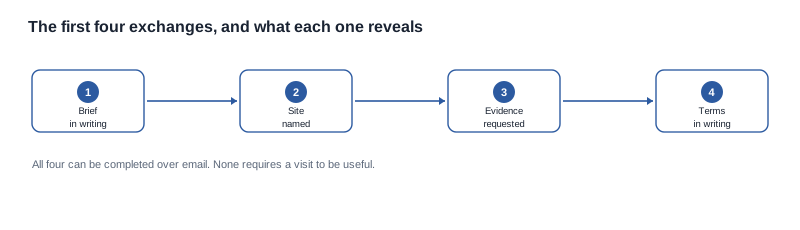
The sequence has four exchanges, and each one has a single purpose. Exchange one establishes what can be built. Exchange two establishes what is documented. Exchange three establishes how the two of you would work together. Exchange four establishes the commercial frame. Resist the urge to merge them. A supplier who answers all four in one reply has usually answered none of them.
The one thing to establish before any of it: what you are actually buying. If you cannot describe the product in a sentence that names a model and a volume band, the replies you receive will be generic, and you will spend the month comparing the quality of two marketing documents rather than the capability of two operations.
Factory vs trading company: how the first month should run
The four exchanges are separated in time, and the gaps are deliberate. Each gap gives the supplier time to answer properly and gives you time to compare the answer against the previous one before asking the next question.
Exchange one — the qualification note. Day one to day three. One page, sent to several suppliers at once, asking only what is needed to decide whether a conversation is worth having: which model in your range comes closest to your requirement, what is not published about that model, and which site would build it. The purpose is to establish scope and to see who answers the question about gaps honestly. Most suppliers reply to this within a day or two, and the ones who reply with a catalogue and no answer to the second question have told you something useful.
Exchange two — the evidence request. Day five to day ten. Now ask for specifics: the specification rows for the model they named, one document that covers that model, and the written answer to a short unpublished list. The purpose is to see whether the first reply was a summary or the ceiling of what they will say. Suppliers that produce per-model rows here are suppliers you can negotiate with, because you are negotiating against a shared factual base.
Exchange three — the working relationship. Day twelve to day eighteen. Now ask a question that requires an operational answer rather than a catalogue answer: propose a small change and ask what it costs and what it delays, or ask how a non-conforming unit would be dispositioned, or ask who would sign off the golden sample. The purpose is to feel the shape of the relationship while nothing is committed. This is the exchange that reveals whether a factory and an intermediary behave differently, because it is the first one that has to be answered rather than looked up.
Exchange four — the commercial frame. Day twenty onward. Only now ask for the numbered commercial list: price and volume breaks, minimum order quantity, lead time, payment terms, sample and golden sample cost, warranty terms, and the compliance scope for your target markets. The purpose is to compare like with like. If the commercial list comes back with gaps, that is information about the supplier and about the programme, and it belongs in the scorecard.
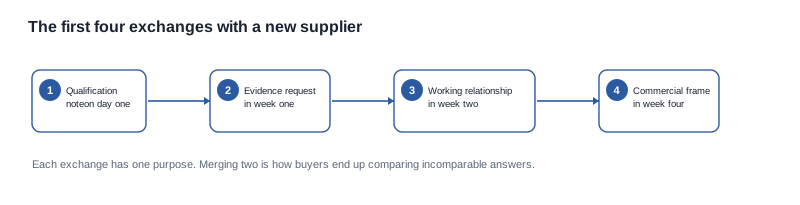
The timeline is roughly six weeks from first contact to a shortlist. That is slower than most buyers want and faster than most buyers allow, and both errors are expensive. Pushed too fast, you negotiate price before you know who is building, and you anchor on a number that includes an unpriced risk. Left too slow, a competitor places an order with someone else while you are still requesting documents.

Writing a factory vs trading company brief that produces a usable answer
Most first messages fail because they describe the buyer's ambitions rather than the buyer's constraint. A brief that says "we need a fashionable AI smart glasses product with translation and a camera" will receive a reply full of feature adjectives, because that is what the sender was primed to expect. The reply will be useless for comparison, because every supplier will list the same adjectives.
A brief that says "we need X units of a camera glasses model in Y markets, with a charging case in the box, and we need the per-model specification with any unpublished row marked" will receive a reply you can actually compare. The difference is that the second brief asks for artefacts rather than for impressions.
Four things to include, and nothing else:
- A named product requirement, not a wish list. Pick the closest model in the supplier's range as a starting point and say so, then describe the delta you need. This is more efficient than describing the product you want from scratch, because it moves the conversation onto a specific configuration that can be priced and sampled.
- A volume band, with a note that it may change. State a range rather than a point, and say what happens at the ends of the range. A supplier who asks for a single number to quote against is asking you to give away the most useful lever you have.
- A market list. Which countries the product will ship into determines a large share of the compliance scope, and it is the point at which a supplier's documentation either covers your product or does not.
- A request for gaps. Ask explicitly which specification rows are not published. This single request does more work than any other, because a supplier who marks their gaps is telling you where the cost of the programme will sit.
It is worth being explicit about what you are not asking for at this stage, and saying so in the message. You are not asking for a quotation with terms, because terms negotiated before the evidence is in will anchor the relationship on price. You are not asking for a production schedule, because nobody can give you one before the configuration is fixed. And you are not asking for a certification promise, because a promise about a document is worth less than a document.
The same logic applies to how you describe your own position. Tell the supplier whether you are a brand, a distributor or a channel partner, because the middle layer prices and behaves differently for each. A brand buying for a launch needs engineering support and long-horizon commitments. A distributor buying against sell-through needs small quantities, fast replenishment and low stock risk. The same supplier is a good fit for one and a poor fit for the other, and the difference shows in how they answer the brief.

The factory vs trading company first exchange, and what to listen for
The reply to the qualification note is the most informative document in the whole process, and it is usually read too quickly.
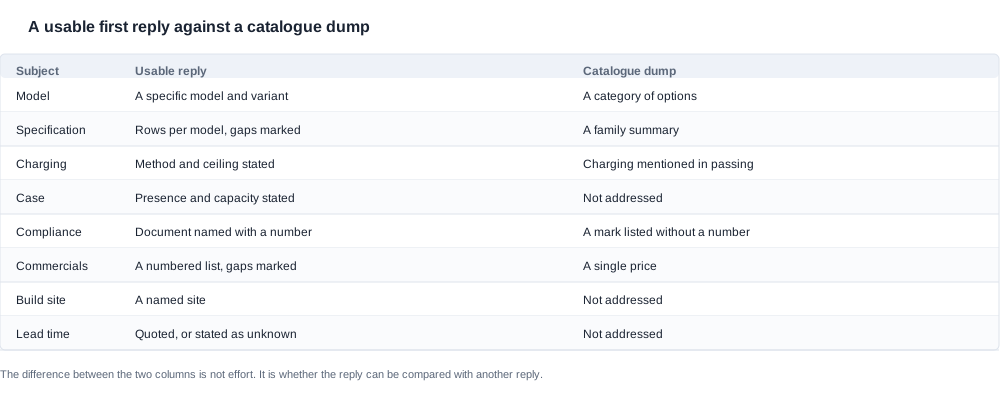
Read it in this order. First, find the model. If the reply names a model from the supplier's own range, you have a starting point; if it names a category, you have a marketing answer and should reply asking for the model. Second, find the gaps. Every blank row in a per-model specification is a cost item you are carrying, and the number of them tells you how much development work you will be funding on your own account. Third, find the site. A reply that names a build site is a reply from a party that controls the process; a reply that describes a partner network is a reply from a party that routes questions.
What a good reply looks like is easier to recognise than to describe. It is specific about the model and specific about its gaps. It says "the charging method for this model is not published, here is what we can tell you about it" rather than "charging is Type-C". It names the site. It does not include a price. And it often includes something you did not ask for, because a supplier who volunteers a constraint is showing you how they will behave when things go wrong.
What a poor reply looks like is a set of adjectives. Full of words like advanced, innovative, competitive and high quality, and empty of model strings, gaps and site names. The reply is not dishonest. It is a reply designed for a buyer who will not compare it against another reply, and the fact that it is that design is itself the finding.
Three things to do with a reply that leaves you unsure:
- Ask once more, in one line, naming what is missing. Not a list of complaints — a single specific question. A reply that still does not answer it tells you the answer will not be coming, and you can now stop paying for the delay.
- Ask the question to the production site. If the supplier has named a site, and the question is operational, ask whether you can address it to that site directly. The reaction is informative: a factory is usually relaxed, an intermediary usually needs to be asked.
- Change the subject to something they can answer well. A supplier who cannot answer the hard question may be perfectly able to answer an easy one, and a good first reply on a different subject still gives you a basis for comparison. Do not confuse a slow answer with a wrong one.
The habit worth building here is to answer every message with a numbered list of your own. It keeps the exchange narrow, it makes the unanswered items visible without you having to hunt for them, and it produces a record that a colleague could pick up and continue without a briefing.

Turning a factory vs trading company reply into a shortlist
Most buyers do not lose at the evaluation stage. They lose earlier, by talking to eleven suppliers and shortlisting three of them without ever having a comparable answer from more than two.
Shortlisting properly needs a scorecard written before the replies arrive, not after. Four criteria, weighted by the programme rather than by habit, and each scored on what is written rather than on what was said:
- Process control — is the build site named, is the party answering able to audit it, and is the tooling owner identified?
- Documentation depth — are the specification rows published per model, are the gaps marked, and is there a document that names the specific model?
- Speed of answer — how long did the qualification note take, and did the gaps get acknowledged rather than glossed over?
- Programme fit — does the minimum order quantity, the lead time and the reorder horizon match the way you actually sell?
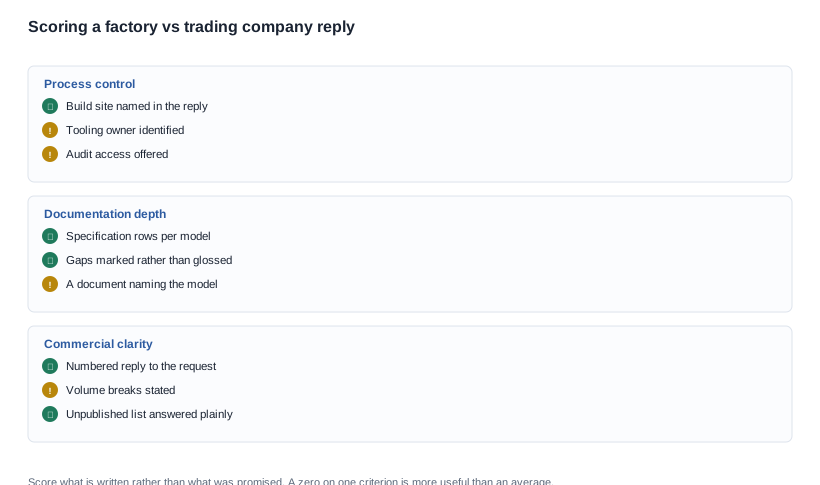
Score what is written, not what was promised. A score of zero on a criterion that matters to your programme is more useful than an average, because averages hide the fact that one supplier cannot do the one thing you need it to do.
Then cut the list. Two suppliers is a shortlist; three is a comparison with a spare; more than four is a collection, and every extra supplier consumes the attention that the two serious candidates deserve. Where a supplier is strong on process control and weak on documentation, that is a real trade-off and not a defect — but it has to be a trade-off you have chosen, with a plan for the weaker side.
One practical point on timing: decide the shortlist before the first commercial conversation, not after. If price enters the process before the scorecard is filled, the scorecard becomes a rationalisation of the answer you already liked. The discipline is to fill in the scorecard, send it, and only then open the price discussion.
A worked example makes the method concrete. A camera glasses programme for two European markets, with a channel partner rather than a direct brand, produces a shortlist with a clear shape once the criteria are applied. Supplier one names the build site, publishes per-model rows, marks the gaps, and offers a visit — a strong score on process control and documentation, and a slow first reply, which is the cost of checking. Supplier two replies in a day with a polished range summary, no site, no gap marking and a firm price — a fast reply that scores almost nothing on the first two criteria. Supplier three names a site, publishes per-model rows, marks gaps, and says a visit is possible once an order is placed — the strongest candidate overall, with one condition attached. That condition is not a defect; it is the single item the negotiation should be built around, because it is the only thing standing between the shortlist and a decision.
Most evaluations stop one step earlier than this and therefore never learn which condition to negotiate on. A shortlist of three becomes a shortlist of two, and the two are then compared on price, which is the one variable that tells you nothing about whether the programme will work.
The factory vs trading company decisions to defer, and the ones to settle now
Buyers routinely settle the wrong things early. They negotiate price in the first exchange, or agree the packaging design before the product is fixed, or commit to a delivery window before anyone has said how long the build takes. Each of those decisions is hard to reverse and easy to postpone.
Settle these in the first month, because they change the answer to everything else:
- The model and the configuration. Not the final one, but the closest available starting point. Almost every downstream question — price, tooling, compliance scope, lead time — depends on it, and it can be revisited cheaply at this stage.
- The target markets. Because the compliance scope, the labelling and the documentation burden follow from the destination, and because the two models differ most sharply on documentation work.
- The volume band and the reorder horizon. Volume decides whether a fixed charge is an investment or a risk, and the reorder horizon decides whether an amortisation argument holds at all.
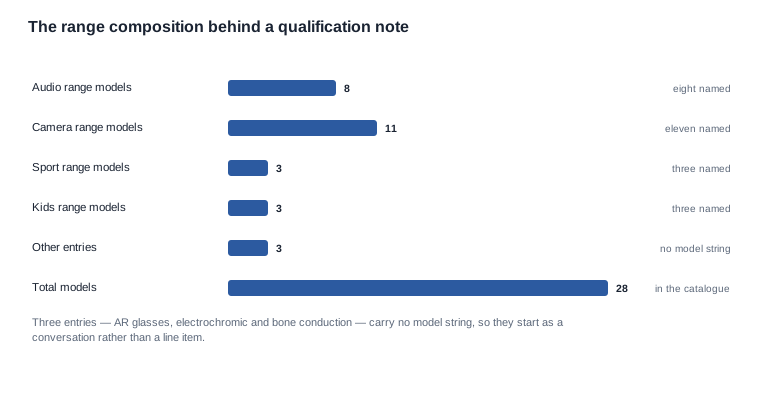
- The charging and case decisions. These are the specification rows most often left blank, and they are the ones that change the product's meaning for the end customer. In our own range the answer varies widely: a charging case capacity is published for five models, and for two of those the figure can be 900 mAh or 1400 mAh. A case decision made early, before anyone has confirmed what the case does for the model, is expensive to reverse.
Defer these, because premature commitment is the expensive error:
- Tooling release terms. Negotiate them when the mould exists and the shots are counted, not before.
- Detailed NRE breakdown. Get the shape of the number in the first month; get the itemised breakdown once the engineering team has scoped the change.
- Packaging artwork and channel pricing. Both are downstream of a configuration that will not be final for another two months.
- Payment terms beyond the first order. The first order's terms are a test; the terms that matter are the ones in place when volume is real and the relationship has history.
The closing point is about what a first month is actually for. It is not for finding a supplier. It is for reducing the set of unknowns until the choice becomes obvious, and for building the evidence base that the negotiation will later rest on. A buyer who finishes the month with two well-documented candidates and a written list of gaps is in a stronger position than one who finishes with five suppliers and a feeling. The first month is also the only month in which you can ask every question for free, and the questions that feel awkward in month four are the ones that will have been impossible to ask in month one.
It also helps to be honest with yourself about what the first month is not going to settle. It will not settle whether the supplier is financially sound, whether the sub-supply base will hold through a demand spike, or whether the relationship survives a difficult first year — those are questions for the second and third order, and the honest method for all of them is the same one used here: ask for the artefact rather than the assurance, and record what arrives against what was promised.
The Factory vs Trading Company pillar carries the model comparison behind this sequence, the standard OEM page covers what a standard programme includes, the contract terms page covers the clauses worth having in writing early, and the factory audit page covers what to do when the documents stop being enough.
Related reading
- Factory vs Trading Company — the pillar behind this sequence
- Common questions — the diagnostic questions to run in exchange two
- Production line questions — for when the reply names a site
- Getting a quotation ready — the sample request as a first milestone
Send your model, volume band and market list, and we will answer the qualification note in the same numbered format.


