

A sample request that arrives as a short email gets you the sample the supplier has on the shelf, and a sample that has been on a shelf is rarely the sample you needed. The difference between a useful sample and a wasted one is almost entirely in what the request specified, not in how politely it was worded.
Our published range makes the specificity worth setting out, because the configuration space is wide enough that a vague request can land a long way from the intended product. Camera models at 8 MP and 13 MP with cells from 220 mAh up to 290 mAh; audio models with dual cells at 55, 70 or 90 mAh per side and single 100 mAh and 115 mAh cells; the sport tier with IP54 catalogue markings; the children's tier with 40 mAh and 70 mAh cells; a light-responsive entry with electrochromic lenses; and a bone conduction entry with a 35 dB gain. Cases at 900, 1200 and 1400 mAh. Bluetooth 5.3 on two models and 5.4 across the rest. Published colour options on two models only.
So requesting smart glasses samples how to request is a question about the structure of a request rather than its wording, and structure is what determines whether the resulting unit can be evaluated or only admired.
The cost asymmetry is worth stating first. A vague request costs almost nothing to send and produces a unit that cannot be evaluated, and the evaluation then has to be repeated against a second sample at the buyer's expense in both time and freight. A structured request costs an hour and produces a unit that closes a specific question. Every hour spent structuring the request is cheaper than the one it saves.
Requesting the six things that make a sample usable
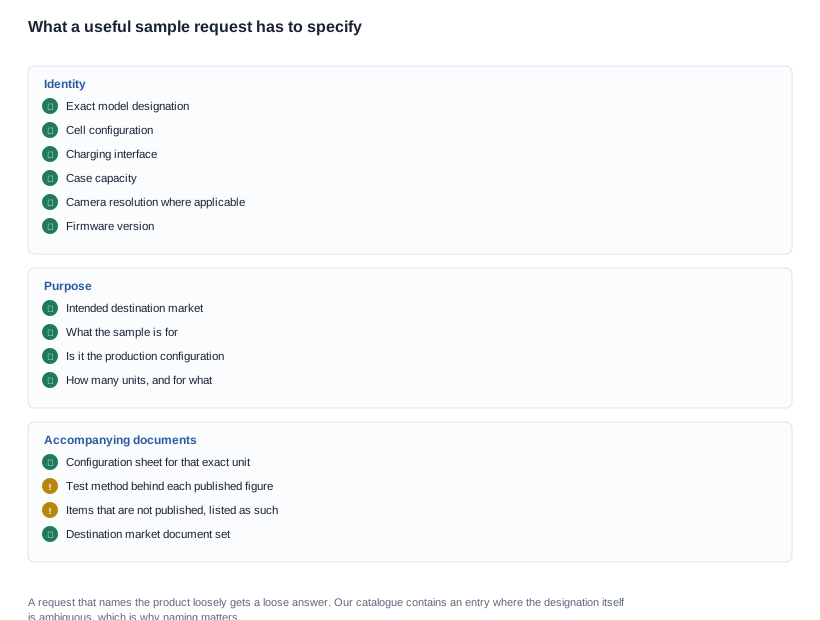
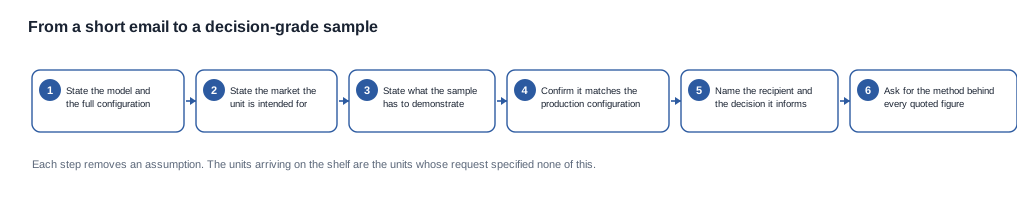
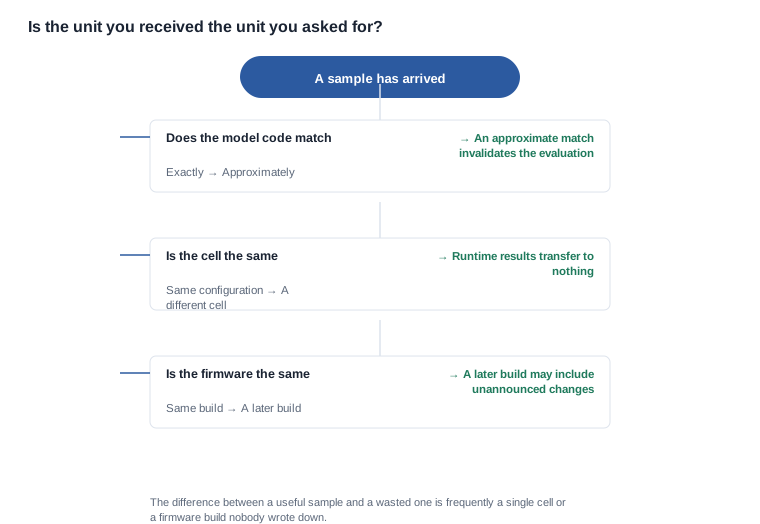
1. The exact model and configuration. Not a family and not "something like the L1 Pro". The model designation, the cell configuration, the case capacity, the charging interface, the camera resolution, the colour and the firmware version. Our catalogue contains one entry listed as "L2 Utral", with a note that "Utral" appears to be a typographical rendering of "Ultra" and a further designation of "Utral Pro Max" whose meaning is not published — a request that names the product loosely gets a loose answer.
That example is worth dwelling on for a moment, because it is not an unusual situation. In a range assembled over several years by several teams, designations drift, and a designation that looks like a mistake is occasionally a real product name. The practical consequence for a buyer is that a request naming a model approximately will be answered approximately, and the unit that arrives may be from a variant that was superseded rather than from the one intended.
The correction is unglamorous and takes ten seconds: write the designation exactly as it appears in the supplier's own catalogue, and ask for confirmation that it is the designation rather than a rendering of one. Where a supplier replies that the designation is itself uncertain, that answer is more useful than a confident guess, because it tells you the range has an identification gap that will also affect the technical file, the declaration and the packaging.
The same discipline applies to every other row on the request. "Any colour" becomes a named colour or an explicit statement that any published colour is acceptable. "The newer model" becomes a designation. "The usual configuration" becomes a cell capacity, an interface and a case capacity. Each of these looks pedantic written out, and each of them is a place where an assumption otherwise enters the programme undocumented.
2. The intended market. The destination determines the documentation set and the labelling, and a sample intended for the European Union and one intended for the United States are the same hardware with different paperwork. Naming the market also tells the supplier which conformity questions you are likely to ask, which determines whether the unit arrives with documents attached.
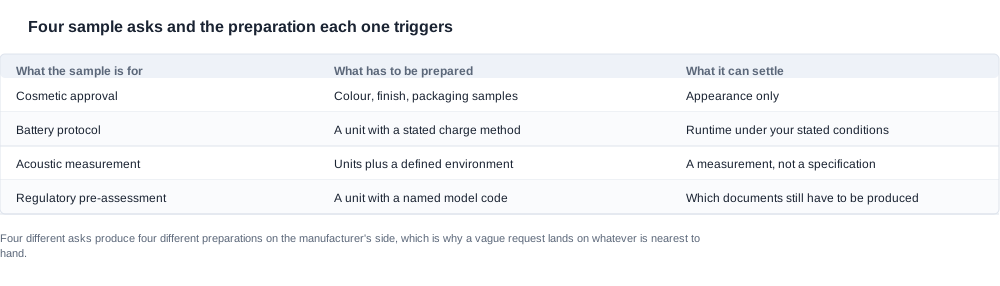
3. What the sample is for. A sample for a cosmetic approval, a sample for a battery protocol, a sample for a microphone test in a specific environment and a sample for a regulatory pre-assessment are four different asks, and they produce different preparation on the manufacturer's side.
4. Whether it is the production configuration. This is the one that matters most and is most often missed. A sample that differs from the production unit in a cell, a colour or a firmware version invalidates every evaluation done on it, and the difference is usually invisible.
5. How many, and for what. One unit for a sizing check is a different request from three units for a side-by-side test, and a different request again from units for a pilot with actual users. The quantity also determines whether the supplier treats it as a standard sample or prepares something specifically.
6. Who receives it, and what the documentation should accompany it. The name and the address of whoever will actually open the box, and the documents you want with it.
Each of these six removes an assumption. A request that omits the market leaves the supplier to assume, a request that omits the purpose leaves the supplier to assume, and a request that omits the configuration leaves the supplier to assume — and in this category the supplier's assumption is generally the nearest thing to hand, which is the definition of a wasted sample.
What to ask for alongside the hardware
1. The configuration sheet for the exact sample. Not the catalogue page, which describes a range. A sheet describing the unit in the box, with its cell configuration, interface, case capacity and firmware build named individually. This is the single most useful document a buyer can request, because it is what converts an evaluation into a transferable record.
2. The test method behind the published figures. Which cell, which charge method, and what the runtime was measured under. Every published runtime in our range comes without a stated condition, and this is the request that gets it. A method is more valuable than a number, because it lets the buyer reproduce the figure on a different unit — which is what makes the result worth anything at the pilot stage.
3. The items that are not published, listed as not published. This sounds odd to request and it is the most useful part of the request. A supplier who answers "the frame weight is not published" has told you something you can plan around; a supplier who produces a number has told you something you will have to defend. In our range that list is long: frame weight beyond the single published figure of 158 g for the MT6, the sensor model, the field of view, the video specification, the microphone figures, the lens performance on the light-responsive entry, the seal material, and the ingress test report numbers.
4. The documentation for the destination market. A sample that arrives with the conformity document set for the market it will be sold into saves a round trip, and it also establishes early whether the documents name your exact model or only the family.
There is a fifth request that is optional but valuable, and it is the one most often left out: a request that the unit be traceable to a specific build. Asking for a build reference or a unit reference costs nothing and makes the eventual test record attachable to something. In a category where several published rows are blank, traceability is what distinguishes a test result from an anecdote.
A sixth request is worth making explicitly, because it prevents a disagreement later rather than producing a benefit now: ask the supplier to state, in writing, whether the unit supplied is a production unit, a pre-production unit, or a hand-built sample. These three have different evidential weight and suppliers know it, so a request that asks the question plainly gets a straight answer. Most buyers never ask, and then rely on the distinction themselves when the pilot run does not match what they approved.
There is a seventh request that has nothing to do with the unit and everything to do with the programme: ask what the supplier would need from you in order to produce the bulk version of this sample, and at what point in the process they would need it. That question returns the conversation from the sample stage to the programme, which is where it belongs, and it frequently surfaces a requirement — a target date, a documentation scope, a packaging approval — that nobody had written down while everybody assumed the other side had it.

Establishing the ground before the request goes out
- Who is the recipient and what is their role. A sizing check, a technical evaluation and a documentation review are three different audiences, and a sample sent to a general inbox gets none of them.
- What decision the sample is meant to inform. A request with a decision attached gets a faster and more useful answer than one without, because the supplier can prepare for the decision rather than for the interest.
- What will happen to the sample afterwards, including whether it will be sold, returned or retained. This determines whether the unit is a marketing asset, a cost or a returned item, and suppliers treat the three quite differently.
- The timeline — the date the answer is needed, and why.
The fourth of those is the one buyers most often answer vaguely, and the vagueness is expensive. "ASAP" produces a unit prepared whenever the supplier gets to it; a date produces a unit prepared for that date. Where the date genuinely cannot be fixed, the better answer is to state the event the sample has to inform — a review meeting, a listing decision, a budget cycle — because a supplier can prepare against an event when they cannot prepare against a sentiment.
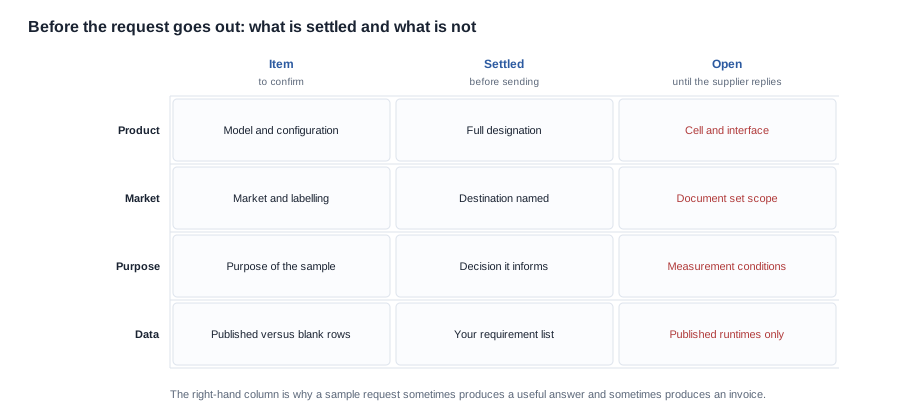
It is worth separating two questions that get merged into one: what the sample is for, and what decision follows from the result. A sample for an internal review and a sample that supports a purchase order are the same unit and entirely different requests, because the second requires the configuration sheet, the documents and the protocol while the first can be a bare unit. Saying which one you are buying determines which preparation you get.
There is a fifth item that belongs on that list and that costs nothing: the written protocol the sample will be judged against. Sending the protocol with the request, rather than after the unit arrives, is what turns a sample into evidence. It also protects the buyer, because a threshold agreed after the result is in view is a threshold that will be negotiated.
And there is a sixth, which is a question rather than a specification: ask the supplier to tell you what the sample will not be able to tell you. A supplier who answers that honestly — this unit cannot establish repeatability, this configuration has no published frame weight, this market is not covered by our documentation — has given you a more useful document than a list of capabilities, because it defines the remaining work.
The four ways sample requests go wrong
1. Requesting "a sample" of a product without specifying the configuration. The most common, and the reason sample evaluations in this category so often produce inconclusive results. The supplier sends what is available; the buyer evaluates a unit that was never the subject of the request.
2. Evaluating a sample that is not the production configuration, and then having to repeat the evaluation. This is the expensive version of the first mistake, because the discovery usually arrives after the evaluation has been completed and reported internally.
3. Requesting samples and not documenting what was asked for, so that when the sample arrives nobody can say what it was supposed to demonstrate. Six months later the only record is an opinion, and an opinion cannot support a purchase order.
4. Not asking for the not-published items, and then discovering the gap at the pre-production stage rather than at the sample stage. The sample stage is the last point at which discovering a gap is cheap.
A fifth way deserves naming, because it is the one that damages the relationship rather than the programme: treating a supplier's honest answer to a question as a negotiating position. When a supplier says a figure is not published, that is information about the product. Responding to it as though it were an evasion teaches the supplier that candour is not rewarded, and the useful answers to subsequent questions decline correspondingly.
That last point is worth expanding, because it has a practical consequence for how a sourcing programme runs over time. The suppliers who are most valuable to work with are the ones whose published data is honest about its limits, because a gap that has been declared can be planned around while a gap that has been concealed resurfaces at the worst possible moment. Buyers who push hardest on getting a number out of a supplier sometimes end up with a number and a worse relationship, and discover the cost of that when the next programme needs information that is no longer offered voluntarily.
The countermeasure is to make candour cheap. Ask for the not-published list as a standard part of every request rather than as a pointed question, and treat a complete list as a good answer rather than as a shortcoming. Where a supplier gives you an exhaustive list of what they cannot yet tell you, you have learned more about the programme than from any capability statement — because the list tells you where the programme's real work is.
Being clear about what a sample can and cannot establish
We will send a sample against a stated configuration, and we will state in writing what the sample is and is not — including where the published data is thin. The published position in our range is that the frame weight is published for one model only, 158 g for the MT6, and not published for the rest, and that the sensor, the field of view, the video specification, the microphone figures, the lens performance and the ingress report numbers are all absent.
We will also say plainly when a configuration is not available rather than sending the nearest thing and letting the buyer discover the difference. A near miss is more expensive than an absence, because it consumes the evaluation before anyone notices it was a near miss.
There is one further thing we will do that costs us nothing and saves the buyer a round trip: where a sample is dispatched against a stated configuration, we will say which build it came from and which build would be produced for a bulk order. Where those two are the same, that is useful confirmation. Where they are not, that is information the buyer needed before the unit arrived rather than after.
What a sample can establish, stated plainly, is this: that one unit, in one environment, at one point in time, is within the thresholds the buyer wrote down in advance. That is genuinely useful and it is worth doing properly. What it cannot establish is repeatability across a production run, which requires a pilot; it cannot establish service life, which requires cycling; it cannot establish regulatory standing in a destination market, which requires a technical file rather than a unit; and it cannot establish the behaviour of a firmware build that will not be the one shipped.
Those four limits are the reason the sample stage is cheap and the specification stage is not optional. A buyer who understands them treats the sample as one gate among several rather than as the decision itself.
There is one further limit that is easier to overlook than the other four, and it concerns the comparison between two units. If a buyer receives samples from two suppliers and compares them directly, the comparison is only meaningful where the two configurations are equivalent. A 290 mAh camera unit and a 90 mAh dual-cell audio unit are not comparable on runtime, and comparing them anyway is a common way for a buyer to reach a confident conclusion from two incomparable units.
Where a comparison is genuinely wanted, the way to obtain one is to specify the comparison before the units are sent rather than after they have been evaluated. Two requests with the same configuration, the same protocol and the same environment produce a comparison; two requests with different configurations produce two evaluations that happen to sit next to each other on the same desk.
This is also where the published gaps bite hardest in practice. When a buyer wants to compare two suppliers on acoustic behaviour and neither publishes the microphone figures, the only route to a comparison is to write the protocol and run it on both. That is entirely feasible and it is also a legitimate way to generate the data our documentation does not hold — which is why it is better done as a designed exercise with a written method than as an impression formed from handling two units in a room.
If you send the model, the configuration, the market, the quantity and the purpose, we will come back with what we can provide and what the sample will and will not tell you. The stage sequence that follows a sample is set out in odm development stages, what to include in a request is covered in requesting smart glasses samples what to include, and starting with a small test order is the subject of can I start with a small test order.
One closing point about timing. A sample request sent without a date produces a unit at some point in the future; a request sent with a date produces a unit prepared for that date. Where the date cannot be fixed, the better answer is to name the event the sample has to inform, because a supplier can plan against an event far more reliably than against a sentiment. In our experience the requests that come back fastest are the ones that say what decision the unit has to support, and the ones that come back slowest are the ones that say only what the buyer would like to see.
There is a further reason to treat the request as a document rather than as correspondence. A supplier who receives a structured request learns something about the buyer's programme, and that changes what they send back. The practical version of this is that a structured request tends to produce a structured answer: configuration sheets, method statements and explicit lists rather than summaries. A buyer who wants the second kind of answer should send the first kind of request, and the difference is visible in the very first reply.
Related reading
- Requesting samples
- What to include when requesting samples
- Can I start with a small test order
- Smart Glasses OEM: how to get started
Send the model, configuration, market, quantity and purpose, and we will come back with what we can provide.


