

A buyer comparing a factory vs trading company rarely opens with the question of which one to pick. The conversation usually starts with capability: can you build this, can you customise it, how long have you been doing it. That is the wrong place to start, because an intermediary can describe a factory's capability accurately and at length. Capability is the one area where the two models sound identical, which is exactly why capability conversations settle nothing.
What separates them is narrower. Which site builds the units. Who owns the tooling. Who signs the compliance file for the model that actually ships. Who authorises a rework when a unit fails. None of these are opinion questions, and none of them are delicate. Each requires a specific fact, and a specific fact can only be produced from somewhere inside the organisation.
This article is organised around eight questions of that kind. For each one it sets out what a useful answer contains, what a deflection looks like, and what to write down so the answers can be compared across a shortlist rather than remembered from a call. It closes with the part of the evaluation that sits outside both models: the specification rows that are published nowhere, and therefore have to be requested as supplier commitments rather than read from a datasheet.
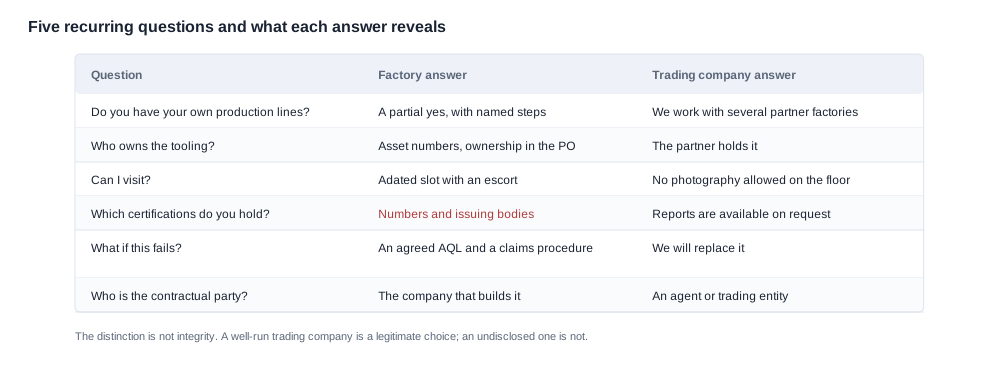
One framing point before the questions themselves. A gap in a specification sheet is not evidence of a weak supplier, and it is not evidence of a strong one either. It is a scope item. The only thing a published gap tells you for certain is that somebody has to fill it, and the difference between the two models is usually in who fills it and how fast.
Factory vs trading company: eight questions that do the work
The order below is deliberate. The first three establish the commercial model, the next three establish who answers for the product, and the last two establish whether anything will be in writing at all. Ask them in a different order and you will end up negotiating a price before you know who is building the goods.
1. Which site builds the units? The first question, and the one that determines how much of everything afterwards you can verify yourself rather than take on trust. A factory answers with a site: often two sites, one for electronics and one for assembly, and the honest answer names both. An intermediary answers with a network, and a good one will be specific about which partner handles a product of this type and this size.
Record the site name, the city, and the function that happens there. Then ask the same question about the second production run. A supplier that names one site for the first order and a different one for the reorder has told you something no capability description would have revealed.
2. Who is the contractual party, and who carries the obligation? This is the question that settles the commercial model, and it is the one most often skipped. If the party you contract with does not build the product, then you have an intermediary relationship, whatever the supplier calls it. That is not a problem in itself — but it must be written down, including which questions route to the supplier and which have to reach the production site before an answer is possible.
3. Who owns the tooling? Tooling is the cleanest test available, because it is a capital asset and factories keep records of them. A factory can give an asset number, a cavity count and an expected life in shots. An intermediary holds no tooling and will name the partner who does. That is a useful answer, and it tells you precisely one thing: your contract is with a party that does not own the equipment that makes your product. Where the ownership terms sit — in the purchase order, or in a later conversation — matters just as much as the answer itself.
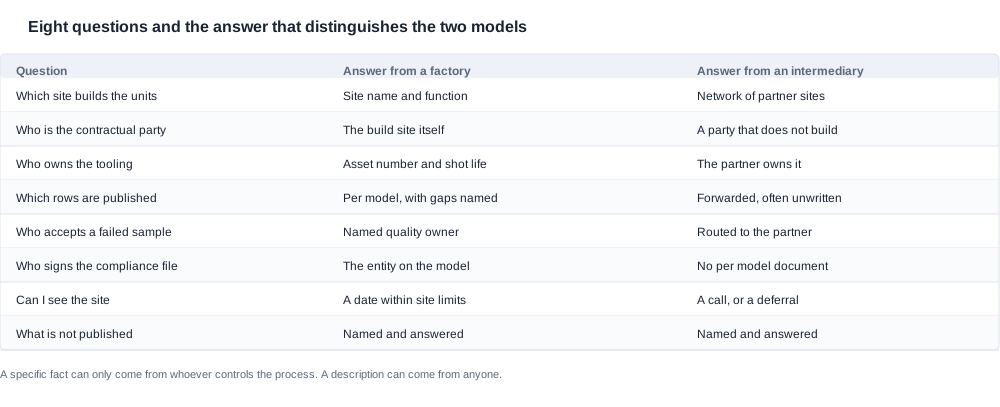
4. Which specification rows are published for the model I am ordering? Ask for the specification per model, not per range, and mark every row that comes back blank. In our own catalogue the pattern is instructive. A Bluetooth version is published for 14 of 28 models and is not published for the 11 camera models, A05, A06 or the bone conduction entry. A charging method is not published for CY03 and CY05, and L1 Pro or MT6. An IP rating is published for V06 and S7 only. A frame weight is published for MT6 only, at 158 g for the glasses alone, excluding its 1200 mAh foldable case. A blank cell is not a defect and it is not a secret; it is the honest edge of what has been documented.
5. Who accepts a failed sample, and who authorises the rework? A factory's answer is a procedure: the acceptance sampling level, the evidence required from you, who pays the freight, whether the remedy is replacement or credit. An intermediary's answer is usually a gesture, because the disposition decision belongs to a partner. If the supplier cannot state an acceptance level without hesitating, ask what their standard is. The answer or the hesitation is the finding.
6. Who signs the compliance file for the model that ships? Ask which document, for which model, issued by which body, under which number. Our own catalogue mentions CE, FCC, RoHS, RED and EN 18031 zero times. The export-certification page is a picture page: ten patent certificate images, eight design patents and two utility models, with no per-model certification row, no Declaration of Conformity and no published compliance document of any kind. We would rather state that plainly than let a buyer assume a document exists that we have not published.
7. Can I see it, and when? A factory proposes a date within the constraints its site imposes. An intermediary may offer a video call, may explain that visitors are not permitted on the floor, or may say production is currently at a partner site. All three are legitimate reasons sometimes. The test is whether a site gets named when you ask. "We can arrange something once the order is placed" is not a refusal — it is a sequencing decision, and you can accept it or not.
8. What is not published, and who fills it? Ask for the commercial list explicitly. In our catalogue, price, minimum order quantity, lead time, sample fee, warranty terms, certificate numbers, production capacity, tooling cost, NRE, test conditions, payment terms and shipping cost are all unpublished. A supplier who answers that list plainly — with a real number, a real date, or a clear "not available at this stage" — has given you more than a supplier who gives you a price and goes quiet.
The eight questions, in the order they should be asked:
- Which site builds the units, for the first run and for the reorder?
- Who is the contractual party, and who carries the obligation?
- Who owns the tooling, and where is the ownership term written?
- Which specification rows are published per model, and which are blank?
- Who accepts a failed sample and who authorises the rework?
- Who signs the compliance document for the shipping model?
- Can I see the site, and on what date?
- What is not published, and who fills each gap?

How to score a factory vs trading company answer, and what a deflection sounds like
The purpose of asking is not to catch anyone out. It is to build a record you can compare. Keep three columns for every exchange: what was asked, what was said in reply, and what has been independently verified. Only the third column is evidence, and in a first evaluation it will often be empty for both kinds of supplier.
That record changes how a shortlist is scored. A scoring sheet built on "how confident am I in this supplier" rewards fluency, and fluency is exactly what a good intermediary has. A scoring sheet built on "what is the cost of the unresolved item" rewards clarity, and clarity is what a factory can usually provide even when the underlying capability is identical.
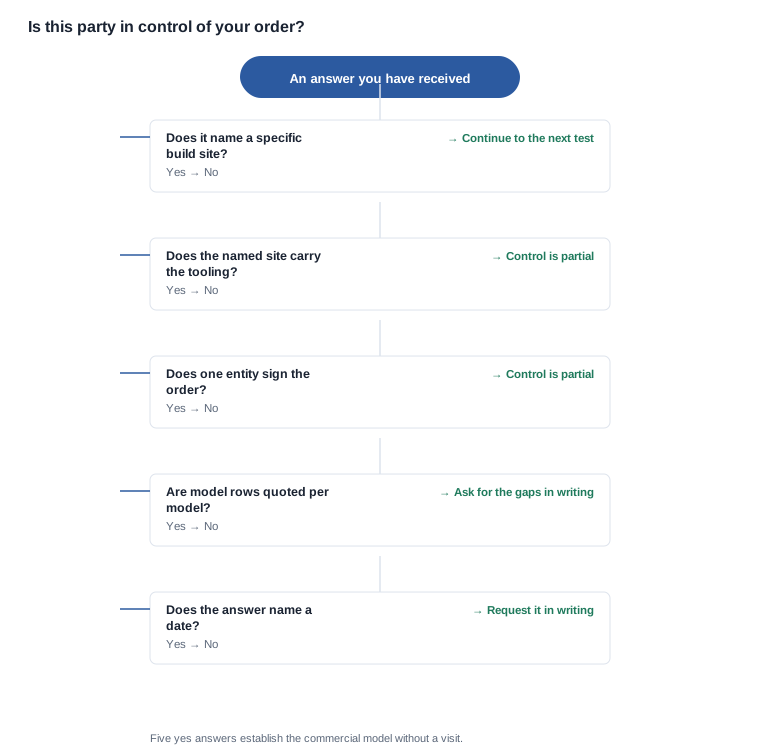
Deflections are worth naming precisely, because they are rarely dishonest and are frequently expensive. Consider these four, which come up in almost every first evaluation of a smart glasses supplier:
- "We work with several partner factories." This is often true and it is not a refusal. It changes the commercial model, so record it and carry it into the contract discussion as a routing question rather than a capability question.
- "That can be arranged once the order is placed." Legitimate for a visit, less legitimate for a sample protocol or an acceptance criteria. Ask for the arrangement to be dated in the response, and see whether it is.
- "We hold all the relevant certifications." A claim without a number. Ask which document, for which model, issued by which body, under which number. In our own catalogue the equivalent answer would be that no certification row is published per model — which is a less impressive sentence and a more useful one.
- "Samples are free of charge." Our sample fee is not published, and neither should it be assumed. Sample terms are a commercial commitment and belong in the quotation, not in a chat message.
The general rule: a deflection is not a lie, it is an unpriced item. Price it. An unresolved acceptance standard, an unnamed build site and an unissued compliance document all carry a cost that will be paid later, usually at the point where the buyer has least leverage.
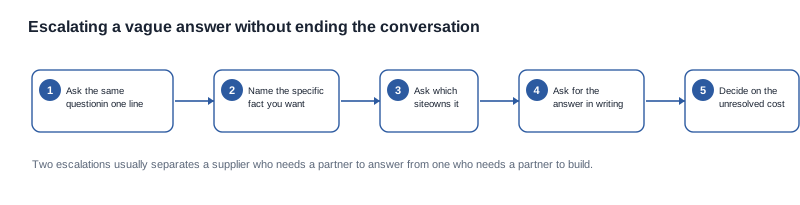
Where the escalation stops is also worth deciding in advance. Most buyers escalate twice and then stop, because the relationship is still young and the answers have been slow. Two escalations is usually enough to tell the difference between a supplier who needs a partner to answer and a supplier who needs a partner to do the work.

Questions that separate the two models in a factory vs trading company review
A document review is a stronger test than a call, and it is available to any buyer who asks. The trick is to run it backwards: start from the unit that would arrive in your customer's hand and work towards the documents that produced it.
A golden sample is the anchor. Ask whether a signed-off unit exists for the exact configuration you intend to order, who signed it, and on what date. A factory that has run the configuration before can produce it or explain precisely what has changed. An intermediary can usually forward the question, and the answer that comes back tells you whether a golden sample exists as a controlled artefact or only as a reference unit in a partner's showroom.
Then the corrective-action path. Ask what happens when a unit fails inspection at your warehouse: what evidence do you send, who receives it, how long does a disposition take, and what are the acceptable dispositions. The factory route is a process with named steps. The intermediary route is a forwarded email that becomes your problem to chase.
Then the records. Tooling maintenance and shot counts, calibration records for the test equipment, incoming material inspection for the cells, and the transport file for the lithium cell — the UN 38.3 test summary for the exact cell fitted, since a summary for a different cell does not cover yours. Each of these is a document a factory holds. None of them is impossible for an intermediary to obtain, and that is the point: the test is not whether the document exists, it is whether it exists in a form you can audit, traceable to the site that builds your product.
The distinction worth keeping is this. An intermediary is not a lesser supplier. Some intermediaries handle customs, financing, certification liaison and market access better than a factory would, and for some buyers that capability is worth paying for. The failure is not the model. It is entering the relationship with the wrong expectation about who performs the work and who answers when something is wrong.
For due diligence purposes, a shortlist should therefore be assessed on two columns, not one:
- Control — how much of the process can you inspect, request and audit directly rather than through a party that has a commercial incentive to present a good answer.
- Speed of answer — how long a non-obvious question takes to come back, including the questions that have to reach a partner.
A factory will usually win the first column. An intermediary will often win the second, and on a short-cycle e-commerce replenishment programme the second column can matter more than the first.

Product-level questions a factory vs trading company buyer should not skip
The eight questions above are about the supplier. These are about the product, and they are where the two models diverge in effort rather than in answers — because the answers often come from the same source either way.
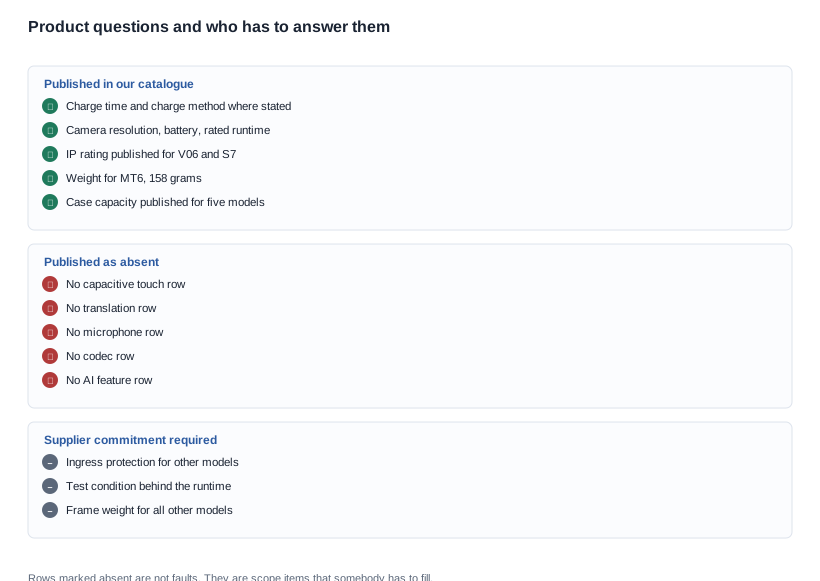
Consider the charging case. Our catalogue publishes a case capacity for five models: CY05 and CY03, and L1 Pro — each at 1400 mAh, L2 Utral at 900 mAh or 1400 mAh, and MT6 at 1200 mAh in a foldable case. For KY06 and MT5 a case is listed but no capacity is published. V06 and S7, and V03 have no case row at all, and V03 Pro has no charging-case row. A buyer who needs a case in the box with a stated capacity therefore has to ask which models can deliver that and which cannot. That question is cheap for a factory and expensive for an intermediary, because it travels to a partner who may not have been asked it before.
Consider the camera range. Eight of the eleven camera models publish 8 MP; L2 Utral and L1 Pro, and S7 publish 13 MP. Camera battery capacity runs from 220 mAh to 290 mAh, and the rated runtime is about five to eight hours with no test condition published. All eleven camera models publish a runtime — that is a consistent row, and a useful one — but the condition behind it is not written down, so it cannot be compared across suppliers. An IP rating is published for V06 and S7 only, which means any requirement for a rated ingress protection level narrows the shortlist to two models in our range and needs a written answer for everything else.
And then the rows that are simply absent. Our catalogue contains no translation row, no AI-feature row, no capacitive-touch row, no microphone row and no codec row anywhere. A buyer asking "does it translate", "is there a microphone", "does it support AI" and "which codecs" is asking four questions the published catalogue cannot answer. That is not a fault in the catalogue; it is the accurate shape of what has been documented. But it means these questions must be put to the supplier as requests for a written specification, and it means the distinction between the two models shows up in the effort required to get a compliant answer at all.
Which one of these is a fact you can read, and which one is a commitment you have to obtain:
- Published and checkable — charge time, charge method where stated, case presence, camera resolution, battery capacity, rated runtime, IP rating for V06 and S7, weight for MT6, colour options, photochromic on V03 Pro, surround audio on D11, D17 and ZH12.
- Commitment required — translation capability, touch input, microphone and audio-capture behaviour, codec support, AI features, test conditions behind the runtime figure, ingress protection for any model other than V06 and S7.
- Model identity to check — YKC02 is a sport model with two 70 mAh cells and is not an audio-range entry; V06 and S7 are named for sport but sit inside the eleven camera models.
The second group is where a factory earns its cost. Not by answering faster, but by being able to answer at all without a round trip to a partner.
What our catalogue publishes, and the rest of a factory vs trading company decision
Stating our own position plainly is part of answering this article. Our published material covers the range structure — eight audio models, three sport models, eleven camera models, three kids models, plus AR glasses, electrochromic and bone conduction entries that carry no model string — and a set of specification rows per model: charging method where published, charge time where published, case presence and capacity where published, camera resolution, camera battery capacity, rated runtime, ingress protection for V06 and S7, frame weight for MT6, colour options, photochromic for V03 Pro, and surround audio where published. Twenty-six models publish a charge time of two hours or less; D17 and ZH12 publish about one hour.
Everything commercial is unpublished. Price, minimum order quantity, lead time, sample fee, warranty, certificate numbers, production capacity, tooling cost, NRE, test conditions, payment terms and shipping cost. None of those numbers appear in our catalogue, and inventing them for a comparison table would be the fastest way to lose a buyer who checks.
That leaves a practical consequence, and it is the recommendation of this article. If you are comparing suppliers, build a document-request list rather than a specification comparison, and treat a supplier's answers to that list as the primary evidence. The comparison table is cheap to produce and proves very little. The document list is the due diligence.
The decision criteria, then, in the order they should be applied:
- Control — can you name the build site, inspect the records, and audit the site directly, or only through a party that is paid to present a good answer?
- Written evidence — does the supplier produce documents that name the model, or only family-level claims that leave the model uncovered?
- Speed of answer — how long does a non-obvious question take, and does the answer survive contact with a second supplier?
- Commercial transparency — is the unpublished list answered plainly, with numbers or a clear refusal?
- Fit for the channel — a fast-replenishment programme and a long-cycle programme with tooling justify different models, and the trade-off should be made deliberately rather than inherited from whichever supplier answered first.
On the first criterion, most established factories score well and most intermediaries score partially. On the third, the ranking often reverses. A shortlist that scores only on the first criterion will tend to a single model, and a shortlist that scores only on the third will tend to the other. Which one is right depends on your programme, not on the category.
The negotiation position that follows is straightforward. Ask all eight questions in one message, in the order above, and ask for the unpublished list as a numbered list. Do not negotiate price until you have the answers, because the price is the easiest part to agree and the hardest part to revisit later. If a supplier is uncomfortable with the eight questions, that is information — not disqualifying, but it should be recorded and weighed before the deposit.
Related reading
- Factory vs Trading Company — the pillar comparison behind these eight questions
- Production line questions — the same approach applied to the build site
- Quality documentation compared — what each kind of document can actually prove
- Cost implications — where the money sits in each model
Send the eight questions with your programme details, and we will answer them in the same order.


