

A quoted lead time is a plan. It describes what will happen if everything goes as expected, which is a condition that holds perhaps most of the time and fails in the ways that matter. The commercial difference between the two models in a factory vs trading company comparison is not the length of the number — the two are often quoted identically, because both quote from the same production schedule. The difference is who controls the queue, who can compress it, and who carries the cost when it slips.
That distinction matters because lead time is rarely the variable a buyer is actually shopping on. It is the variable that decides whether a channel programme is viable. A distributor with a reorder cycle has to know when the goods will land before the stock runs out. A brand with a launch date has to know whether the product can be in the warehouse before the campaign starts. In both cases the buyer is not comparing two lead times so much as comparing two answers to the question: if this slips by three weeks, what happens, and who pays for it?
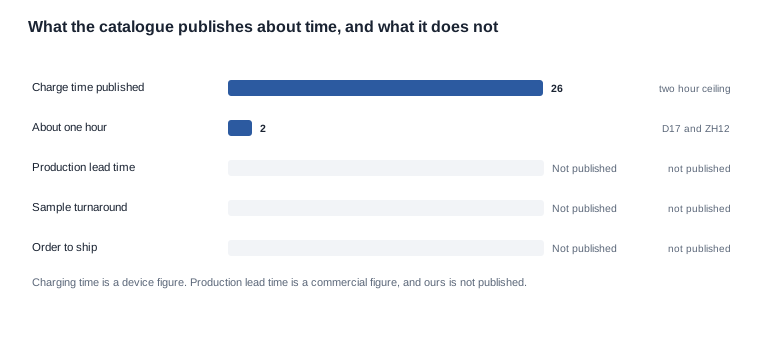
One clarification worth making before anything else, because it is confused constantly in this category. The charge time of a device has nothing to do with the lead time of an order. Our catalogue publishes a charge time for 26 of the 28 models — a ceiling of two hours or less — and about one hour for D17 and ZH12. That figure tells you how long the unit takes to charge on the bench. Our production lead time, the interval between a confirmed order and a delivered shipment, is not published, and neither is our sample turnaround. Both are commercial commitments rather than product attributes, and both are answered in a quotation rather than on a specification sheet. Conflating the two is the most common source of the unpleasant surprise in this category.
Factory vs trading company: the five ways lead time changes with the model
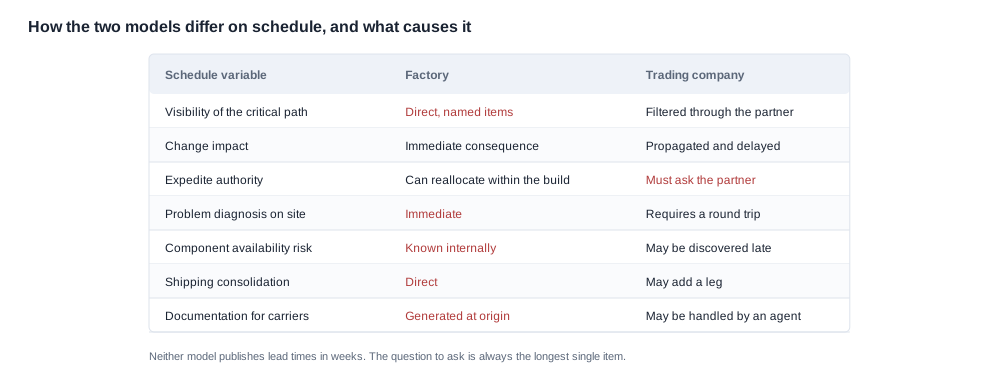
1. Control of the production queue. This is the largest single difference. A factory controls the line, the shift pattern and the order in which runs are scheduled, so when it says three weeks it usually means three weeks on its own schedule, and a delay caused by an upstream component is a delay it can usually reschedule around. An intermediary quotes a lead time that belongs to a site it does not control, and it has to relay the schedule change when that site moves a run. The quoted number can be identical while the reliability behind it is not.
2. Material procurement. The cell, the PCB, the frame and the optics all have their own lead times, and these are frequently longer than the assembly. A factory that holds stock of standard items can start on the assembly queue immediately. A factory that buys to order cannot. An intermediary inherits the position of the site it buys from, and adds nothing to it — except that it may not know the position, because nobody has asked.
3. Visibility of the schedule. A factory can usually tell you where your order is today: at material procurement, in the queue, on the line, in test, or ready to ship. An intermediary can usually tell you that it is on schedule, which is a different and much weaker statement. The practical test is whether you can name the stage your order occupies and who confirmed it.
4. Who can compress the schedule. Compression levers are specific: pre-booked material, an approved golden sample, finished artwork and packaging, a booked inspection, and payment terms that let work start. In a factory relationship, most of these are yours to pull. Through an intermediary, each one has to be requested, and each request becomes a scheduled task for a party that is not doing the work.
5. Who carries a delay. This is the one to write down. If a shipment is late, does the supplier offer a remedy, a revised date, a partial shipment, air freight at their cost, or an apology? The answer depends on who owns the failure, and it should be agreed before the first order rather than discovered during the first shortage.
Notice that none of these five is about speed in the abstract. A well-run intermediary can beat a badly-run factory on delivery, and frequently does for a small order, because it can consolidate and prioritise across sites. The difference is structural, and it shows up in the bad month rather than the good one.

The factory vs trading company lead time difference, decomposed
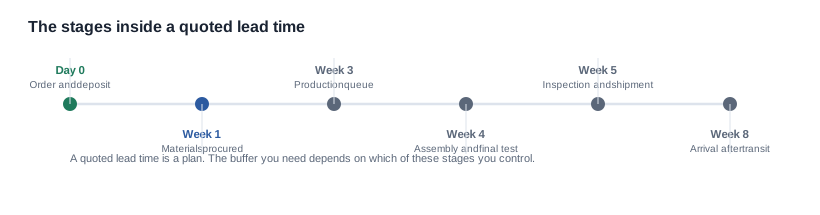
A lead time number becomes useful when it is broken into the stages it contains, because each stage has an owner and each owner can be asked a question.
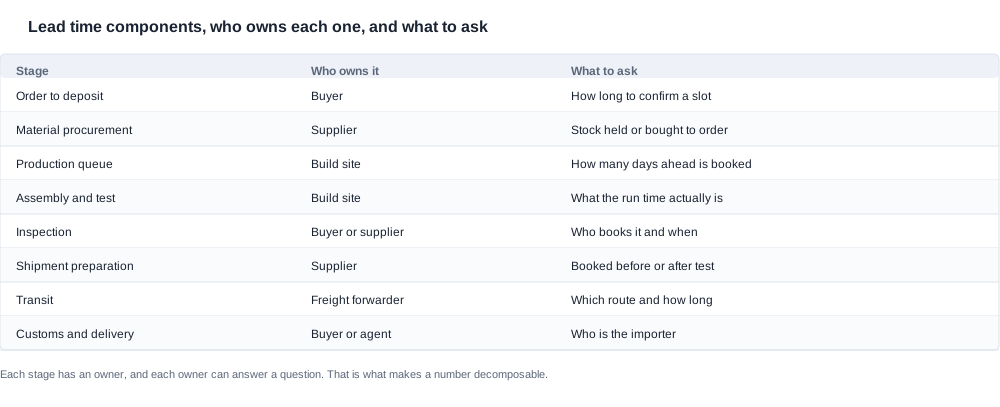
Two stages deserve particular attention because they are where buyers most often lose time without knowing it.
The start of the clock. When does the lead time begin? On the day the order is placed, on the day the deposit is received, on the day the golden sample is approved, or on the day the artwork is signed off? If the answer is "on approval of the artwork", then the real programme includes the artwork cycle, and the artwork cycle for packaging across several markets is often longer than the production run. Ask for the clock's start point and its end point in the same sentence, and write them into the purchase order.
The end of the clock. When the goods are delivered, or when they are on the vessel, or when they have cleared customs? These are different by weeks. A lead time quoted to the port and a lead time quoted to the warehouse are not comparable, and the gap between them is where a launch date quietly disappears.
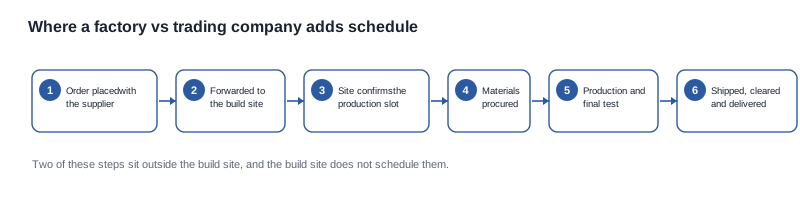
The middle stage is where the two models diverge most visibly. Material procurement, production queue, assembly, final test, inspection and shipment preparation are all things the factory controls and the intermediary relays. Add customs clearance and inland delivery, and you have a chain in which the number of parties determines the variance. More parties does not automatically mean a slower chain; it means a wider distribution of possible delays and a smaller probability that any single one of them is visible to you.
What this produces in practice is not a longer average and a shorter best case. It is a wider spread. And a wider spread is what a buffer has to cover, which brings the arithmetic to the part of the conversation that matters most.
What a factory vs trading company lead time commitment should contain
A lead time in a quotation is a number. A lead time in an agreement is a commitment, and the difference between them is entirely in what surrounds the number.
Seven elements, and they are not negotiable as a set:
- A defined start point — the event that starts the clock, stated as a condition rather than a date.
- A defined end point — port, warehouse, or something named.
- The scope of the quote — which configuration, which volume, which market, which packaging.
- The explicit exclusions — artwork approval, tooling, certification work, inspection by the buyer, label printing, and anything else that is on the buyer's critical path but not on the supplier's.
- The measurement basis — whether the clock runs in calendar days or working days, and whether it pauses for a buyer action. A clock that pauses for a buyer action is the fairest form, because it makes both sides' behaviour visible.
- The remedy for a miss — what the supplier does when the date is not met: a partial shipment, a revised schedule with a stated basis, or freight recovery. Without a remedy the date is an aspiration.
- The reporting cadence — how the supplier tells you where the order is, and how often. This is the cheapest clause in the agreement to write and the one that most changes the experience of a delay.
A further note on documentation. The lead time commitment should reference the configuration it applies to, by the same designation that appears on the specification sheet and on the test report. In our catalogue, model designations are published for the audio, sport, camera and kids ranges, and three entries — AR glasses, electrochromic and bone conduction — carry no model string at all. If your programme includes one of those, the configuration reference in your purchase order has to be something else: a configuration code, a drawing number, or a sample reference. Sorting that out at the quotation stage is cheap; sorting it out during a customs query is not.

The factory vs trading company schedule risk, and who carries it
Risk is not the same as duration, and the two models differ more on the first than on the second.
Duration risk is the chance that the order simply takes longer than quoted. In a factory relationship this is usually a capacity or component problem at a known site, and it can usually be mitigated by a partial shipment or a slot reallocation. In an intermediary relationship the delay may be upstream, at a site you cannot see, and the mitigation may not be available to you at all.
Commitment risk is the chance that a date is given that the supplier never intended to meet. This is not about honesty; it is about who is quoting from a plan and who is quoting from a hope. An intermediary quoting a lead time for a site it does not control is, in a weak market, occasionally quoting the site it hopes will have capacity.
Consequence risk is the damage to your programme if the date is missed, and it varies enormously with your model. A distributor whose channel partners reorder on a fixed cycle carries it badly. A brand launching into a seasonal window carries it worse. A programme with a long reorder horizon and a forgiving channel carries it least.
Detection risk is the chance you learn about the slip late. This is where the intermediary model is most exposed, because the information has to travel back up the chain before it reaches you. A factory can telephone you the day it knows. An intermediary may only know after the factory has told it, and may not treat it as urgent until it has been asked.
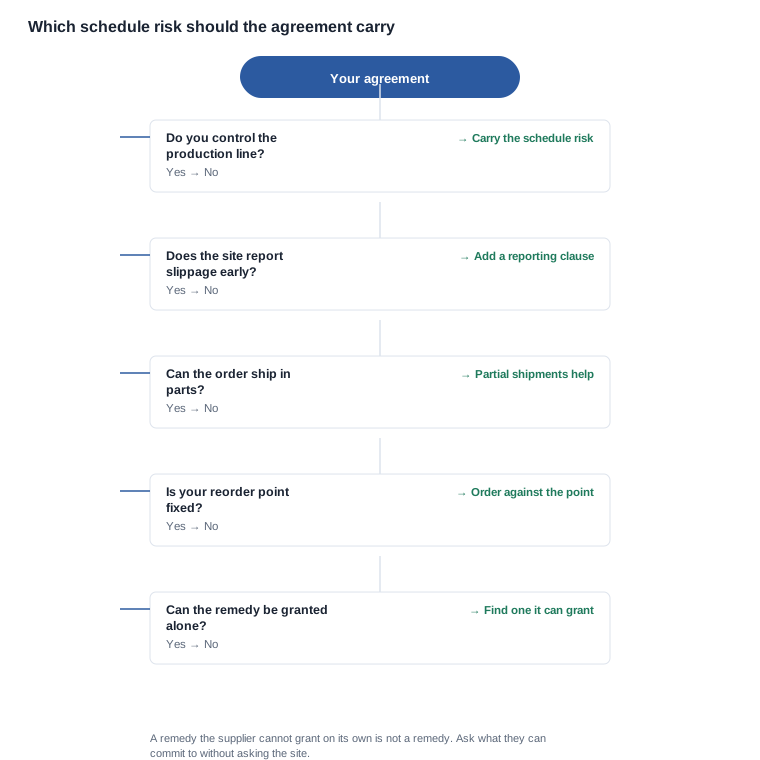
The allocation principle from the cost side applies here too, and it is worth stating plainly: schedule risk should be carried by whoever controls the schedule. Where the factory controls the line, the factory should carry the commitment and the remedy. Where an intermediary controls the relationship but not the line, the agreement should say which of the two absorbs a delay, and should specify a remedy that is within the intermediary's power to grant — a partial shipment, a freight uplift, a credit — rather than one that requires the factory's agreement.
A useful test for any lead time commitment: read it as though the date will be missed, and check that the document tells you what happens next. If it does not, the document assumes perfect execution, and the first miss will be negotiated in the worst possible conditions.

The factory vs trading company schedule negotiation, and the due diligence behind it
Schedule is a term you can negotiate, and most buyers never try, because a lead time is usually presented as a property of the supplier rather than as a condition of the arrangement. It is not. A lead time is the result of decisions about material procurement, queue priority, inspection scheduling and shipping method — and every one of those decisions sits on one side of the table or the other.
The negotiation has three levers, in this order of usefulness.
The start of the clock. This is the cheapest and the most frequently conceded. If the clock starts on deposit rather than on artwork approval, and if it pauses while your packaging is being finalised, you have bought back weeks of calendar time without anyone changing anything about how the product is made. Ask for it explicitly, and expect it to be resisted, because it transfers risk to the supplier.
The reporting obligation. A standing requirement to state where the order is, and by when the next update will come, is a low-cost commitment for the supplier and a high-value one for you. It converts the delay from something you discover into something you manage. In a negotiation this is almost always available, because it costs the supplier little.
The remedy. Harder to obtain and worth more. A partial shipment at your request, freight recovery on a missed date, or a credit against the next order are all things a supplier can often grant without asking the build site. Ask which of the three they can grant, and take the one they can.
The due diligence behind a lead time is straightforward and mostly documentary. Ask for the historical on-time record for your product category, not for the supplier in general, because a good record on someone else's product tells you little. Ask how the supplier has handled a late component in the last year. Ask which stage most often causes the variance. And ask to speak to a customer who has reordered more than once, because a reorder is the only test of whether the second lead time matches the first.
Which model to shortlist for which programme is then a straightforward application of the criteria, and the criteria are worth writing down before the responses arrive. Score each candidate on four things: control of the production queue, how early a slip is reported, whether partial shipments are possible, and whether the remedy is one the supplier can grant alone. Then apply the trade-off that actually matters — a firm specification and a long horizon reward queue control, while a fluctuating demand and a short reorder cycle reward the flexibility to re-size and re-split an order. Most buyers get this backwards, choosing the model that is more impressive on the visit rather than the one that fits the planning regime they will actually operate in.
Planning around a factory vs trading company lead time
Buffer sizing is the practical consequence of everything above, and it is where the difference between the models becomes quantifiable.
Start from the number of stages that can slip, and from who will tell you about each one. Then, for each stage, ask two questions: what is the longest plausible delay, and how likely are you to hear about it early enough to act? The sum of the delays you cannot see coming is your buffer, and it is usually larger for an intermediary relationship than for a factory relationship, not because the factory is faster but because the factory's information arrives sooner.
Do this per stage rather than as a single percentage on the total. A ten per cent buffer applied to a nine-week number is meaningful; the same ten per cent applied to a two-week buffer on the front of the chain is not. The stages at the front of the chain — materials, artwork, approvals — are where a disproportionate share of the variance usually sits, and they are also the stages a buyer can usually control or shorten without asking the supplier for anything at all.
Three planning practices follow, and they work in both models:
- Plan to the worst credible case, quote to the plan. A launch date built on the quoted lead time has no margin at all. Build the plan on a lead time that includes a buffer, and let the quoted number be the case where everything goes well.
- Order against a reorder point, not against a calendar. If you know the reorder point, the lead time determines when you must place the order; if you only know a date, the lead time determines when you panic. The first is a plan and the second is a reaction.
- Keep one lever you can pull. Whether that is a reserved production slot, an air-freight option, or a second source already qualified to the point where a switch is a phone call rather than a project, the value of it is that it makes the buffer optional rather than permanent.
The final observation is about which model suits which planning regime, and it is worth stating because it is counter-intuitive. A factory suits a programme with a long horizon and a firm specification, because the schedule can be planned and the queue is visible. An intermediary suits a programme with a short horizon and a fluctuating demand, because the order can be sized, split and re-sized without renegotiating a factory slot. Buyers who want a factory's control and an intermediary's flexibility usually end up paying for one of them twice.
The practical way to tell which regime you are in is to look at your own reorder pattern rather than at the supplier's capability. If you can name the date you will place your second order before you have placed your first, you are in a long-horizon regime and queue control is worth more than flexibility. If your second order depends on how the first one sells, you are in a short-horizon regime, and flexibility is worth more than a visible queue. Almost every schedule negotiation in this category becomes easier once that distinction has been made, because the buyer can then ask for the thing they actually need instead of the thing they assumed they needed.
The Factory vs Trading Company pillar carries the full model comparison, the engineering customisation page covers the work that sits on the critical path before production starts, and the lead time procurement page covers the contractual side of a delivery commitment.
Related reading
- Factory vs Trading Company — the pillar behind this schedule analysis
- Common questions — the questions that establish who controls the queue
- Cost implications — what a delay actually costs
- How factories actually differ — the stage map behind every lead time
Send us your configuration, volume and target delivery window, and we will tell you which parts of it we can commit to in writing.


