

The word factory is doing a lot of work in this category, and most of that work is being done by buyers rather than by suppliers. When a buyer writes "factory direct" on a request for quotation, they are usually asking for three different things at once: a lower unit price, a shorter route from order to shipment, and a guarantee that somebody actually controls the process. Those three come apart, and the point where they come apart is where the real negotiation lives.
Factories do not all resemble each other. Some run assembly, firmware flashing, calibration and final test under one roof and buy in cells, PCBs and frames. Some run a single assembly line and outsource the test house. Some own their moulding and subcontract everything else. All of them are factories, all of them are legitimate, and they differ in ways that will decide whether your programme works. A factory vs trading company comparison that stops at the label will miss every one of those differences.
So this article does something more granular than the usual model-versus-model framing. It maps the stages where a smart glasses order passes through, shows where control typically sits at each stage, and then asks the practical question: which of those differences actually decides the outcome for your programme, and which are noise.
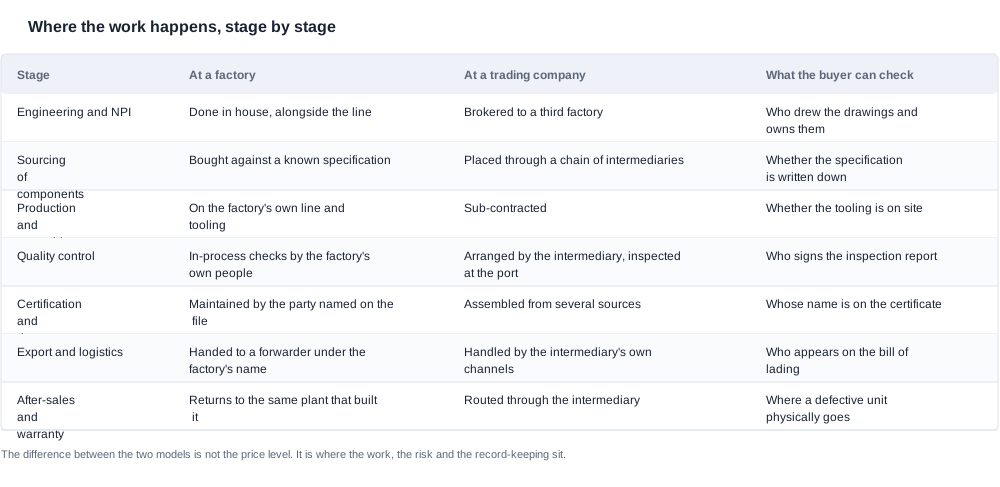
The other half of the article is about reading differences without over-reading them, because in this category there is a strong temptation to treat every difference as a defect. A factory that does not own its moulding is not thereby weaker than one that does. A factory that outsources final test is not thereby less serious. What matters is whether the difference falls inside the part of the order your programme depends on.
Factory vs trading company: what a factory actually controls, stage by stage
Control in this category is not a single thing, and it is better described as a profile than a label. Nine stages carry a unit from a purchase order to a delivered product, and at each one the factory may hold the step, share it, or be entirely outside it.
Cell sourcing. Nobody in this category makes their own lithium cell. Every supplier buys them. The difference between a strong factory and a weak one here is not who made the cell — it is whether the cell part number is specified, whether incoming inspection is documented against that part number, and whether the cell file for transport is available for the exact cell fitted. This is also where a lot of the catalogue variation comes from. In our own range the charging method is published for 24 of the 28 models — seventeen magnetic and seven Type-C — and is not published for CY05 and L1 Pro, and MT6 and CY03.
Frame and optical sourcing. Frames are usually bought from a frame maker, and the optics — lenses, filters, coatings — usually from a lens supplier. The camera glasses in our range carry photochromic lenses on one model only, V03 Pro, with three colour options, and V06 publishes four colours. The number of options a supplier will commit to is a reasonable proxy for how much of that component they actually specify rather than accept.
Tooling. Here the difference is clearest, because tooling is an asset and assets are tracked. A factory that owns the moulds can tell you the cavity count, the shot count and the maintenance history, and can modify the tool. A factory that does not own it will name the partner and arrange the introduction. Neither is a problem, provided the arrangement and the modification rights are in the purchase order.
Assembly. The step most buyers care about, and the one most factories do hold. The question is whether the last operation happens on site and who signs it off.
Firmware flashing. In many factories this is a separate station run by a partner, and it is routinely invisible to the buyer because the unit works. It becomes visible at the moment a firmware version needs to be changed on a partly built batch.
Calibration. Rarely in house at a small factory, frequently in house at a large one, and relevant to any product whose output has to be consistent across units.
Final test and acceptance. Where the acceptance criteria live, and therefore where the quality conversation lives. A factory with its own test station can decide a disposition. A factory without one is dependent on a test house, which means the disposition travels.
Packaging. Bought in as a service more often than owned, and rarely the place where the programme fails.
After-sales disposition. Where a returned unit physically goes, and who can examine it. This is the stage that determines how fast a failure can be diagnosed, and it is usually the last one buyers think to examine.
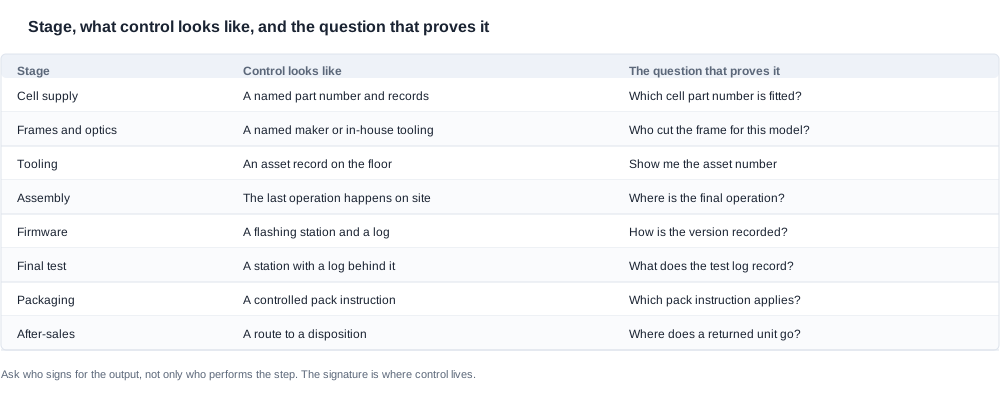
Read across the profile and two things become visible. First, a factory that holds assembly and final test but outsources tooling is a very common shape, and for most programmes it is a perfectly good shape. Second, the stages where control is usually thin — cells, frames, optics, packaging — are the same stages for everybody, which is why they rarely separate two candidates. The stages that separate them are assembly, final test and disposition.

Factory vs trading company: three factory profiles and what each one is good for
Looking at a single factory's profile is still abstract. In practice the factories a buyer meets fall into three recurring shapes, and each one is genuinely good at something and genuinely weak at something else.
The integrated producer. It owns its moulding, runs its own assembly line, does its own flashing and its own final test, and buys in cells, PCBs and standard components. This profile is strongest when the mechanical design is settled and the volume is real: tolerances are controlled in-house, changes are made by the people who made the tools, and a quality problem can be traced in one building. It is weakest at flexibility and at low volume, because the cost structure assumes the line runs.
The assembly and test house. It buys frames and optics, holds or rents tooling, and runs assembly, flashing and final test itself. This is the most common profile in the category and the one that suits standard configurations, competitive unit cost and a programme that needs to move quickly. Its weakness is mechanical: if the requirement involves a mould change, a new frame geometry or a different optical stack, the work leaves the building, and the cost and the delay stop being under the same roof as the line.
The flexible job shop. Small lines, low tooling investment, quick-turn custom work and a willingness to run small batches. This profile is the right answer for prototypes, for market tests and for the first production run of a genuinely new configuration. Its weakness is repeatability at volume, and the discipline a buyer needs to apply: what was proven on the sample line must be proven on the production line, because they are rarely the same process.
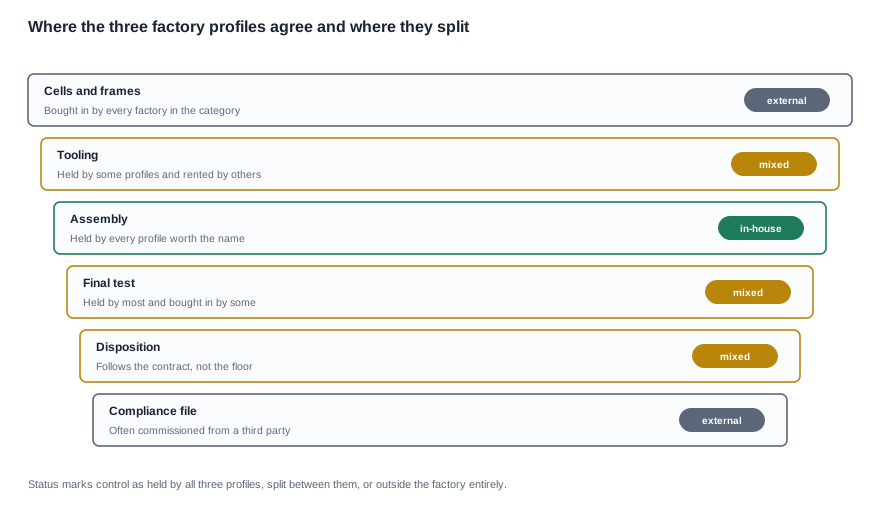
Identifying the profile is a short exercise, and it is worth doing before the price conversation rather than after it. Ask how many lines run the product, whether the tooling is on the floor, whether the final test station is on site, and what the smallest run the plant accepts is. Four answers place the supplier in one of the three shapes, and the shape tells you which negotiation you are going to have.
It also tells you what to negotiate. With an integrated producer, the negotiation is about volume commitments and price tiers, because the cost structure rewards continuity. With an assembly and test house, it is about the mechanical scope — what stays in-house and what is bought in, and at what price each. With a job shop, it is about the transition to volume, and specifically about what has to be true before the production run replaces the sample run.
The one mistake to avoid is treating a profile mismatch as a quality judgement. An assembly and test house asked to do a mould-heavy custom programme is not a weaker supplier; it is the wrong shape for the job. The correct response is to choose a different profile or to narrow the scope, not to add pressure.
The factory vs trading company difference at each stage of the order
The useful question at each stage is not "do they do this" but "who signs for this". A factory that outsources a stage can still sign for the output, because the contract and the acceptance criteria sit with the factory. An intermediary that outsources a stage cannot, because the acceptance criteria sit with the partner who built it. That single distinction is worth more than the whole capability conversation.
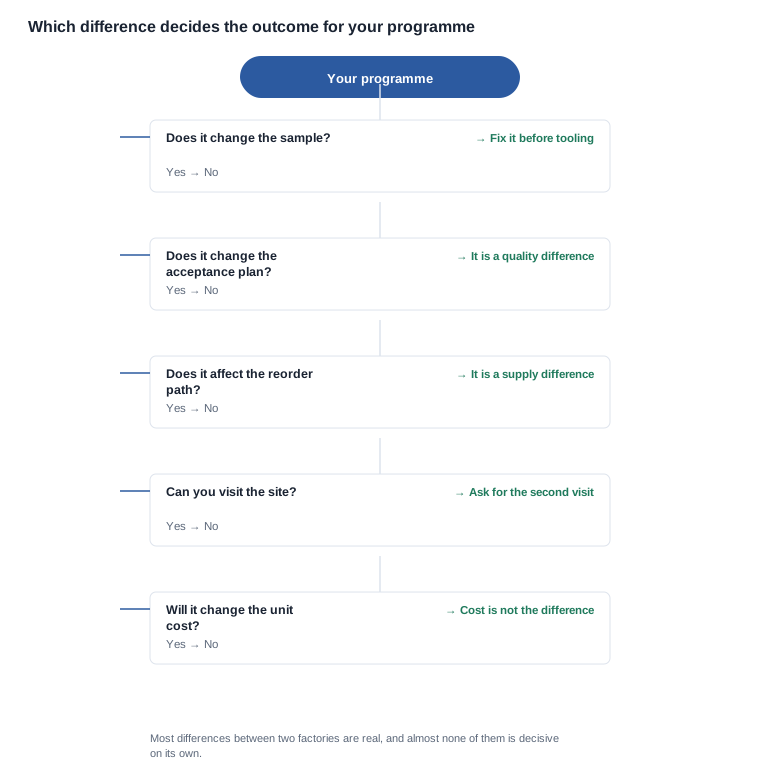
So at each stage, ask three questions in this order. Who performs the step? Who signs for the output? What happens to the output when it fails? If the answers are one entity, one entity and one remedy, control is intact. If they are three different entities, you have three handoffs, and each one adds a day of delay and a slice of ambiguity to any failure.
Applying this to our own range illustrates how much of the question is really about the answer to the third part. In our catalogue, a charging case capacity is published for five models: CY05 and L1 Pro, and CY03 — each at 1400 mAh, L2 Utral at 900 mAh or 1400 mAh, and MT6 at 1200 mAh in a foldable case. KY06 and MT5 have a case but no published capacity. V03 Pro and S7, and V03 and V06 have no case row at all. On the camera models, battery capacity runs from 220 mAh to 290 mAh and the rated runtime is about five to eight hours with no test condition published, so the number is comparable in shape but not in meaning. An ingress protection rating is published for V06 and S7 only. A frame weight is published for MT6 only, at 158 g for the glasses alone, excluding its 1200 mAh foldable case.
Each of those gaps is a place where the buyer has to obtain a commitment rather than read a figure, and each of them is a question with the same structure: who signs for it.
Where the factory vs trading company gap appears in your programme
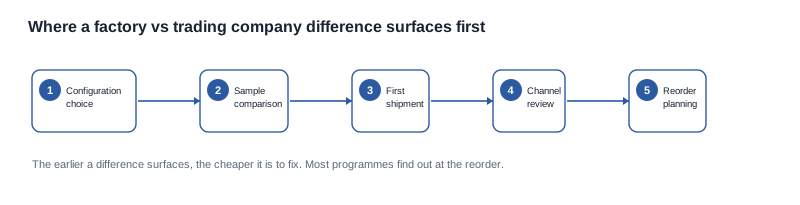
A difference between two factories is only interesting if it lands somewhere in your timeline. There are four moments when it usually does, and knowing them tells you which difference to look for.
At configuration. Two factories may support different configurations from the same starting model, and the gap appears as an engineering answer rather than a quality one. This is where the range structure matters: our catalogue holds eight audio models, three sport models, eleven camera models and three kids models, plus AR glasses, electrochromic and bone conduction entries that carry no model string at all. A buyer who assumed "the camera glasses range" would find that three entries have no model designation and four camera models have no charging-case row at all. Discovering that during configuration is cheap; discovering it after the tooling order is not.
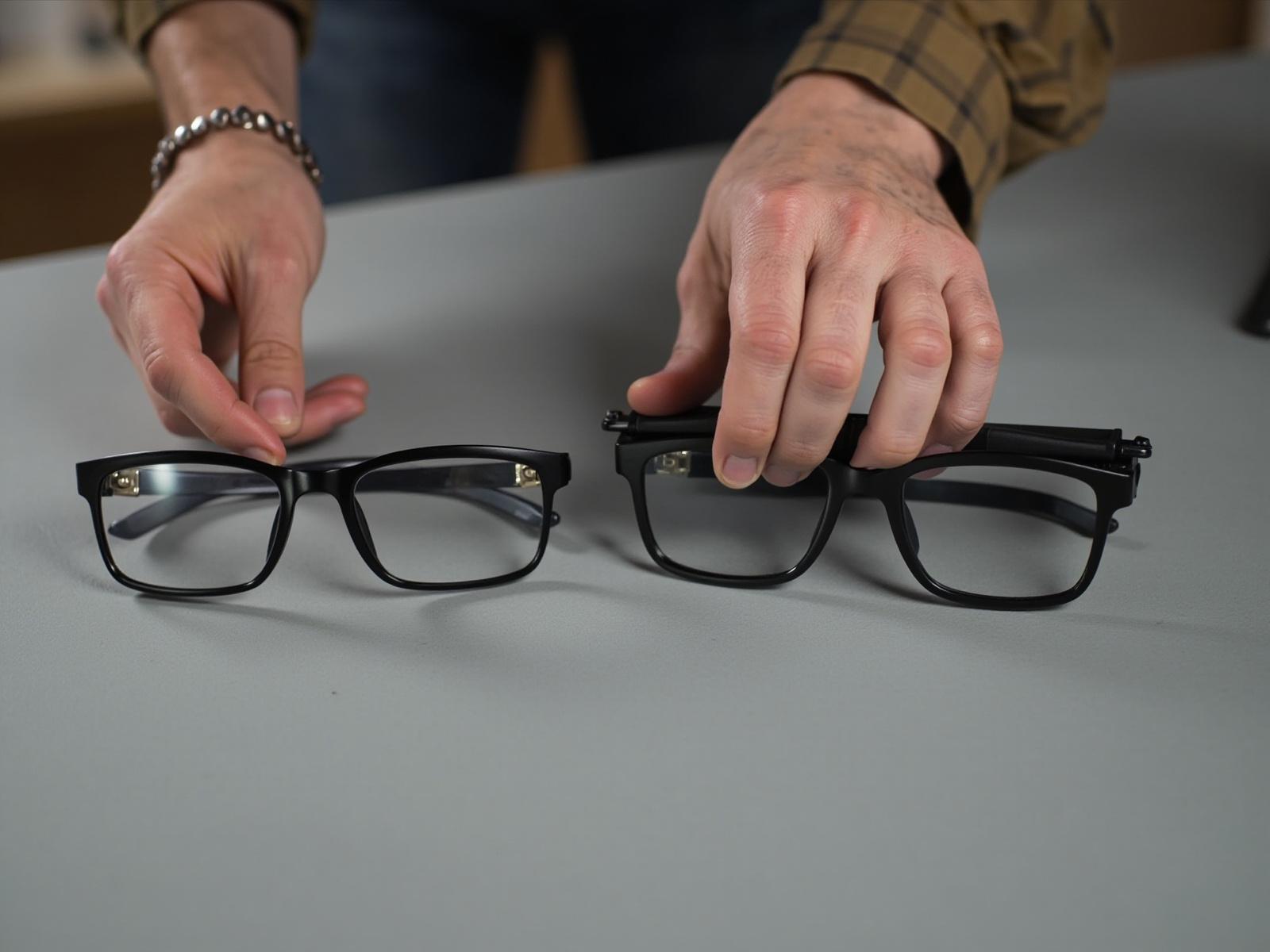
At sample comparison. Two samples from two factories, same specification sheet, will differ in ways the sheet does not describe — in fit, in the sound of the speakers, in how the camera behaves in low light, in how the battery indicator behaves. This is normal and it is not a defect. It is the moment to write the acceptance criteria, because a criterion written after you have seen the samples is a criterion written to fit the samples.
At first shipment. The gap that was theoretical becomes a document problem: the release note, the test report, the model list on the file, the packaging, the labelling for your market. This is where documentation depth is revealed, and it is revealed in a way no questionnaire can anticipate.
At reorder. The most expensive moment, because everything is already committed. The reorder asks whether the site that built the first run will build the second, at the same configuration, with the same files, at a price you have already accepted. If the answer is no, the whole qualification has to be redone.
The practical instruction from this is to schedule a second conversation with each candidate supplier specifically after you have seen their sample and before you place the first order. In a factory vs trading company comparison, that second conversation is where the differences surface while they are still cheap.
The factory vs trading company differences worth checking on a first order
These are the checks worth doing, in the order that produces the most information. Each is cheap, each produces a document or a named answer, and each is available before you commit.
- The build site for your specific model. Not the company address, not the group structure — the site that will assemble your configuration.
- The assembly and final test steps. Are they on site, and who signs the last operation?
- The tooling owner, the cavity count and the modification route. And whether the ownership term is in the purchase order.
- The cell part number, and whether incoming inspection records exist for that part number.
- The firmware version control — how a version change is recorded and applied to a batch.
- The acceptance criteria in writing, with the sampling level, the evidence you must supply, and who pays the freight on a failure.
- The golden sample, and the approval record that references it.
- The document that covers your model in your target market. Read the model list printed on it.
- The after-sales route. Where a returned unit physically goes and who examines it.
- The reorder path. Whether the same site builds the second run, and what would change that.
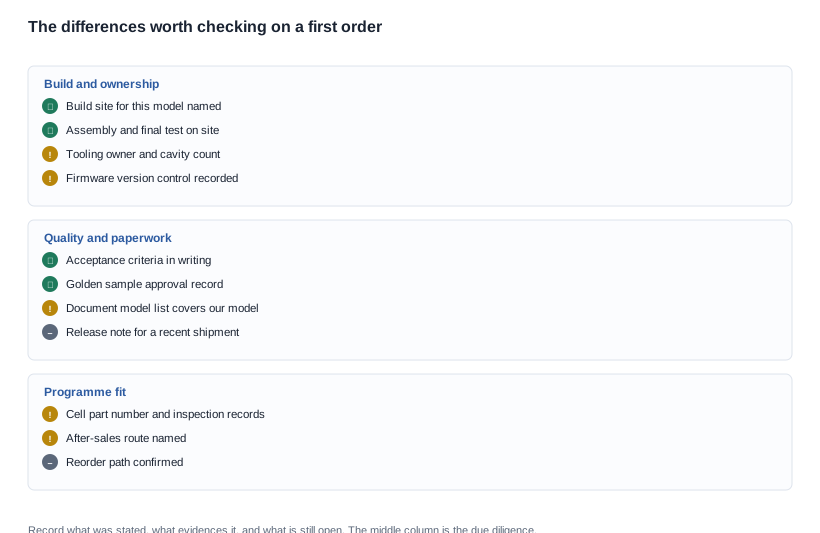
For each check, record three things: what was stated, what document evidences it, and what is still open. The middle column is what turns a capability conversation into due diligence, and it is the column that is empty for most suppliers on a first order — which is itself the finding, and a normal one.
Reading a factory vs trading company difference without over-reading it
The final discipline is interpretive, and it is the one that separates a useful comparison from a list of anxieties.
A difference in control is not a difference in quality. A factory that outsources final test has not thereby produced a worse product. It has moved one step away from itself, and the consequences are concentrated in the speed of a disposition rather than in the product itself.
A strength in one place can be a liability in another. The factory that holds everything in house is slower to change and harder to redirect; the factory that holds little is faster to change and slower to diagnose. Which of those matters depends on whether your programme is stable or still moving, and that is a decision about your business rather than about the supplier.
Documentation gaps are not evidence of weak capability. Our own catalogue is a useful case: it publishes no capacitive-touch row, no AI-feature row, no translation row, no microphone row and no codec row anywhere, and it mentions CE, FCC, RoHS, RED and EN 18031 zero times. Its export-certification page is a picture page carrying ten patent certificate images, eight design patents and two utility models. None of that means the underlying work is not done; it means the catalogue records a subset. Judge a supplier on whether they will put the missing piece in writing for your model, not on whether their website already displays it.
Read the difference against your programme, not against an abstract ideal. The question is never "is this a strong factory". It is "does this difference fall inside the part of the order my programme depends on". For a distributor replenishing a proven model, cell sourcing and firmware control are close to irrelevant and disposition speed is everything. For a brand launching a new configuration with a marketing commitment attached, the engineering answer and the acceptance criteria dominate.
Which one to select comes down to three questions you should be able to answer before you ask any supplier anything: what part of the order does your programme actually depend on, what will you do if that part goes wrong, and how much of the relationship can you afford to replace if it does. Answer those, and the factory vs trading company comparison stops being a search for a mythical best supplier and becomes a search for the supplier whose weaknesses do not overlap your risk. A supplier whose strengths overlap your risk is, in the end, the most dangerous one on the list.
The related material here covers the same ground from different directions: how trading companies operate describes the middle layer from the inside, how to tell the difference gives the six exchanges that establish the model, the cost implications translate these differences into money, and the factory audit questions turn them into questions to ask on a floor. The Factory vs Trading Company pillar holds the full comparison.
Related reading
- Factory vs Trading Company — the pillar behind this stage-by-stage map
- Common questions — the eight diagnostic questions
- Getting started — the first four exchanges, in order
- Red flags — warning signs in a supplier reply
Tell us which stage your programme depends on most, and we will tell you which of these checks we can answer in writing.


