

Almost every supplier comparison begins with unit price, and almost every supplier comparison then stalls, because a price on its own is not a cost. It is one term in a stack of at least a dozen, and the terms that differ most between the two models are rarely the ones printed on the quotation. A tooling charge, a compliance bill, a batch that fails inspection and a quarter of stock sitting in a container are all real money, and none of them appears in the line item most buyers negotiate first.
There is a second problem specific to this category. None of the cost terms that would let you model the comparison are published. Price, minimum order quantity, lead time, sample fee, warranty terms, tooling cost, NRE, payment terms and shipping cost are all unpublished in our catalogue, and they will be unpublished at most suppliers too until you ask. A buyer who is shown a comparison table with confident numbers in it is being shown someone else's assumptions.
So this article does something less dramatic and more useful. It sets out the full cost stack, identifies which lines genuinely move between the two models, gives a method for quantifying the trade-off without a single fabricated quotation, and finishes with the sequence of questions to ask before you compare any two numbers at all. The short version: a factory vs trading company comparison is not a price comparison, it is a question of which costs you are able to carry yourself.
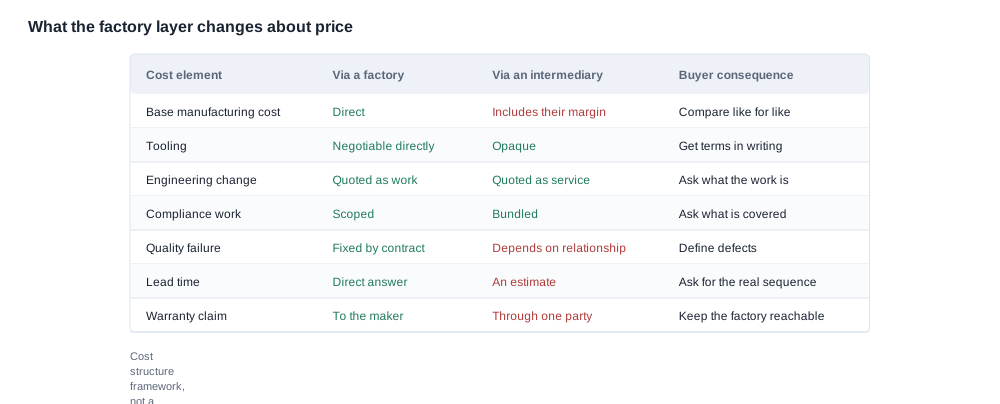
Factory vs trading company: where the cost actually sits in each model
Both models end up with the same physical product in your warehouse. The difference is in the twelve or more accounts that surround it. Reading them as a stack, in the order the money actually leaves the business, is the most reliable way to see which model is cheaper for your programme.
Non-recurring engineering and design. The cost of getting your configuration to exist at all: mechanical changes, PCB changes, firmware, a new industrial design or a colourway. This is the largest single line in a first programme and it is almost always understated in early conversations, because it is quoted as a range or as "to be confirmed". A factory typically quotes it directly because it controls the engineering resource. An intermediary has to obtain it from a partner and usually cannot commit to it without the partner's involvement, so the number arrives later and moves more easily.
Tooling. Moulds, dies, jigs and fixtures. Tooling is a capital asset with a real life measured in shots or cycles, and it is the line where the two models are most transparently different in ownership terms. A factory owns the tooling, tracks it, maintains it and can tell you its age. An intermediary holds none and will name the partner who does. For the buyer the cash cost may be similar; the difference is who controls the asset, who can modify it, and who can release it at the end of the programme.
Unit price at the agreed volume. The line everyone negotiates first. The volume break points in this category are steep, because component cost, cell cost and assembly time all scale differently with quantity.
Minimum order quantity and its consequence. MOQ is not a price, it is a commitment of cash. A small MOQ lowers the entry barrier and raises the per-unit cost of every line that does not scale with volume: your own qualification time, your own packaging work, your own listing photography, your own compliance file.
Working capital in transit. The gap between paying and receiving. Longer lead times and worse payment terms both extend it. For a business with a thin margin this is often the single largest number in the comparison, and it never appears in a quotation.
Inspection and testing. Pre-shipment inspection, third-party inspection, sample rounds, golden sample approval. A factory can usually run an incoming and outgoing check on its own floor; an intermediary has to schedule someone else's time.
Cost of a failure. A batch that fails inspection, a shipment that misses a launch window, a specification change made after the golden sample, a compliance document that does not cover the shipping model. These are the costs that decide a relationship, and they are the ones a price comparison is blind to.
After-sales and warranty handling. Whether a defective unit goes back through the same party that built it, and how long it takes to be dispositioned, is a cost driver as much as a service question.
Logistics and duty. FOB or DDP, who is the importer of record, how the duty is calculated on the declared value, and what happens to the declared value when the two parties disagree about it.
Compliance. Certification, testing, the technical file, the responsible person in the destination market. Here the honest starting point for our own catalogue is worth stating plainly: we publish no per-model certification row, no Declaration of Conformity and no compliance document, and we mention CE, FCC, RoHS, RED and EN 18031 nowhere in the catalogue body. Our export-certification page is a picture page showing ten patent certificate images, eight design patents and two utility models. That is a fact about our documentation, and it is also a budget line you must price for yourself, because the work of producing a compliance file for a specific model is yours to commission and to pay for.
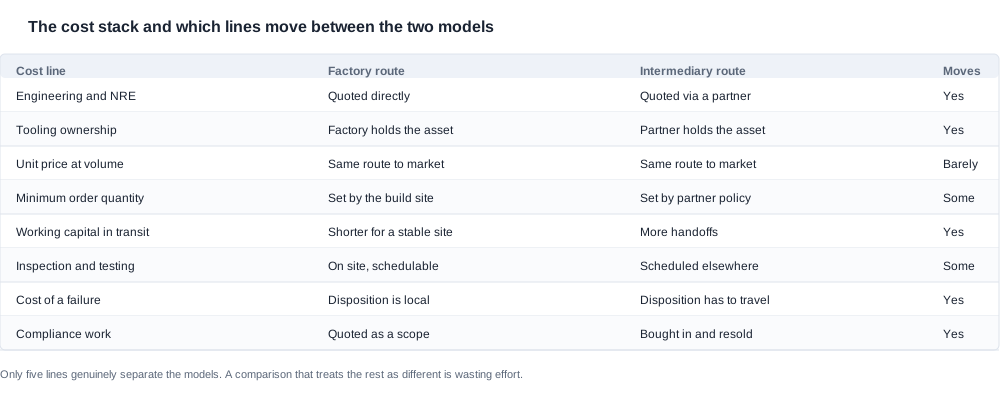

The factory vs trading company cost lines that move, and the ones that do not
Not every line on that stack discriminates between the models. Some are identical because the underlying operation is identical, and a comparison that treats them as different is wasting effort.
The lines that genuinely move are the ones tied to control of information and control of assets: NRE, tooling ownership and modification, the speed at which a non-obvious answer arrives, the disposition of a failed batch, and the ability to hold a delivery date. These five are where the commercial difference between a factory and an intermediary actually lives.
The lines that barely move are the ones tied to the physical product and the route to market: unit price at a given volume, the cost of the goods in transit, the duty and freight, and most of the after-sales handling if the unit itself is identical. An intermediary does not buy your product more cheaply. If a quotation suggests it does, the difference is usually in the specification, the volume assumption, the payment terms or the inclusion of a service you have not asked for — and all four of those need to be unwound before the number means anything.
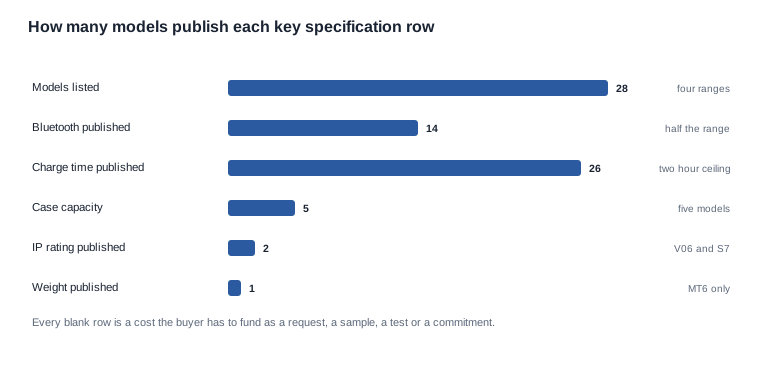
The chart above is the catalogue in one picture, and it is a fair proxy for the problem. Of the 28 models in our range, a Bluetooth version is published for 14 and not for the 11 camera models, A05, A06 or the bone conduction entry. A charge time is published for 26, with a ceiling of two hours or less, and only D17 and ZH12 publish about one hour. A charging case capacity is published for five models. An ingress protection rating is published for two, V06 and S7. A frame weight is published for one, MT6 at 158 g for the glasses alone.
Every one of those blanks is a line in the cost stack that the buyer must fund as a request, a sample, a test or a commitment. A supplier who publishes a thin specification sheet and a supplier who publishes a thick one are not being judged on quality — they are being judged on how much of the cost you have to find out yourself. The number of rows a supplier will put in writing is a direct measure of how much of your development budget they are carrying.
That is a more useful way to read a catalogue than a capability claim, and it is the reason we have never replaced a blank row with an estimate.

Quantifying a factory vs trading company trade-off without inventing numbers
The temptation with a cost comparison is to model it immediately, and the reason buyers end up with invented numbers is that they model it before they have the inputs. The inputs do not exist yet at quotation stage, which is why any model built that early is a guess wearing a spreadsheet.
The alternative is to build the model around what you can learn, and to learn it in a defined order. Take the following as an illustrative structure rather than a quotation — every figure below is a placeholder chosen to show the arithmetic, and none of them is our price, our MOQ or our lead time.
Suppose a first programme of 5,000 units, and suppose the two candidates differ by an amount in unit price at that volume, a fixed engineering and tooling charge, a minimum order quantity, and a lead time expressed in days. The arithmetic that matters is a break-even: at what quantity does the fixed charge stop dominating the unit difference?
- If the unit difference is small and the fixed charge is large, the break-even sits high, and a 5,000-unit programme sits below it. The factory route looks more expensive on paper and is the correct answer anyway, because the alternative is a fixed charge you never amortise.
- If the unit difference is large and the fixed charge is small, the arithmetic favours the intermediary and the difference survives every volume increase.
- If the volume is uncertain, the decision is not arithmetic at all. It is a negotiation about who carries the downside of a slow start.
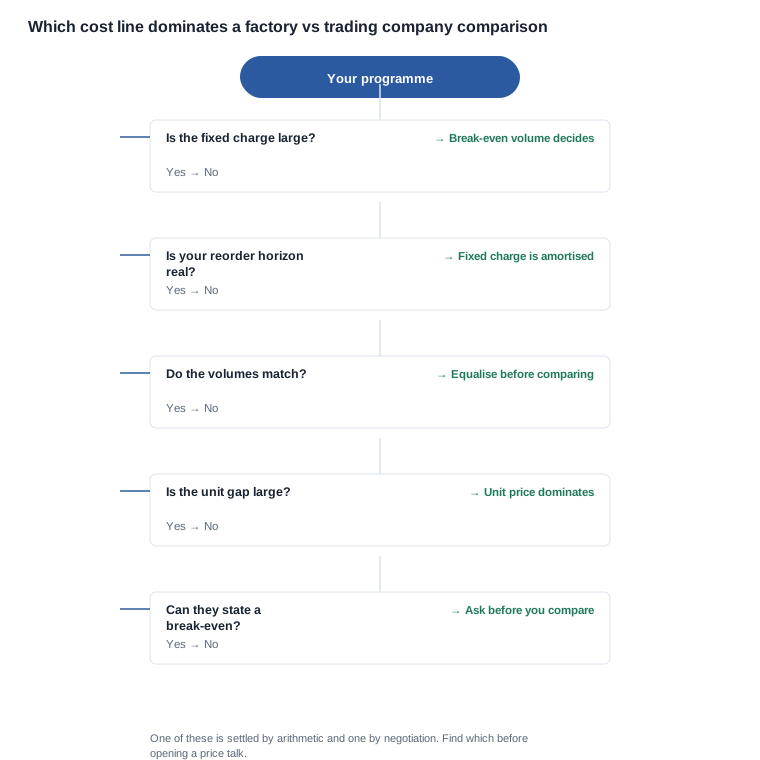
Two things break this model in practice, and both should be stated before the numbers are collected. The first is that the unit price difference is usually quoted at a volume the supplier expects, not the volume you need, so the comparison is a comparison of two different assumptions until the volumes are equalised. The second is that the fixed charge is rarely the same shape for both candidates: a factory may quote NRE and tooling separately and be flexible about recovering it over a second run, while an intermediary's charge may be bundled, fixed and non-negotiable in practice even if the conversation suggests otherwise.
The useful output of this exercise is not a number. It is a shortlist and a set of negotiation levers:
- Break-even volume, computed from your own programme, and then asked of each candidate directly. A supplier who cannot state a break-even is telling you the fixed charge is not really fixed, which is itself an answer.
- Which line you intend to make the subject of negotiation — the unit price, the fixed charge, the MOQ, or the payment terms. Four suppliers will otherwise negotiate four different lines and you will compare four different things.
- The volume at which you would reorder, which is the number that decides whether a fixed charge is worth paying. If your reorder horizon is short and your first order is small, the fixed charge is being amortised over a programme that does not exist yet.
- The cost of being wrong in each direction — a delayed launch versus an over-committed fixed charge — priced in the terms your business actually uses.
The last one matters most for distributors. For a brand with a funded launch and a real reorder horizon, the fixed charge is an investment. For a distributor buying on a sell-through forecast, the same fixed charge is a risk, and the trade-off lands somewhere else entirely.

Cost risks in a factory vs trading company programme, and who carries them
A cost comparison describes the expected case. The decision is usually made by the tail.
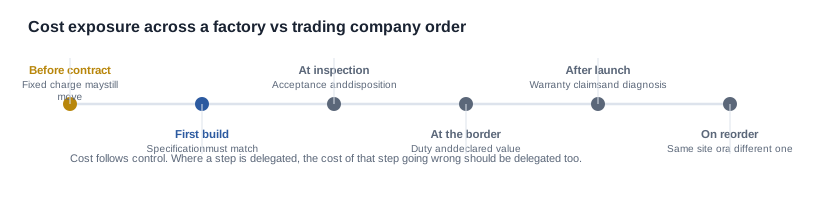
Before the contract. The risk that a quoted fixed charge moves after you have committed marketing spend to the launch date. This risk belongs to whoever cannot yet name the build site, which in practice is the model with the most partner layers.
During the first build. The risk that the specification you approved is not the specification that ships. The mitigation is a golden sample: a signed-off unit that both sides keep, and the benchmark every later dispute is measured against. Where the sample has to travel between a partner and the contracting party, the transport and the handling add cost that nobody budgets.
At inspection. The risk that a batch fails acceptance and the disposition takes weeks because the decision has to travel to a partner who did not build the units and does not carry the cost of the failure. The remedy for this is contractual, not procedural: name the acceptance standard, the evidence the buyer must supply, who pays the freight, and whether the remedy is replacement or credit, in the purchase order rather than in a later email.
At the border. The risk that the declared value on the paperwork is not the value you expected, and that the duty and the delay fall on you. If the commercial model does not include the party that handles customs and duty, that risk sits with you by default.
After launch. The risk of a warranty claim that must be diagnosed remotely by someone who never touched the unit, and of a failure rate that arrives too late to be caught before the channel inventory is committed. A supplier that built the product can usually diagnose from a symptom faster than one that has to relay the question.
On a reorder. The risk that the second run comes from a different site with a different configuration, and that your published photographs and listing copy no longer match the product in the box.
The allocation principle is simple and worth putting in the negotiation: cost follows control. Where you retain control of a step, you retain the cost of that step getting wrong. Where you delegate the step, delegate the cost with it — in writing, with a named owner, a named remedy and a date.
The factory vs trading company cost question to ask before you compare quotes
The cost conversation usually starts too late. By the time two quotations are on the same page, the buyer has already spent weeks and has an anchoring problem, because the first number seen becomes the reference point for everything afterwards. The cost question has to be asked earlier than feels comfortable.
The right question is not "what is your unit price". It is "which costs do you carry and which costs do I carry, and what happens to each of them if the programme goes differently than planned". That question produces a supplier's cost structure, it is answerable before any quotation exists, and it does not commit you to anything.
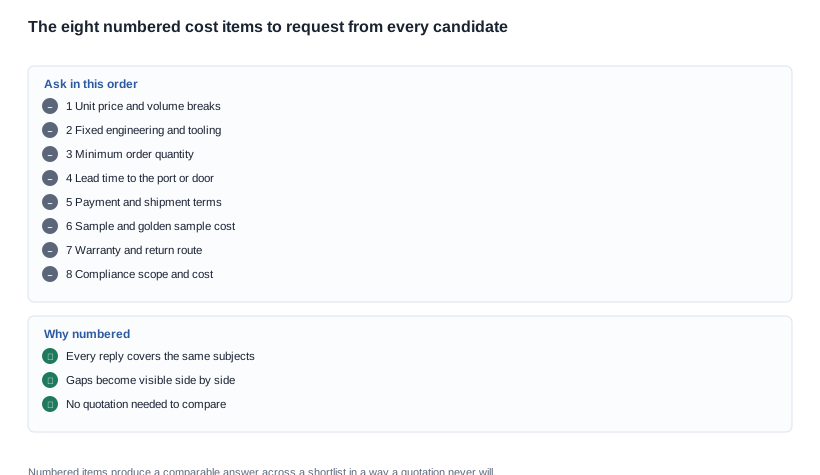
In practice, send this as a numbered list and ask for a numbered answer. Nothing on our own side is published, so the request is the same in both directions:
- The unit price at our programme volume, and the volume breaks.
- The fixed engineering and tooling charges, split by category and by who owns each asset.
- The minimum order quantity, and what the practical consequence is below it.
- The lead time, and whether it is quoted to the port or to the door.
- The payment terms and the shipment terms, including who is the importer of record.
- The sample and golden sample cost, and the acceptance standard to be applied.
- The warranty terms, the return route and the expected disposition time.
- The compliance work required for our target markets, quoted as a scope and as a cost.
Eight numbered items produce a comparable answer across a shortlist in a way that a quotation never will, because the numbering forces the same eight subjects into every reply.
On the negotiation itself, the discipline is to make one line the subject. Negotiating price, MOQ and payment terms simultaneously in a first exchange produces a supplier response that improves each of them slightly and confirms none of them, and it tells you nothing about which of the three was genuinely flexible. Pick the line that your own model says is largest at your expected volume, and negotiate that one hard. The others can move afterwards, once you know what moved.
Two closing observations. First, the cheapest option on paper is frequently the one that transfers the most risk to you, and the transfer is invisible in the quotation. Second, if two candidates differ in cost but the difference disappears once you price the unresolved items — the unnamed build site, the unissued compliance document, the unstated acceptance standard — then the comparison was never between prices. It was between levels of written detail, and it should have been run as a document request from the start.
That is the same due diligence discipline described in the factory vs trading company checklist, applied to the cost lines rather than to the capability claims. The customisation depth article covers how much of the NRE line you can avoid by choosing a platform that is closer to your target, and OEM risk factors covers the risk allocation points that sit underneath both. The Factory vs Trading Company pillar holds the full comparison.
Related reading
- Factory vs Trading Company — the pillar behind this cost comparison
- Common questions — the eight questions that establish the commercial model
- Quality documentation compared — what each document type can actually prove
- Red flags — warning signs in a supplier response
Send your programme volume and target markets, and we will answer the eight numbered items in the same order.


