

A red flag is a signal, not a verdict. That distinction matters more in this category than anywhere else, because the alternative is worse: a buyer who treats every ambiguity as evidence of bad faith ends up either over-paying for a cautious supplier or walking away from a good one at the wrong moment. The useful skill is not suspicion. It is the ability to name the unresolved fact behind the signal, decide whether it can be closed in writing, and then decide whether it should be.
Red flags in the factory versus intermediary conversation have a specific character. They are rarely lies. They are gaps in specificity, presented confidently. A supplier who says "we have an experienced factory" has not lied. A supplier who says "our certificates cover all our products" has not lied either. Both statements are compatible with a perfectly good supplier who has not been asked a precise question, and both are incompatible with a buyer who has to know what is covered before a shipment leaves the country.
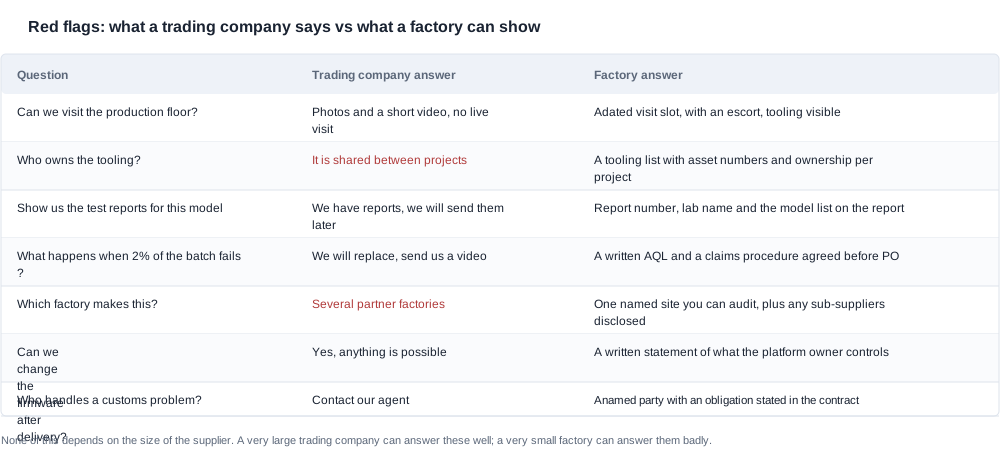
This article is organised as a triage rather than a list of warnings. The first three sections collect the signals by where they appear — in the reply, in the documents and on site, and in the commercial terms. The last section does the work that matters: separating the signals that should end the evaluation from the ones that belong in a clause.
One framing note on our own position, because a supplier that publishes a thin catalogue is itself an example of the phenomenon. Our catalogue mentions CE, FCC, RoHS, RED and EN 18031 nowhere. It publishes no per-model certification row, no Declaration of Conformity and no compliance document. Its export-certification page is a picture page carrying ten patent certificate images — eight design patents and two utility models. We say this plainly rather than because it is a red flag in anyone else's file, but because it illustrates the central point: a document is worth what it covers, and a page of certificates is worth what a certificate covers, and those are different questions.
Factory vs trading company: the signals that appear in the first reply
Eight signals, in roughly the order they appear in a normal first exchange.
- A reply that answers an adjacent question. The brief asked for a model with a charging case in the box; the reply describes camera models with high resolution. It is not evasion, and the answer may even be relevant. But the supplier has demonstrated that it answers around the question rather than on it, and that pattern will repeat. Test: ask the same question again in one line, and see whether the second reply addresses it.
- An address with no site. A registered office, a business centre, a headquarters. Every factory has a production site and the absence of one in the reply is the absence of an answer. Test: which building makes our units.
- A document that names no model. A test report or a certificate whose model list is absent, generic, or covers a family. It looks like evidence on the page and proves nothing about your variant. Test: find your variant in the list.
- A certification claim with no number. Marks rather than documents. Test: which document, which issuing body, which number, which model list.
- A price before a specification. A unit price in the first reply, before anyone has agreed what the product is. It is either a catalogue price for a standard configuration that is not yours, or an anchor for the negotiation. Both are worth knowing; neither is a basis for a decision. Test: ask which configuration the price is for.
- A free sample with no acceptance criteria. Generosity that has not been defined. Nothing in the catalogue is published about sample fees, so "free" is a statement about a commercial term rather than about a product. Test: what does the sample have to pass, and what happens if it does not.
- A production line with no bottleneck. "High monthly capacity" with no cycle time, no station and no shift pattern. The capacity is real somewhere; the claim is about a plant rather than about your model. Test: which station sets the schedule, and at what cycle time.
- A range summary in place of a per-model answer. The single most common signal in this category, and the hardest to spot because it looks thorough. A page listing every model and every feature, with no row marked as absent, is a page assembled from other pages. Test: ask for one model, one row set, with the blanks marked.
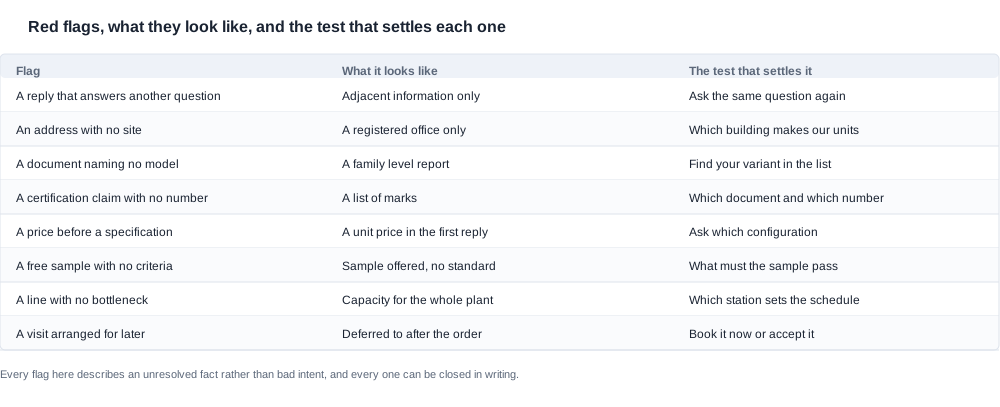
None of these eight proves anything about quality or capability. All eight describe the same underlying condition, which is that a specific fact has not been produced. That is why the test column matters more than the flag column: every one of them can be closed with a single written answer, and the supplier's willingness and speed in closing them is the real signal.

The factory vs trading company red flags that look harmless and are not
The most expensive signals in this category are the ones that sound like accommodating. Each of these is a normal, reasonable-sounding sentence that quietly moves a question into a later and less convenient time.
"We can arrange a visit once the order is placed." Completely reasonable to say, and it defers the single most informative activity in the evaluation to the moment when you have committed money and have nothing left to learn. The test: ask whether a site visit is possible before the purchase order. If the answer is that it can only happen after, understand what that means and price it.
"Our certifications are available on request." Available on request means the request is what produces the document, and the document may name a different model. The test: name the model and the market and ask for the document itself, not an assurance that it exists.
"Samples are free of charge." Sample terms are commercial terms. Our sample fee is not published, and neither should it be assumed. Free samples without an acceptance criterion and a cost schedule are a way of moving the negotiation to a stage where the buyer is emotionally invested in the unit.
"We have been doing this for many years." A statement about the company, not about the product, the site or the model. Long experience in this category frequently means experience with other people's programmes rather than with yours. The test: how long have they built this exact model.
"We work with several partner factories." Often entirely true and frequently said to make a strength sound like a network. The question it raises is which one builds your units, and the fact that it was not volunteered is itself mildly informative.
"The lead time is flexible." Flexible in which direction, and at whose cost? A flexible lead time with no start point and no remedy is a lead time that will move. The test: ask what makes it flexible and what happens when it is not.
"We will introduce you to the factory." Whether the site is introduced before or after the order changes what the introduction is worth. Before, it is due diligence. After, it is a courtesy.
The common feature of all seven is a shift of timing. The supplier has not refused; it has moved. Each is closed the same way, which is to ask for the thing now, in writing, with a date attached.
The factory vs trading company red flags found in documents and on site
Documents and sites produce a different species of signal, because they are where claims become checkable.
In documents, the recurring patterns are:
- A model list that excludes your variant. A family-level report where your configuration sits outside the list. It may be a hair's breadth — a different cell, a different lens, a firmware branch — and it is the difference between a compliant shipment and one that is held.
- A certificate whose scope names a different legal entity than the one you are contracting with. Group companies, sister factories and renamed entities are all normal, and all of them matter.
- A work instruction at an earlier revision than the specification you have approved. This is the most alarming of the document signals because it suggests the process is not version-controlled.
- Incoming inspection records that begin after the period you would have seen. A folder containing three months of records when the site has been running for a year.
- A release note for a shipment that does not carry your model, offered as an example of the documentation.
- A compliance document that is actually a patent certificate. Our own export-certification page is the clean illustration of the confusion: ten patent certificate images, eight design patents and two utility models, with no certification row anywhere in the catalogue. A patent proves an invention was registered; it does not prove that any product conforms to anything, and it cannot be presented as if it did.
On site, and on video, the patterns are:
- Access arranged by the sales contact, with the production or quality manager present only for the opening.
- A floor that has been cleared for the visit — no work in progress, no half-finished units, no rejects visible. A working floor is untidy; an empty one is staged.
- A line that cannot be described in operation. Operators who cannot say what station they are responsible for.
- Rejects in a bin that have been there a long time, which tells you the site does not remove them, or that they are not real.
- Quality staff who defer to the commercial person on every question.
None of these requires you to catch anyone out. They are the questions you ask when the documentation and the site do not corroborate each other, and the pattern worth naming is the absence of corroboration: a supplier whose documents are impeccable and whose site is vague, or the reverse.

Red flags in the factory vs trading company commercial terms
The commercial terms are where red flags are most often smuggled, because they arrive looking like standard terms.
- A lead time with no start point. What begins the clock — the order, the deposit, the artwork approval, the golden sample? Without a start point the number is decoration.
- A lead time with no end point. To the port, to the warehouse, or to the customer's door. These differ by weeks, and the gap is where a launch date goes.
- Payment in full before production starts. The risk is entirely yours for a period during which nothing has been made. Ask for a structure that matches the stages.
- No acceptance criteria in the purchase order. A rejection later becomes a negotiation about two different products.
- No remedy. A date with no consequence attached is an aspiration, and it will be met when it is most convenient for the supplier.
- No tooling ownership term. Who holds the moulds, who can modify them, and what happens at the end of the programme. A factory will answer this one quickly, which is why the silence from an intermediary is informative.
- A price valid for a short period with no stated basis. A seven-day validity means the price is expected to move, and it tells you the quote was constructed rather than derived.
- No deviation clause. Nothing stops a change to the materials or the sub-suppliers arriving as an invoice.
- No confidentiality or ownership terms on a custom programme, where your own design work is at stake.
Each of these is fixable in a clause, and the negotiation is straightforward once the clause is named. The red flag is not their presence; it is the absence of any reaction to them.

The factory vs trading company red flags that only appear under pressure
The signals in the first reply are the visible ones. The consequential ones appear later, and they appear in the gap between what a supplier says it will do when things go wrong and what actually happens when they do.
There are five pressures worth watching, and they are worth watching in both models because both models fail differently under them.
A late component. A cell does not arrive, a frame batch is rejected, a PCB has a defect. The question is not whether it happens but who tells you and when. A factory that owns the line can see the shortfall before it reaches the schedule. An intermediary learns about it at the same time as you do, unless the site has been instructed to report directly, which is worth asking for in writing during the first order.
A forecast that doubles. Your channel partner commits to a volume you did not plan for. Does the supplier accept it, at what price, and on what lead time? This is the clearest test of whether you have a relationship or a transaction, and the answer arrives fastest here.
A failed batch. Some units fail inspection. Who decides what happens, how fast, and at whose cost? An intermediary's disposition decision belongs to a site it does not control, and the question "how long does a disposition take" is answered differently from "how fast can you dispatch a replacement".
An angry channel partner. A distributor is unhappy with a shipment and wants an explanation, a credit or a replacement by Friday. Whether the supplier absorbs the conversation or passes it to you is the clearest possible demonstration of what you are paying the middle layer for.
A regulator or a certification body asking for more. A document is queried, a test report is challenged, a market authority asks for something the file does not contain. The supplier who has done this before has an answer; the supplier who has not has a delay.
None of these can be triggered honestly in a first evaluation, and deliberately provoking them damages the relationship you are trying to assess. What can be done is to ask about them, because the way a supplier tells a story about a failure is itself a signal. Ask two questions: tell me about a time a shipment went wrong and what happened, and can I speak to a customer who was affected. Then check the answer against three things — whether the story has dates in it, whether there are documents behind it, and whether the supplier was the party that did something about it. A story with no dates, no documents and no supplier agency is a story the supplier was not in.
The reference call is the strongest signal available and the one most often declined. A supplier who declines a reference call, or who offers a reference who cannot discuss a failure, has told you that the failures are either rare, hidden or someone else's. Any of those three is worth knowing before you place an order, and the first two are worth knowing a great deal.
Triage: what a factory vs trading company red flag actually means
This is the section that matters, because a list of warnings is only useful if it ends in a decision.
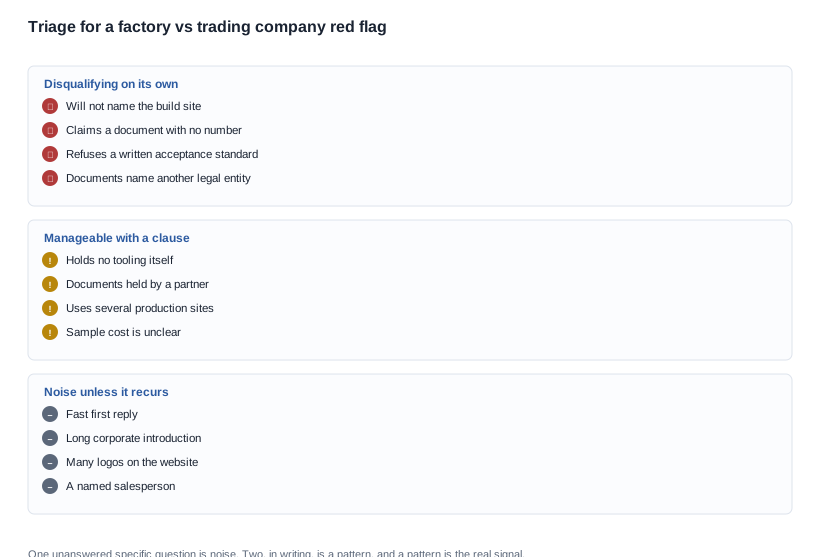
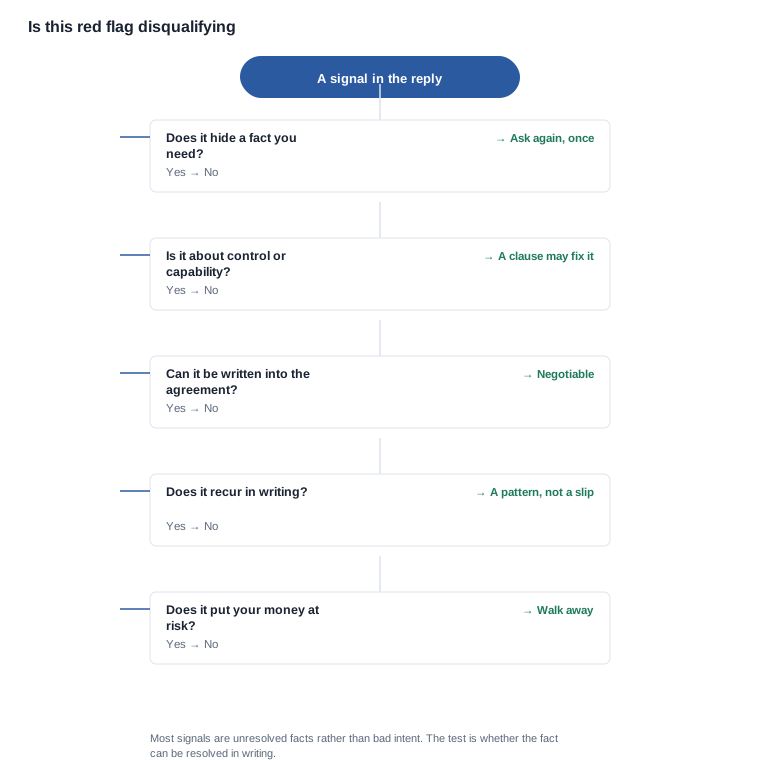
Disqualifying on its own. A supplier who will not name the build site in writing, who refuses to state what is covered by a document they have offered, who will not accept a written acceptance criterion, or whose documents consistently name a different legal entity. These are not gaps; they are refusals, and refusals tend to be consistent.
Manageable with a clause. A supplier who holds no tooling itself, whose documents sit with a partner, who uses several production sites, whose sample cost is unclear, or who offers a visit after the order. All of these are ordinary features of an intermediary model and all of them can be handled in the purchase order — provided you have handled them rather than discovered them.
Noise unless it recurs. A fast first reply, a long corporate introduction, a lot of logos on a website, a named salesperson who answers everything quickly. None of these is a signal in either direction. The only time they become one is when a specific, checkable question goes unanswered twice.
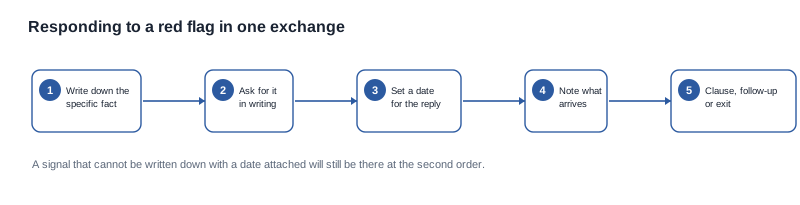
The triage procedure itself is short, and it is the same every time:
- Write down the fact you do not have. Not the impression — the fact. "Which site builds our units." "Which model the certificate lists." "When the clock starts."
- Ask for it in writing, in one line, with a date. One question per message, because a list invites a brochure.
- Record what arrives against what was promised. The answer, the format, and the date.
- Decide on one of three actions: close it with a clause, escalate it once with a deadline, or drop the supplier.
The escalation step matters. A single unanswered specific question is noise; two, in writing, is a pattern. The pattern is what distinguishes a busy supplier from a supplier who is avoiding something, and it is the only evidence you will get.
The last point is about timing. A red flag that appears in the first reply is cheap. The same flag appearing after the deposit is expensive, and appearing after the first shipment is fatal. Which means the evaluation is a race of a sort — not against the supplier, but against the point at which you stop asking. Every day of unanswered questions is a day of declining leverage, and the cost of the signal rises sharply as the programme commits.
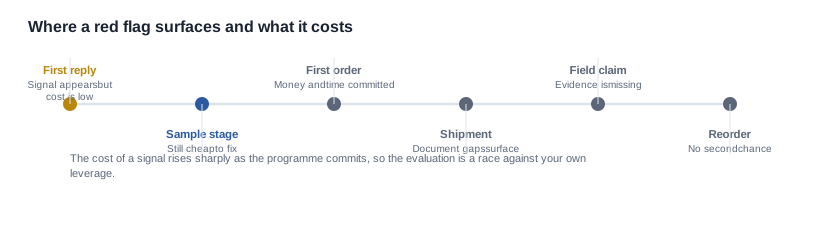
Which is the argument for doing the red flag work early, while it is still cheap, and for treating a supplier who answers the triage list promptly as evidence of something beyond diligence. A supplier who closes four specific facts in writing in one exchange is telling you how the relationship will work when something goes wrong. That is worth more than any capability statement, and it is the one thing a factory and an intermediary can both do.
The Factory vs Trading Company pillar carries the full comparison, the OEM and ODM overview covers the engagement models themselves, and the certification checklist covers the document side in more depth.
Related reading
- Factory vs Trading Company — the pillar behind this triage
- Common questions — the diagnostic questions to run first
- Quality documentation compared — what each document actually proves
- How trading companies operate — the middle layer described fairly
Send us the specific facts you cannot get an answer on, and we will answer them in writing.


