

Documentation is the part of a supplier relationship that outlives the relationship. The people who negotiated the price have moved on; the specification sheet, the test report, the release note and the work instruction are still on the shelf, and when a customer asks in eighteen months whether the product in their hand was built to a controlled method, those documents are the answer or the absence of an answer. Which is why the quality documentation a supplier produces is one of the most revealing things about them, and one of the least examined.
The factory versus intermediary question sharpens the point rather than blurring it. A factory can generally produce its own records, because the records are created by the processes it controls. An intermediary can usually obtain them, because the site creates them, and there is an important difference between a document that arrives from a site and a document that is created by the site and handed over. The content may be identical. The provenance is not, and provenance is what determines whether a document can be audited later or merely accepted once.
This article works through what each kind of document actually proves, because the most common failure in this category is treating a document as evidence of something it was never evidence of.
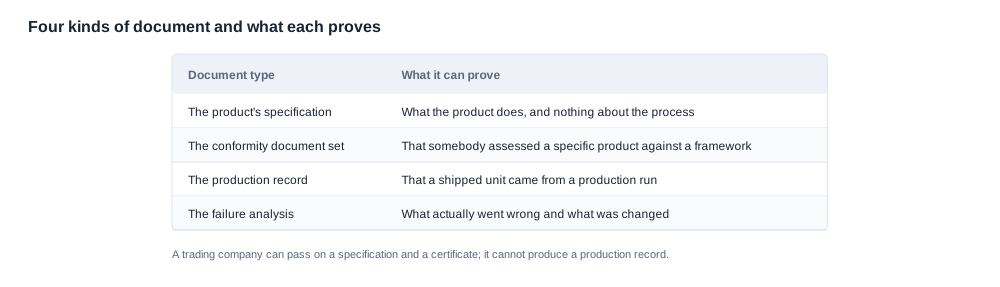
One clarification that belongs at the top, because it changes how a catalogue should be read. A published specification is documentation. A compliance document is documentation. A patent certificate is documentation of a completely different kind, and the two are routinely presented side by side as if they said the same thing. They do not, and the difference is worth understanding before anything else.
Factory vs trading company: the document ladder, and what each rung proves
Documents can be arranged into a ladder, and each rung proves more than the one below it. The practical value of the ladder is that it gives you a way to ask for the next rung instead of accepting the one on offer.
Rung one — a mark on a website. "CE certified", "FCC compliant", "RoHS". This proves that someone put a claim on a page. It proves nothing about a model, a date or a document. It is a starting point for a request and nothing more.
Rung two — a certificate for a family or a company. A real certificate, with a number, an issuing body and a scope. It proves that the holder met a management or product requirement at the time of issue. It says nothing about whether your particular variant is inside the scope, which is exactly what the model list is for.
Rung three — a report with a model list. A test report that names the models it covers. This is a substantial step up, because the model list is the part that connects a document to a product. A report whose model list is empty or generic is not much better than a certificate, however impressive the laboratory name.
Rung four — a report that names your model and your variant. The document you actually need. If your product differs from the certified variant in a radio implementation, a firmware version, a lens or a battery, then rung four becomes rung three again for your purposes, and the gap has to be closed with a new assessment.
Rung five — a release record for an actual shipment. A release note, a packing list with a test reference, a shipment-specific document. This proves something different in kind: not that the product can conform, but that this consignment was checked against a stated criterion before it left.
Rung six — the controlled process documents. The work instruction for your model, the incoming inspection record for the cells, the calibration certificate for the test station, the golden sample approval. These are not product documents at all. They are process documents, and they are the only ones that tell you what happens on a Tuesday when nobody is visiting.
Rung seven — the underlying data. Test measurements, capability data, the raw results behind a summary. Rarely available and rarely needed, but the reason the summary documents exist at all.
The ladder also explains the difference between the two models. A factory climbs it internally — the documents are in its own filing system and can be produced in an afternoon. An intermediary has to ask somebody else to climb it, which means the response time is set by a third party's calendar and the provenance is always second-hand.

Reading a factory vs trading company document for the model you are actually buying
The single most valuable thing a buyer can do with a quality document is read the model list. It takes thirty seconds and it changes the meaning of everything else on the page.
A test report covering "the BT-5 series" tells you about a family. If your product is the BT-5 and your product is only the BT-5, you are in good shape. If your product is the BT-5 with a different cell, a different firmware branch or an added radio module, you are not, and the report does not cover what you are shipping.
Four readings to perform on any document you are given:
- The identity line. Model, model family, variant, and the electrical configuration if one is stated. A document that names no model at all proves less than a document that names one, and a document that names a model list covering several tells you your job is to locate yours within it.
- The date and the validity. A report has a date; a certificate has an expiry. An old report proves that a product once met a method, and tells you nothing about the batch on the water now.
- The scope. What was tested and what was not. A radio report does not cover mechanical safety; a battery report does not cover the radio. Where a document covers one aspect of your product, it says nothing about the rest.
- The issuer. Whether it is a first-party document from the site that built your units, a laboratory document, a document the supplier wrote about itself, or a photograph of something somebody else produced. Provenance decides whether it can be audited.
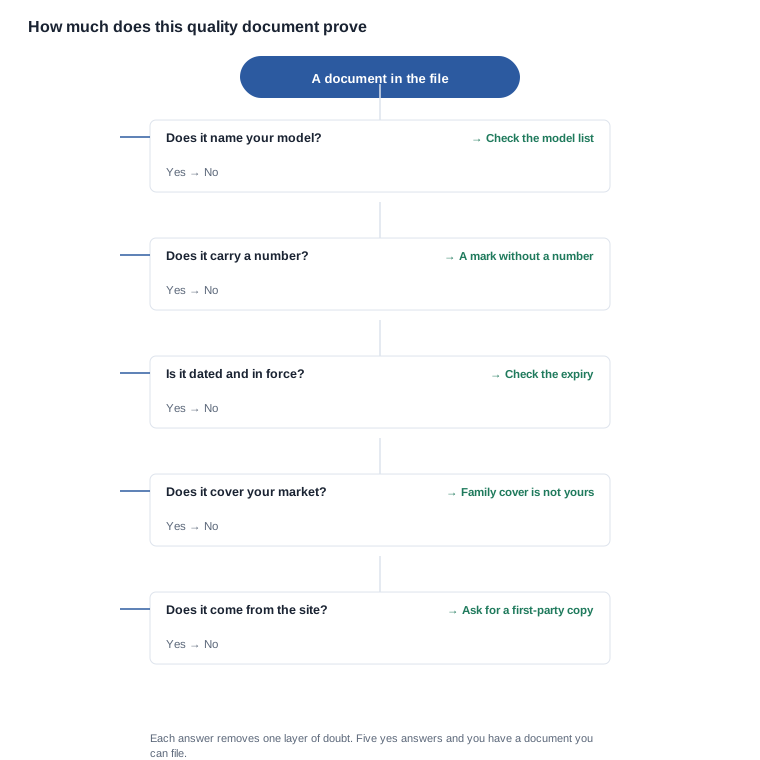
On the fourth reading, worth a note: a document produced by the site and forwarded by an intermediary is stronger than a document produced by the intermediary, because it can be verified directly. A document produced by the intermediary about the site is weaker than either, because it can only be verified by asking the intermediary whether it is accurate. This is a small distinction on day one and a large one on the day you have to prove something.
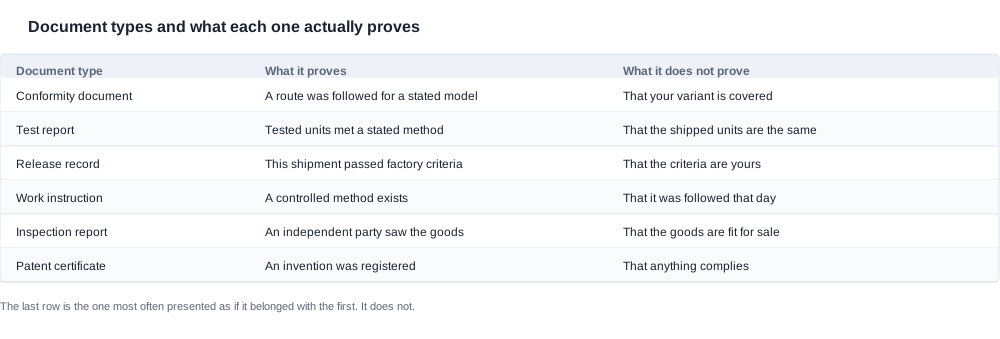
And on patents, the point that so often gets lost. A patent certificate proves that an invention was registered in a jurisdiction, with a holder and a subject matter and a date. It does not prove that any product conforms to any requirement, that any test was performed, or that the certificate covers your model. Our own export-certification page is exactly this: ten patent certificate images, eight design patents and two utility models, with no per-model certification row, no Declaration of Conformity and no compliance document of any kind. That page is worth something, and it is worth something different from what a compliance file would be. Presenting it as the second would be a mistake, and a buyer who asks to see it described as a certificate of conformity has been misled.

What a factory vs trading company catalogue does and does not document
The most useful documentation a buyer will ever receive is a specification that is already written, already consistent and already published. It costs the supplier nothing to send and it removes an entire layer of enquiry. It is worth being precise about what our own catalogue contains in this category, because the pattern is instructive.
Rows we publish, per model. A charging method for 24 of the 28 models — seventeen magnetic and seven Type-C, with CY05 and CY03, and L1 Pro and MT6 not published. A charge time for 26 models, with a ceiling of two hours or less, and about one hour for D17 and ZH12. A charging case capacity for five models: CY05 and CY03, and L1 Pro — each at 1400 mAh, L2 Utral at 900 mAh or 1400 mAh, and MT6 at 1200 mAh in a foldable case; KY06 and MT5 have a case with no published capacity; V03 and V03 Pro, and S7 and V06 have no case row at all, and a row that is not printed is a question for the supplier rather than a documented position. A Bluetooth version for 14 of 28 models, not published for the 11 camera models, A05, A06 or the bone conduction entry. Camera resolution of 8 MP for eight camera models and 13 MP for S7 and L1 Pro, and L2 Utral. Camera battery capacity from 220 mAh to 290 mAh with a rated runtime of about five to eight hours and no test condition published. An ingress protection rating for V06 and S7 only. A frame weight for MT6 only, at 158 g for the glasses alone, excluding its 1200 mAh foldable case. Surround audio published for D11, D17 and ZH12. Photochromic lenses for V03 Pro only, with three colour options; V06 publishes four colours.
Rows we do not publish at all. There is no capacitive-touch row, no AI-feature row, no translation row, no microphone row and no codec row anywhere in the catalogue. There is no test condition behind the runtime figures. There is no per-model certification row, no Declaration of Conformity and no compliance document of any kind, and CE, FCC, RoHS, RED and EN 18031 are mentioned nowhere in the catalogue body.
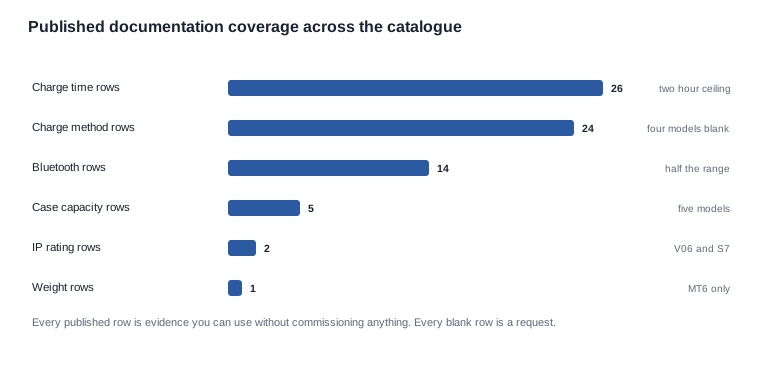
Read that as a documentation profile rather than as a list of gaps. Every published row is a piece of evidence you can use without commissioning anything. Every blank row is a document you have to request, and a request has a cost in time that is invisible in the unit price. That is the practical measure of a supplier's documentation maturity: not how many claims they make, but how much of what they claim they have already written down.
The same logic applies to the commercial terms, which are all unpublished in our catalogue: price, minimum order quantity, lead time, sample fee, warranty terms, certificate numbers, production capacity, tooling cost, NRE, test conditions, payment terms and shipping cost. A supplier whose specification sheet is complete and whose commercial terms are blank has given you the cheaper half of the answers and charged you for the expensive half.

The factory vs trading company document request, in the order that reveals the most
A request sent as a single sentence — "please send your quality documentation" — returns a marketing pack. A request sent as a numbered list, in the order below, returns evidence. The order is chosen so that each answer either satisfies the next question or tells you where to push.
- The specification for your exact model, per model, with unpublished rows marked. Not the range summary. The rows that are blank, marked as blank.
- The test report for that model, with the model list visible. Ask for the page that shows the models covered, not a summary.
- The market document for that variant in each of your target markets. One document per market, with the model list read against your variant.
- The release note or equivalent for a recent shipment of that model. This is the rung-five document, and its existence tells you the site produces them routinely.
- The current work instruction for that model. Ask for the revision number as well as the document.
- Incoming inspection records for the cells used in that model. A cell part number and a date range.
- The calibration certificate for the station used at final test.
- The golden sample approval record.
- Any certificate the supplier holds for the company, with its number, scope and expiry, so it can be checked against the legal entity and the site.
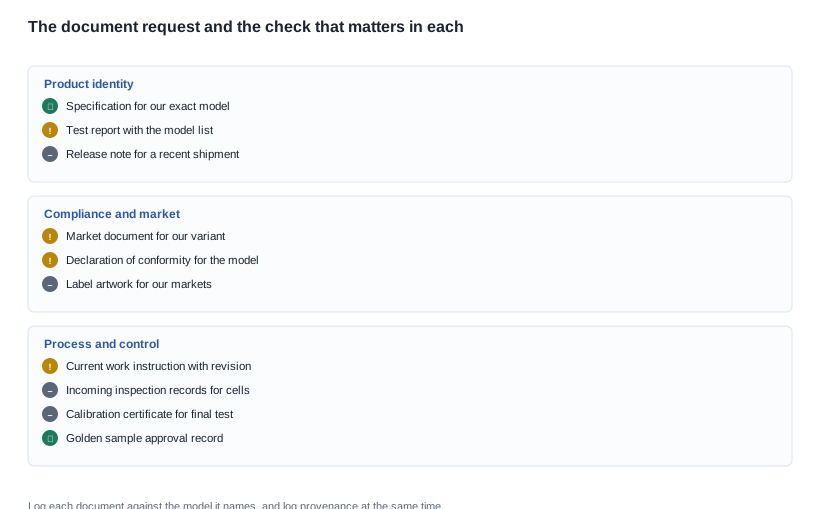
Two rules govern how you process what comes back. First, log each document against the model it names, not against the supplier who sent it, because a supplier can hold six documents and have them apply to none of your units. Second, log provenance at the same time, so that when a document is needed again in a year you know whether it can be re-verified at source or has to be accepted on trust.
Now the harder part, which is what to do with the items that come back as "not available". There are three legitimate reasons and one that is not.
The document does not exist for your model. This is the most common and the least alarming. It means the assessment was never done for your variant, and it has a cost and a timescale: the assessment itself has to be commissioned, and until it is finished, the row on your specification sheet is a gap. Price that gap and put it in the schedule rather than in the hope that it will not be challenged.
The document exists but is held by someone else. A laboratory holds the report, a certification body holds the certificate, a partner site holds the process records. This is common with an intermediary and it is not a refusal. Ask for the holder, the reference number and the date, and ask whether a copy can be released to you directly. A supplier who cannot do that but will tell you who holds it has still given you something workable.
The document exists but is out of date. An expired certificate, a report for a superseded variant, a work instruction at an earlier revision. Ask what has changed since. If the answer is nothing, it may be a paperwork issue; if the answer is a component change, the document is worthless for your purposes and the request becomes an assessment.
The document is refused. A supplier who will not produce a document that exists is telling you something about how the relationship will work when a claim is filed. That is not a documentation problem, it is a commercial one, and it belongs in the scorecard rather than in a follow-up email.
The due diligence judgement that follows is narrow and practical. A supplier who answers nine items with seven and marks the other two as unavailable has given you more usable information than a supplier who answers all nine with a brochure. A supplier who marks every one of the nine as available and produces them is rare, and if you find one, that is worth knowing too.
When a factory vs trading company documentation gap becomes expensive
Four situations account for most of the cost of a documentation gap, and they are worth anticipating because each one has a cheap preventative answer.
A design change after the golden sample. The approved configuration changes, and the documents describe the old one. The cost is a re-assessment, a new release cycle and a delay that lands on your launch. Prevention: a written change-control clause that says a change to the specification triggers a documentation review before production continues.
A market that rejects the file. The goods clear the first market and are held in the second because the document covers a variant you are not shipping. The cost is storage, duty, demurrage and a channel partner asking difficult questions. Prevention: read the model list for every market before the first shipment, not after the first hold.
A warranty claim with nothing behind it. A customer returns a unit and the supplier asks for evidence of the defect. If the acceptance criteria were never written down, the disposition becomes a negotiation about two different products. Prevention: an acceptance standard with a named remedy, agreed before production, and a golden sample that both sides hold.
A second source that cannot be qualified. You need a second source because the first one cannot deliver, and the documentation cannot be transferred because it names a specific model built by a specific site at a specific date. The cost is a full re-qualification at exactly the moment you have no time for it. Prevention: ask early whether a family-level document exists that a second site could be assessed against, and whether that assessment has been done.
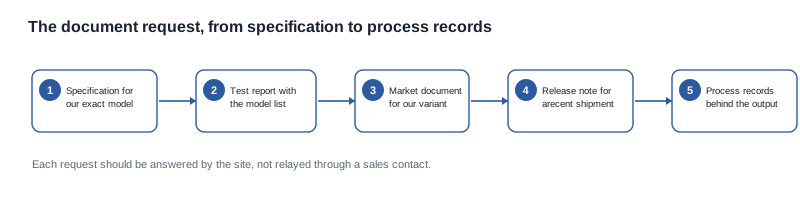
The closing point is about the difference the two models make to all of this, and it is a modest one. In practice a well-run intermediary can assemble a document set as complete as a factory's, because the documents come from the same site either way. What the intermediary cannot do is change them, or produce them faster when they turn out to be wrong, or produce one for a model that the site never built. If your programme depends on documentation being right rather than merely present, that is the point at which the difference between the two models becomes real, and it is a point worth discovering before the shipment rather than after the hold.
The related material here covers the surrounding practice: the production line questions establish who the site is before you ask it for records, the OEM documentation article sets out the minimum set from the buyer's side, and lifecycle support covers what has to be in place after the shipment, which is when the documents start to be used. The Factory vs Trading Company pillar carries the full model comparison.
Related reading
- Factory vs Trading Company — the pillar behind this document ladder
- Factory audit questions — the same checks, asked on site
- Common questions — the questions that identify the site
- Red flags — warning signs in a documentation response
Tell us the model and the markets, and we will tell you which of the nine documents we can produce today and which we have to request.


