
A buyer does not usually need the laboratory procedure. What a buyer needs is the supplier's answer to it, because the answer tells you whether the supplier knows what the rating covers — and in this category that distinction separates a tested product from a marked one.
The mechanism is not complicated. An ingress protection rating is produced by a defined test regime: the product is assembled in a specific configuration, exposed to a defined condition for a defined duration, and then inspected for the entry of water or dust against a stated criterion. What varies between suppliers and between claims is not the regime — it is the configuration, the condition and the criterion. Those three, plus the edition of the standard, are the whole substance of the question.
Our published position in this area is worth stating with the same care, because it is narrower than a buyer might expect. The V06 and the S7 carry an IP54 marking in the catalogue, and no third-party test report number is published for either. Every other model in the range publishes no ingress marking at all, and no charging case in the range carries one. No test method, no laboratory and no report is published for any product in our range.
So how is ip tested faq has two answers: the method, which we can describe, and our own position, which we will describe exactly rather than approximate.
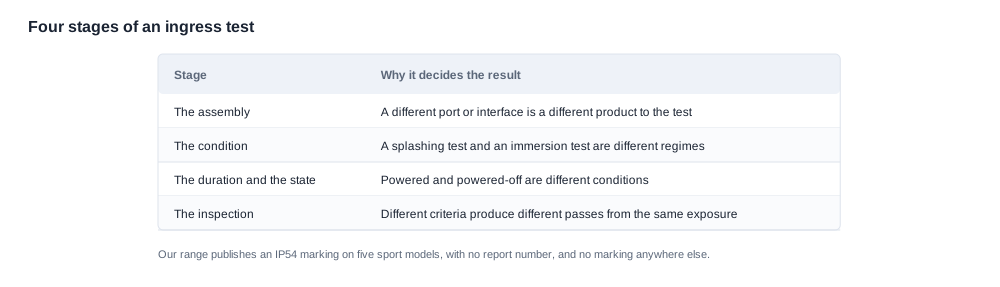
How is IP tested: the four stages of an ingress test
Stage one is the assembly. The product is assembled in a specific configuration, and this is the stage that decides whether the result describes anything a buyer will receive. A sealed port where the tested unit had an open one, a different charging interface, a different accessory fitted, a different case — each of these is a different product to the test, and each of them is invisible in the resulting number. The report, if you get it, states which configuration was tested. If it does not, the result describes something.
Stage two is the condition. The exposure itself. A dust test and a splashing test and a jet test and an immersion test are different regimes with different durations, different flow rates and different equipment, and the second digit of the marking tells you which regime was applied. A 4 is a splashing condition, and it is the least demanding of the water conditions in common use. A buyer who reads "IP54" as "can be rained on for an hour" has already upgraded the rating by several steps without noticing.
Stage three is the duration and the state. How long the exposure lasted, and what state the product was in while it happened — assembled, powered, at rest. A powered state is a more demanding condition than a powered-off one, and the difference matters for a product with an active lens, a live radio or a charging contact. The state also decides whether the result is about a product sitting on a bench or a product in a pocket.
Stage four is the inspection. What is looked at afterwards and what counts as a failure. Water inside the enclosure. A functional failure. A visible ingress. A loss of seal integrity under magnification. Different criteria produce different pass results from the same exposure, and the criterion is the part most often left unstated — which is why the failure-criterion question below is the one that most reliably reveals whether a test was a formal procedure or a demonstration.
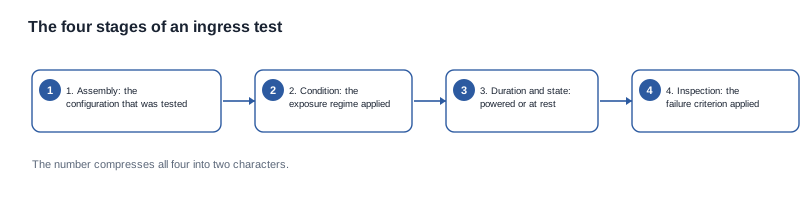
The flow above is worth keeping in front of you when a supplier quotes a rating, because each stage is a place where a rating can be true of something other than your product. The stages are not equal in risk. The assembly and the criterion are where most of the practical ambiguity lives, because they are the two things a copywriter is most likely to omit.
How is IP tested when two suppliers give you two different ratings
This is the situation that makes the question real, and it has a short answer: compare the reports, not the numbers.
Two suppliers can both be entirely honest and still quote different ratings for two products in the same family. The reasons are all in the four stages above, and they are worth naming because each one points at a different document.
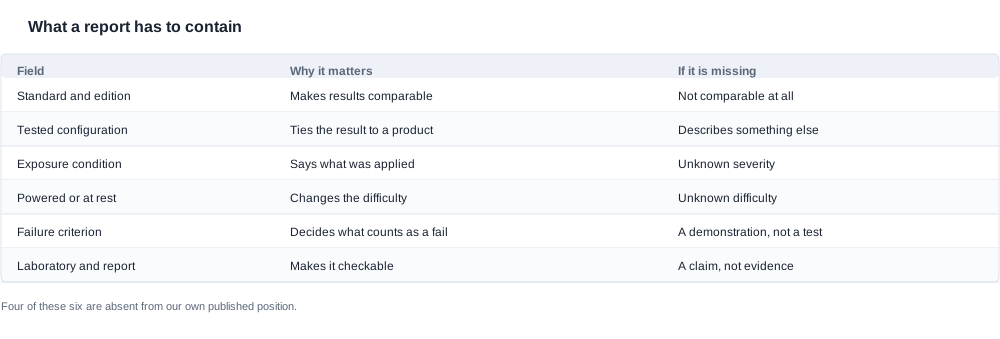
The table above lists the fields a report has to carry for a buyer to be able to compare it with anything. A rating without the standard and edition behind it is not comparable, because the editions differ in detail and a rating from an older edition may describe a different exposure.
Two suppliers quoting the same two digits can still differ on all four rows in that table, and each difference changes what the rating means for your product. One supplier tested with the charging port capped and the other tested with it open; one used a powered state and the other used a resting state; one applied a strict functional criterion and the other accepted a visual inspection only.
The buyer-facing consequence is specific: the ratings are not comparable, so the shortlist comparison you were about to run on the numbers was not a comparison of like with like. And the fix is cheap — it is a request for two documents, one from each supplier, each carrying the fields in the table.
There is a fourth reason two suppliers can differ, and it is the one buyers forget: the tested sample was not the product. A rating can be inherited from a previous model, from a development sample, or from a larger product in the same family whose enclosure happens to be the same size. The only protection against this is to check the model list on the document against the exact designation you are buying, and to check whether the configuration on the document matches the configuration on your purchase order.
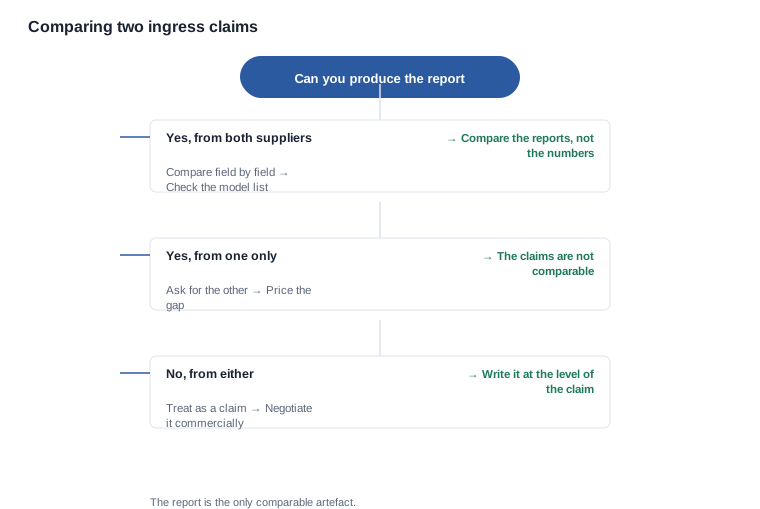
The decision tree above is the short version of the same instruction, written as a sequence. Start from the report, not from the number. If the report cannot be produced, the rating is a claim rather than an evidence, and the two have to be treated differently in a listing and in an agreement — which is the subject of the last section.
One practical note on verification. A report number is verifiable, and asking for it is not an unreasonable thing to do. A laboratory will confirm whether it issued a report with that number and for what model. That single check is stronger than any question you can ask the supplier, and it is available before you place an order.
How is IP tested when the question is about the product, not the report
A report tells you about a test. It does not tell you about the product you will hold in three years, and four questions bridge that gap.
- What is the seal material, and is it user-replaceable? The rating is a measurement of a seal on a day. The seal's service life is not published for any model in our range, and in the wider category it is rarely published at all. A replaceable seal turns a warranty event into a service event, which changes the economics of a spare-parts line.
- What is the expected service life of the seal, and what is the position at the end of the product's life? Wear is not a test condition in any ingress regime, and no rating addresses it.
- Does the marking cover the configuration you are buying, including the case and including any accessory fitted in the field? This is the configuration question from stage one, applied to a real purchase order rather than to a test bench.
- What happens to the marking if a component is substituted? Because a substitution can change the enclosure or the seal, and the marking travels with the test rather than with the product name. A changed cell supplier, a changed charging interface, a changed button — each one can invalidate the link between the marking and the product, without anyone deciding to deceive anyone.
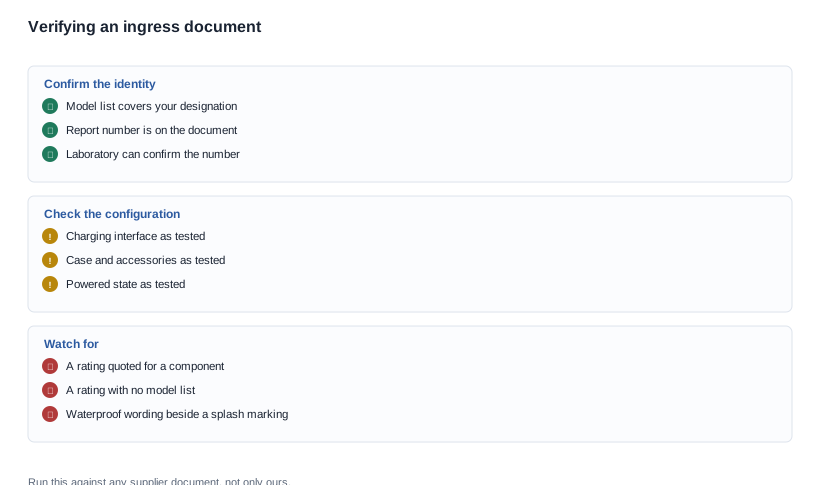
The checklist above is the verification routine we would run against any document in this category, whether it comes from us or from another supplier.
The same routine applies to the surrounding claims, which are usually more useful to a buyer than the rating itself. Whether the product is sold in a wet environment, whether the warranty covers liquid ingress, and what the return terms say about a unit that came back wet — these decide what a rating is worth to your channel, and they are commercial rows rather than technical ones.
How is IP tested in the digit scale, and what the two digits separate
Four things about the numbering that buyers consistently get wrong, and that separate a rating you can rely on from a rating that looks stronger than it is.
- The digits are not equally spaced. A 4 and a 6 are much further apart in test severity than the numbering suggests, because the jump from splashing to powerful water jets is a large change in the regime. Reading the scale as a linear scale of quality is the most common error in the category.
- The first digit is about solids and the second about water. They are separate scales, tested separately, and they are not comparable with each other. A first digit of 5 says nothing about the water performance.
- A high second digit does not imply a high first digit. A product can be immersion-rated and not dust-rated, and the two claims are independent. A marking of IPx7 is a partial marking, and it should be written that way rather than padded.
- A rating on one part is not a rating on the product. A sealed speaker in a frame with an open charging contact is not a sealed product. This is the single most useful thing to remember when a supplier quotes the rating of a component rather than of the unit.
The first digit deserves a note of its own, because it is the one most often left off entirely. The solids test is a separate regime involving a particulate medium that is circulated through the enclosure for a stated time, and it is graded on whether the ingress reaches inside the case — not merely whether dust is visible in the seam. A marking written as "IP54" therefore says nothing at all about particulate ingress, and the omission is not a trick: the digit scale allows it, and the two tests are unrelated. If particulate exposure is part of your channel — a workshop, a dusty site, a warehouse — the first digit is a separate question with a separate document behind it, and it is worth asking for it explicitly rather than assuming that a water rating covers it.
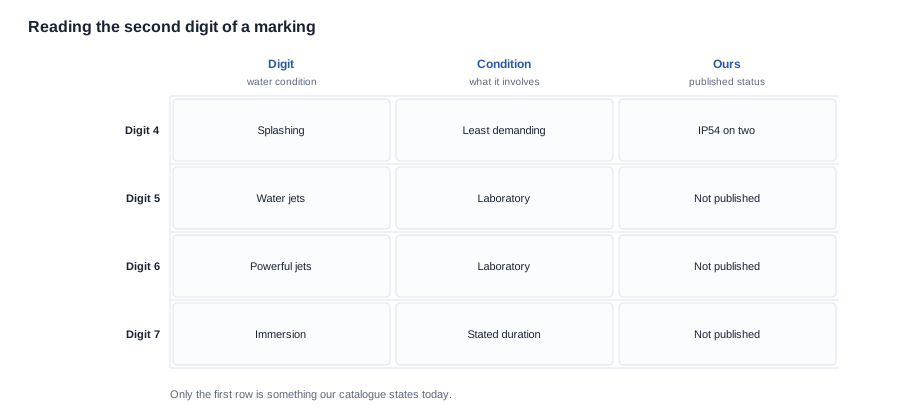
The matrix above sets the common second-digit conditions against what each one involves and against whether our range publishes anything at that level. The third column is the part that matters commercially: the conditions above the splashing row are regimes that a laboratory runs with equipment a factory does not have, which is why they appear on documents and not on catalogue rows.
The row to read twice is the first one. Our V06 and the S7 sit there, because a splashing regime is the least demanding water condition in common use, and a marking in that row is a real result rather than a weak one — provided the report exists and the configuration matches.
A closing caution on reading the digits. A marking is a summary, and the number compresses the configuration, the condition, the duration, the state and the criterion into two characters. Two suppliers can quote the same two characters for materially different products, which is why the number alone can never support a claim about a specific variant. The IP ratings for smart glasses page covers the scale in more detail, IP rating common mistakes collects the errors that recur, and IP rating supplier verification covers the due diligence on the supplier side.
How is IP tested in a factory versus in a laboratory
This distinction explains most of the differences buyers run into between suppliers, and it is worth being blunt about: a marking that appears on a catalogue page has, in a good number of cases, come from somewhere other than a formal laboratory programme.
A factory check is an internal routine. A unit goes onto a bench, water is thrown at it, somebody looks inside, and the result is recorded. It is cheap, it is fast, and it is useful for catching a seal that has regressed during production. What it is not is a formal test, because it does not run against a stated standard, does not fix the configuration, and does not carry a failure criterion that anybody else can apply. A factory check can produce a genuine "water did not get in" result and still not produce a report, and a supplier that says "we tested it" may be describing exactly that.
A formal laboratory test runs against a stated standard and edition, with the configuration fixed and recorded, the exposure parameterised, the state of the product stated, and the failure criterion written down in advance. It produces a document, on laboratory letterhead, with a report number that the laboratory can confirm. It costs money and it takes time, which is why it is done per product family and reused across variants — and why the report's model list is where the family boundaries show up.
The distinction has direct commercial consequences for a buyer, and they are the ones that matter:
- A marking with no document cannot be compared with another supplier's marking, because you do not know whether the two came from the same kind of exercise.
- A marking with no document cannot be re-verified, so it cannot survive a component substitution or a factory change.
- A marking with no document is harder to put in an agreement, because there is no document to reference and no criterion to name.
- A marking with no document is not transferable between variants, which matters if you intend to list more than one model in the same box.
The question that separates the two is short and worth sending before anything else: was this a third-party laboratory test against a named standard, and what is the report number? A supplier who answers with the standard and the number has done the work. A supplier who answers with a description of what they do in-house has told you the marking is a factory check, and that is a perfectly legitimate thing for them to have — it is simply a different claim, and your listing and your agreement should reflect it.
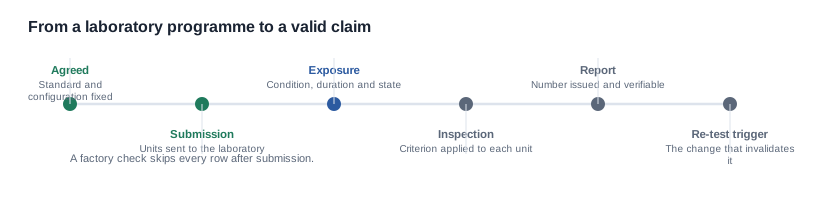
The sequence above is the triage, and it is deliberately short. A yes on the report number takes you down the evidence route. A no takes you down the commercial route, where the marking is a supplier statement you can rely on as a statement and should not print as a specification.
Two practical points close this section. First, ask how many units were tested. A formal programme of one unit tells you about that unit; a programme of several tells you about a batch, which is a different and more useful claim. Second, ask what triggers a re-test, because a supplier with a change-control procedure can tell you which changes invalidate the marking and which do not. That answer is worth more than the marking itself, because it is the one that keeps the claim true over the life of the product.
How is IP tested evidence we can publish, and where the evidence stops
We publish the marking exactly as the catalogue states it. Two models in the range carry IP54 — the V06 and the S7. No third-party test report number is published for either. Every other model in the range publishes no ingress marking, and no charging case in the range carries one. We will not convert that into a conclusion like "waterproof" or "suitable for immersion", because the marking describes protection against water splashing in any direction and nothing more.
We will also say plainly where no marking exists. For every other model, and for every case, the absence of a claim is the absence of a claim — not a judgement about the product, and not evidence that the product would fail. That is the position we can defend, and it is different from saying the product is unprotected.
What a buyer can do with that is straightforward. Ask for the report, check the model list on it, check the configuration on it against the configuration on the purchase order, and write the claim at the level of the marking. If a supplier cannot produce the document, treat the marking as a claim to be negotiated on commercial terms rather than as a specification to be relied on.
That distinction has a price, and the price is where the negotiation sits. A formal test programme is a cost and a lead time, and the sensible question is not whether to have one but whether it is already paid for. If a supplier quotes a report for a model you intend to list in volume, the cost is per family and amortises across the order; if you ask for a new test on a variant nobody has tested, you are buying a programme with a laboratory's queue in it. The certification checklist is where a buyer establishes which documents already exist, and the due diligence that follows from it is short: which model list, which configuration, which criterion, which number.
The commercial terms worth putting on the quotation in the same conversation are the usual ones — unit price and volume tiers, the spare-parts set with its minimum order quantities, the warranty period with a stated response, the return terms, and the payment nodes against inspection. The one that is specific to an ingress claim is the sealed-spares line: if a seal or a charging contact can be replaced, the failure becomes a service event rather than a warranty event, and the difference between those two is the difference between a return rate you can manage and one you cannot. Which one you shortlist should follow the evidence you have gathered, and which model you actually order should follow the configuration on the document rather than the digit on the listing.
One trade-off worth naming before the order goes in. A higher-marked product looks safer on a shelf and costs more in testing and often in hardware, and in a channel where the real exposure is splash rather than immersion, the extra rating buys nothing the customer can feel. Better to have one model with a documented splashing rating and a replaceable seal than two models with an undocumented claim.
The sport smart glasses page is the range reference, and it is worth noting that the two models carrying a published marking are camera models with no charging case row — a combination that matters if you are planning a long outdoor session with the case as part of the workflow.
What to do next.
- Ask for the standard and edition, the laboratory, the report number, the tested configuration and the failure criterion — five fields, one message.
- Check the model list on the document against the exact designation you are buying.
- Check the configuration on the document against the configuration on the purchase order, including the case and any accessory.
- Ask what changes the marking, and put the substitution rule in the agreement.
- Write the claim at the level of the marking, and nothing above it.
Related reading
- IP ratings for smart glasses
- IP rating common mistakes
- IP rating supplier verification
- Sport smart glasses range
Send us the models and the environments, and we will say what evidence you need and which models carry a published marking.


