

IP rating: a short marking, a long file
Verifying an ingress protection claim is unusual among supplier checks, because the marking is two characters long and it looks like the end of the enquiry. What sits behind it is the opposite: a long, specific document, and in many cases the only document in the file that tells you whether the product may lawfully be sold as described.
Three conclusions follow. First, the report number behind the marking is the only part of the file that a broker, a marketplace reviewer or your own compliance team can check later, so it is the first thing to request and the thing to attach to the purchase order. Second, a marking without a report number is a catalogue annotation rather than a specification, and it supports a narrower claim than a product page usually wants to carry. Third, the document attaches to a tested configuration rather than to a product name, so a model-designation check on receipt is worth more than any photograph of a test chamber.
What follows is the verification sequence: the documents to request and the order to request them in, the checks to run on the units when they arrive, the four answers that tell you the file is thin, and the questions worth adding to the file after the first order. It is written for the buyer holding a quotation with an ingress marking on it and no document behind it.
Who runs this check, and what they are holding
The person running it is rarely the person who chose the product. It is usually a brand-side product manager who has been handed a quotation because a channel partner asked a question about water damage, or a quality engineer handed a returns file with a cluster of wet-looking units and no explanation. They are holding a sample, a price, a target market and a launch date. What they are not holding is the document set, and that is normal, because document sets live with the factory and the request has not been made.
Three fears shape the check. The first is a claim that cannot be defended: a product page that says waterproof because the catalogue said IP54, and a customer who tests it in the rain. The second is a documentation gap discovered after the packaging is printed, when the certificate turns out to name a different model designation. The third is a returns trend nobody can explain, because nobody in the chain ever agreed what the marking covered.
All three are cheap to prevent at the quotation stage and expensive to prevent afterwards, and the reason they are expensive afterwards is a scheduling fact rather than a technical one. The documentary work runs on the brand's own timeline rather than the factory's, and the artwork sits at the end of it. A marketing decision taken in week three becomes a reprint in week twelve.
The position most suppliers actually start from
The common starting position in this category is a marking with no report number attached to it, and a buyer who assumes the second will arrive once the order is placed. It usually does not, because a report that would have been produced before the design freeze has to be produced afterwards, on a sample built from production tooling, at a laboratory's convenience.
There is a second position worth naming, because it looks like a strength and is not: a family-level document offered as coverage. A report that names a family of models is evidence about that family's tested configuration. If your branded unit differs in a charging interface, a port treatment, a seal material or a button seal, the document describes a product you are not shipping.
Both positions are workable, and neither is a reason to stop buying. They are reasons to know, in writing and before the deposit, exactly which of the two you are dealing with — because the fix for the first is a document request and the fix for the second is a configuration comparison, and they belong at different points in the programme.

Six documents, and the order to ask for them
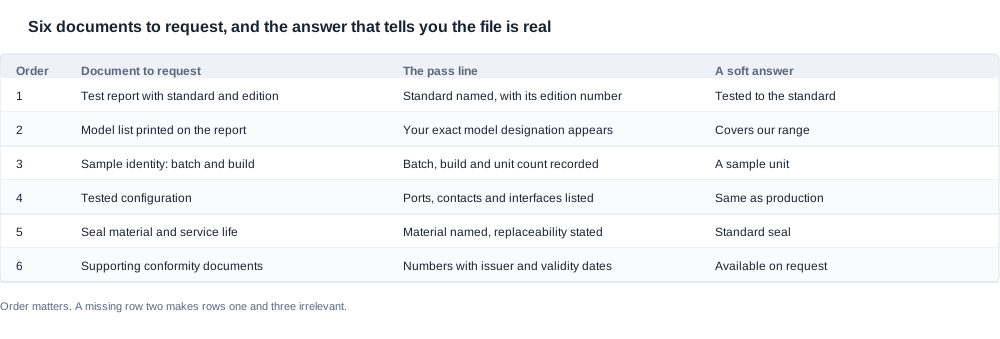
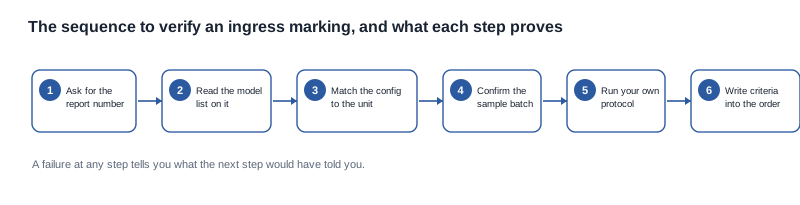
The documents are not interchangeable, and a missing one at the top of the list makes the ones below it irrelevant. The order below is an order of dependency rather than of importance, and it is the same order in which the verification should be carried out.
The test report itself, with the standard and its edition. Not the marking, not a summary, not a photograph of a label. An ingress rating is meaningless without the standard it was tested against, because the requirements differ between regimes and between editions. The pass line is a standard name with an edition number attached to it.
The model list printed on the report. This is where verification usually stops, and it is the highest-yield single row on the list. A report is written for a specific model designation, sometimes with variants enumerated. If your model is not on it, the report does not cover your product, however similar the names look. Ask for the designations as they appear on the document, not as they appear in the catalogue.
The sample identity. Which batch, which build, how many units. A report on a pre-production build is evidence about that build, and a report on an early-article unit is evidence about a unit that no longer exists in any meaningful sense.
The tested configuration. Which ports, contacts and interfaces were fitted when the sample was tested. An ingress rating applies to an enclosure, and the rating travels with the tested configuration rather than with the product name.
The seal material, its replaceability and its expected service life. This is the row most often skipped and the one that matters most across a product's life. A seal that cannot be replaced turns a minor failure into a warranty event, and the rating is only ever as good as the seal it was measured with.
The supporting conformity documents. The declaration of conformity, the radio qualification position, the materials declarations, the battery transport documentation for the fitted cell. Each has its own trigger for becoming invalid — a component substitution, a different model designation, a new edition of a standard.
The two documents that decide everything else
If a supplier will only give you two answers before the deposit, make them the report number and the model list. Everything else on this page can be reconstructed later from a good sample and a laboratory booking; those two cannot, because they are the only record of what was tested and what the product was called at the time.
There is a phrasing of the request that distinguishes a supplier with a documentation habit from one holding a folder of unrelated documents. Ask for the report number, with the issuing body and the validity dates, in the body of the email, as a list, per model designation. A supplier who answers that in one message is running a document set. A supplier who answers it across three messages and a call is assembling one on the spot, and the difference will show up in your schedule rather than in the document.
There is also a version of this request that fails, and it is worth naming because it is the one most buyers write first. Asking for "the IP certificate" gets you an answer about the level without the number, or the number without the model list, and the conversation has to restart. Asking for the number, the issuing body, the validity dates and the model designations, as four separate lines, does not.
When the marking and the document disagree
It is worth planning for the case where they do, because it is the normal case rather than the exception. A marking on the unit that differs in any character from the designation on the document is a substitution finding and a stop condition, not a query. A designation on the document that exists in the catalogue but not in your order is a scope error, and the remedy is a written confirmation of what was actually produced.
The rule that makes this cheap is to compare the physical unit, not the paperwork, at the point where the unit and the document are both in front of you. Paperwork comparison alone cannot catch a substituted component, a reworked port or a swapped seal, and those three are the failure modes that actually reach a customer.

What arrives at receipt, and what it tells you
The document review tells you what was tested. The receipt review tells you what was built, and it is the only point at which the two can be compared on the physical product in your hand. It is also the last cheap point — after receipt the unit is in a container, on a shelf or in a distribution centre, and the comparison turns into a returns investigation with a much larger cost.
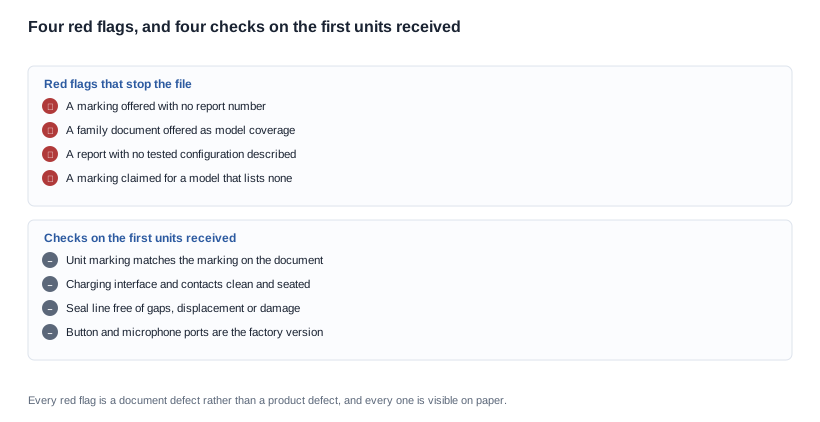
The marking on the unit against the marking on the document. A mismatch is a substitution finding. Compare the model designation character by character, including the suffix, because the suffix is usually where the difference lives — the camera module, the lens tint, the cell capacity, the charging interface.
The interface condition. A magnetic contact in a temple is an opening. A misaligned, corroded or partially seated contact is a functional failure before it is an ingress one, and it is also the place where a unit that has been handled roughly starts to leak.
The seal line, visually. A visible gap, a displaced gasket, a damaged lip or a witness mark means the enclosure has been opened, or assembled differently from the factory standard. It is a finding at receipt, and it is far easier to raise at receipt than in month four.
The button and microphone ports. These are the openings most likely to have been reworked between the tested unit and the production unit, because they are the openings handled most, and because a rework does not appear in a catalogue photograph.
The seal is the part that ages, and nobody tracks it
Every ingress rating describes the product as it left the factory. Seals compress, harden and lose their interference fit, and the rating says nothing about year three. Two of the most common sources of unexplained returns in this category are not failures at all — they are products specified for a splash exposure and then sold into a use that included a hot car seat in summer, where heat does more to an aged seal than water ever would.
The practical consequence for a buyer is a documentation request rather than a product request. Ask what the seal material is, whether it is replaceable as a service item, what the expected service life is under the exposure you actually sell into, and whether fitting a replacement seal would change the marking. If the fourth answer is yes, then the replacement policy is part of the claim, and it belongs in the agreement rather than in a service manual.
Four red flags, and the branch to take at each one
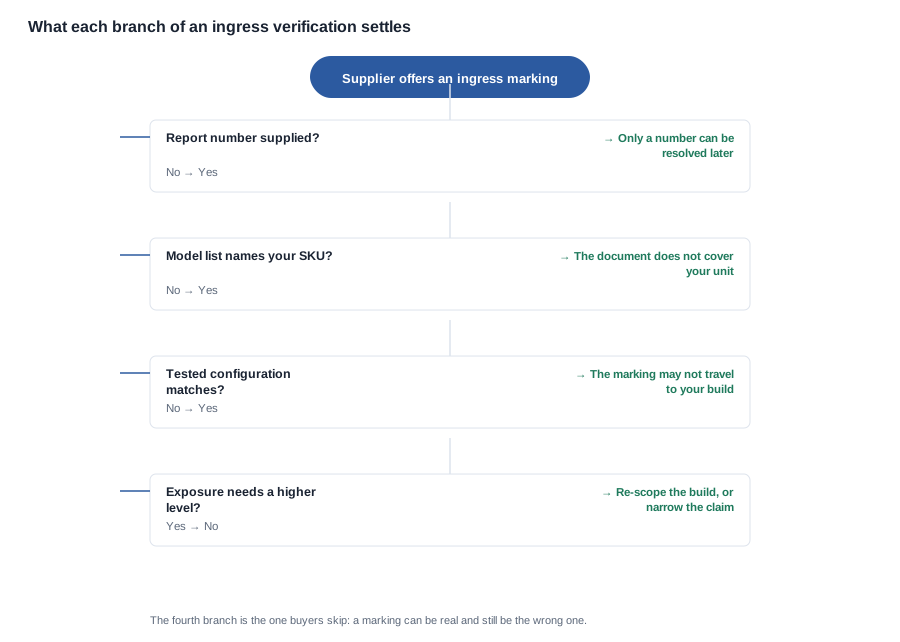
A marking offered with no report number. This is the most common position in the category, and it is not by itself a reason to walk away. It is a reason to decide deliberately which of three things you are buying: a claim with a document behind it, a claim with a document to be produced, or a product with a marking and a narrower listing. Those three have very different costs and they are not interchangeable, so the decision has to be explicit rather than inherited from the quotation.
A family-level document offered as model coverage. Ask which model designations the document names. If yours is not among them, the answer is one of three: extend the document to your configuration, re-test your configuration, or narrow the claim to what the document does cover. All three are legitimate, and the mistake is not choosing one — it is not knowing which one you have chosen.
A report with no tested configuration described. The document proves that some enclosure passed some test. Without the configuration it cannot be mapped onto a product, and the mapping is the entire purpose of the document.
A marking claimed for a model that lists none. A supplier offering a marking for a model with no published rating is either quoting a variant that does not exist in your catalogue or borrowing a rating from a sibling model. Ask for the model designation the document names, in writing.
The branch where the report number is missing
This is the branch most buyers handle badly, because the instinct is to treat the absence as a problem to be solved rather than as a fact to be incorporated. The better handling is to write the number request into the purchase order as a delivery condition. The unit arrives with a document or it does not; if it does not, the retention held against the documentation package is what protects you, and the pre-shipment inspection is where the document is checked.
That reframe also changes the commercial conversation. A supplier who cannot produce a report number before the first shipment may still be able to produce one before the second, and the difference between those two dates is worth a price agreement rather than a walk-away. It is also worth asking what the second date costs, because the answer tells you whether the document is a production task or a fresh qualification.
Four questions worth adding to the file after the first order
What is the renewal position for the documentation itself? Every document in a conformity file has an expiry date, a supersession rule or a trigger for invalidation. A supplier who answers "we will keep it current" has not answered. Ask what happens when an edition changes, how that is notified, and who carries the cost of the resulting work.
What is the charging case's position? A case is a separate enclosure with a separate rating, and the two do not transfer. We publish charging cases in this range at 900 mAh, 1200 mAh and 1400 mAh capacities, and none of them carries an ingress marking. That is a fact about our own catalogue, and it generalises: a product protected while it is on a face and unprotected inside its case is a product whose listing needs to say so. The mechanics are set out in whether an IP rating covers the charging case.
What is the change-control position on the seal parts? A seal change, a port change, a contact change or a material change can each move the product outside the tested configuration. A notice obligation — not an approval right, a notice obligation — is the realistic ask, and it costs a supplier very little to grant.
What claim are you going to make? This is the question that ties the file together. A marking on a catalogue is a marking. A marking supported by a report naming your exact model designation and configuration is a claim you can defend to a retailer's technical team, a marketplace reviewer or a broker. The commercial difference between those two is the difference between a listing that converts and a listing that gets pulled.

What our own catalogue can and cannot carry
To put it plainly — simpler than it sounds: we publish the ingress marking we actually hold, and we publish the fact that we do not hold the document behind it. A buyer who intends to check a claim should be able to run the same check on ours first, and that only works if the gaps are stated rather than smoothed over.
In our catalogue the IP54 marking appears on two models, and on two models only: the V06 and the S7, both of which sit in the sport photo class. We publish no third-party test report number, no standard, no test condition, no sample size and no laboratory behind either marking, because the company has not confirmed them to us. No other model in the range carries a published ingress marking, and no charging case in the range carries one either. We publish the frame weight for exactly one model in the whole catalogue — 158 g for the MT6 — and we would rather tell you that than quote a typical figure you cannot verify.
The other half of that position is worth stating just as plainly. A model with no published marking is not a model that cannot handle the environment; it is a model with no claim to evaluate, and a buyer is free to run their own test on a sample rather than relying on ours. And a marking without a report number is a statement rather than a document, and the difference matters the first time somebody asks.
We do not publish the words waterproof, rain-capable or immersible for any model, and we will not present a marking as a lifetime guarantee. Every seal ages, we hold no ageing data, and we will not estimate a service life for something we have not tested.
The three requests worth sending before the deposit
Send the document request as a list, in the body of the email, before the sample ships. The report number with the issuing body, the standard and the edition, the model list, the tested configuration with the ports and contacts, the sample identity, and the seal material with its expected service life. Six lines. A supplier who answers all six has a documentation habit; one who answers two is telling you something you need to know before the deposit.
Ask the configuration question in the same message. Which ports, contacts and interfaces were fitted on the tested sample, and how do they compare with the unit in the quotation? This is the question that converts an ingress marking from an advertisement into a specification, and it costs one paragraph to ask.
Send us the models, the environments and the target market. We will tell you which of our models carry a published marking, what the qualification would involve for the ones that do not, and which rows of our documentation answer your question today. The range is at sport smart glasses, the technical background is under IP ratings and durability, and the two companion checklists are the IP rating buying checklist and the IP rating procurement checklist for teams.
Where the verification method comes from
- IP ratings and durability
- The IP rating buying checklist
- The IP rating procurement checklist for teams
- Sport smart glasses range
Tell us the models and the environments, and we will say which carry a published marking and what evidence you still need.


