

Ingress protection mistakes in this category are unusually expensive relative to how small they are, because the mistake is usually made in the listing copy rather than in the product, and a claim in a listing is the buyer's liability regardless of what the catalogue says. The fourteen mistakes below are grouped by where they are made — in the listing copy, in the specification, and in the commercial decisions that sit behind both — and each one is paired with the action that prevents it.
Our published position in this area is what a buyer has to work with. Exactly two of the twenty-eight entries in our catalogue carry an ingress marking: the V06 and the S7, both annotated IP54, with no third-party test report number published. Every other model in the range publishes no ingress marking, and no charging case in the range carries one either.
So ip rating smart glasses common mistakes is a list of the specific errors, most of which are made in a sentence on a product page.
Why a copy error costs more than a specification error
A specification error is a disagreement between a document and a product. It is found by inspection, it is found before the product ships, and it is fixed by replacing a part. A copy error is a disagreement between a document and a promise. It is found by a customer, it is found after the product ships, and it is fixed by withdrawing the promise in public — which means a reprint of the packaging, a correction of the listing, a revised manual and a revised support script, in every market the product reached.
The asymmetry is worth quantifying in the buyer's own terms. A specification mistake found at incoming inspection costs a unit, a credit note and a conversation. A copy mistake found after launch costs the same conversation, plus every unit already in the channel, plus the credibility of the listing itself. And the credibility cost is the one that does not get repaired by issuing a credit note.
There is a second reason the copy errors dominate, and it is that they are invisible to review. A reviewer checking a specification sheet against a drawing has something to check it against. A reviewer checking a sentence for accuracy has nothing to check it against except their own recollection of what the product does, which is exactly the recollection that wrote the sentence in the first place. That is why copy errors need a written reference, and why the reference has to exist before the copy is written rather than after it is published.
IP rating: the words that cannot be defended
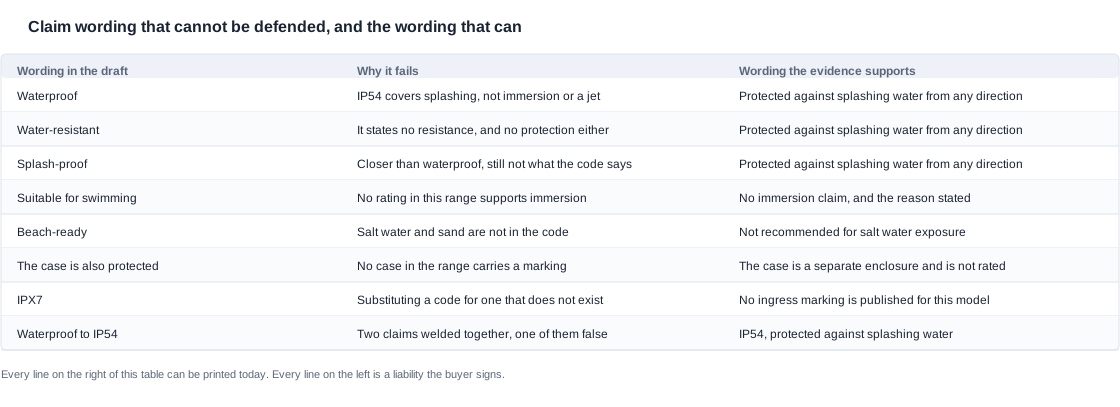
The table below is the working part of this article. The left column is wording that appears in listings in this category; the middle column says why it fails; the right column is wording that the published evidence supports. Every line on the right can be printed today.
"Waterproof." The second digit of a 4 describes protection against water splashing in any direction. It is not immersion, not a shower and not a hose. Our own IP ratings guide sets out what each digit permits, and "waterproof" is not among the things it permits.
"Water-resistant." Closer to the marking and still vaguer than it, because it states no resistance at all. A reader who sees "water-resistant" does not know whether they can rinse the unit or only wear it in light rain, which means the wording creates the expectation it was supposed to remove.
"Splash-proof." A hyphenated near-synonym of waterproof that sounds more technical than it is, and that is worse than either plain word because it reads as a measured term.
"Suitable for swimming" or "beach-ready." Neither the marking nor anything else in our range supports it, and the two marked models have no test report number published. A beach-facing claim also carries a salt water exposure that a fresh-water splash procedure says nothing about.
"IPX7" or "IPX4" in place of the actual marking. Some products in the range publish no marking at all, and substituting a different code is a false claim rather than an approximation. It also fails in a specific way: the X means the dust half was never evaluated, so the substituted code is missing a question rather than answering one.
"The case is also waterproof." No case in our range carries a published marking, and a case is a separate enclosure with its own openings, its own materials and its own conditions. This is the most repeated of the six because the case looks like a sealed box.
"Waterproof to IP54." Two claims welded together, one of which is false. This phrasing appears because it reads as a specification, and the specification half is what gives the adjective half its apparent authority.
The pattern across all seven is the same: the wording is a little broader than the code, and the broadening is invisible to the person who wrote it. That is what makes a library necessary rather than a rule.

The specification mistakes, and the question that closes each one
The next group of mistakes is made before any copy exists, and each of them closes with a question rather than a phrase.
6. Accepting a family-level document as model coverage. Our catalogue contains one entry listed as "L2 Utral", with a note about the spelling, a further "Utral Pro Max" designation whose meaning is not published, and two product groups whose entries carry no model designation at all. A family statement is not coverage. Closed by: which exact model designations does the report name.
7. Assuming a rating transfers to a reworked configuration. A rating applies to a specific enclosure, so a unit with a different port or interface is a different product. Closed by: which ports, contacts and interfaces were fitted on the tested sample.
8. Assuming it covers the product's life. The rating describes a seal on a day, and the seal material and its service life are not published for any model in this range. Closed by: what is the seal material, what is its service life, and is it replaceable.
9. Treating the marking as a test report. A catalogue marking is a summary. In our range the IP54 annotation appears with no report number, so the document behind it has to be obtained. Closed by: the report number, with the issuing body and the date.
10. Assuming the digit is a linear scale. The digits are not equally spaced in difficulty, and a 4 and a 7 are further apart than the numbering suggests, so a comparison written in those terms is a comparison between two different procedures. Closed by: which procedure, under which standard and edition.
The four mistakes that cost a listing its position
These four are separated because they are the ones that end a listing rather than a sentence, and because each of them takes a decision that could have been made earlier for nothing.
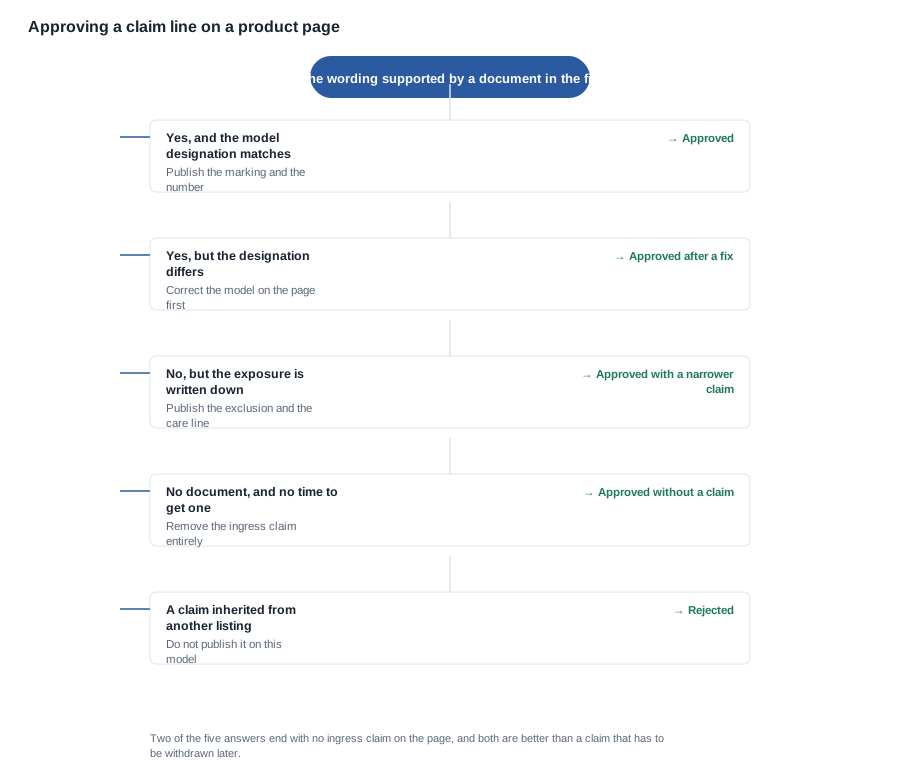
11. Converting the marking into a marketing claim, and then having to withdraw it. A withdrawn claim in a retail listing is a public event, and it is the retailer's problem rather than the manufacturer's. The remedy is to publish the code and the words that describe it exactly, with the exclusions beside them, so that there is nothing to withdraw.
12. Designing a product line around a marking that the sample did not carry. If the sample was not the same enclosure, the marking was never yours to claim, and the discovery arrives after the tooling is cut. The remedy is to compare the tested configuration against the sample physically, before anything else is done with it.
13. Failing to specify the case. A product sold with a case and a product sold without one are different claims, and the case is the part with no marking and the least published information. The remedy is to name the case in the accessory specification and to say what may be said about it.
14. Not asking for the test report before committing the copy. The report either exists or it does not, and that is knowable before the page is written. This is the cheapest of the four to prevent and the most commonly skipped, because the copy is written first and the request is sent afterwards as a formality.
What the correction costs in money and in schedule
It is worth putting a number-free but concrete shape on the cost of a copy correction, because procurement teams are asked to approve the work that prevents it and they are rarely told what the alternative looks like.
The direct cost is a packaging reprint. Depending on the print run and the number of markets, that is a new print plate or plate change, a new production run, new freight, and a disposal or clearance decision for the existing stock — which on a perishable listing is where the real money sits. A factory that has run a print cycle and is asked to change the artwork mid-run will treat it as a re-order, and a re-order below the minimum order quantity is priced at the run rate rather than the reprint rate. The minimum order quantity on print is frequently higher than the minimum order quantity on the product, and that gap is where a copy error gets expensive.
The second cost is inventory that is already moving. Units in a distribution centre cannot be re-labelled cheaply unless the change is a sticker, and a sticker on an ingress claim is a legal statement of the same weight as a printed one. Units in the channel cannot be re-labelled at all, and the withdrawal has to reach them through the listing, the insert, the support script and, in some markets, a written notice to the retailer.
The third cost is the schedule, and it is the one that hurts a launch rather than a quarter. A copy correction that arrives after the artwork approval pushes the artwork approval, which pushes the print window, which pushes the delivery date, which pushes the listing date. When a listing date is fixed by a channel window, that chain either slips or the launch happens with the wrong artwork — and the wrong artwork on a product that has already been advertised in a press piece is worse than a delay.
The fourth cost is the supplier conversation, and this is where a procurement team has a lever. A supplier who has quoted a claim wording into the artwork has participated in the error, and the correction is a change request rather than a reprint, with the cost of the change request being the point at which the supplier's own documentation gets examined. That examination is worth having, and it is the reason the copy library should be built before the artwork rather than after the correction.
Some of these costs are avoidable at the quotation stage and are worth negotiating explicitly. A first order that splits into two deliveries against a copy approval milestone costs nothing to arrange and gives the buyer a second point at which the wording is confirmed. A quotation that includes the artwork proof as a priced deliverable, rather than as a free sample, gives the buyer a contractual reason to require it before print. A purchase order that attaches the approved claim wording makes the supplier a party to the wording, and a supplier who has signed a sentence withdraws it less readily than one who was handed it in a spreadsheet. Payment terms that tie a balance to the artwork approval — rather than to the shipment — put the reprint risk on the side that can still prevent it.
Choosing a supplier who will not create these errors for you
Supplier evaluation in this category is usually conducted on the wrong axis, which is unit price against lead time. Two additional questions cost nothing and predict the copy outcome better than either.
The first is whether the supplier's own documentation carries the claim wording. A factory that publishes the claim on its own product page or in its own catalogue has made a decision about what the marking supports, and that decision is visible. If the supplier's copy says waterproof and the report behind the marking is a splash-protection result, then every buyer who takes that copy inherits the error and inherits the cost of correcting it. Ask to see the wording the supplier uses on its own listing. If the answer is a code with no adjective, that is a good sign about the supplier's documentation discipline. If the answer is an adjective, the quotation you are comparing has an unfunded liability in it.
The second is whether the supplier operates a change notification process that the buyer can see, rather than one described in a contract clause. A factory with a real documentation habit has a written change control procedure, a dated file for each model, and a person whose job is to keep them. A factory without one has a clause it has never used. The difference is visible in one question: ask which changes in the last two years triggered a re-assessment of an ingress marking, and ask what happened to the units already produced.
The supporting due diligence is short and mechanical. The report number must resolve in the issuing body's register. The model list on the report must match the model designation on the quotation. The tested configuration must match the configuration in the sample order. And the quotation itself must carry the model designation as a line item, because a quotation that says a family name gives the buyer no way to hold the supplier to the specific configuration that was tested. These are the four checks to run before you commit to a shortlist, and each of them costs a phone call.
Building a copy library that survives a legal review
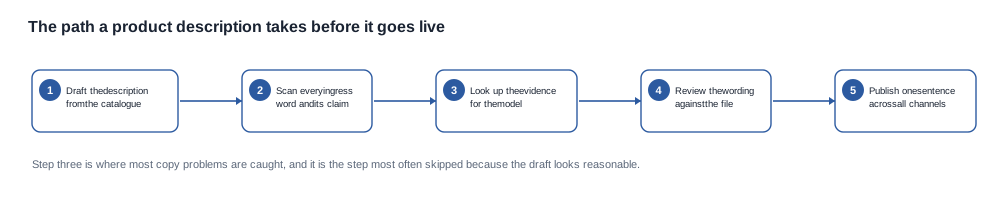
A copy library is the mechanism that stops these errors from recurring, and it works because it replaces judgement with lookup. The library is a table of approved phrases, one row per claim type, with the condition under which each phrase is permitted. It is not a style guide and it is not a marketing document; it is an evidentiary index that a reviewer can check a sentence against in a minute.
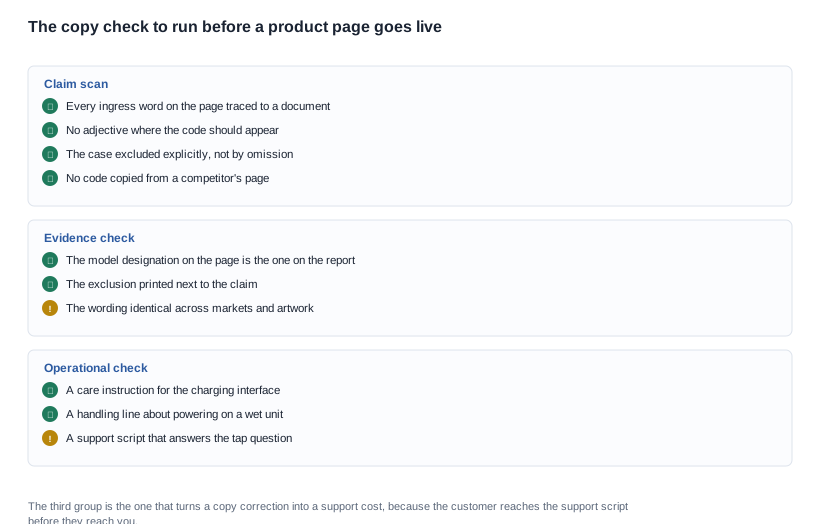
Three rules govern a library that works. First, each approved phrase is tied to a document and a model designation, so a phrase that stops being supported stops being used automatically. Second, each row names the exclusion that must appear next to it, because the exclusion is the part that carries the liability. Third, the library is versioned with the artwork, so a change of copy and a change of print happen in the same cycle rather than one print cycle apart.
The pre-publication check that a library supports is short: find every ingress word on the page, trace it to a row in the library, and confirm the row's condition is met for this model in this market. Any word that does not trace to a row is either deleted or escalated. That check takes ten minutes and it is the only thing standing between a plausible sentence and a public withdrawal.

What our catalogue supports, in the words we will let you use
The boundary we hold: we publish the marking exactly as the catalogue states it — an IP54 annotation on the V06 and on the S7, with no third-party test report number published — and we will not convert it into a claim about waterproofing, immersion or beach use, because the marking describes protection against water splashing and nothing more.
We will also say plainly where there is no marking: for every other model in our range, and for every case, no ingress claim is published. That is the absence of a claim rather than a negative statement, and it is the honest position to take to a customer.
The wording we will put our name to, for the two marked models, is the code and the description that goes with it — protection against splashing water from any direction — with the exclusions published alongside it. For every other model, the wording is the absence, stated as an absence. What we will not do is supply a phrase for a model whose exposure the buyer has described but whose evidence does not yet exist.
The specifications behind the marking that the catalogue omits are set out in IP rating what the spec sheet omits, the request list behind the document questions is in IP rating buying checklist, and the models that carry the marking are at sport smart glasses.
The check to run before a product page goes live
- Find every ingress word on the page. Not the code — the words. Waterproof, resistant, protected, sealed, swim, beach, dust-tight. Each one is a claim, and each one has to resolve to a document.
- Check that the model designation on the page is the one on the document. This is a single character-by-character comparison and it catches the most common failure in the whole category.
- Confirm that the exclusion is printed next to the claim. A claim with an exclusion beside it reads as considered. A claim with the exclusion only in the manual reads as a contradiction.
- Confirm that the same sentence appears in the listing, the artwork and the support script. Three versions of one claim is three claims, and they will drift apart the moment one of them is edited.
- Confirm that the case is either named as excluded or left out of the claim entirely. The case is the part with no marking, and it is the part a customer is most likely to assume is protected.
- Record what was checked, by whom and on what date. The record is what makes the check auditable, and it is what turns a plausible sentence into a decision somebody made.


