

The answer is longer than most buyers expect, and the reason is structural rather than bureaucratic: "how long do I keep documentation" is really two questions wearing one coat, and the second one is much harder than the first.
The first question is about a document. A Declaration of Conformity does not expire, so it is kept for the life of the product and for as long as the product is exposed to a recall or a market-surveillance request. That answer is simple and it is the same in every market.
The second question is about a file. The technical file, the batch records, the change log, the material declarations, the shipping documentation — these follow the life of the product in the market, the limitation periods in each jurisdiction you sell into, and the internal change history of the product itself. There is no single number, and there should not be, because a buyer who stores every document for a fixed period will either hold some for too long or dispose of one too early.
Our published position in this range shows what a file can and cannot contain. The export-certification page is a picture page: it presents ten patent certificate images, eight design patents and two utility models. There is no per-model certification row anywhere in the catalogue, no certificate numbers, no issuing bodies, and no published validity period. That is a real and specific shape of gap, and a buyer planning a retention policy needs to know about it before the policy is written rather than during a recall.
Three audiences ask this question and they need different answers. A compliance lead wants a period they can write into a policy and defend to an auditor, and the honest answer for most of the file is that the period is derived rather than chosen. A procurement manager wants to know what to demand from the supplier, and the answer is a document set at configuration granularity, handed over at a defined point. A channel or e-commerce buyer wants to know what to keep when a customer asks for proof of conformity three years after the sale, and the answer is that the buyer who did not keep it will be told no.
The rest of this page is written for all three, and it is organised by the structure of the answer rather than by the type of document.
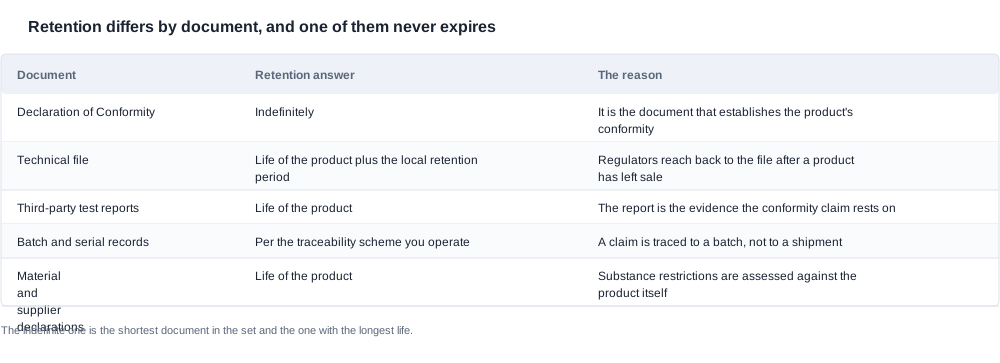
How long do I keep documentation: four categories and their answers
The documents in a smart glasses import fall into four categories, and the categories have different retention logic. Sorting them first is most of the work.
1. The conformity documents. A Declaration of Conformity has no expiry date. What invalidates it is a change to the product or to the legal framework it was made against. So it is kept for the life of the product and for as long as the product is in the market or under recall exposure. The framework that assumes this is the General Product Safety Regulation, which applies in the European Union from 13 December 2024 and which operates alongside sector-specific rules for electronic products — the GPSR compliance page covers how that framework is usually read.
2. The technical file. The design information, the test reports and the certificates behind the declaration, kept at configuration granularity. It is retained for the same period as the declaration, because the declaration is only as good as the evidence behind it, and it is the document that has to be produced when a regulator asks. In practice this is the largest and the most expensive category to store well, because it is a set rather than a single file.
3. The production records. Batch and serial trace, change log, first-article records, defect data, inspection results. These are retained for the period the product is in service plus the limitation period, and the limitation period is a legal question in each market rather than a fact about the product. These records are the ones that answer the question that actually gets asked during an incident: which units.
4. The commercial records. The order, the quotation, the invoice, the packing list, the freight documents, the claims records. These follow the commercial and legal retention rules of your own jurisdiction and are usually the longest-lived of the four, because a limitation period for a contract claim can run for years.
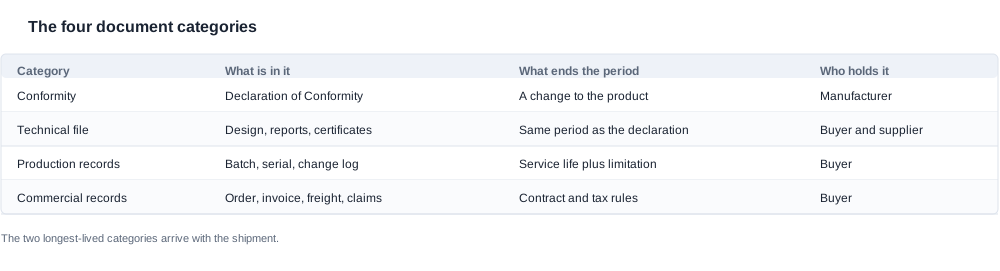
The table above is the version we would put on the wall. Notice that the two longest-lived categories — production and commercial — are the two with the strongest traceability requirement, and the two that are easiest to lose, because nobody decides to file them: they arrive with the shipment and get forwarded to an inbox.

How long each category is kept, and what ends the period
Four things make this harder than a filing policy, and each one is a reason why a fixed retention period is the wrong instrument.
1. The product's life in the market. A product with a two-year retail lifecycle generates claims in its third year, and sometimes in its fifth. The retention period is therefore not the product's shelf life — it is the product's shelf life plus the tail of exposure after it. Which is why the traceability record has to be issued with the shipment rather than reconstructed afterwards, because reconstruction is what fails when it is needed.
2. The divergence between markets. The United Kingdom has already diverged from the European Union in this category, and the divergence has to be tracked rather than assumed, which means the file is not one file. It is a set of files with a common core and market-specific annexes, and the common core is the part that gets duplicated carelessly while the annexes get ignored.
3. The change history. A product that has been in the range for three years has usually had more than one cell and possibly more than one component, supplier and firmware baseline. Each of those corresponds to a shipped configuration, and each configuration needs its own document set, because the coverage is per configuration and not per model family. A family-level file hides the difference, and the difference is what a regulator is looking for.
4. The children's tier. Where a certification position is not published, the question of how long to keep documentation is premature — the documents have to be obtained before their retention period can be calculated at all. This applies to our own range: we publish no per-model certification row for any model, so the buyer has to obtain the documents from the manufacturer and then own them for their whole life.
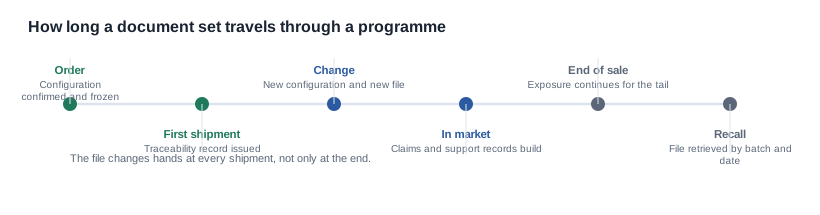
The timeline above follows one document set through a programme, and it is worth noticing where the file actually changes hands. It does not change hands at the end — it changes hands continuously, at every shipment and every change, and each of those is a point where a document can be created, and where a gap can be opened.
How long the file has to follow the market rather than the product
The rule that catches people is short: you stop retaining documents when the exposure stops, and the exposure stops when the product stops being relevant to a market. That is not the same date as the product leaving the shelf.
Three consequences follow, and they are practical rather than legal.
The recall question arrives before the product is old. A market-surveillance request or a field safety notice can arrive in the first year of a product's life, and the documents that answer it are the ones written at the point of manufacture. If they were not written then, they cannot be produced at all, and the gap cannot be closed retrospectively.
The market you stopped selling into is still a market you sold into. If a country was on the list for two years and then came off it, the documentation for those two years is still subject to the limitation period of that country. Most buyers think about the market they are in now, which is exactly the wrong frame.
The traceability granularity has to match the recall granularity. A recall is issued against a batch, a date range, a firmware level or a component change. A file indexed by model cannot answer it. A file indexed by model, configuration, batch and shipment date can. This is the single most useful structural decision in the whole topic, and it is made at the first shipment or not at all.
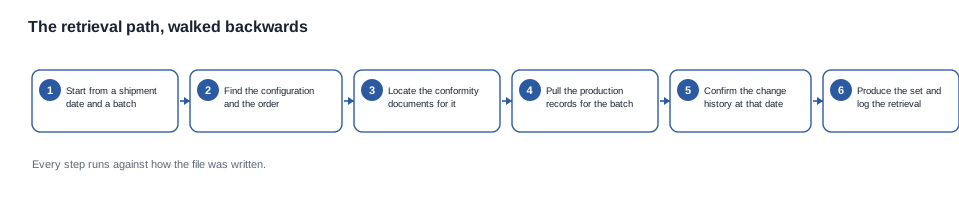
The flow above is the retrieval path a regulator, an insurer or a large customer will walk when something goes wrong. Notice that every step runs backwards from the shipment — which is the direction the file has to be built in, and the reason the file is assembled as the product ships rather than reconstructed afterwards.

How long a document set stays usable: five habits that outlast the file
A retention policy is a policy on paper. What actually determines whether you can produce a document in year six is a set of habits, and none of them are difficult.
- Issue the traceability record with every shipment, at configuration granularity, so the file is assembled as the product ships. This single habit answers most recall questions and it costs nothing at the point of shipment — which is why it is so often skipped.
- Keep documents per configuration, not per model. A family-level file hides the difference between two variants, and the difference is what gets asked about.
- Record the change history as it happens, with the change-control procedure, so the document set for each shipped configuration is reconstructible. A change log written six months later is a reconstruction, and reconstructions are what the question is really about.
- Store the file in a retrievable form, indexed by model designation, configuration, batch and shipment date. The question asked during a recall is never "what did we decide" — it is "which units".
- Name a custodian and a retrieval test. The retrieval test is the one nobody does and the one that matters: pick a random shipment, ask for its file, and time how long it takes. If it takes more than a day, the policy is not working, whatever it says.
There is a sixth habit that belongs to the supplier relationship rather than to the filing system: ask for documents in the format you will keep them in, and ask at the point of ordering rather than after the first shipment. A supplier who can provide the technical file for a configuration as a structured set is worth more than one who can provide a PDF of a scanned folder, and the difference shows up in year three.
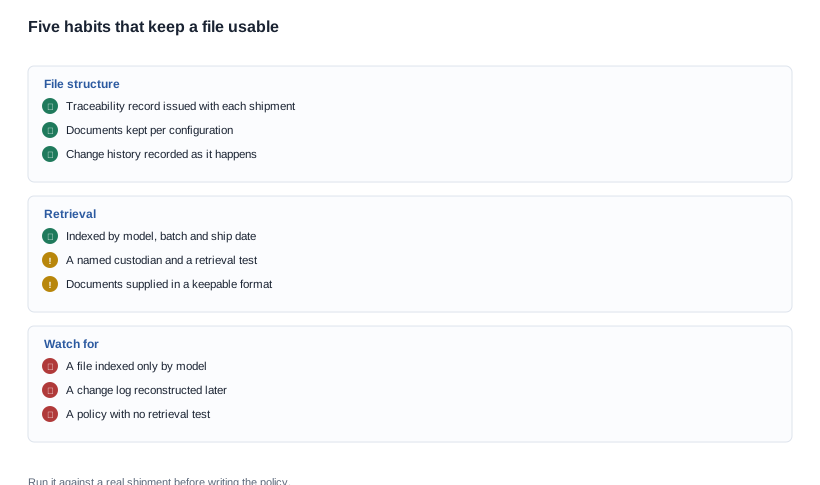
The checklist above is the working version. Run it against a real shipment before you write the policy, because a policy written in the abstract tends to describe a process that does not exist.
A worked example shows why the habits matter more than the policy. Consider a distributor who imports a model into three markets over two years, sells through a running channel in one, a gift channel in a second, and a corporate programme in a third, and who has replaced the cell once in the second year because the original supplier could not guarantee allocation.
That distributor now has, at minimum, two configurations in the field, three markets with different documentation expectations, and a batch range in each market. If the file was kept by model, the answer to "which units have the original cell" is a search through invoices. If the file was kept by configuration, batch and shipment date, the answer is a query. One of those two answers takes an hour and the other takes a week — and the week is the one that happens during an incident.
The same example shows why the change log has to be contemporaneous. The cell change is unremarkable in itself, and it is also the change that invalidates the transport documentation and possibly the conformity position. A distributor who records the change at the moment it happens links it to the batch range that used the old cell. A distributor who reconstructs it in year three is guessing, because the batch boundaries no longer exist in any system. The retrieval test in habit five is what catches this: if you cannot produce the file for a random shipment, you do not have a filing system, you have a folder.
There is one more habit in the same area that costs nothing and is worth more than it looks. Ask for the documents in the language and structure you will keep them in. A supplier who can provide a structured set per configuration, in a format your system can index, is doing work that you would otherwise do yourself at the worst possible time. That is a negotiation point, and it is a cheap one to win early.

How long a supplier document package has to last
Most buyers treat the supplier's document package as a handover, a folder of PDFs passed across a desk. It is closer to a shared liability, and the length of the relationship determines how long it has to work.
The reason is simple. A document that the supplier holds for you is a document you do not control, and the three things that decide whether you can rely on it are all relationship questions rather than technical ones. First, whether the supplier's own retention arrangement covers the period you need. Second, whether the supplier's business will still exist in year five, which is a question about the due diligence you do before the first order rather than after. Third, whether the supplier's system is organised in a way that lets them produce a document for a specific configuration rather than a folder for a model family.
That last one is the practical test, and it is easy to run. Ask the supplier to send you the document set for one specific configuration, not for the model. A supplier whose files are organised by configuration will produce it in minutes. A supplier whose files are organised by model will produce a superset and tell you to pick the right part, which means the work is yours and the risk is yours.
What a buyer should ask for, at the point of ordering rather than after the first shipment:
- The document set for the exact configuration ordered, with the configuration described in the same terms as the purchase order.
- The conformity documents themselves, not a summary of them, in a format the buyer can file and retrieve.
- The change-control procedure, and the rule that says which changes require a new document set.
- A named contact who can produce the file, and what happens to that file if the contact leaves.
- The retention arrangement on the supplier side, including how long they hold the file after the relationship ends.
The commercial terms that follow from this are ordinary negotiation items and they are worth raising early. Unit price and volume tiers, the tooling position, the payment nodes against inspection, and the warranty period with a stated response are all standard; the specific addition here is a document handover clause that states what is delivered, in what format, at what point in the programme, and what happens on a substitution. That clause is cheap to write and expensive to omit, because the moment it is needed is the moment somebody is trying to recall a batch.
The trade-off is worth naming honestly. A supplier who commits to a complete, configuration-level document package with a named retrieval contact is committing to real work, and that work is sometimes priced into the first order. A supplier who commits to nothing costs less and leaves you with a folder and a problem. Which one you shortlist should follow the evidence rather than the price, and the evidence is available before you order anything — ask for one configuration's document set and see how quickly and how cleanly it arrives.
The criteria for judging that package are short, and they are the criteria worth carrying into any supplier scorecard for this category:
- Completeness against the configuration you ordered, not against the model family.
- Retrievability, tested rather than asked about — one request, timed.
- Structure, because a set that a system can index is worth more than a set a human can read.
- Change-control clarity, because a document set without a re-issue rule goes stale silently.
- Continuity, because a supplier who reorganises their files without telling you has just removed your retrieval path.
Those five also answer the question of which model to prioritise when the budget only stretches to one documentation set. It is the model with the highest volume and the most configurations in the field, not the model with the widest specification, because the risk being managed here is the inability to produce a file — and that risk scales with the number of units and the number of variants, not with the richness of the datasheet.
How long we hold what we produce, and what you have to obtain
We produce the technical file and the Declaration of Conformity for a specific configuration and hand them over as part of the programme, and the OEM documentation page sets out the full set with who holds each.
We will also be direct about the limits of that position, because the limits are what a buyer has to plan around. The catalogue body mentions no conformity marks at all — there is no per-model certification row, no certificate number, no issuing body, and no published validity period for any model in the range. The export-certification page is a picture page: ten patent certificate images, eight design patents and two utility models. Those are intellectual-property documents, and they are not the same thing as conformity documents for a specific model.
What that means for a retention policy is concrete. The conformity documents for your configuration have to be obtained, and once obtained, they are yours to keep for the life of the product plus the market tail. The patent position is a separate file with a separate purpose, and it is not a substitute for the conformity evidence. If one of those rows decides your project, the certification checklist is where you establish what exists and what has to be commissioned, and it is cheaper to do that before the first order than during a recall.
The retention periods themselves are a legal function's question, not a manufacturer's, and we will point you at the frameworks rather than give you a number we cannot stand behind. What we can tell you is which documents exist as a deliverable, which have to be obtained, and how long the programme's own commitments run — the lifecycle support page sets out how the support commitment interacts with the period during which your file has to be retrievable.
What to do next.
- Sort your existing documents into the four categories, and check which of them are indexed by configuration rather than by model.
- Start issuing the traceability record with every shipment, at configuration granularity.
- Request the conformity documents for your exact configuration, in the format you will keep them in.
- Ask the supplier what triggers a re-test or a re-issue after a component change, and put the answer in the agreement.
- Run one retrieval test on a random shipment before you write the retention policy.
Related reading
- GPSR compliance
- OEM documentation needed
- Lifecycle support commitments
- Certification checklist and model coverage
Ask us for the document set and we will tell you which parts we hold and which you must obtain.


