

The question has no single answer, because "certificate" covers several different documents with different rules, and the most common version of the question is built on a document that does not exist.
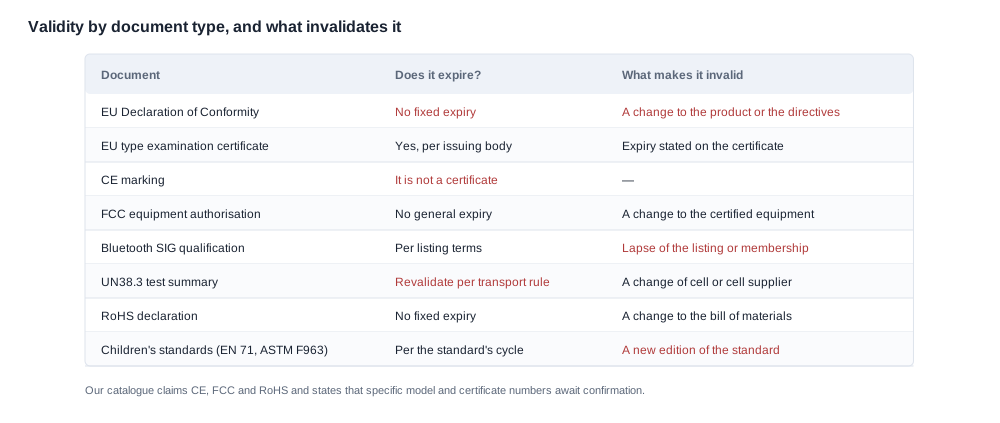
Start with that. There is no CE certificate. No authority issues one. CE marking is a manufacturer's own declaration of conformity against the applicable framework, and the document that results is the Declaration of Conformity, which names the product and is signed by the manufacturer. It carries no expiry date, and what ends its applicability is a change to the product or to the framework it was made against.
So how long is a certificate valid has three different answers depending on which document is on the table, and the practical advice is the same in every case: obtain the document, read what it says about its own validity, and re-verify before you reorder.
It is worth saying at the outset that this is a question with a method rather than a number, and that the method is cheaper than most buyers expect. Three documents, each read once, each against the purchase order rather than against a folder, will tell a buyer everything they need to know about validity — and will do it in an afternoon rather than across a season of missed shipments.
Our published position on this is narrow and worth stating precisely, because a buyer planning a compliance calendar needs to know the gaps before they plan around them. The catalogue mentions no conformity mark — no CE, no FCC, no RoHS — for any model, and it publishes no certificate numbers, no issuing bodies and no validity periods. The export-certification page is a picture page presenting ten patent certificate images: eight design patents and two utility models. Those are intellectual-property documents, and they are not conformity evidence for a model.
How long is a certificate valid: the most common misunderstanding
The misunderstanding is that a document has a shelf life that someone decided on. For the Declaration of Conformity there is no shelf life at all, and for several other documents in this category the relevant date is not on the document in the way people expect.
The distinction that matters most to a buyer is between a document that expires and a document that stops applying when something changes. The first is a calendar problem. The second is a configuration-management problem, and it is the one that actually catches buyers out — because a declaration can sit in a file for five years looking perfectly current while the product it describes has had two component substitutions since it was signed.
A useful working rule, and one that will serve most buyers in this category: the question to ask is never "is this still valid?" but "does this still cover what I am buying?" The second question has an answer you can establish by comparing the document against the purchase order, and the first question usually has no answer at all.
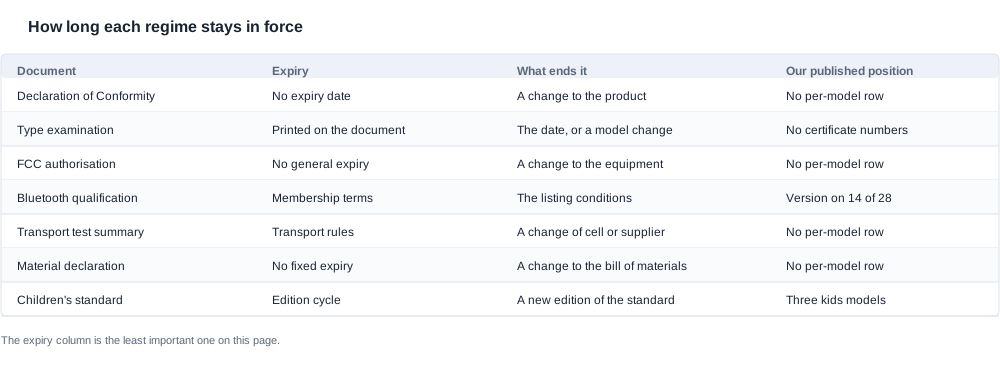
The table above is the version we would hand to a buyer assembling a compliance calendar. Read the last column rather than the second one: the expiry dates that do exist are the least important column, because the documents that expire on a printed date are the ones whose scope is written down clearly.

How long each regime stays in force, and what ends it
Type examination certificates expire. Where a conformity assessment route requires third-party examination, the resulting certificate carries an expiry date and an issuing body, both printed on the document. Check the date, and check the model list on it. The common finding here is family-level coverage where your exact variant is not named — it looks complete on the page and it is not.
The Declaration of Conformity does not expire. What invalidates it is a change to the product: a different radio, a different battery, a different charging interface, a different firmware baseline if the change affects the assessment. Ask the supplier which changes trigger a new declaration, and get the answer in writing, because the supplier's change-control procedure and your belief about what has changed are two different documents.
FCC authorisation in the United States and Bluetooth qualification are different mechanisms, and suppliers conflate them. An FCC authorisation covers specific equipment; a change to that equipment can render it inapplicable, and there is no general expiry date that travels across all equipment. Bluetooth qualification is not a regulatory approval at all — it qualifies an implementation for use of the Bluetooth mark, and the listing and the membership terms govern it. When a listing says "Bluetooth certified", ask which of the two it means. In our own catalogue the Bluetooth version is published for fourteen of the twenty-eight models and not published for the eleven camera models, the A05, the A06, or the bone conduction entry, which is a different question from qualification but a related one.
Transport documentation follows transport rules rather than a conformity regime. A transport test summary covers a specific cell, and the practical trigger is a change of cell or of cell supplier. The summary is invalidated by that substitution regardless of whether the finished product is otherwise unchanged. This is the single most common invalidation in the category, because a cell substitution is an ordinary purchasing event and the documentation consequence is not ordinary at all.
A material declaration such as RoHS has no fixed expiry, but it has to correspond to the actual bill of materials. A declaration that has not been updated after a component change is not evidence of anything, and this is a document where the date on the page is nearly meaningless.
Children's standards work on a cycle. For products aimed at children, the applicable standard is published in editions, and a new edition can require retesting against it. This is the document most likely to need re-examination in a range that is otherwise stable, and it is the one most often assumed to be covered by general certification. Our children's models — the A05, the A06 and the A07 — are a separate platform in the range, and the kids certification requirements page covers what a buyer should establish for that tier specifically.
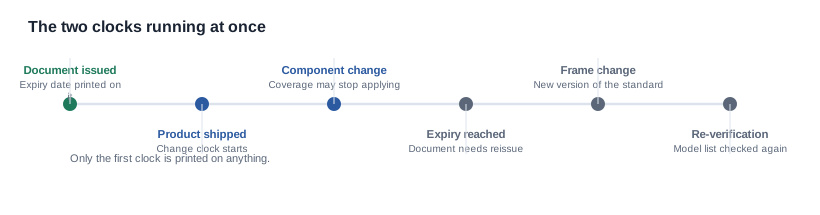
The timeline above shows the two clocks running side by side: the expiry date on the document, which is fixed and published, and the change clock on the product, which runs from the day of purchase and is not published anywhere. The second clock is the one that decides whether the document still covers what you are buying.
How long the model list on a document stays relevant
This is where a certificate answer most often goes wrong, and it is worth giving it a section of its own, because the model list is the field on the document that decides whether the document applies to you.
A certificate and a model list are different things. A type examination certificate names a family, and the model list inside it names the specific designations covered. Three questions decide whether your purchase is inside that list:
- Is your exact designation named? Not the family, not the series, not "the same platform" — the designation on the purchase order.
- If the designation differs from the family, what is the relationship? A suffix change, a colour change, a firmware change and a component substitution are all different, and only one of them is usually covered by the same list. The test is not "is it similar" but "is it named, and if not, what does the manufacturer say about the difference".
- Who maintains the list, and when was it last updated? A list that is maintained with the supplier's product information is a live document. A list that was printed when the certificate was issued is a snapshot, and it is out of date the moment a variant is added.
The practical consequence is a rule rather than a date. Re-verify when the product changes, not when a reminder fires. A calendar entry for "check the certificates" that fires on a fixed anniversary will find the same document every year and will never notice that the product moved three months ago. A calendar that is triggered by the change log — a cell substitution, a component change, a firmware baseline change — catches the event that actually invalidates something.
There is a fourth reason to re-verify that has nothing to do with expiry, and it is the one buyers forget most often: the framework itself can change. A new or revised framework edition, a new enforcement priority in a market, or a new technical standard for the product category can all require work that nobody asked for, and none of them announce themselves through an expiry date on a supplier's document.
A worked example shows how these clocks combine. Suppose a distributor bought a model in its first year with a cell from one supplier. Two years later, in a market where the model is still selling, the original supplier cannot guarantee allocation and the distributor qualifies a second cell. The transport summary for the first cell no longer describes the product being shipped. The Declaration of Conformity was signed against a product that contained the first cell, so its coverage of the current product is a question rather than an assumption. The type examination certificate, if the model has one, may or may not name the variant, and the answer is in the model list rather than in the document's front page.
None of that is a compliance failure on the day the second cell arrives. All of it becomes one on the day somebody asks which units are covered — and the answer, in a well-kept file, is a query rather than a week of reconstruction. Which is the whole argument for logging changes with their dates and their batch ranges while they are still in the head of the person who made them.

How long before you re-verify, and what the calendar should hold
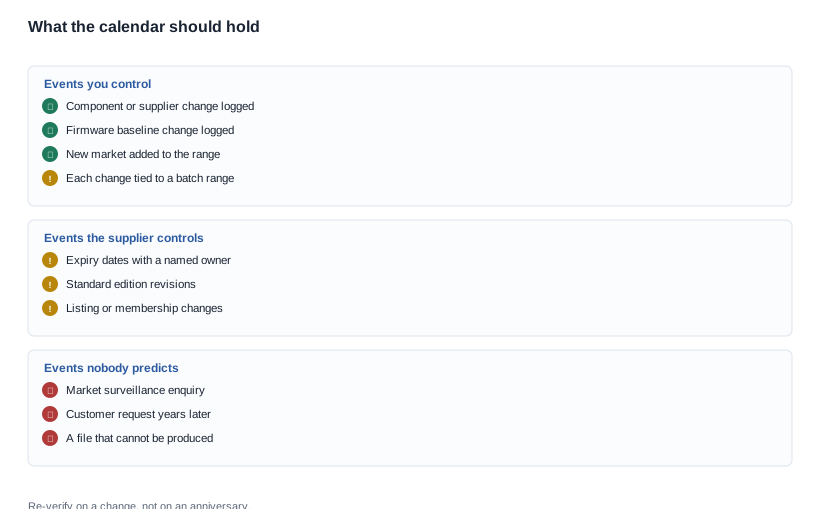
What goes in the calendar is more useful than a date, and it is worth splitting into three kinds of event.
Events you control. Any component or supplier change, any firmware baseline change, any addition of a new market, and any change of the manufacturing configuration. Each of these is an event you can put on a log, and each one triggers a question: does this document still cover what we are now buying?
Events the supplier controls. A document that expires, a type examination certificate with a printed date, a standard edition that has been revised, a membership or listing condition that changes. These arrive from outside, so they need a named owner who checks the supplier's position periodically rather than reactively.
Events you cannot predict. A market-surveillance enquiry, a field safety notice, a customer request for proof of conformity three years after the sale. These are why the retrieval test matters more than the retention period: a file that cannot be produced on demand is not evidence, whatever the date on it.
A short worked version of the calendar for a single-model buyer: log every configuration change with its date and its batch range; set a reminder to ask the supplier for the current validity status of each document you hold, once a year, even when nothing has changed, because documents get revised; and re-verify immediately after any cell, radio or firmware change. That is three habits rather than a system, and it is enough to keep a file honest.
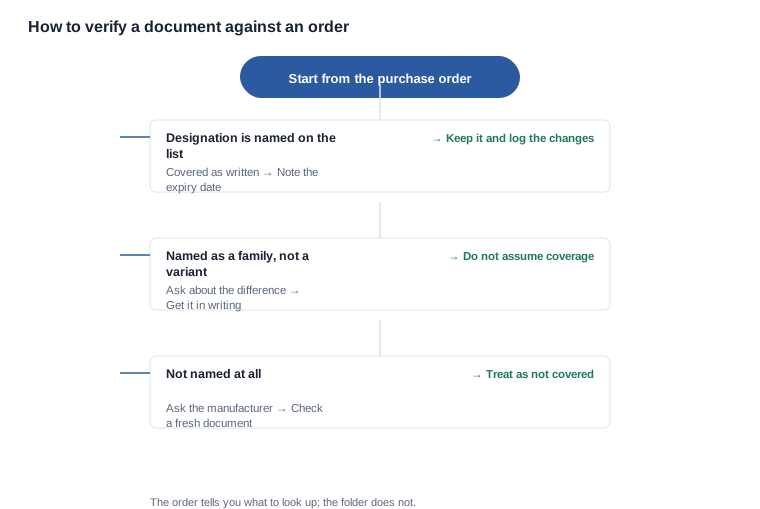
The tree above is the order of operations for a single verification, and it is deliberately cheap: start from the purchase order rather than from the folder, because the folder is where you started and the purchase order is where the answer is.

How long the answer stays valid when somebody audits you
The certificate question is not only about regulators. It is asked by corporate procurement teams, by insurers, by marketplace listing reviewers and by customers running their own supplier qualification — and each of them asks it at a different moment and with a different consequence.
A corporate procurement qualification review asks for the document set for the exact configuration being purchased, and it asks during the supplier approval rather than after the order. An insurer asks whether the evidence exists at all, because an insurance position on a product category is usually written against the presence of documentation rather than against the content of it. A marketplace listing review asks for evidence of conformity at listing time, and it is the reason so many listings in this category carry a claim without a document behind it.
The practical point for a buyer is that these audits arrive on a schedule you do not control and they ask for material you produced years earlier. Three habits keep that from being a problem:
- Produce on demand, not on request. A file that takes a person three days to assemble is a file that fails a 48-hour review, and a 48-hour review is the most common deadline in this category.
- Keep the evidence and the claim together. A conformity document and the listing copy that relies on it should sit in the same place, because the most common finding in a review is not a missing document — it is a listing claim with no matching document.
- Track the gap. Where a document does not exist for a configuration, that gap belongs on a register with an owner and a review date, not in somebody's memory.
There is a commercial consequence too, and it belongs in the negotiation rather than in the filing cabinet. Buyers who resell under their own brand carry the conformity obligation for what they place on the market, and the terms of the supply agreement should say what the supplier provides, in what form, at what point in the programme, and what happens on a component substitution. That clause is the difference between a documentation problem you can solve in an afternoon and one you can only solve with a new product programme.
Which model you put in front of an auditor is worth choosing carefully as well. A model with a complete, configuration-level document set can be qualified quickly and repeatedly; a model without one will consume disproportionate time every time it is reviewed, and that time is paid for in commercial terms long before anyone points at the paperwork.
The criteria for judging a document package are short enough to use as a supplier scorecard: completeness against the configuration being bought, retrievability tested rather than assumed, structure that a system can index, and a stated rule for what invalidates coverage. A supplier who can produce a configuration-level set in a day is a different proposition from one who forwards a folder and calls it documentation, and the difference shows up in the due diligence rather than in the sample.
Which one of the two you shortlist should follow that judgement rather than the unit price, because the price of a document package is small and the cost of not having one is paid every time somebody audits you. The trade-off worth naming is that a supplier who maintains configuration-level documentation is carrying real cost, and that cost is sometimes reflected in the first order. A cheaper supplier who cannot produce the file is not cheaper, because the file is a per-audit cost and audits do not stop.
How long we publish, and what you have to obtain
We will not present a claim as a certificate, and we will not tell you a certificate covers your model without seeing the model list on the document.
The published position across our range is this. There is no per-model certification row for any model in the catalogue. No certificate numbers, issuing bodies or validity dates are published. The export-certification page is a picture page presenting ten patent certificate images — eight design patents and two utility models. The intellectual-property position and the conformity position are separate files, and one does not substitute for the other.
What we will do is tell you which documents your configuration needs, where each of them comes from, and which parts of our published data already answer part of the question. The certification checklist is the working version. On the technical side, the battery certification requirements page covers the rows that a lithium cell brings with it — the transport documentation, the cell declaration and the change-trigger questions that follow from a substitution. For the children's tier, the kids certification requirements page covers the separate platform and the standards a buyer should be asking about.
The practical sequence, then, is short. Obtain the documents rather than the claims. Check the model list against the exact designation. Note every expiry date that exists. Log the changes that would invalidate coverage, and re-verify after any of them. And for products aimed at children, ask which edition of the standard was used, because it is the document most likely to need re-examination and the one most often assumed to be covered.
What to do next.
- List every document you are relying on for a specific model, and separate the conformity documents from the intellectual-property ones.
- Obtain each document and check its model list against your exact designation.
- Put every expiry date you find into the calendar, with a named owner.
- Log every component, cell and firmware change against a date and a batch range.
- Re-verify after any change, and once a year regardless of whether anything changed.
Related reading
- certification checklist and model coverage
- battery certification requirements
- kids certification requirements by market
Tell us your markets and we will say which documents you need and where to get them.


