

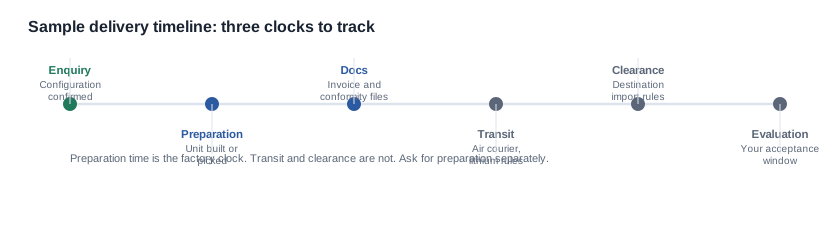
The honest answer to this question is a shape rather than a number, and buyers who are disappointed by that usually are because they asked the wrong supplier the wrong question. A single "arrival" date blends at least four separate clocks: the factory preparing the unit, the courier moving it, the destination's import rules clearing it, and your own team evaluating it. Three of those four are commitments that somebody has to make; one of them is mostly outside anybody's control. The supplier who quotes you one date has usually told you which clock they control, without saying so.
What makes the question harder than it sounds is that the range here is not homogeneous. A sample of a model in a published configuration, drawn from stock, is a different operation from a sample with your firmware, your logo, your packaging and your colour, and the second one is an engineering programme with a logistics tail attached. A sample of a camera model that ships with a charging case is a different object in a bag from a camera model that does not. And every unit in this catalogue carries a lithium cell, which puts the shipment into a regulatory lane with its own acceptance criteria that the factory does not control.
None of this is published on our site as a fixed figure. Sample cost, preparation time and production lead time are all not published, and they are confirmed per enquiry because each of them depends on the configuration you specify. That is not a way of avoiding the question — it is the honest position, because a preparation time quoted before the configuration is known would be a guess dressed as a commitment.
How long until the sample arrives: four clocks, not one
Separate the four clocks and the whole question becomes manageable, because each one has a different owner, a different failure mode and a different remedy.
Clock one — preparation. This is the factory's work and the factory's commitment. It is also the clock that varies most with what you ask for. The only part of it that is genuinely the factory's is the physical work: taking a unit in the right configuration, fitting the right accessories, adding your branding if you are commissioning it, producing the documentation that travels with it and packing it correctly. The part that is not the factory's is the part that has to be engineered first.
Clock two — transit. The courier's performance, influenced by your destination, the lane, the mode and the paperwork. This is the clock that is most often quoted and least often controlled, and it is the one that most often produces a supplier being blamed for something that was never theirs.
Clock three — clearance. The destination country's import rules, applied to the paperwork and to the product. This is the clock buyers forget entirely, and it is the one that most often turns a smooth shipment into a held shipment. It is also the clock with the least negotiation room, because it is nobody's commercial decision.
Clock four — your evaluation. Time your own people spend. This clock does not appear in any supplier's quotation, and if nobody reserves it the sample arrives and then sits, and the elapsed time from enquiry to approval stretches without anybody being at fault.
| Clock | Who owns it | Who can move it | Typical failure |
|---|---|---|---|
| Preparation | Supplier | Specification detail | Firmware build not scoped |
| Transit | Courier and lane | Destination and mode | Lithium acceptance refused |
| Clearance | Destination rules | Paperwork accuracy | Model code mismatch |
| Evaluation | You | Internal scheduling | No acceptance window booked |
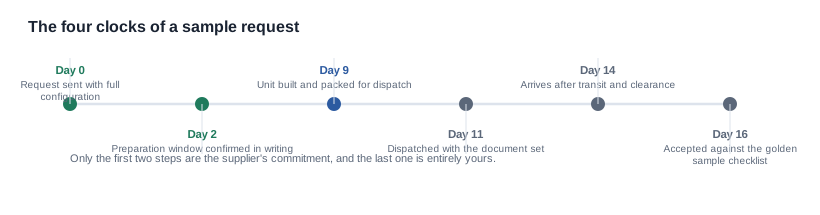
When a supplier quotes a single date, ask them to split it into these four. A supplier who will split it is telling you which part of the timeline they are actually promising, and a supplier who cannot is telling you something else.

How long preparation takes, and what drives it
Preparation is where the schedule is won or lost, and the variables are all things you control at the point of writing the request — which is why preparation is the clock worth spending negotiation time on.
Whether the configuration already exists. A model in a published configuration, in a published colour, with the published accessory set, needs the least preparation of anything you can ask for. The further your request departs from the published configuration, the more preparation it needs, and the departure does not have to be large to matter. A different logo is a short job. A different logo plus a different firmware build plus a different box is a small development programme, and it will be quoted and scheduled like one.
The state of the firmware. This is the variable buyers most often underestimate, because it does not appear on the product. If the configuration you want corresponds to a firmware build that already exists, preparation is physical work. If it does not, somebody has to build it, test it, and sometimes get it signed off internally before the unit can be produced — and that work sits in front of everything else, including the packing. A unit in an existing build can typically be produced while a new build is still in testing.
The paperwork travelling with it. If the sample is to carry a document set issued in your brand name rather than the manufacturer's, that is a separate task with its own lead time, and it is a task that sits with a compliance function rather than with a production floor.
Whether the unit is drawn from stock or built to order. Stock is faster. Built to order is slower and more certain, and for a first evaluation it is usually worth paying the difference to receive the configuration you actually intend to buy rather than a proxy.

The practical way to compress preparation is to send a complete request the first time: model, configuration, colour, accessories, packaging, destination, invoice requirements, the name the paperwork should be issued in, and the date by which you need the unit. Every missing field is a round trip, and a round trip during preparation is pure waste because nothing else can move until it is answered.
Ask for preparation time as a separate committed line in that request, in writing, for the specific configuration. This is worth insisting on for a reason beyond scheduling: it forces the supplier to tell you whether your configuration is already buildable. If the answer is that it needs a new build, you have learned something that changes the commercial conversation before you have committed to anything.

How long transit adds, and the variable buyers miss
Transit is a logistics variable, and three things dominate it: the destination, the mode, and the battery. The third is the one that catches people.
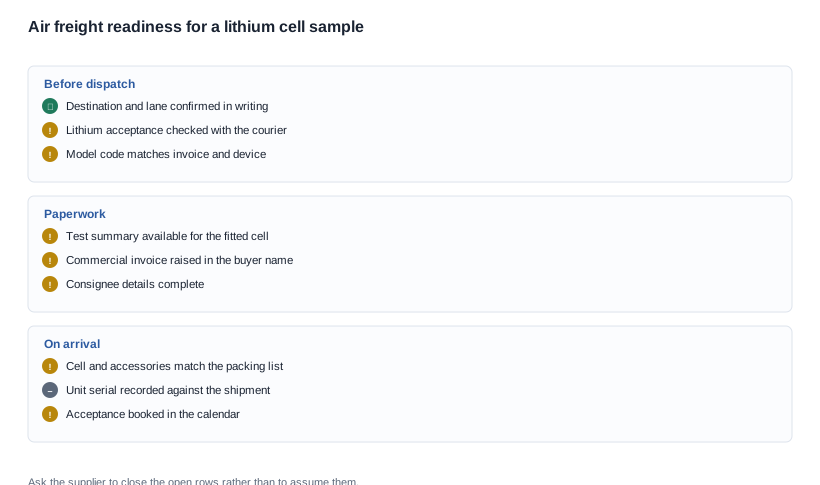
Every model in this catalogue carries a lithium cell. Lithium batteries shipped by air travel under acceptance criteria that a courier applies at the counter, and a sample can be held, returned or re-routed for documentation reasons with nothing whatsoever wrong with the product. Air is the default for a single sample and air is also the strictest lane. A sample sent by sea takes longer and asks different questions, and for a single unit that is rarely the right trade.
The variable that decides whether transit is smooth is whether the shipment is accepted by the carrier, and that depends on the paperwork rather than on the product. The documentation requirements for moving a lithium cell are set out on our battery transport compliance page, and the practical implication for a sample request is simple: confirm, before dispatch, that the destination and the configuration qualify under the courier's lithium acceptance rules.
There is a second transit variable worth naming, and it is not logistics at all. If you are shipping several units to several reviewers, or one unit to an office that then forwards it internally, the sample can spend days in a receiving queue. That is not the supplier's time and it is not the courier's time, but it lands in your elapsed measurement, and it is the reason a sample programme that looks efficient on paper can quietly take a week longer than it should.
If speed genuinely matters to your evaluation — and for a launch with a fixed on-shelf date it often does — the lever is preparation, not transit. Preparation is compressible by specifying earlier and more completely; transit is largely a function of geography.
How long clearance adds before the unit is usable
Clearance is the clock with the least commercial flexibility and the most impact on the arrival date, and it is driven by one thing above all: whether the paperwork matches the physical unit.
The goods description on the commercial invoice, the model designation on the product, the description on the packing list and the marking on the device should all resolve to the same model. A single character of difference in a model code is a genuine delay at the border, and it is a delay that will happen again on every subsequent commercial shipment of that configuration, which is why it is worth catching on the sample rather than on the first production order.
Beyond the model-code question, the destination's requirements for a radio-equipped consumer electronic product sit in a framework whose details are set out in the certification checklist. We publish no per-model certification row in this catalogue, so we cannot tell you which approvals attach to which model, and we will not invent one. What the checklist is for is making sure the requirement list is applied to the specific configuration and the specific destination, rather than assumed from a previous project.
Two practical points that shorten this clock.
Ask for the document set to be issued in the correct name before the sample ships, not after it arrives. A sample that arrives with documentation in the wrong name is a sample that needs a second documentation cycle, and the second cycle is longer than the first because it now involves a third party.
Tell the supplier the destination and the consignee details at enquiry stage. Clearance failures caused by incomplete shipping information are the easiest class of delay to eliminate, and eliminating them costs nothing.
A worked example, because the arithmetic matters more than the theory. A brand evaluating a camera model for an EU launch requests two samples in a published configuration. The supplier commits to a preparation window; the samples go by air on a Tuesday; the forwarder files the lithium documentation and the commercial paperwork with the correct model code and consignee; the units clear and arrive late in the following week. The elapsed time from enquiry to arrival is dominated by preparation and transit, and clearance adds almost nothing — because the paperwork was right the first time. The same request with the invoice raised in the wrong name, or with a model code transcribed from an old catalogue, adds a week that nobody can explain from the outside.
How long from enquiry to approval, and how to make the date binding
Now the part that turns a timeline into a commitment. A buyer rarely needs a guaranteed arrival date; what a buyer needs is a date they can put in a plan, which means the factory's part of the clock has to be committed in writing and the rest has to be visible.
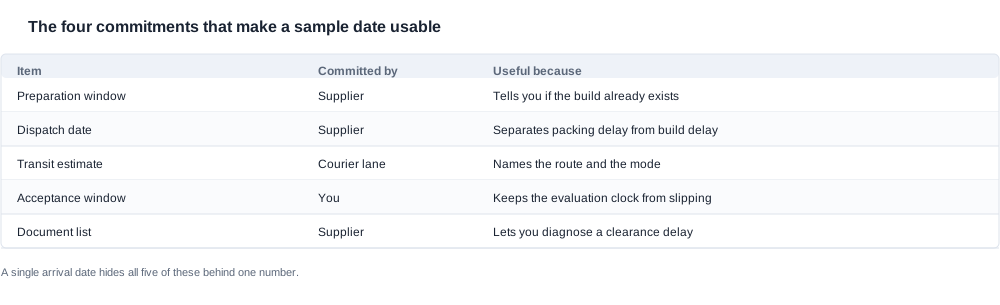
The request you send should separate four items that suppliers habitually bundle into one number:
- Preparation time for the named configuration, committed in writing, with a start condition stated — typically the point at which the specification is agreed and the firmware build is confirmed.
- Dispatch date, committed separately from preparation, so that a delay in packing does not hide inside a preparation number.
- Transit estimate, offered as an estimate with the lane named, and understood to be the courier's performance rather than the factory's.
- The documentation that will accompany the unit, listed by name, so that a clearance delay can be diagnosed as a clearance problem rather than being blamed on the shipment.
The commercial terms around the sample are negotiable and worth negotiating, because the sample is usually the first transaction in the relationship and the terms established there tend to persist.
Sample cost and whether it is credited against the first order. This is the line most often left unstated. A supplier that treats the sample fee as revenue and one that credits it against a pilot order are making very different statements about intent, and the second one is easy to ask for and easy to grant.
The number of samples, and whether a second unit is available for a second reviewer. Two units in the same configuration let a buyer run an internal comparison — one unit for the evaluation team, one for the person who will write the user guide — and they also protect the programme against a single unit being lost. If the sample fee is credited, the marginal cost of a second unit is usually small.
The relationship between sample lead time and production lead time. A sample that takes three weeks tells you very little about a production order if the sample was a stock unit and the production order is not. Ask whether the quoted preparation window is representative of the build you are actually buying.
Payment terms on the sample. Sample fee, refund on order, deposit, and whether the sample is at your cost or theirs are all negotiable, and each of them belongs in the same conversation rather than arriving as a surprise with the invoice.
What is not negotiable, and what should therefore be priced rather than argued with, is the cost and lead time of certification work, which follows the testing body and the process rather than the relationship. It is worth asking the supplier to quote tooling and certification separately rather than as one bundled line, because they behave differently: tooling is often amortised across a first order, while certification cost is generally a per-family charge that repeats if you add a model.
And there is one term that belongs in the agreement explicitly. The warranty and the return terms for the sample. A sample that arrives with a defect and cannot be returned is a sample that is a write-off, and a write-off that happened during the evaluation phase is the most expensive kind, because it delays the programme at the point where the programme is least able to absorb a delay. The terms that cover a sample are often narrower than the terms that cover a production order, and that gap is worth closing before it is used.
Making the date survive a bad week
Three habits turn a quoted timeline into a plan you can keep.
Book the acceptance window before dispatch, not after arrival. Decide who reviews the unit, on what day, and for how long, and put it in a calendar before the unit is in the air. The evaluation clock is the only one of the four that you own completely, and it is the one most often left unbooked.
Ask for the preparation commitment in writing against a named configuration. The moment the request becomes configuration-specific, the commitment becomes meaningful. A general statement about typical preparation times is useful for planning and worthless for scheduling.
Track each clock separately in your own records. Record the date the request was sent, the date the configuration was agreed, the date preparation completed, the date of dispatch, the date of arrival and the date of acceptance. Most buyers keep only the first and the last, which is why they cannot tell a preparation problem from a clearance problem when it happens — and therefore cannot renegotiate the right thing.
The procedure that should run the moment the box is opened
Arrival is the start of the next clock, not the end of this one. The acceptance routine that runs on day one is set out in what to check when a sample arrives, and it exists because a sample that is accepted without inspection becomes an assumption that survives into the production order. The commercial side of the same request — sample policy, fees, deposits and refunds — is covered in the sample policy and SOP template, which is the document a brand can lift into its own process rather than reinvent.
The two activities belong together in the programme plan. A sample programme is not complete when the unit arrives; it is complete when the unit has been evaluated against a golden-sample checklist, the findings are recorded, and the checklist becomes the acceptance reference for the first production order. Buyers who build the checklist from the sample, rather than after it, save themselves a negotiation later.
What we can commit to, and what we cannot
We will commit a preparation window in writing for a specified configuration, and we will not quote a single "arrival" figure that silently bundles a factory commitment with a courier's performance. Transit and clearance sit outside our control, and quoting a total for them is how a supplier ends up blamed for a customs delay it could not have prevented.
What is published on this site, and what is not, is worth stating plainly because it decides what you can plan around. Published: the models in each range, the battery capacities and charge times, the charging method and interface for each model, the charging case capacity where a case exists, the camera platform resolution tiers, and the published runtime figures for the camera models. Not published: sample cost, preparation time, production lead time, minimum order quantity, warranty terms, certificate numbers, and any per-model certification row. All of the second group is confirmed per enquiry, which is a slower answer than a table but a more accurate one.
One point about the first group is worth making, because it affects how you evaluate a camera model specifically. The catalogue publishes no storage capacity and no file size for any camera model, so a camera sample is the only route to a number for those rows. That has a direct effect on sample planning: if your evaluation depends on storage behaviour or on how content moves off the device, the sample you receive should be in the configuration you intend to ship, and you should budget time in the evaluation window to establish it rather than assuming it.
The questions to put in the request
- What is the committed preparation time for this exact configuration, and what is the start condition?
- On what date will it be dispatched, separately from the preparation commitment?
- Which document set travels with the unit, and in whose name will it be issued?
- Does this destination and this configuration meet the courier's lithium acceptance criteria for the intended lane?
- Is the sample fee credited against the first order, and what are the terms if it is not?
- What are the warranty and return terms for the sample itself?
- Will a second unit be available in the same configuration for a second reviewer?
Ask the seventh question even if you only expect one unit, because the answer tells you how the supplier thinks about evaluation support, and because it is the cheapest possible insurance against a programme stalling on a single damaged unit.
Why we separate the clocks rather than quote a total
A supplier who quotes one number is usually not being evasive. They are trying to protect themselves from a delivery failure they cannot control, and a total date is the only way to do that. The cost of that protection falls on the buyer, because the buyer cannot tell which part slipped and therefore cannot renegotiate the part that mattered.
The alternative is unglamorous and works: a preparation window in writing, a dispatch date, a transit estimate with the lane named, a document list, and a booked acceptance window. Five lines. Each one has an owner, and each one can be escalated to the right party when it slips. A single date has no owner at all, which is precisely why it fails silently.
Related reading
- Sample policy and SOP template — the process behind the timeline
- What to check when a sample arrives — inspection on day one
- Battery transport requirements — the paperwork that delays air shipments
- Certification checklist — the destination requirements that sit inside clearance
Tell us the configuration, the destination country and your evaluation deadline, and we will tell you what we can commit to and which parts of the timeline sit with the courier and the destination's rules.


