

Most contract terms in this category are not arbitrary numbers, and the ones that are arbitrary are the ones that cause the trouble. The rule is simple enough to apply in a single sitting: every term in a smart glasses contract should be traceable to something the supplier actually knows, and a term that cannot be traced is a term that will be renegotiated at the worst possible moment — usually after the units are on a vessel.
What follows is a way to work through a contract line by line, identify which terms are calculated, which are agreed, and which are facts that have to be established before the order is signed. The commercial point underneath is the same for all of them. A term with a derivation behind it is predictable in normal operation and enforceable in a dispute. A term without one is neither, and it costs more to fix late than to write down properly at the start.
Smart glasses contract: no derivation, later renegotiation
The buyer who most often struggles with this is a procurement manager who has inherited a contract template from a previous programme, or from a colleague, or from a supplier's own standard form. The clauses are familiar, they read as reasonable, and nobody in the room remembers the fact that each one was derived from. That is the situation this method is designed for: a term is only reasonable relative to the thing it was derived from, and the thing has usually changed.
A worked example makes the mechanism concrete. An acceptance clause written for a standard configuration with a magnetic charging interface can be a function check and a charge check, because the risk sits in the electronics and the interface. The identical clause carried over to a configuration with a 13 MP camera module, a custom logo and a private-label retail box is inadequate, because the risk has moved from the electronics to the optics and to the packaging. The clause has not changed and the number has not changed, but the fact behind it has, and the fact is the only part that mattered.
The second reason derivation matters is that it determines where a buyer should spend negotiating capital. A term derived from a configuration can be re-negotiated by changing the configuration. A term derived from a third party's queue — a laboratory, a certification route, a component supplier — cannot be moved by pressure at all, and a buyer who spends the meeting on it has wasted the meeting. And a term derived from a fact the supplier has not established yet is not a term at all; it is a gap, and the way to handle a gap is to close it before the signature rather than to argue about it afterwards.
The third reason is narrower and matters for private-label programmes specifically. A clause that names a configuration, a case variant, a cell or a charging interface has to be checked against the model designation that the units actually ship under, because the designation is what the documentation, the packaging and the customs declaration all refer to. A term that does not name the designation will be satisfied by a unit that technically does not match the product the buyer approved, and the dispute at that point is a legal one rather than a commercial one.
A worked derivation: the same clause, two configurations
Take a clause set that appears in almost every order in this category: a five per cent defect allowance, a thirty-day delivery date, and a twelve-month warranty. Now put them against two configurations from our own range and let the derivation sheet do the work on its own.
The first configuration is the A07, which publishes a 70 mAh cell, a charge time of two hours or less, a rated runtime of about twenty hours, magnetic charging and Bluetooth V5.4, with no camera and no charging case. The risk profile is simple: a functional check, a charge check, a battery check, and a five per cent allowance against the units inspected. A thirty-day delivery date is credible, because there is no case, no artwork beyond a box and no camera to verify. A twelve-month warranty written against a cell that fails to hold a charge is a reasonable place to start.
The second configuration is the L2 Utral, which publishes a 13 MP camera, a rated runtime of about seven hours, a 290 mAh cell, a charge time of two hours or less, a charging case available at either 900 mAh or 1400 mAh, and a Type-C charging interface. The same five per cent allowance is now a much larger number in practice, because the units that can be rejected in a sample are the ones with a lens fault, a case fault, an interface fault or an artwork fault, and the number of ways a unit can fail has grown. A thirty-day delivery date has to name the stage, because the case variant, the camera verification and the artwork are three separate preconditions and one of them sits on the buyer's critical path. The warranty has to say which events are covered, because a camera module and a charging case fail differently from a cell.
The numbers did not change. The derivations did, and that is the whole argument of this article. A buyer who runs the derivation sheet across two configurations of the same order will find, in under an hour, that the clause they were going to copy is the wrong one for half the order — and will find it before the order, not after the first shipment.
Where each term comes from, and the document that evidences it
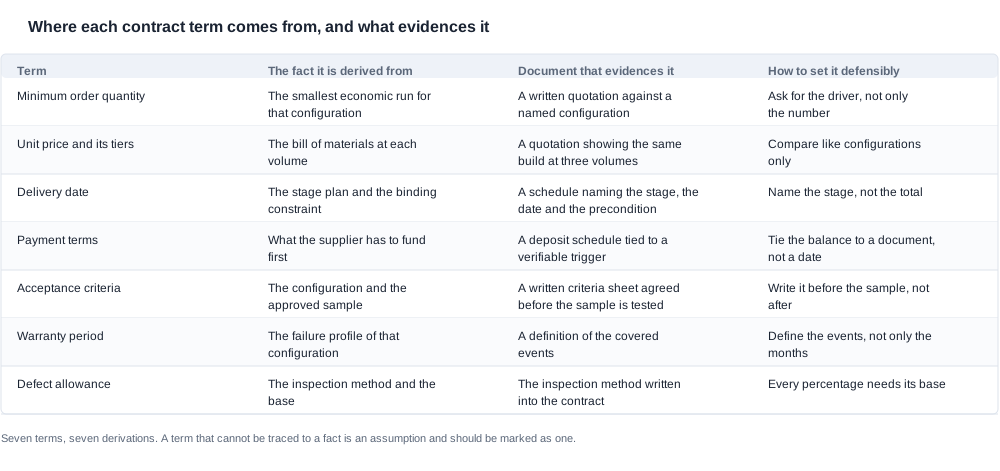
The right-hand column in that table is the part most contracts omit, and it is the part that decides whether a term can be checked after the fact. A minimum order quantity that is recorded as a number in a schedule and a minimum order quantity that is recorded as a number, a configuration and a date in a signed quotation are different things, and only the second one settles a dispute.
Three of these derivations are worth expanding because they are the ones most often written wrongly.
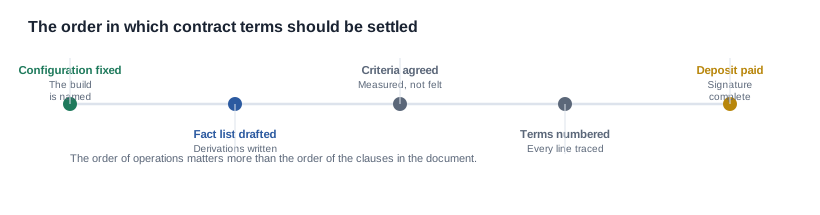
The delivery date. A duration is not a commitment. A contract that says four weeks has no mechanism in it, so when the date moves there is nothing to discuss — there is only a supplier who was late and a buyer who is disappointed. A date has a mechanism: name the binding stage, the precondition for that stage and the date the stage is expected to complete. A buyer who has "the artwork delivered by the third, production from the fifth, ready to ship on the fortieth" has a contract. A buyer who has "four weeks" has a hope, and the difference between them shows up in the first late shipment.
The payment terms. These are derived from what the supplier has to fund before the buyer pays, and that is different for every programme. A programme with custom tooling and custom artwork puts more of the cost on the supplier's side than a standard configuration does, which means the deposit that the supplier can justify is different. A buyer who copies a payment structure from a standard-configurations contract into a custom programme is either financing the supplier unnecessarily or creating a cash-flow problem that the supplier will solve by reordering the schedule. The tie to a verifiable trigger — the approved artwork, the approved sample, the first article passed — is what makes the structure defensible on both sides.
The warranty period. This derives from the failure profile of the particular configuration, and it should be written as a set of covered events rather than a number of months. A configuration with a 290 mAh cell, a 1400 mAh charging case and a 13 MP camera module does not have the same failure profile as a configuration with a 40 mAh cell and no camera, and a warranty expressed in months cannot express the difference. A warranty written against a defined failure — a cell that will not hold a charge, a charging interface that will not make contact, a unit that will not complete a charge in the stated time — can be settled from evidence, and a warranty expressed only in months can only be argued about.
The three miscalculations that cause the disputes
Copying a term because another contract had it. This is the most common drafting error and it is the one described above. The clause is reasonable, the fact behind it is gone, and the mismatch is usually discovered during a quality incident rather than during a review. The fix is procedural and it takes two minutes: when a clause is inherited from another contract, write down the fact it was derived from and check whether that fact still holds for the configuration in front of you. Keep that derivation note in the contract file, not in someone's head.
Using a percentage without a base. A defect allowance written as a percentage without saying of what — of the units inspected, of the units delivered, or of the units in the batch. A warranty period written as a percentage of something. A discount ladder written as a percentage at each tier without the quantity that unlocks it. Each of these is unarguable at the moment it is written and unusable at the moment it is needed. The distinction between two per cent of the units inspected and two per cent of the delivery is not academic: a single rejected unit in a small sample can fail an entire batch under the first reading, and that is a dispute about the whole shipment rather than about one unit.
Treating a duration as a commitment. This is the one the industry does most often, and it is the reason delivery disputes in this category are so noisy. The four weeks example above is the standard case, and it generalises: any date without a named stage, a named precondition and a named owner is a duration, and durations move. The fix is to write the mechanism in the same sentence as the number, and to name what happens when the stage slips, because the absence of a consequence is itself a term.
There is a fourth miscalculation that is less common and more expensive, and it is the tendency to accept a term that describes a family rather than a configuration. A minimum order quantity quoted for "the range", a warranty quoted for "the product", a lead time quoted for "smart glasses" — these are all statements about nothing in particular, and a buyer who accepts them has accepted a term that cannot be performed, because the supplier cannot perform a commitment about a category.

The terms that cannot be calculated at all
Three of the terms in a contract in this category resist arithmetic, and pretending otherwise produces a clause that cannot be performed.
The capacity commitment. Our own line count, daily output and stage durations are not published, because they move with the order, the configuration and the week. A contract that quotes a standing capacity figure is quoting a number that was true on a day in the past, and the day in the past is rarely the day the buyer needs it. The alternative is a slot: a date on which a specific job starts, with the configuration named. A slot is a commitment the supplier can make, because it depends on a specific job rather than on a general throughput claim.
The conformity position. The certificate numbers, the model coverage and the issuing bodies are facts, and they are either established for a model or they are not. In our own documentation the export-certification page is images rather than text, the catalogue names no CE, FCC or RoHS, there is no per-model certification row anywhere, and the children's models carry no recorded conformity position at all. That is not a number to negotiate; it is a fact to establish, and the clause that needs to be in the contract is a delivery obligation on the supplier rather than a warranty on a figure.
The minimum order quantity. Our source material records three conflicting internal positions on minimum order quantity, so we do not publish a standing figure. It is agreed per order, in writing, against a specific configuration. A contract that quotes a general minimum is quoting a number that does not apply to the order being placed, and the disagreement surfaces as an argument about a figure rather than about the configuration that produced it.
The alternative to a standing figure in all three cases is the same: name the configuration, name the order, name the date, and put it in the document. What cannot be calculated cannot be published, and what cannot be published has to be specified.

A working method, and where a term can be negotiated
The method itself is short, and it produces a document that is different from the contract at the start: a derivation sheet, one line per term, that sits behind the contract and tells the buyer what each number is standing on.
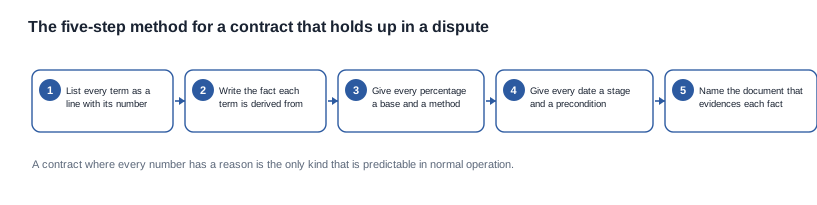
- List every term in the contract as a line, with the number in the right-hand column.
- For each line, write the fact it is derived from. If you cannot, the term is an assumption and should be marked as one.
- For each percentage, write the base and the method in the same sentence.
- For each date, write the binding stage and the precondition.
- For each fact the supplier has to supply, write the document that evidences it, and the date it is due.
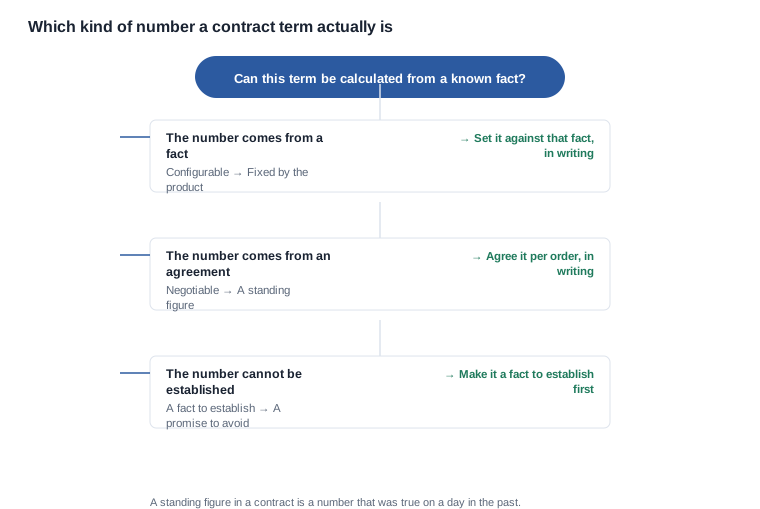
The commercial negotiation follows from the classification the decision chart describes. A term derived from a fact the supplier knows is a term to be negotiated against that fact. A term derived from an agreement is a term to be agreed per order and dated, because a standing figure will be wrong. A term that cannot be established is a term to be converted into a fact to establish, with a delivery obligation attached, before the order is signed.
On the question of what can actually move, the picture in this category is clear. The configuration count, the per-configuration minimum, the artwork round count, the sample quantity, the packaging, the accessory set, the split-delivery rule, the payment nodes and the warranty scope are all negotiable, because all of them are within the programme's own design. The certification cost and the certification lead time are not, because they are a fixed cost per family and a queue at a test laboratory. Tooling is a one-off, so the useful questions are over what volume it is amortised and what happens to it if the programme is discontinued, and the re-validation cost of a configuration change is per configuration, which makes it the line that compounds.
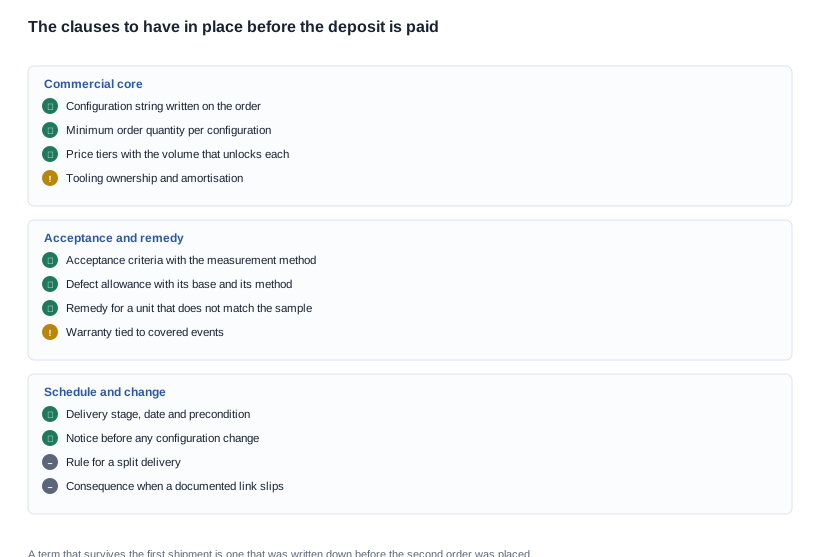
The clauses worth having in the order are the configuration string as a named attribute, the model designation the units ship under, the acceptance criteria with their measurement method, the defect allowance with its base and its method, the delivery stage with its date and its precondition, the notice obligation before any configuration change, the tooling ownership and amortisation, and the payment structure tied to a verifiable trigger. Each one is cheap to include while the parties are still discussing terms, and expensive to add after the first shipment.
The contract terms we will commit to, and the ones we will not
The boundary we hold: we publish the per-model configuration facts that belong in a contract, and we set the commercial terms for the specific order in writing rather than publishing a standing table that would be wrong for most orders.
What we publish is resolution, cell capacity, charging time, the rated runtime with its caveat, the charging interface, the case configuration, the Bluetooth version where the catalogue row carries one, the colour options, and the scope of customisation we support. So a contract can be written against published rows. The V03 Pro publishes three colour options and a Type-C charging interface, the V06 publishes four colour options, the L2 Utral publishes a 900 mAh or a 1400 mAh case, the D17 publishes a 115 mAh cell and a charge time of about one hour, and the MT6 publishes a 265 mAh cell, a 1200 mAh foldable case and a unit weight of 158 g for the glasses themselves, excluding that case.
What we mark as not published is longer than that list, and it is deliberate. The frame weight of every model except the MT6, the sensor part numbers, the field of view, the ingress test report numbers, the certification numbers, the AI implementation details, the line capacity, the stage durations and the standing minimum order quantity. We will not sign a clause that depends on a specification our source material does not contain, and we would rather explain that at the quotation stage than argue about it after the goods have been made.
We also make no vision, health or hearing-efficacy claim for any product in any market, and we do not permit a contract clause that requires one on our side.
If you send us the configuration, the quantity, the destination market and the schedule you are working to, we will set the minimum order quantity, the slot, the lead time, the payment terms and the warranty for that specific order, in writing, and tell you which of those numbers is ours to commit to and which depends on a third party. The clauses in drafting order are set out in the contract terms section, the same terms attached to a sequence of events are in the worked example, the deeper commercial structures are in An advanced contract guide, and the clause-by-clause reading method is in Reading a contract line by line. The range itself is at Camera and audio smart glasses range.
Related reading
- Camera and audio smart glasses range
- An advanced contract guide
- Reading a contract line by line
- contract terms
Send the configuration, the quantity, the market and the schedule, and we will say which terms we will commit to and which depend on a third party.


