

Smart glasses for office charging is settled by three things a buyer can hold in the hand: the charging method each platform publishes, the charge time every model states, and the size of the charging case where one is published. Everything after that is arrangement work — docking density, consumable replacement, and who owns the end-of-day count. The mistake that costs money is specifying the route per model instead of per platform, because a model list produces three accessory order lines where one route would do. This page is written for the buyer deploying a desk pool or a floor fleet, and it treats charging as a fleet operation with a recurring cost line rather than an accessory purchase.
Smart glasses for office: the fleet route, not the accessory line
Who is specifying the charging arrangement, and what they are defending
Three roles end up holding the charging decision, and they defend different things.
A facilities or operations owner is arranging power for a floor, a reception desk, or a pool of shared units, and needs one route per device type rather than one route per product name. Their exposure is a queue at the end of the day and a pool that shrinks over a quarter.
A procurement manager is buying the fleet and needs to know which route each platform supports, because the route determines the accessory SKU count, the minimum order quantities, and the number of cables that have to be replaced each quarter. Their exposure is a landed cost that lands higher than the quotation because the accessory line was never added.
A channel buyer is writing the customer-facing routine and needs to know which charging statements survive contact with a desk, a meeting room, and a shared cupboard. Their exposure is a customer who was told "recharges overnight" and then found a flat unit at nine in the morning.
None of the three is the person who physically plugs anything in, which is exactly why the arrangement needs an owner before it needs a dock. If the buyer cannot name the person who closes the pool at the end of the day, no hardware decision fixes the loss rate.
Why one catalogue figure produces three different office plans
The catalogue publishes 28 models, and every one of them publishes a charge time — two hours or less for 26 of them, and roughly one hour for the D17 and the ZH12. That single published row is the reason three different office plans are defensible. A platform on a two-hour charge supports a nightly window, a mid-day top-up and a shift handover with slack. A platform on a roughly one-hour charge supports a mid-shift swap without losing a working block. A platform that ships with a charging case turns the device from a one-shift item into a two-shift item and adds a second item to the pool that has to be counted.
Underneath the charge time sits the charging method, and this is where the plans diverge. Seventeen models publish a magnetic method, seven publish a Type-C port, and four publish neither — the MT6 and the L1 Pro, and the CY05 and the CY03 carry a capacity and a charge time but no interface row at all. Those four are the models a buyer cannot place on a desk plan from the catalogue alone, because the question "does it take a cable or a cradle" has no catalogue answer for them. That is not a defect in the range; it is a gap the buyer has to close in writing before the accessory order goes out, and it is the single most useful thing to ask a supplier in the first email.
The runtime bands then decide how long a device can be away from power at all. The camera models publish 5 to 8 hours, 6 to 8 hours or around 7 hours depending on the model, so a desk pool sized on the shortest end of the band needs a top-up discipline that a pool sized on the longest end does not. The runtime side of that arithmetic sits at battery life, and the camera and audio configurations it applies to are listed at camera and audio smart glasses.

The six charging routes the catalogue rows imply, and the accessory bill each one creates
Mapping the route per platform, not per model
A route is the combination of the charging method, the accessory the office has to own, and the consumable that degrades in service. Two models that publish the same method share a route, and the accessory set follows the route rather than the model. That single distinction is what turns three accessory order lines into one.
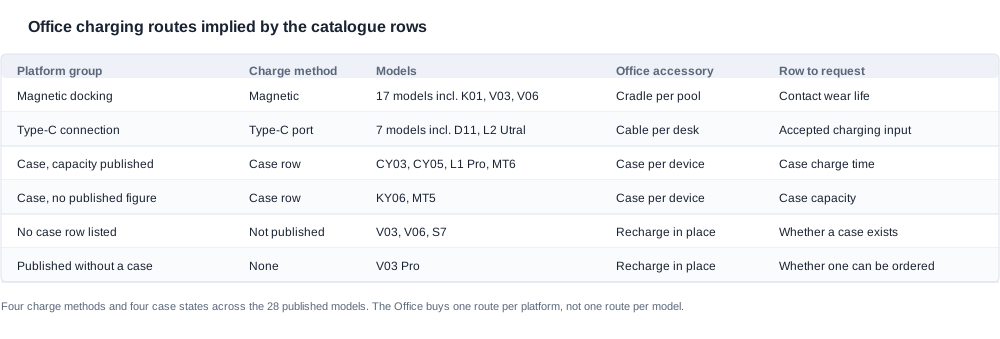
The table below is the working map. It is built directly from the catalogue rows, and it separates the four charge methods from the three case states so that no model gets double-counted.
Magnetic docking. Seventeen models publish a magnetic method, including the K01, the K02, the V06 and the S7, and the V03. The office buys a cradle per pool position, and the cradle is a capital item with a finite life. The consumable is the contact itself, which degrades through insertion cycles, and the failure it produces is a device that charges intermittently — which an operations team reads as a flaky unit rather than a worn part.
Type-C connection. Seven models publish a Type-C port, including the V03 Pro and the D11, the D17 and the L2 Utral, and the D12 and the ZH12. The office buys a cable and an adapter per desk, and the cable becomes a consumable with a replacement rate. The acceptance criteria here are the charging input and the state the device is in when the timer starts, and neither is published.
Case with a published capacity. Five camera models publish a case capacity: the L1 Pro and the CY05, and the CY03 — each at 1400 mAh, the L2 Utral at 900 mAh or 1400 mAh, and the MT6 as a folding 1200 mAh case. The office buys a case per device and a second charging point per case, because a case is itself a battery that has to be recharged somewhere.
Case with no published figure. The KY06 and the MT5 publish a case row without a capacity. The accessory has to be bought on the assumption of a size, and the assumption has to be checked before the order rather than after the delivery.
No case row listed. The catalogue prints no charging-case row for the V03 Pro and the V03, and the V06 or the S7. That is an unpublished status rather than an absence of a case, and the distinction matters: the buyer cannot order a case for these models from the catalogue alone, and the supplier should be asked whether one exists.
Published with no charging-case row. The V03 Pro is one of the four camera models for which the catalogue prints no charging-case row at all. Here the buyer does not know the answer, and the arrangement has to be built around a request to the supplier rather than around a published row.
The rows the catalogue does not publish, and why they decide the order
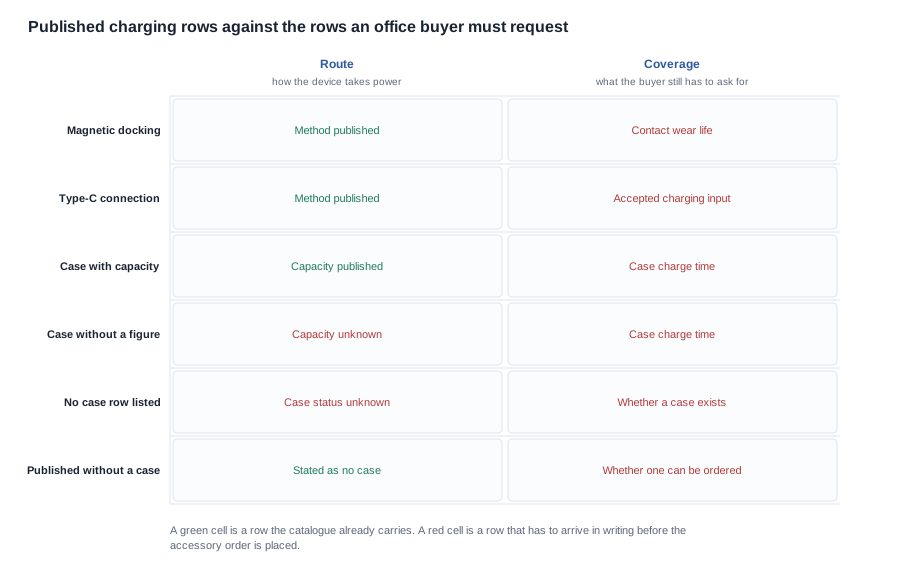
Four questions sit underneath every route, and the catalogue answers none of them. What charging input the device accepts. What state the battery is in when the charge timer starts, and what state it stops at. How long a magnetic contact survives in insertion cycles. And how long the charging case itself takes to recharge, and whether it can top a device up while it is plugged in.
None of these are unusual requests, and none of them are speculative: they are the difference between a charging plan and a charging hope. A buyer who receives them in writing can write an incoming inspection criterion against each one. A buyer who does not receive them inherits a device that charges slowly, or intermittently, or not at all, and the first person to notice is usually the person whose desk it is.
How to close the charging rows before the fleet order is placed
Five steps, each with a written completion standard
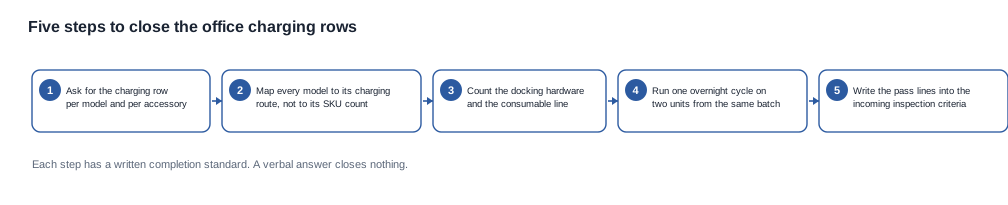
A verification process that produces numbers without producing a criterion is a demonstration, and a demonstration is the supplier's document rather than the buyer's. This is how to evaluate a charging route before you order, in five steps, each closed by something in writing:
- Ask. Request the charging method row, the charge time row, the runtime row, the case capacity where one is published, the accepted charging input, the charge start state, the contact service life in insertion cycles, the case charge time and its pass-through behaviour, and the indicator behaviour while the device is charging. The completion standard is a written answer per item, not a verbal one and not a paragraph of general assurance.
- Map. Assign every model in the fleet to exactly one route, using the platform rather than the product name as the key. The completion standard is a route table in which no model appears twice and no route carries a model that has no catalogue row.
- Count. Tally the docking hardware per pool position, the cables per desk, the cases per device and the spare contacts per dock, then check each of those lines against the minimum order quantities the supplier quotes. The completion standard is a bill of materials whose accessory lines are priced, not a bill of materials that says "accessories as required".
- Test. Run one overnight cycle on two units from the same batch, on the same dock and the same route, and record the elapsed time, the state at the start and the state at the end. Two units are needed to separate a design characteristic from a manufacturing inconsistency, because the two have completely different remedies. The completion standard is a signed sheet with the conditions attached.
- Judge. Write the pass lines into the incoming inspection criteria, so that a device which arrives without charge, or with an intermittent contact, or with a case that will not hold a charge is caught at goods-in rather than at the desk. The completion standard is one criterion per measured characteristic.
The routine the plan has to produce
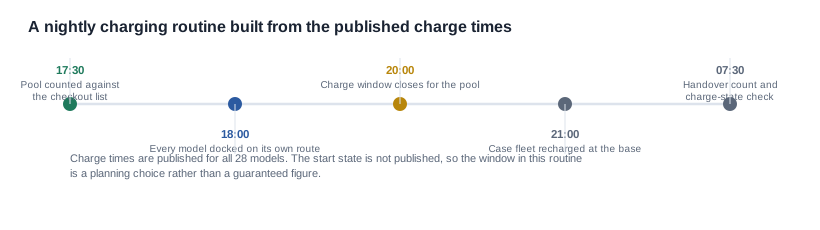
The routine in the timeline above is the smallest thing that can go wrong at the end of a day, and it is worth writing it down because a routine that is assumed is a routine nobody runs. The published charge times make the window comfortable — two hours or less for every model in the range — so the constraint is not the charge. It is the count, the sequence and the owner.
The document set to request in one message
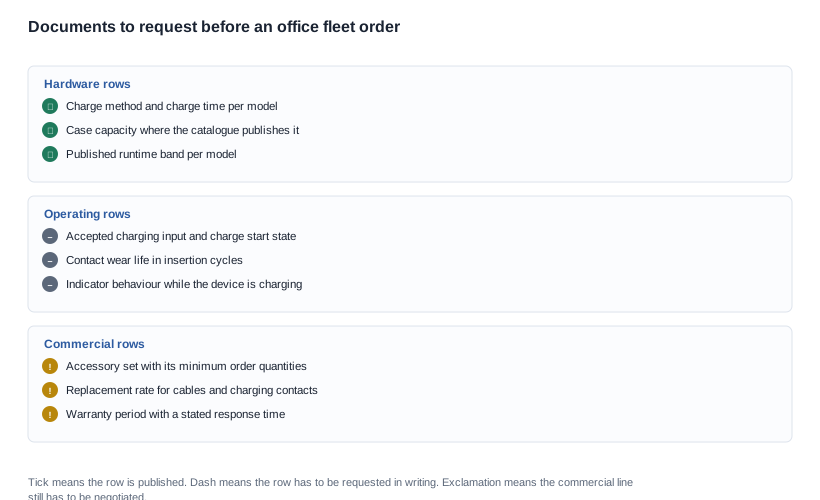
The questions to ask divide into three groups, and sending them as one message matters because it forces a single answer rather than three partial ones. The hardware rows are the published ones — the charging method, the charge time, the runtime band, the case capacity where the catalogue carries it — and they should be confirmed against the catalogue rather than re-derived from a marketing sheet. The operating rows are the ones that are missing everywhere, and they are the ones that actually determine whether the arrangement works. The commercial rows cover the accessory set, its minimum order quantities, the replacement rate for cables and contacts, and the warranty period with a stated response.
Two of the four gaps are the classic red flags in supplier due diligence, because both carry commercial consequences that are easy to miss. If the case cannot top a device up while it is plugged in, then every case needs its own charging point, and the number of points in an office is a fixed installation cost that appears in nobody's quotation. If the contact service life is short, then the spare-contact line is a recurring consumable that has to be ordered on a cycle, and a supplier who will not state the cycle has effectively declined to price it.

Where an office charging arrangement fails, and what each failure costs
The route was mapped per model instead of per platform. This is the first of the common pitfalls, and the one that produces the most accessory SKUs. The symptom is three accessory order lines, three minimum order quantities and three quotations where one route would have covered the pool. The root cause is that the fleet was specified from a product list rather than from an interface list. Prevention is an hour of mapping at the start: two models that publish the same method share a route, and the accessory set follows the route.
The cable was treated as free. The symptom is a consumable cost that appears in month three, by which point the replacement decision belongs to someone who has never heard of the project. The root cause is that a cable is not on the bill of materials as a product but only as a consequence of a charging method. Prevention is to put the cable on the accessory line with its replacement rate, even if that rate is still an estimate.
The contact service life was never asked. The symptom is a device that charges intermittently and is written off as defective. The root cause is that a worn contact and a defective device produce the same symptom at the desk. Prevention is to ask for the service life in insertion cycles, stock the spare, and put a contact check into the weekly routine rather than waiting for a report.
The case was counted as one item. The symptom is a second charging point per case that was never in the plan, and a pool that quietly runs on half its intended capacity. The root cause is that the case's own charge time and its pass-through behaviour were assumed. Prevention is to ask both, count the points, and decide in advance whether a device is ever expected to run past the end of a shift.
Nobody owned the end-of-day count. The signs that a handover has been assumed rather than assigned show up in the reconciliation, not on the floor. The symptom is a fleet that shrinks over a quarter and a reconciliation that turns into an argument about whether the device was ever in the building. The root cause is that the handover was assumed rather than assigned. Prevention is a named owner, a count at a fixed time, and a checkout list that the count is made against.
The runtime band was assumed to cover the shift. The symptom is a unit that is flat before the end of the afternoon, on a day when the band was at its short end. The root cause is a rating with no condition applied to a duty cycle. Prevention is to size the pool on the short end of the published band and to treat the top-up as routine rather than exceptional.
| Failure symptom | Root cause | The preventive action that closes it |
|---|---|---|
| Three accessory lines for one pool | Route mapped per model | Map by platform and method |
| Consumable cost appears late | Cable left off the bill of materials | Price the cable and its replacement rate |
| Intermittent charging written off | Contact service life unknown | Ask for insertion cycles, stock spares |
| Half the pool out of service | Case counted as one item | Ask for case charge time and count the points |
| Fleet shrinks over a quarter | No owner for the handover | Name an owner and a fixed count |
| Flat unit before the shift ends | Rating applied without its condition | Size the pool on the short end of the band |

What an office charging arrangement is worth commercially
The cost stack behind a desk-pool deployment
The unit price of the device is usually the smallest line in the total cost of an office deployment. The recurring lines are the accessory chain, and they are entirely predictable once they are counted: a cradle per pool position, a cable and an adapter per desk, a case per device for the camera models that publish one, and a spare contact per dock. Add the consumable replacement rate on top and the office deployment carries a second, quieter budget that the initial quotation almost never shows. A buyer who arrives at the supplier with the accessory bill already assembled is negotiating from a different position than a buyer who is still counting the boxes.
The second commercial question is the replacement rate of a pooled device, and it is decided by the charging arrangement more than by the device. A device that lives on a cradle at a known desk is replaced when it fails. A device that lives in a case that lives in a bag is replaced when it is lost, and the loss rate is set by how many charging states the office has to keep track of. Every additional state is a separate inventory line, a separate handover step and a separate thing to count.
Which terms move, which do not, and what belongs in the agreement
The charge time, the charging method, the cell configuration and the case capacity are fixed by the catalogue and by the engineering behind the product; a buyer cannot negotiate them into a different value, and any supplier offering to is describing a different product. Certification cost and lead time follow the testing body and the process, and tooling is normally amortised across the first order and quoted as its own line — ask which of the two a quoted lump sum is hiding, because the two are frequently bundled and the buyer ends up unable to tell which part of the first order is reusable.
The terms that genuinely move are commercial and structural, and the trade-offs between them are where the negotiation time is best spent. The accessory set and its minimum order quantities, and whether the supplier will quote them as a line item at the same order volume as the devices. The docking hardware and its connector type. Whether a first order can be split into two deliveries against a staged payment. Whether the supplier will run the overnight test on production units rather than engineering samples, and whether they will supply the recorded sheet so the result can be re-judged — that single clause is worth more than a unit price reduction, because it converts a demonstration into a criterion. Packaging specification, delivery splitting, the warranty period with a stated response, and the replacement terms for a pooled device all sit on the same list.
What belongs in the agreement is the set of published rows for the configuration actually ordered, plus the four operating rows the catalogue does not carry: the charging input, the charge start state, the contact service life, and the case charge time with its pass-through behaviour. Add the accessory set with its minimum order quantities, the consumable replacement rate, the warranty period with a stated response, and the replacement terms for a pooled device.
What should be left out is any shift-length guarantee drawn from a published rating, and any consumable cost that has not been counted. A guarantee of that kind is not a commercial term; it is a dispute that has been pre-announced.
What we publish about office charging, and what we will not estimate
It is worth being precise: an office charging arrangement is a fleet operation in an electronics question's clothes, and the published parameters are enough to plan it once the route is chosen per platform. We publish the charging method, the charge time, the runtime band, the cell configuration and the case capacity for every model that carries those rows, and we state plainly that the catalogue publishes no charging-case row for the V03 Pro and the V03, and the V06 or the S7, and that seven camera models ship with a case.
What we will not do is publish a charging input, a charge start state, an indicator behaviour, a contact service life, a case charge time or a pass-through behaviour for a model where the manufacturer has not provided one, and we will not present a published runtime band as a shift-length guarantee. We will not quote a charging arrangement for a model whose charging method row is absent, and we will not infer one from the model family. If a buyer needs that row, it is a question for the factory, and the answer belongs in the purchase order rather than in a catalogue page.
What we will do is take the fleet size, the desk or floor layout, the shift pattern, the models you are deploying and the markets you are shipping into, and tell you which routes exist, which accessory lines each route creates, which rows still have to be closed, and which claims the documentation supports. The configurations and their published rows are at camera and audio smart glasses, the sample-stage checks are at testing smart glasses for office use, the recurring faults are at common problems in the office, and the scenario entry point is office.
What to send us next. Send the fleet size, the number of desks or pool positions, the shift pattern, the model list and the target market. We will return the route map, the accessory bill that the map implies, the list of rows still open, and the criteria worth writing into the purchase order.
Related reading
- The configurations and their published rows — camera and audio smart glasses
- The sample-stage checks — testing smart glasses for office use
- The faults the arrangement prevents — common problems in the office
- The runtime side of the same decision — battery life
- Where the scenario starts — office
Tell us the headcount, the shift pattern and the models you are deploying, and we will tell you which routes the fleet needs and which rows still need closing.


