
Smart glasses for office: not eight symptoms, but eight causes
Almost every office deployment that goes wrong goes wrong in one of eight ways, and in most of those eight the cause is known before the shipment leaves. That is the useful part of the problem taxonomy: the failures are not random hardware faults, they are gaps that were visible in the specification, and each one is caught at a different point depending on how far into the programme it is allowed to travel. The symptom a department reports is almost never the same as the cause, which is why a returns ticket is the least useful document in the process.
The eight problems, in the order they usually appear: the image is unusable because the imaging requirement was never written; the wrong class of model was ordered because the requirement was stated as a product rather than as a purpose; the unit will not charge because the charging interface was assumed rather than confirmed, or because the contacts are fouled; the battery does not last a working day because a published ceiling was treated as a duration; nobody uses the units because no workflow was defined for the record they produce; the internal security review blocks the deployment because the data-handling record was not requested; the shipment is held because the certification position or the transport file was not obtained; and a claim in the deployment document does not survive contact with the catalogue, because a catalogue attribute was read as a promise.
Two of these deserve to be stated up front, because they are the ones a buyer is most likely to assume are already handled. First, the catalogue publishes a charge time for every model, and twenty-six of them publish a charge time of two hours or less — that is a ceiling and not a measured duration, because no start state of charge and no end criterion are published. Second, the catalogue text contains no reference to CE, FCC or RoHS and there is no per-model certification row, so a deployment document that asserts either of those is asserting something the documentation does not carry.
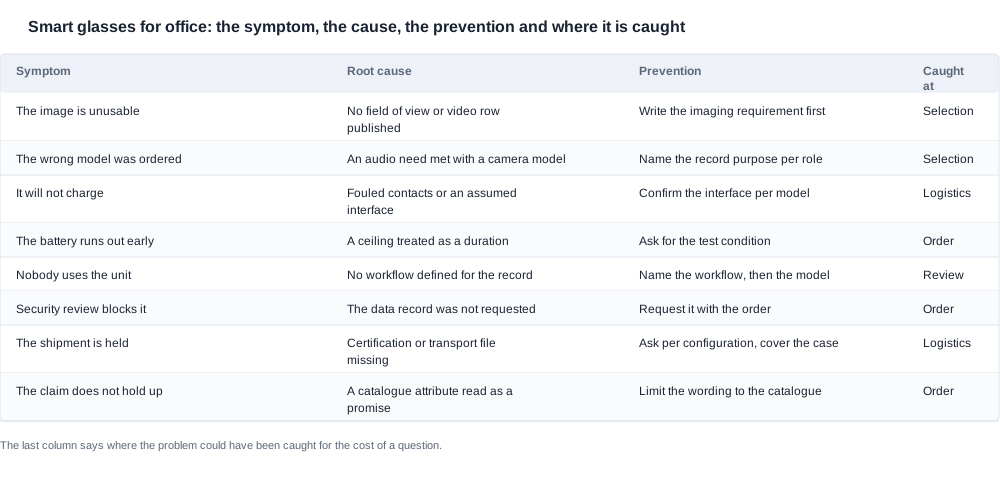
The table below is the working taxonomy. The last column is the one that matters commercially, because it says where the problem could have been caught for the cost of a question rather than for the cost of a return.
| Symptom | Root cause | Prevention | Caught at |
|---|---|---|---|
| The image is unusable | No field of view, video or lens row published | Write the imaging requirement before the order | Selection |
| The wrong model was ordered | An audio need met with a camera model | Name the record purpose for every role | Selection |
| It will not charge | Fouled contacts, or an assumed interface | Confirm the interface per model, protect the contacts | Logistics |
| The battery runs out early | A published ceiling treated as a duration | Ask for the test condition, then record your own | Order |
| Nobody uses the unit | No workflow defined for the record | Name the workflow, then choose the model | Review |
| Security review blocks it | The data-handling record was not requested | Request it before the order, not after | Order |
| The shipment is held | Certification position or transport file missing | Ask per configuration, cover the case as a cell | Logistics |
| The claim does not hold up | A catalogue attribute read as a promise | Limit the wording to what the catalogue states | Order |
The imaging problems, and why a resolution class does not answer them
The image is unusable
This is the most common complaint in the category and the hardest to diagnose, because the complaint and the cause are in different places. The complaint arrives as "the picture is bad". The cause is usually that no imaging requirement was written, so the buyer accepted a resolution class as though it were an image specification.
The published rows make this trap unusually easy to fall into. The camera tier publishes 8 MP on the CY03 and the KY06, the MT5 and the V03 Pro, and the V03 and the V06, and the CY05 and the MT6, and 13 MP on the L2 Utral and the L1 Pro, and the S7. Those are the only imaging figures published for the range. No field of view, no video resolution, no frame rate, no stabilisation figure, no low-light performance, no sensor model, no lens material and no coating accompanies them. A 13 MP record of a badly lit room at an unknown frame rate with an unknown lens is still a badly lit room, and the number of pixels is the one variable the buyer cannot see.
The prevention is a short paragraph rather than a long test, and it is worth writing into the requirement: the environments the unit will be used in, the lighting available in each of them, whether the record is reviewed live or later, and what happens to a record that is too dark to be useful. That paragraph, written before the order, converts an unusable-image complaint into a measurable acceptance criterion. Written after, it converts a return into a negotiation about whether the image was ever going to be good — and the catalogue has no image row to point at in either direction.
The second imaging problem, and the one that looks like the first, is the mismatch between the class and the job. A record kept for a week and read on the day it was captured needs very little from the sensor. A training record reviewed eight months later, where a specific step has to be identified, needs a great deal. The catalogue does not let a buyer calculate either requirement, which is exactly why the workflow has to be named before the model is chosen.
The wrong tier was ordered for the job
A second problem sits next to the first and is a purchasing error rather than a technical one. The requirement was written as "smart glasses" rather than as a purpose, and the order that followed was placed against whichever model the buyer's own channel had handled before. The result is a camera model supplied to a team that needed audio, or an audio model supplied to a team that needed a record.
The published structure of the range makes this easy to prevent. There are eight audio models — the K02 and the LC-105-1, the D11 and the K01, the D12 and the LC-105-2, and the G07 and the YK12 — and eleven camera models, and the two sets share almost nothing in the specification apart from the charge time. The audio models publish a Bluetooth version of 5.3 on the K01 and the K02 and 5.4 across the rest, cell configurations of 55 mAh × 2, 90 mAh × 2 or a single 100 mAh cell, and rated runtimes of about six to about eight hours. The camera models publish a resolution class and a different set of cell and runtime figures. If the requirement is a record, an audio model is not a cheaper version of the answer; it is a different product.
The prevention here is the shortest instruction in this article: name the record purpose per role, in one line each, before a model appears in any document. Where the audio tier is the answer, the product page is bluetooth audio glasses, and the camera configurations are listed under AI camera glasses.
The power problems, and the arithmetic behind them
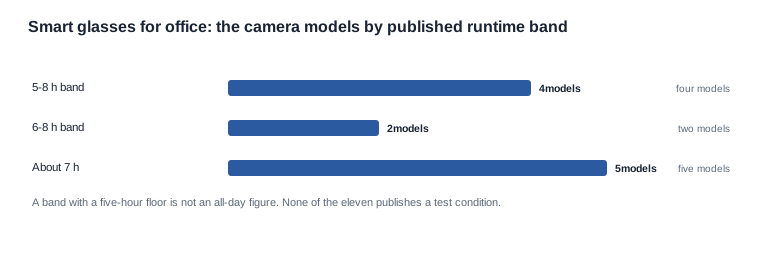
The chart above is the single most useful thing to put in front of a buyer who has asked for "a model that lasts all day". The eleven camera models publish three distinct runtime bands: four publish 5~8 h — the V03 and the S7, and the V06 and the V03 Pro — two publish 6~8 h, the KY06 and the MT5, and five publish about seven hours, the CY03, the MT6 and the L1 Pro, and the L2 Utral, and the CY05. A band is a range, not a figure, and a band that starts at five hours is a band with a five-hour floor in it.
The unit will not charge
Two different faults present identically. The first is fouling on the magnetic contacts, which is a hygiene problem and a recurring one: a unit that lives in a bag or a drawer collects debris, and a flat contact produces a unit that appears completely dead. The second is an interface assumption, and it is the more expensive of the two because it affects the whole order rather than one unit.
The interface assumption has a documented footprint. Of the eleven camera models, five publish magnetic charging — the V03 and the KY06, and the S7 and the V06, and the MT5 — two publish Type-C — the V03 Pro and the L2 Utral — and four publish no charging interface row at all: the CY05 and the CY03, and the L1 Pro and the MT6, all of which do publish a charging case capacity. A buyer who carried the magnetic assumption across from a neighbouring row has ordered docks for a model with no published magnetic interface, and the receiving bay has nothing to put them on. The Type-C models in the range are the D12 and the L2 Utral, the D17 and the V03 Pro, and the ZH12 and the D11, and they need a cable rather than a dock, which is a consumable rather than an installed asset.
The prevention is to state the interface per model on the order and on the packing list, and to say explicitly for the four models where the catalogue publishes none that the interface is to be confirmed before the dock or the cable is procured.
The battery does not last a working day
The published runtime is a claim without a condition, and every one of the eleven camera models publishes one. The conditions that would make it a measurement — the volume, the pairing count, the camera load, the ambient temperature, the standby draw — are not published for any model, and neither is the cycle life rating, so a buyer cannot ask the supplier how the figure degrades over a year of use.
Two consequences follow that a buyer has to handle explicitly. The first is that a runtime band such as 5~8 h is not "all day" in any sense a rota can use: the floor of the band is the number that decides whether a unit survives a morning. The second is that a charge time of two hours or less is a ceiling, so the time a unit actually needs is somewhere at or under it and is not published, and the time a charging case needs is not published at all for any model. A department that receives twelve units and one shared case will discover this arithmetic immediately, and it is much cheaper to discover it in the requirement than in the first week of use.
The prevention is to request the test condition for the runtime and the start state and end criterion for the charge time, and then to run one measurement of your own against a recorded condition. The office acceptance checks are set out in the office test sequence.

The deployment problems, which arrive as hardware complaints
The unit that nobody uses
This is the failure that is most often filed as a hardware fault, and it is the one a returns counter will misread. In an office, a unit that is issued and then left in a drawer is the single most common outcome of a deployment, and the symptom that reaches the returns desk is a set of units that were never actually used, which looks like a quality problem and is a workflow problem.
The published structure of the range shapes this behaviour in a way that is worth understanding before the order rather than after it. A cased model — the CY03 and the L1 Pro, and the CY05 publish a 1400 mAh case, the L2 Utral publishes 900/1400 mAh and the MT6 publishes a 1200 mAh foldable case — is a unit that can be put away, and a unit that can be put away is a unit that will be. The catalogue publishes no case row at all for the V06 and the V03 Pro, and the V03 and the S7, so for those models the unit has to go back to a charging point to be ready, and the behaviour that follows from that is the same whether or not a case exists, which makes it more visible and therefore more used.
That is a genuine procurement trade-off rather than a defect: the case is a second lithium cell to declare, a second object to track, and a second thing to lose, and it also removes the excuse that kept a unit on a desk. A programme that wants both has to decide which one it is buying, and the decision belongs in the requirement.
The security review nobody anticipated
The catalogue publishes an AI voice assistant as a capability on a set of models — twenty of the twenty-eight in the range carry an AI feature entry — and it does not publish the implementation details, the offline behaviour, the storage location, the data handling model or the update mechanism. In a consumer purchase those are product questions. In an office deployment they are the question that decides whether the deployment happens, because the internal review asks about them and the answer has to come from somewhere.
The problem is almost always procedural rather than substantive. The IT team asks for a data-handling record at the point of review, which is after the order, which means the answer arrives during the review rather than before it, which means the deployment is paused. The same information requested in the order is an ordinary document.
The prevention is one request, sent with the other order documents, asking for the data-handling position for the exact configuration. The related question an IT team raises about the AI feature and connectivity is covered in whether the AI feature needs an internet connection, and the deployment kit that has to accompany the units is set out in what to bring on site.
The paperwork problems, which arrive at the worst possible moment
The certification claim
The published position has to be stated accurately in both directions. The catalogue text contains no reference to CE, FCC or RoHS, and there is no per-model certification row anywhere, so a deployment document that asserts the range is certified to those standards is asserting something the catalogue does not carry. Equally, the absence of a per-model row in a catalogue is not the same as the absence of certification material — it means the material has to be requested for the exact configuration, and the framework to ask against is the Radio Equipment Directive (EU) 2014/53/EU for the radio path.
The timing is what makes this a problem rather than an irritation. A certification position requested with the order is a document that arrives in the ordinary course. The same position requested when the shipment is in transit is a delay, and a delay on a shipment is a delay on the buyer's schedule, not on the supplier's.
The ingress claim
Two camera models in the range carry an IP54 marking as a catalogue attribute: the V06 and the S7. No third-party test report is published behind that marking, and it is not a waterproofing claim — it covers a dust protection level and splashing water, not immersion and not a sustained downpour. A deployment document that says "waterproof" on the strength of it is a claim the documentation cannot carry, and it is the kind of claim that gets discovered by the person who tested it.
The prevention is a wording rule rather than a document: the marking is stated as a catalogue attribute, on the two models that carry it, and it is not extended to the audio tier or to the camera models where no rating is published at all.
The transport file for a configuration with a case
A charging case is a second lithium cell, and a configuration that ships with a case is a configuration whose transport file has to cover the case rather than only the glasses. In the camera tier that applies to the CY05 and the CY03, and the L2 Utral and the MT6, and the L1 Pro with published case capacities, and to the KY06 and the MT5 where a case is indicated but its capacity is not published. A file requested for "the glasses" and not for "the glasses and the case" is a file that does not cover what is in the box.
Working the taxonomy: the triage that replaces the returns ticket
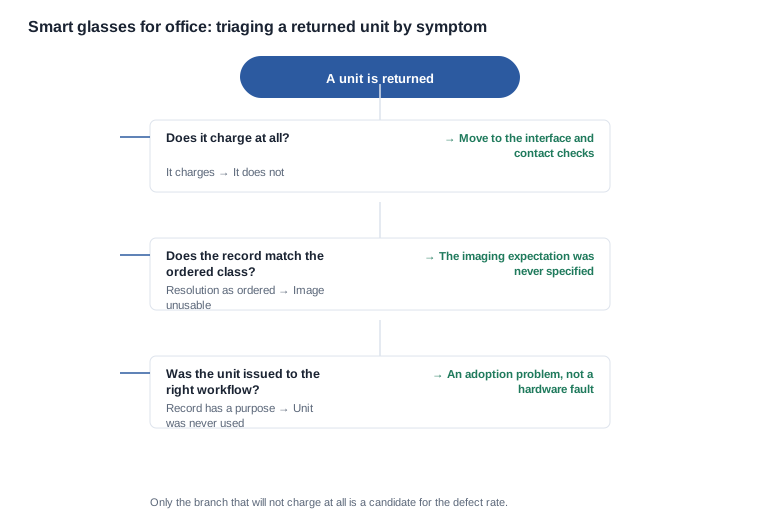
The decision diagram above is the triage a returns desk should run before a unit is written off, and it works because it separates the three causes that arrive with identical symptoms. A unit that charges but produces an unusable record is an expectation problem and should never enter the defect rate. A unit that charges and produces a record that nobody uses is an adoption problem and should never enter the defect rate either. Only the third branch — a unit that will not charge at all — is a candidate for the defect rate, and even there the interface and contact checks have to run before the unit is called faulty.

The six steps in the flow are the minimum record. The last one is the one that changes the commercial picture: the outcome is counted against the number of units issued, not against the number of returns received, because the two denominators produce completely different rates and only the first of them is a real one. A returns-based rate is flattering by construction, and a warranty conversation built on it loses.
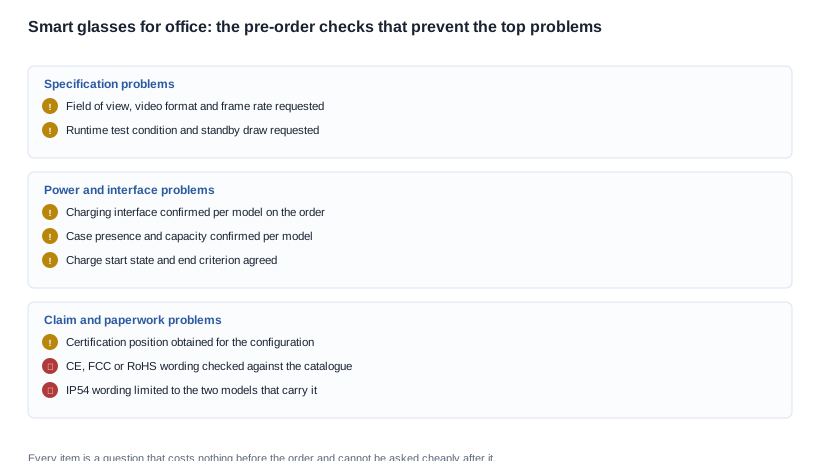
The remaining prevention work is the checklist above, and the ordering matters more than the list. Every item on it is a question that costs nothing to ask before the order and cannot be asked cheaply after it. The pricing and the commercial structure of the first order are covered in pricing, and the certification request that closes the paperwork gap is at the certification checklist.
What we publish about the problems this range can actually cause
We publish the rows a buyer can order from, and we will not fill the gaps with typical figures. For the camera tier that means the resolution class, the cell capacity, the charge time, the rated runtime, the charging interface where it is published, the case capacity where it is published, the structural features that are published, the colour counts, and the IP54 marking on the V06 and the S7 stated as a catalogue attribute. For the audio tier that means the Bluetooth version, the cell configuration, the charge time, the rated runtime, the charging mode, the absence of any published touch row, the surround sound published on the YK12 and the ultra-slim detachable temples published on the G07.
What we do not publish and will not estimate: the frame material, the lens material, the coating, the hinge specification, the unit weight beyond the single 158 g whole-unit figure for the MT6, the field of view, the video specification, the storage and overwrite behaviour, the operating temperature range, the cycle life rating, the runtime test condition and the standby draw. We will not state that the range is certified to CE, FCC or RoHS, because the catalogue text contains no reference to those standards, and we will not describe the IP54 marking as waterproof.
The symptom and the programme stage
Send the symptom you are trying to explain, the models on the order and the point in the programme where it appeared, and we will tell you which of the eight causes above it matches, which published row bears on it, and which document closes it. The companion pieces are the office gear checklist for the hardware that has to accompany the units, the deployment gate checklist for the gates that catch these problems, and the scenario entry point smart glasses for office.
Related reading
- Where the scenario starts — smart glasses for office
- The families in the range — AI camera glasses and bluetooth audio glasses
- The acceptance checks — the office test sequence
- The prevention gates — the deployment gate checklist
Tell us the symptom, the model and the point in the programme, and we will tell you which cause it matches and which document closes it.


