

Smart glasses for office programmes are decided at the sample stage, and the test that decides them is one the catalogue cannot run for you. The published rows for this range are electrical — charge time, rated runtime, cell capacity, charging interface, resolution class and case capacity — and every one of them answers a question about a unit on a bench. What an office programme actually needs to know is whether a device survives a shared desk, a first session with an employee who has never held one, and a handover to the next person.
None of those answers is published for any model in the catalogue, and that is the single most useful thing to understand before a purchase order is drafted. The acceptance test you run is not a formality attached to a decision you have already made; it is the specification itself. A buyer holding nothing but the published rows is choosing on bench data and filling the remaining gaps with assumptions. A buyer holding a written pass line for every office behaviour has something a supplier can be held to. The sections below set out that pass line, the documents that sit behind it, the failures it removes, and the commercial lines it moves.
Smart glasses for office: where a sample and a shipment differ
The answer in three sentences
Test the configuration you have priced, not the configuration that was demonstrated to you, because a demonstration unit is frequently a better-specified unit than the one that will be shipped. Write the pass line for every test before the sample arrives, because a line written afterwards is a line written to fit the result you already have. Treat any figure that reaches you without its test condition as unverified until the supplier states the condition in writing, and treat a refusal to state it as a finding worth recording rather than an objection worth arguing.
The three instructions matter because the published catalogue is unusually strong in one direction and silent in another. The electrical rows are complete enough to compare two suppliers on paper: every model in the range publishes a cell capacity, a charge time and a rated runtime, the charging interface is published per model, and the resolution class is published for every camera model. The office behaviours — what a device does on a desk between two users, how long a docked unit takes before it is usable again, what a newcomer has to be told — are published for nothing. A test programme that only checks the published rows has checked the half of the question that was never in doubt.
Who signs the acceptance sheet, and what they are risking
The reader is a brand-side buyer, a channel buyer or an e-commerce seller with an office programme to build, and the specific situation is almost always one of three: two quotations to compare for the same brief, a new product line to open with a supplier who has not been audited, or a market entry where the compliance route has not been settled. In every one of those situations the question is the same, and it is not about price. It is about which supplier can actually build what has been written down, and what happens to a launch schedule when they cannot.
The risk underneath the enquiry is unusually specific. A delivery arrives and it is not the approved sample — a different cell, a different case, a different packaging — and there is no contractual language that catches it because the purchase order said "smart glasses" and nothing else. A documentation route stops the goods at a border. A first shipment turns into a returns problem that was never priced, because the configuration that reached the warehouse was never tested against the way the office actually uses it. The fear is not a bad price; the fear is a programme that consumes a quarter of a year before the first unit is in a desk.
Two questions arrive before the specification does, and both are administrative in a way that hides their weight. The first is what is being ordered in enough detail to be quoted, because a configuration described in general terms produces a price that cannot be compared with anything, and a test programme that cannot name a configuration cannot produce a pass line. The second is what the programme has to survive, which is the part that decides whether this is a specification exercise or a lesson in discovering after the fact which supplier was right. The office scenario entry point is smart glasses for office, and the selection logic that sits upstream of the test is at how to choose smart glasses for office.
Why two office quotations diverge long before a sample arrives
An office programme is unusual in how much of its cost sits outside the unit price. The device is the smallest part of the commercial picture. What actually consumes budget in an office deployment is the onboarding material, the packaging that survives being opened by someone with no context, the warranty route that does not require an employee to argue, the internal cost of reissuing a device when a person leaves, and the documentation that lets the shipment clear. Two quotations that differ by four per cent on unit price can differ by a third on landed programme cost, and the difference is entirely in those lines.
The reason those lines differ is that they are not specified. A supplier who has been asked for a bill of materials per configuration can quote the kit; a supplier who has been asked for "office glasses with a case" will quote a case and leave the rest of the box to chance. The published configuration rows are close enough together on the electrical side that the differences that matter commercially are structural rather than numerical. The charging interface is the clearest example: the range publishes Type-C on the ZH12 and the D12, the D17 and the L2 Utral, and the V03 Pro and the D11, and magnetic charging on seventeen models including the camera models and the audio models. A Type-C configuration recharges from a cable the office already owns, while a magnetic configuration needs either a dock or the charging case carried, which turns an accessory into part of the charging architecture and adds a second lithium cell to the transit file.
The second structural difference is the case itself, and the catalogue publishes it in four different ways rather than one. The CY05 and the CY03, and the L1 Pro publish a 1400 mAh case, the L2 Utral publishes 900 mAh or 1400 mAh as a configuration choice, and the MT6 publishes a foldable 1200 mAh case. The KY06 and the MT5 ship with a case whose capacity is not published, and the catalogue lists no charging-case row at all for the V06 and the V03, and the S7 and the V03 Pro, which is a different statement from publishing that they have none, and the office buyer has to ask rather than read it off the page. A buyer who has not asked which of those four states applies to the model being quoted has not priced the office programme at all.
Reading smart glasses for office rows as electrical answers, not office answers
What the catalogue settles and what it leaves open
It is worth being precise about what the published material can carry, because a large part of the test programme can be built from it and a larger part cannot. The electrical block is complete. Every model publishes a battery figure, a charge time, a rated runtime and a charging interface, and the charge time is published for the whole range: at or under two hours for everything except the D17 and the ZH12, which publish roughly one hour. The cell values differ by tier and the catalogue publishes the cells as they are, which is to say as a cell count and a per-cell value rather than as a single derived total.
The resolution block is complete for the camera models as well. Eight of the eleven camera models publish 8 MP, and the L1 Pro and the L2 Utral, and the S7 publish 13 MP. The camera models are the KY06 and the L1 Pro, the CY03 and the MT6, the V06 and the MT5, the V03 and the S7, the CY05 and the L2 Utral, and the V03 Pro. Eight audio models publish their own block — the K02 and the YK12, the D11 and the D12, the LC-105-1 and the K01, and the G07 and the LC-105-2 — and three sport models publish theirs: the YKC02, the D17 and the ZH12. Twenty of the twenty-eight models in the range publish an AI feature entry. The Bluetooth version is published per audio and sport model, and it is not published for the camera models, which is a gap worth naming rather than filling with a typical value.
What none of that touches is the office question. The catalogue publishes no per-model certification row. There is a company-level export certification page in the catalogue carrying ten design-patent images, but the document text contains no CE, no FCC and no RoHS wording at all, which means a certification claim about any specific model in this range would be a statement the catalogue does not support. The range publishes no field of view, no video specification, no acoustic figures, no microphone pickup distance, no standby draw, no cycle-life rating, no operating temperature range and no runtime test condition. It publishes one weight figure in total, at 158 g for the MT6, which is the whole-unit figure for the glasses including the cell and the camera and excluding the foldable case, and the case weight is not published either.
The conclusion is not that the catalogue is weak. It is that the catalogue answers a different question than the office programme asks, and a test programme built only from published rows will pass on the bench and fail on the desk. That gap is not a reason to distrust the supplier; it is a reason to write the missing rows yourself.
The office rows that no model publishes
The rows an office programme needs are consistent enough across the deployments we are asked to quote that it is worth listing them once, in the form they should appear in a purchase order. The reset path — whether a unit can be returned to a known state centrally when it changes hands — is the first, because a device that cannot be reset is an asset that cannot be reassigned, and in an organisation that rotates staff that becomes a recurring cost rather than a one-off. The second is the first-session instruction count, which is the number of things a newcomer must be told before the device does anything useful. The third is the storage behaviour on a desk: what the unit sits in between uses, and whether a lens can come into contact with a surface.
The fourth is the recharge-from-dock behaviour, including the start state and the end state of the charge, which are the two numbers that turn a published charge time into something schedulable. The fifth is the privacy behaviour of a camera model in a room with other people in it, including whether there is an indicator and what it indicates. The sixth is the firmware and configuration update path, including whether an update can lose a device's settings, because a configuration that cannot be reproduced is a configuration that cannot be audited when something goes wrong.
None of these six is published for any model. Each one is therefore a question to the supplier, and each one becomes a line in the acceptance sheet. A supplier who answers all six in writing has told you something that the catalogue could not, and a supplier who answers three of them has told you something too: the remaining three are where the risk sits.
Passing lines for a smart glasses for office desk test
The desk test cases and their pass lines
A pass line is a sentence that can be marked true or false by someone who was not in the room when the criterion was written. That discipline is what separates an acceptance test from a demonstration, and it is why the lines below are stated as observable outcomes rather than as intentions. The eight cases in the table cover the behaviours that actually differ between office configurations; they are not a generic product checklist, and a buyer with a different deployment should write different ones.
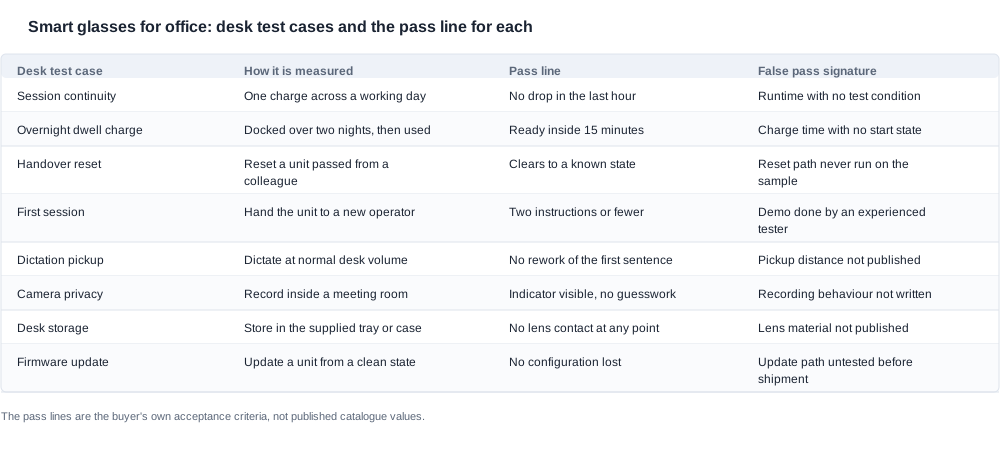
| Desk test case | How it is measured | Pass line | False pass signature |
|---|---|---|---|
| Session continuity | One charge across a working day | No drop in the last hour | Runtime with no test condition |
| Overnight dwell charge | Docked over two nights, then used | Ready inside 15 minutes | Charge time with no start state |
| Handover reset | Reset a unit passed from a colleague | Clears to a known state | Reset path never run on the sample |
| First session | Hand the unit to a new operator | Two instructions or fewer | Demo done by an experienced tester |
| Dictation pickup | Dictate at normal desk volume | No rework of the first sentence | Pickup distance not published |
| Camera privacy | Record inside a meeting room | Indicator visible, no guesswork | Recording behaviour not written |
| Desk storage | Store in the supplied tray or case | No lens contact at any point | Lens material not published |
| Firmware update | Update a unit from a clean state | No configuration lost | Update path untested before shipment |
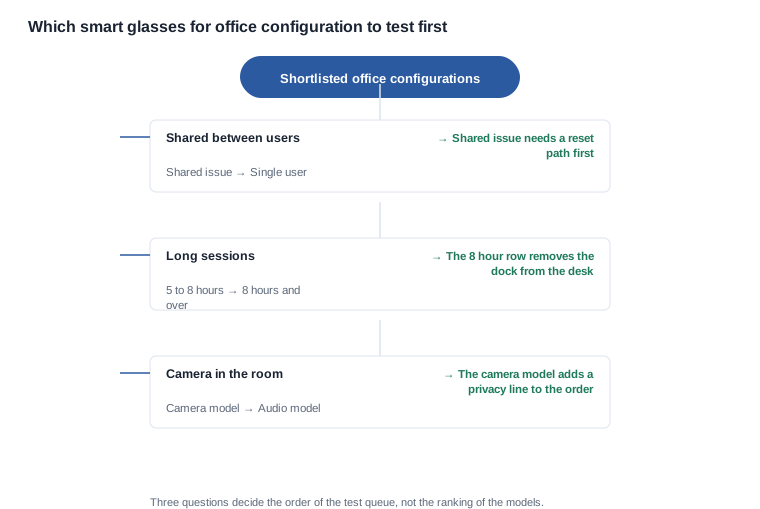
The order of these cases is not arbitrary. Session continuity comes first because it decides whether the unit is docked overnight at all, and the answer changes the recharge case, the storage case and the docking decision that follows it. The handover and first-session cases come next because they are the two that decide whether the device can be issued to a person who has never seen one, which is the normal case in an office rather than the exception. The camera privacy case sits at the end deliberately: it applies to eleven camera models and to no audio model, so it is a question for a subset of the shortlist rather than a question for all of it.
Thresholds that arrive without their condition
Three of the pass lines above are effectively thresholds on published numbers, and those thresholds are where a programme is most often sold a figure that does not mean what the buyer assumes it means. The session continuity line has to be read against the published runtimes, and the published runtimes are a band rather than a point: the camera models sit between five and eight hours, the L2 Utral and the L1 Pro, and the CY05 and the CY03, and the MT6 publish about seven hours, the KY06 and the MT5 publish six to eight hours, and the audio models split between roughly six hours on the 55 mAh per side tier and about eight hours on the larger cells. A buyer who treats "five to eight hours" as eight hours has misread the catalogue, and the office test is where that misreading surfaces.
The charge time is the second trap, and it is a trap the catalogue itself sets because the figure is published without the state that makes it meaningful. A charge time with no start state is not a time; it is a duration from somewhere unspecified to somewhere unspecified. Two hours from flat means something quite different from two hours from the level a docked unit sits at overnight, and the difference is exactly the recharge window an office has to live with. The published rows are honest — charge time is published for every model in the range — they are simply incomplete on their own, and the completion is a one-line question.
The third is the case capacity, and here the trap is arithmetic. Several models publish their cells as two cells rather than one, and the catalogue's own convention is to publish the per-cell value with the cell count rather than a derived total. A buyer who reads a 55 mAh per side tier and a 100 mAh tier as the same order of magnitude will size a dock and a storage area wrongly. Using the derived total in an analysis is legitimate, provided it is marked as a derived figure rather than presented as a published one.
Rows that cannot be compared between two suppliers
Some rows should never be put side by side in a comparison table, and knowing which ones is worth more than any amount of data. The runtime test condition is one, because two suppliers can both publish an eight-hour figure and mean completely different things by it, and a table that places those two numbers in adjacent cells implies a comparison that has not been made. The certification scope is another, because a company-level capability and a per-model declaration are different objects, and comparing them is comparing a portfolio against a product. The frame weight is a third, because this range publishes one weight figure in total and a buyer comparing weights across a shortlist is comparing a published number against an unpublished one in most cells.
The fourth is the audio and acoustic performance, and the fifth is the field of view. Both are unpublished across the range, and both are where a buyer is most tempted to fill the gap with a general impression carried over from a demo. The working rule for all five is the same: if the row is not published on both sides, it does not go in the comparison table, it goes in the test sheet, with a pass line attached to it. The distinction matters because a comparison table implies the two suppliers have been measured on the same basis, and when they have not, the table produces a decision rather than a question.

The document trail behind a smart glasses for office test
The request that precedes the sample
The documents do not arrive after the sample; they arrive before it, because their purpose is to tell you what to test. The request below is the one to put in the first enquiry, and every line on it is something a supplier either has or can produce without a project starting. The categories marked as unpublished in the catalogue are included deliberately, because those are the rows the office test exists to fill, and asking for them in the enquiry tells you how a supplier handles an open row.
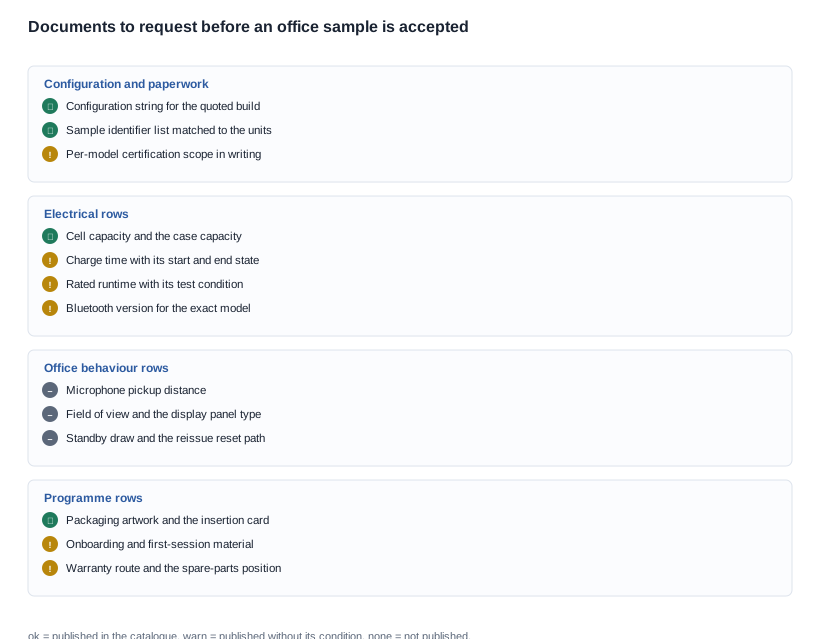
- The configuration string for the quoted build. Model, cell configuration, charging interface, case configuration, packaging and logo treatment, written as a string that can be repeated in the purchase order and on the carton. A quotation without one cannot be compared with another quotation, and a test without one cannot be attributed to a build.
- The per-model certification scope, in writing. Not the company's export certification page — the scope that applies to the model in the quotation, against the market it is destined for. The certificate and conformity procedure is set out at certification checklist, and the Radio Equipment Directive route is at RED directive.
- The electrical rows with their conditions. Cell capacity, case capacity where one applies, charge time with its start and end state, rated runtime with its test condition, and the Bluetooth version for the exact model. The published rows are at battery life and charging solutions.
- The office behaviour rows, or an explicit statement that they are not held. Microphone pickup distance, field of view, standby draw, the reset and reissue path, the update path, the privacy indicator behaviour. "Not held" is an acceptable answer and a useful one; a missing row is not.
- The programme materials. Packaging artwork, the insertion card, any onboarding material, the warranty route and the spare-parts position.
Running and logging the sample session
A sample that arrives without an identification scheme is a sample that cannot be used in an audit. The first action on receipt is to log every unit identifier against the quotation and against the paperwork, which takes minutes and prevents the most expensive category of dispute in this category — a claim that a shipped unit was not the approved sample, which is unanswerable once the units have been mixed.

The session itself is run by someone who was not present when the device was demonstrated, and that is a deliberate choice rather than a ceremony. A first-time operator is the only realistic test of the onboarding path, because an experienced buyer fills in the gaps an employee would hit, and the gaps the buyer fills in are precisely the ones that end up in a support queue. Record every point where that operator stops and asks something. The count of questions is the onboarding cost, and it is the number the supplier cannot argue with because it was produced on their own hardware.
Two conditions should be written into the sheet before the session rather than discovered during it. The first is the volume at which dictation is attempted, because the microphone pickup distance is not published and the only way to get a comparable figure is to fix the volume in advance. The second is the ambient condition of the room, because an open-plan desk and a meeting room produce different results from the same device and both occur in a normal office. A test result without the room condition attached cannot be compared with a later result, and the second result is the one that decides whether the pass line held.
Log each result against its pass line, with a date, the tester name and the unit identifier. A sheet that records observations without marking them true or false is a set of notes, and notes do not travel well into a purchase order, a quality-control plan or a warranty discussion six months later.
Where a smart glasses for office programme breaks before the first shipment
The failures below are the ones that reach a buyer as a surprise, and each is written as the symptom, the cause and the control that removes it. None of them is exotic, and none of them is a reason to change supplier — they are reasons to put a line in the order.
The build that is not the build that was quoted. Two quotations arrive, the units look the same, and the programme is launched on the lower-priced one. The cause is almost always a configuration that was never written as a string, so the factory built what was convenient and the buyer assumed what was meant. The control is the configuration string as a line in the purchase order, with the cell configuration, the charging interface and the case configuration spelled out and priced separately.
The charge window that was quoted without a start state. The office assumes two hours from flat overnight and finds out that the unit is at forty per cent and unusable for the first hour of the morning. The cause is a published charge time with no state attached, which every model in this range publishes and no model qualifies. The control is the start and end state in the acceptance sheet, and a dock that charges to a defined level rather than to a full stop.
A device that cannot be reissued. A person leaves, the device goes into a drawer, and the next person cannot start because the previous configuration is still on it. The cause is that no reset path was ever requested, because no model publishes one. The control is a reset test on the sample and a reset obligation in the contract.
A camera model in a room with no stated indicator behaviour. A camera model is deployed for note-taking and the first customer assumes a recording is happening when it is not, or the reverse. The cause is that the privacy behaviour of a camera model is published nowhere, and the buyer assumed it matched a phone. The control is a written statement of the indicator behaviour, a line in the user material, and a pass line on the sample.
An onboarding cost that was never budgeted. The device works, the instructions are missing, and every deployment is handled by one internal person who learned it once. The cause is that the onboarding material was treated as a nice-to-have rather than as part of the delivered product. The control is to make the first-session instruction count an acceptance criterion and to require the material with the first shipment.
A documentation route discovered at the border. The goods are made, the transit file is incomplete, and the shipment waits while papers are chased. The cause is asking for the documentation late, after the build rather than before the order. The control is the transport file request as part of the same document list, and the battery transport route at battery transport.
The commercial lines a smart glasses for office test result moves
Terms that move with the result
The useful commercial consequence of a test programme is not a discount; it is the ability to price two configurations against each other and to move the lines that the test exposed. The first is the case. Whether the case is in the box or sold as a separate accessory is the largest single lever in an office programme, because it is the difference between one price point and two, and it changes the artwork, the freight weight and the transit file at the same time. A Type-C configuration can carry the case as an accessory because the interface does not depend on it; a magnetic configuration is a different commercial object entirely.
The second is the consumables and the desk kit. A lens item and a contact item cost a fraction of a unit each, are printed on the insertion rather than carried, and are the cheapest return reduction available in this category. The third is the onboarding material. A supplier who supplies and reviews it is reducing the buyer's internal cost, which is a line worth negotiating explicitly rather than expecting to appear in a quotation. The fourth is the packaging, where a factory-applied protective film is often the cheapest available reduction in handling damage.
The total cost of an office programme is the unit price plus the returns reserve plus the documentation route plus the internal cost of reissuing a device, and the trade-offs between those four are settled in the quotation rather than after it. The pitfalls in this category are rarely about the device itself; they are about the artwork and the instructions, which is why the acceptance checklist carries more lines about documents than about measurements.
What does not move is the cell configuration, the charging interface and therefore the charge time and the runtime ceiling, the case architecture, the certification cost and lead time, and the tooling, which is amortised across the first order and quoted as a separate line rather than folded into the unit price. Those are structural and they are settled before any conversation about price. The wording of the commercial section is set out at contract terms, and the structure of a first order at pricing.
A hypothetical office programme, step by step
Take a European software company that has decided to issue smart glasses to a twenty-person operations team, with a second hundred units planned for the following year if the first group works. The first decision is the interface, because it settles the desk. The team already owns Type-C cables, and the range publishes Type-C on the L2 Utral and the D12, and the D11 and the V03 Pro, so the configuration takes a Type-C unit and the case becomes an accessory rather than a mandatory part of the kit.
The second decision is the session profile, and it is decided from the published runtime rather than from a demonstration. A team meeting-heavy day is closer to the five-hour end of the camera band than the eight-hour end, which means a dock on every desk rather than a pocket full of cables, and it means the dwell-charge test case matters more than the session-continuity case. The third decision is the case configuration, and it is settled with the transit file rather than with the artwork, because a magnetic unit would pull a second cell into the file and a Type-C unit does not.
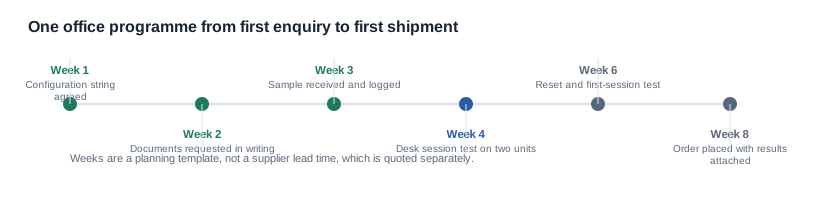
The fourth decision is the documentation, and it is a list rather than a conversation: the configuration string, the per-model certification scope for the destination market, the electrical rows with their conditions, the office behaviour rows, and the packaging and onboarding material. The fifth is the sample, which is logged on arrival and tested by an operator who was not at the demonstration, against the eight pass lines. The result is a purchase order that carries an acceptance sheet, an agreed incoming inspection criterion and a warranty route, rather than a product name and a quantity. Whether this is a hypothetical case rather than a client project — it is, and the sequence is illustrative rather than a report of a specific engagement — the order of the decisions is the part worth reusing.
What we publish and what we will not estimate
On an office programme, that we publish the rows a buyer can order from and we will not fill the open ones with an industry average. For this range that means the resolution class, the cell capacities from 40 mAh upward, the charge times at or under two hours and roughly one hour on the D17 and the ZH12, the rated runtimes, the charging interface per model, the published structural features, and the case capacities where they are published.
What we do not publish, and will not estimate: the frame material, the lens material, the coating, the hinge specification, the per-model weight beyond the single 158 g whole-unit figure for the MT6, the field of view, the video specification, the runtime test condition, the standby draw, the cycle-life rating and the operating temperature range. We will not state that any model in this range is certified to CE, FCC or RoHS, because the catalogue carries no per-model certification row and no such wording in its text, and we will not extend the IP54 marking beyond the two models that publish it, the V06 and the S7. We would rather say that a row is open than quote a figure you cannot trace to a document.
What we will do is take a configuration, a desk scenario and a market, and tell you which published rows cover it, which rows have to come from the supplier in writing, and which questions should be on the acceptance sheet before the sample is paid for. The product families are at AI camera glasses and Bluetooth audio glasses, the testing procedure is at quality control testing, and the sample route is at samples.
The action to take next
Send the desk scenario, the shortlist and the market, and we will return the published rows that apply to each shortlisted model, the office rows that remain open for all of them, and the pass lines we would write onto the acceptance sheet. If you want the reverse, ask for the configuration string we would ask for and compare it against the one on your desk. The scenario entry point is smart glasses for office, the kit questions are at what to bring to an office evaluation, and the lens handling questions are at cleaning lenses for office use.
Related reading
- Smart glasses for office — the scenario entry point
- Quality control testing — the incoming inspection procedure
- Office setup guide — the deployment sequence


