
Smart glasses for security charging is not an office problem with a uniform applied to it. The charging station is an unattended location holding the fleet's data and the fleet's evidence, the device spends most of its life away from the station, and the moment of exchange is the moment a shift either starts with a working unit or does not. The catalogue publishes the charge time for every model — two hours or less for twenty-six of them, roughly one hour for the D17 and the ZH12 — and it publishes runtime bands of 5 to 8 hours and around 7 hours for the camera models. The questions to ask before you order a patrol fleet are therefore short, and the total cost of the shift is decided by them. That second figure is the one that breaks a twelve-hour patrol, because a camera model at around seven hours of published runtime cannot cover a long shift on a single charge, and no charging arrangement changes that. This page is written for the buyer specifying a patrol fleet, and it treats the charging station as a controlled location with an audit trail rather than as a row of sockets.
Smart glasses for security charging happens inside a custody chain
Who is specifying, and what the audit will eventually ask
A security operations buyer is buying a fleet for a contract, and the contract has a service level attached to it. The decision in front of them is not how many devices to buy; it is how many devices have to exist so that every post is covered for every hour of the shift, including the hours when a unit is on charge. Their exposure is a service-level breach that traces back to a device that was flat at a post.
A brand product manager is deciding whether the product can be sold into security at all. A device that is handled by a rotating team, carried across posts and returned to a dock at the end of every shift has a different failure profile from one that stays on a desk, and the charge arrangement is where most of those failures surface. Their exposure is a return rate that climbs with the number of shifts per device rather than with the number of hours.
A channel buyer supplying security resellers is buying the documentation that a reseller will be asked for. In this segment the questions arrive from the end operator rather than from the buyer, and they arrive after the first contract has started. Their exposure is a reseller who cannot answer a question about device custody and loses the next tender.
The audit question underneath all three is simple and uncomfortable: at 03:00 on a particular night, which device was on which post, and what state was it in when it left the dock. A charging arrangement that cannot answer that produces an answer only through reconstruction, and reconstruction is not evidence.
Why a security charge plan is not an office charge plan with a uniform applied
In an office, the device spends most of its life on a desk and the charging arrangement is an end-of-day convenience. In a patrol deployment the device spends most of its life away from the station, and the charging arrangement is what guarantees that a unit is presentable at the start of each shift. Three consequences follow, and each of them changes what the buyer has to specify.
First, the charging station becomes a location with an access list, not a row of sockets. It holds the pool, and on the camera models it also holds the material the fleet produces. Whoever can reach the dock can reach the devices, and if the dock is also a charging point for a case, the cases hold their own memory. Whether the camera is active while the device is docked is not published anywhere in the catalogue, and it is exactly the question an operator's information officer will ask before the dock is allowed into a building.
Second, the handover becomes a record, not a signature on a clipboard. Every exchange between a device and a person has to carry enough information for the shift that followed to be reconstructed later, and the charge state at handover is one of the cheapest and most useful fields a buyer can insist on.
Third, the pool has to be sized for the shift, not for the roster. If a camera model publishes around seven hours of runtime and the shift is twelve hours, the pool needs either a mid-shift swap or a case-powered reserve, and the cost of that reserve belongs in the quotation rather than in the operating budget discovered afterwards.
The dock is an evidence location, not just a plug
What the charging station becomes when the fleet carries cameras
The camera models in this range publish a resolution class, a charge time, a cell configuration, a runtime band and a charging method, and the charging method is published for seven of the eleven. Four camera models — the MT6 and the CY03, and the CY05 and the L1 Pro — publish no charging-method row at all, and the MT6 is the only model in the range with a published unit weight, 158 g for the glasses themselves including the cell and the camera and excluding its folding case. The charging hardware itself is not part of the catalogue, so it is bought separately, and what it does is specified by the buyer rather than inherited from the device.
That specification is where a security deployment differs from an ordinary one, and it is where supplier due diligence earns its cost. A dock that only charges is a piece of furniture with an access problem. A dock that also reports the device's state is an instrument, and an instrument that reports state has to have its readings preserved, time-stamped and attributed to a shift. The catalogue publishes no indicator behaviour for any model, so whether the charging state can be read from the device rather than inferred from a light is a question to ask before the dock is chosen.
The second question is about the case. Five camera models publish a charging case with a capacity — the CY03 and the CY05, and the L1 Pro — each at 1400 mAh, the L2 Utral at 900 mAh or 1400 mAh, and the MT6 as a folding 1200 mAh case — and two more publish a case row without a capacity, the KY06 and the MT5. A case in a patrol deployment is a second item that leaves the building and returns, and it is the item most likely to be left in a vehicle, which is why the reconciliation has to count cases as well as units.
The handover record and the fields it has to carry
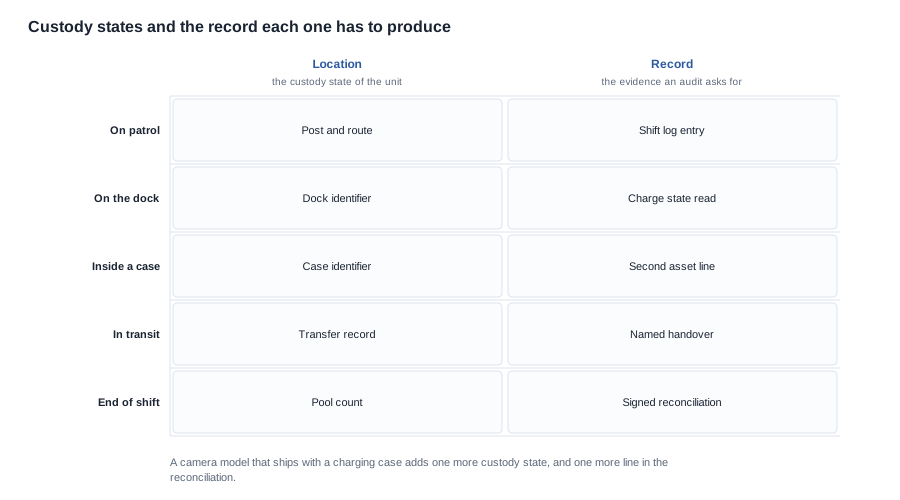
The table above sets out the fields. None of them is exotic, and each of them can be produced by hand on paper if the fleet is small enough. The value of fixing them in advance is that the end-of-shift reconciliation becomes a comparison rather than a reconstruction, and that a question asked six months later can be answered from a record instead of from memory.
Two of the fields carry most of the weight, and they are the two that most checklists leave out. The charge state at handover is the field that tells an operator whether the next block starts with a usable device, and it is the one most often left out because it looks like a detail when the pool is small. The exception entry is the field that covers the flat unit, the swapped unit and the unit that went out with a case that was empty; without it, a gap in coverage has no explanation and an auditor has to assume the worst.
The remaining fields are logistics, and logistics is where the failures cluster. A device identifier links a shift to a unit; without it, a pool of identical units produces footage that cannot be tied to a post. A post or route identifier matches the material to a location. A return time and dock identifier shows the gap between shifts, which is the interval in which a unit is out of service and therefore not part of the covered hours.
The shift length is what decides the charging strategy
Runtime bands measured against a patrol shift
The camera models publish three runtime bands. The V03 Pro and the V06, and the S7 and the V03 publish 5 to 8 hours. The KY06 and the MT5 publish 6 to 8 hours. The L1 Pro and the CY03, the MT6 and the L2 Utral, and the CY05 publish around 7 hours. None of these figures carries a test condition, so a buyer cannot tell what workload produced them, and the honest planning position is to size a shift against the short end of the band rather than the middle.
Against an eight-hour shift, a camera model at around seven hours of published runtime is marginal without a top-up, and against a twelve-hour shift it is not viable on one charge at all. That is not a specification defect; it is the shape of the category. The consequence is that a security deployment sized for long shifts is a pool-size problem and a mid-shift swap problem, and the charging arrangement has to include the swap point, not only the dock.
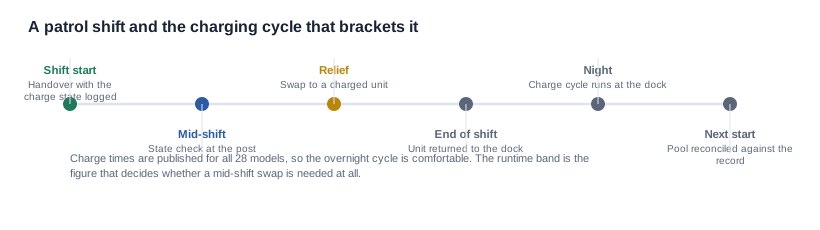
The night side is comfortable. Charge times are published for all 28 models and 26 of them are two hours or less, so an overnight cycle on a dock covers the whole night comfortably and the D17 and the ZH12 do it in about an hour. The runtime figures are set out at battery life and the charging hardware at charging solutions.
The two models that publish an ingress marking are the V06 and the S7, both camera models, both on the 5 to 8 hour band, and neither publishes a charging-case row. That combination decides a wet-weather patrol plan by itself: the marked models cannot be assumed to carry a case, so their power has to come from the device cell and the swap point has to be indoors. The marking is explained at IP ratings and at what the second digit means, and the trade-offs between the models are at security pros and cons.
The case as a second asset under custody
Where a case is used in the field, the power arithmetic changes shape. A 1400 mAh case against a 290 mAh device cell is roughly five charges of reserve, and a 1200 mAh folding case against the MT6's 265 mAh cell is close to four and a half. Those are comparisons between two published figures rather than product claims, and they are the reason a case turns a one-shift camera unit into something that can cover a long shift without a swap.
The cost is custody. The case is a second asset, it has a label, it has to travel with the device, and it has to be counted at the end of the shift. A pool that reconciles units but not cases will lose cases, and a lost case on a camera model is not a lost accessory; it is a unit that has to be returned to the dock on a fixed schedule for the rest of its service life.
How to make the charging arrangement auditable
Making a charging station auditable

- Name the location. Give the charging station an address, an access list and a custody status, and decide whether it sits inside the monitored perimeter. The completion standard is a written location description that a reader who was not there can follow.
- Fix the record. Choose the handover fields before the first shift and bind them to the dock and to the pool labels. The completion standard is a one-page form with a field list and a named owner.
- Size the pool. Take the runtime band against the shift length and decide the reserve ratio, then the swap points. The completion standard is a calculation that shows covered hours per device per shift.
- Specify the hardware. Docking hardware, connector type, cable set, spare contact ratio, case quantities and the storage for the pool all go on one line of the purchase order. The completion standard is a priced accessory schedule.
- Reconcile. Count the pool against the record at the end of every shift, including the cases. The completion standard is a signed reconciliation with the exception line completed even when it is empty.
What to specify in writing
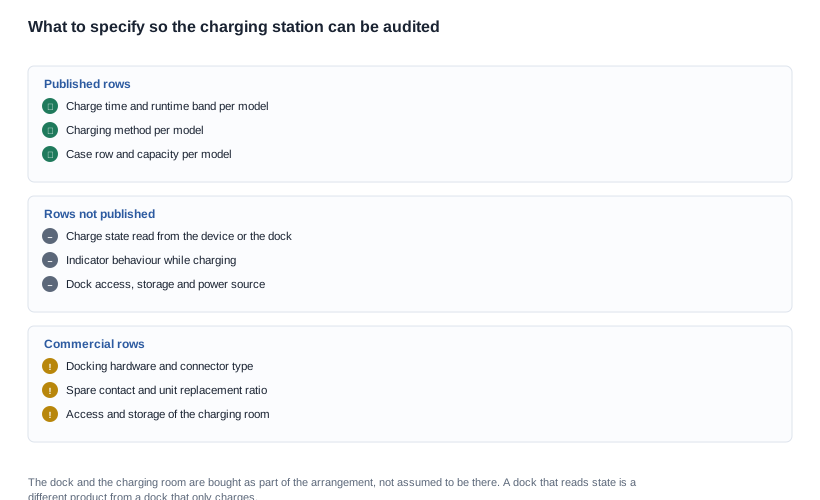
The published rows — charge time, runtime band, charging method, case row and capacity — are the ones to confirm against the catalogue, because they are the ones a reseller sheet gets wrong. The unpublished rows are the ones the audit will ask about: whether the charge state can be read from the device or the dock, what the indicator does while charging, and how the dock is powered and where it is stored. The commercial rows are the docking hardware, the spare contact and unit replacement ratio, and the access arrangements for the charging room. The trade-offs between them are worth an explicit negotiation rather than a line in a quotation.
Two commercial questions are worth raising early, because they change the shape of the first order and because they are the usual red flags in a first-order review. Whether the supplier will quote the dock and the case as a priced accessory schedule against the device order, rather than as a goodwill item, and whether the supplier will support a pool split across more than one site, which decides whether the charging station is one centralised dock or several.

Where security charging arrangements fail
The pool was sized against the roster rather than the shift. The symptom is a post uncovered in the small hours because the only device available was on charge. The root cause is that the reserve ratio was never derived from the shift length and the runtime band. Prevention is to calculate covered hours per device per shift and set the ratio from the result.
The handover record was kept but never reconciled. The symptom is an end-of-shift count that takes ten minutes and finds nothing, because the count is against the shift log rather than against the devices. The root cause is that the record and the pool were maintained separately. Prevention is to reconcile the pool against the record, and to complete the exception line even when nothing happened on it.
A case went missing and the unit followed it. The symptom is a camera unit that has to sit on a dock for the rest of its service life because its reserve power is in a vehicle. The root cause is that the case was treated as an accessory rather than as a second asset. Prevention is to label cases, count cases, and write the case into the handover fields.
The dock was installed inside an uncontrolled room. The symptom is an access question that nobody can answer after an incident. The root cause is that the charging point was chosen for the socket rather than for the perimeter. Prevention is to name the location, list the access, and decide the position of the room before the hardware is ordered.
The wet-weather plan assumed a case on the marked models. The symptom is a patrol that cannot keep a spare unit charged in the rain because the case does not exist for those models. The root cause is that the ingress marking and the case row were read as one product feature. Prevention is to check the case row separately for the V06 and the S7 and plan their power from the device cell.
A charge-state claim was made that no row supports. The symptom is a dock chosen for a feature the specification does not contain. The root cause is that a demonstration was accepted in place of a written row. Prevention is to put the charge-state reading into the purchase order as a criterion and test it on two units from the same batch.
| Security failure | Root cause | Preventive action |
|---|---|---|
| Post uncovered in the small hours | Pool sized on the roster | Derive the ratio from shift length |
| Reconciliation finds nothing | Record and pool kept apart | Reconcile pool against the record |
| Unit out of service after a case is lost | Case treated as an accessory | Label and count cases |
| Access question unanswerable | Dock placed for the socket | Name the location and its access |
| No spare power in the rain | Marking and case row merged | Check the case row separately |
| Dock bought for an unpublished feature | Demonstration taken for a row | Put the reading into the order |
What we publish about security charging, and where we stop
The boundary we hold: the security category is settled by the shift length and the runtime band, and the charging station has to be specified as a controlled location with a record behind it. We publish the charge time for every model in the range, the runtime band for every model, the charging method where the catalogue carries one, the charging-case row and capacity where they are published, and the IP54 ingress marking on the two camera models that carry it. We publish the 158 g whole-unit weight for the MT6 glasses, with the folding case excluded, and we will not present that figure as a frame weight or as a figure for any other model.
What we will not do is publish an indicator behaviour, a charge-state reading capability, a runtime test condition, a charge start state, a termination point, a contact service life, an assembled weight including a case, or any statement about what the camera does while the device is docked. We will not publish a certification claim for any model, because the catalogue carries no per-model certification row; a certification file is something to request in writing, and it is on the list at certification checklist. We will not extend an ingress marking to a model that does not carry it.
What we will do is take the shift length, the number of posts, the environment, the models you are considering and the target market, and tell you which models' runtime bands cover the shift, what reserve ratio the shift forces, which rows still have to be closed, and which claims the documentation supports. The product family is at camera and audio smart glasses, the charging hardware is at charging solutions, and the scenario entry point is security.
What to send us next. Send the shift length, the number of posts, whether the deployment runs in wet conditions, the shortlist and the target market. We will return the shift-to-runtime fit, the reserve ratio the shift forces, the list of rows still open, and the handover fields worth fixing before the first shift.
Related reading
- The model family — camera and audio smart glasses
- The charging hardware — charging solutions
- The runtime rows — battery life
- The ingress marking — IP ratings and what the second digit means
- How the scenario opens — security
Tell us the shift length and the number of posts, and we will tell you which published runtime bands cover the shift and what reserve ratio it forces.


