
What does the second digit mean is a question that buyers ask because the first digit is intuitively easier. The first digit of an ingress marking is about solids and dust, and it maps onto a familiar idea: bigger numbers mean finer exclusion. The second digit is about water, and it does not work that way at all. It is a ladder of exposure conditions — drips, spray, splashes, jets, immersion — and a higher number is not "more waterproof" in any general sense. It is a more severe and more specific exposure. Reading the second digit properly means reading the exposure it describes rather than the reassurance it appears to offer, and the two readings come apart most sharply at 4, which is the digit that appears on the two models in this catalogue that publish an ingress marking at all.
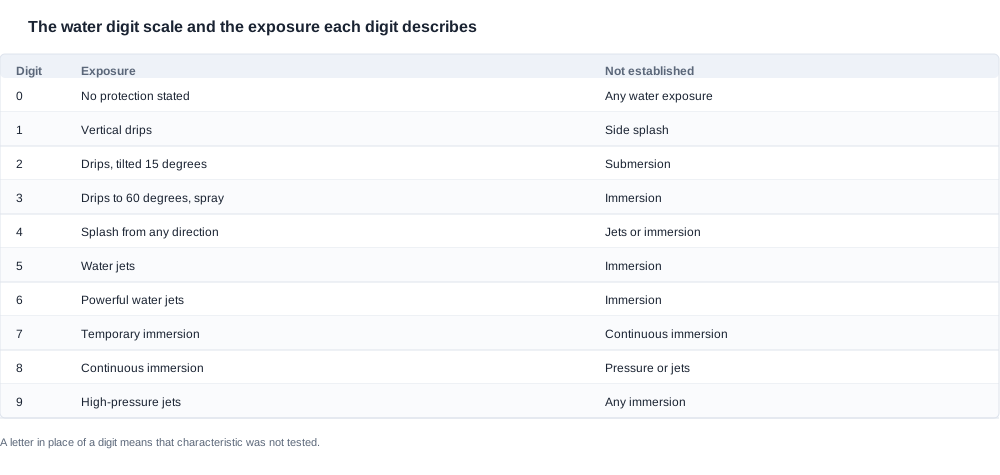
The digit scale itself is short, and it is worth putting the whole ladder in front of a buyer before any single digit is discussed. Zero states that no protection is claimed for that characteristic. One is water falling vertically. Two is drips with the product tilted up to fifteen degrees. Three is drips with the product tilted up to sixty degrees together with sprayed water. Four is splashing water from any direction. Five is water jets. Six is powerful water jets. Seven is temporary immersion. Eight is continuous immersion with the depth and duration stated by the manufacturer. Nine is high-pressure and high-temperature water jets. And a letter may stand in place of a digit to mean that the characteristic was not tested — no entry in this catalogue publishes a marking of that form, because the only marking it publishes is IP54.
That ladder is not a marketing scale and it was never designed as one. Each digit describes an exposure under a defined test condition, and the conditions are what a buyer has to hold on to when a product page turns a marking into a sentence. A digit of 4 describes a splash exposure. It does not describe a shower, a washing machine, a jetty, a swimming pool or a dropped device, and a product claim that says "water resistant" without the condition attached is a claim about a digit rather than about an experience.
| Digit | Exposure described | What it does not establish | Verification question |
|---|---|---|---|
| 0 | No protection stated | That the product fails in any water | Is any exposure claimed at all |
| 1 | Vertical drips | Splash from a side | Spray angle and duration |
| 2 | Drips, tilted to 15 degrees | Submersion or spray | Tilt angle and duration |
| 3 | Drips to 60 degrees, plus spray | Immersion or high pressure | Nozzle and pressure used |
| 4 | Splash from any direction | Submersion, jets, pressure washing | Nozzle, distance and duration |
| 5 | Water jets | Immersion | Pressure and duration |
| 6 | Powerful water jets | Immersion | Pressure and duration |
| 7 | Temporary immersion | Continuous immersion | Depth and time stated |
| 8 | Continuous immersion | Pressure or jets | Depth and time stated by maker |
| 9 | High-pressure, high-temperature jets | Any immersion | Pressure, distance and angle |
Why the digit 4 is the hardest one to use
Three things make 4 the most over-read digit in the category, and each of them is a property of how the digit is used rather than of what it measures.
The first is that it is the default. IP54 is the most widely used combination in this product class, which means it carries no information at all in a market where every competitor publishes it. A marking that every competitor also publishes tells a buyer nothing about how the product was built; it tells them only that the manufacturer decided the marking was worth printing. The informative comparison is not against the competitors' markings but against the conditions the marking describes, and against the evidence behind it.
The second is that a digit describing an exposure gets read as a description of a use. Splash from any direction is a test condition, and the tests are performed on a defined product in a defined state. A buyer who converts the digit into "fine in the rain" has silently changed the subject from an exposure to a scenario, and the scenario carries consequences the digit never addressed: how long the product is in the rain, whether it is running at the time, whether the charging case is with it, and whether the exposure is repeated a hundred times a season or once. Those are the variables that decide whether a marking is useful, and they are precisely the variables a marking cannot carry.
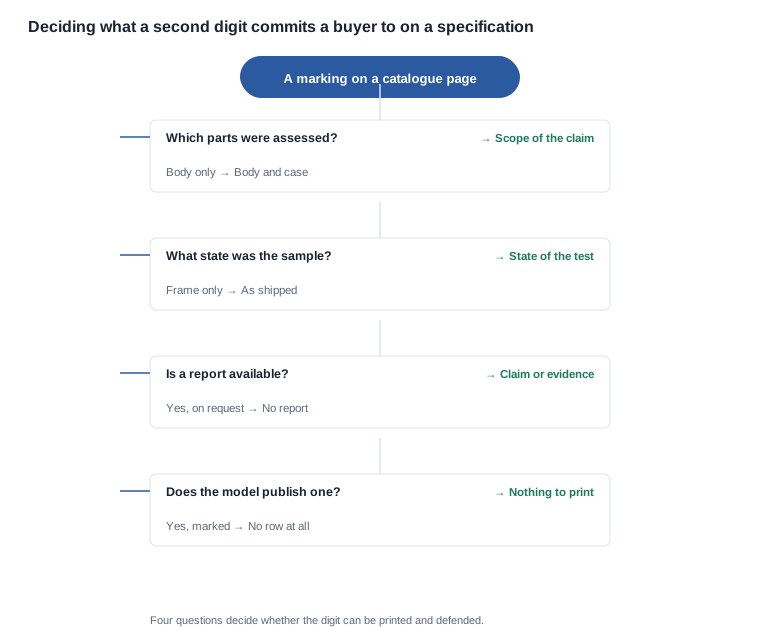
The third is that the marking says nothing about which parts were tested. A pair of glasses is an assembly of an electronics body, a battery, a removable inner frame on two models in this range, and a charging case on several. A marking assessed on the body says nothing about the case, and a marking assessed on the assembled product says nothing about the state in which the product was assessed. This is not a technicality in this category, because the charging case is where the cell and the water meet, and the catalogue publishes a charging-case capacity on five of the eleven camera models, shows a case without a capacity figure on the KY06 and the MT5, and publishes no charging-case row at all for the V06, the V03 and the V03 Pro or the S7.
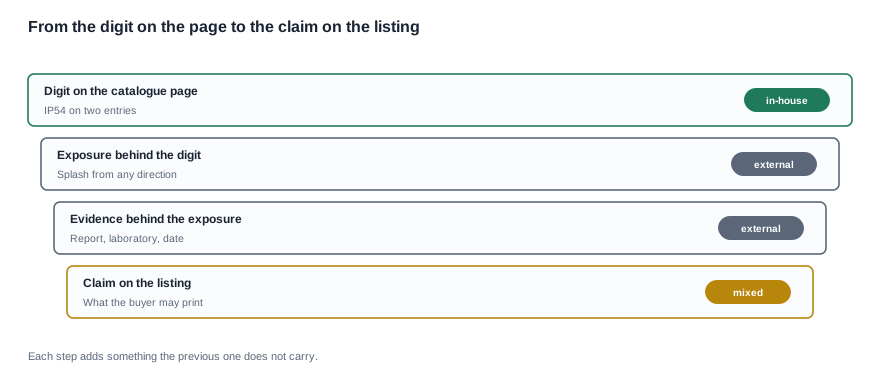
There is a fourth difficulty, and it is a documentation one rather than a technical one. An ingress marking on a product page is a claim; a test report is evidence; and the two are different artefacts with different holders and different lives. A marking tells a buyer that an assessment was made and that someone decided to print the result. It does not name the laboratory, the date, the sample count, the standard edition, the state of the sample, or the report number. A buyer who needs to defend the claim to a channel partner, a retailer or a market authority needs the document, not the digit.
The selection question underneath all four difficulties is worth stating plainly, because it is the one procurement teams actually have to answer: the marking is a filter, not a specification. When a procurement team is choosing between configurations for a programme with wet exposure, the digit is a way of ruling things out rather than a way of ruling things in. A configuration that publishes no marking has not been ruled out, and a configuration that publishes a marking has not been ruled in either, because the marking does not say what it covered. The criteria that do the real work are the four questions further down this page, and the cost of running them is one request and one reply. A buyer who skips them and shortlists on the digit is accepting a claim in place of evidence, which is the trade-off the digit is always offering.
The failure mode that follows from that is specific enough to watch for. A marking travels between configurations more easily than a report does, because a digit is short and a report is a document. Two models in a range often share a shell, and the marketing instinct is to carry the digit across without asking whether the assessment covered the other configuration. The red flags are consistent: a marking published for one entry and then quoted for a sibling, a claim of waterproof on a product page where the catalogue publishes only IP54, and a product whose marked and unmarked variants are sold in the same channel without any explanation of which state was tested. None of those is visible in a catalogue row, which is why a buyer's due diligence has to ask for the report rather than for the digit.

What this catalogue publishes, and what it does not
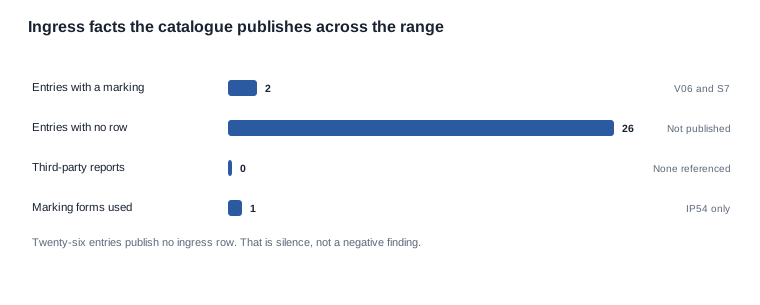
The position in this range is unusually narrow, and it is worth stating with the same precision the marking itself deserves. Two entries publish an ingress marking: the V06 and the S7, both marked IP54. The other twenty-six entries publish no ingress row of any kind. That is a statement about the published record. It is not a statement that those twenty-six entries are unsealed, and it is not a statement that they would fail any particular exposure.
The two marked entries have feature rows that are otherwise worth noting, because they describe what the marking is attached to. The V06 publishes an ergonomic design line, a long-runtime line, a removable inner frame and an IP54 marking, along with four colour options. The S7 publishes an ergonomic design line, a thirteen-megapixel resolution class, a removable inner frame and an IP54 marking. Both are camera models, both are in the range's sport-photography group, and both have a detachable inner frame, which means a buyer has to ask the obvious question: was the marking assessed with the inner frame fitted, with it removed, or in both states? A removable element is a seam, and a seam is where an enclosure rating is most easily lost.
Two further points complete the published position. The marking is a catalogue marking: it appears in the catalogue's own feature lines, and no third-party test report reference is attached to it anywhere in the published material. And the marking appears on exactly two entries, which means it cannot be described as a family property, a category default within this range, or an attribute that can be carried across to a model that does not publish it.
What the catalogue publishes for the remaining twenty-six entries is a specification set without an ingress row: cell capacity and count, charge time and rated runtime, charging method, resolution on the camera models, colour on two models, and the charging-case position across the camera models. A buyer who needs an ingress position for one of those entries is asking for information that has to come from a request, and the request has to be answered for the exact configuration. The how ingress testing works note covers what the test involves; whether a marking covers the case covers the case question specifically.
The way to evaluate two suppliers' answers on this point is straightforward and worth fixing before the first request goes out, because the answers arrive in different shapes. One supplier may answer with a digit, another with a digit and a report, and a third with a statement that the product is sealed to a standard without naming the standard. Those three answers are not of equal value, and a buyer who treats them as interchangeable ends up comparing a claim with evidence. The criteria that separate them are simple: an exposure stated in words, the parts it covers, the state of the sample, and a document that can be produced. A shortlist built on those four criteria can be compared with a shortlist from another supplier, which is the only kind of comparison that survives a channel partner asking why the two products differ.
There is also a question a buyer should put to a supplier that has no marking at all, because a silent answer is an answer. Is the product assessed in any way — for water exposure, for transit exposure, for a sealed enclosure — and if so, why is the result not published? The three possible replies are that the assessment exists and is not published, that it exists and did not reach the requested digit, or that no assessment was made. Each of them tells a buyer something different about the engineering position, and each of them tells a buyer something about how the supplier handles an unanswered question, which is often the more useful signal for a programme that will involve several rounds of requests.

Turning the digit into a question
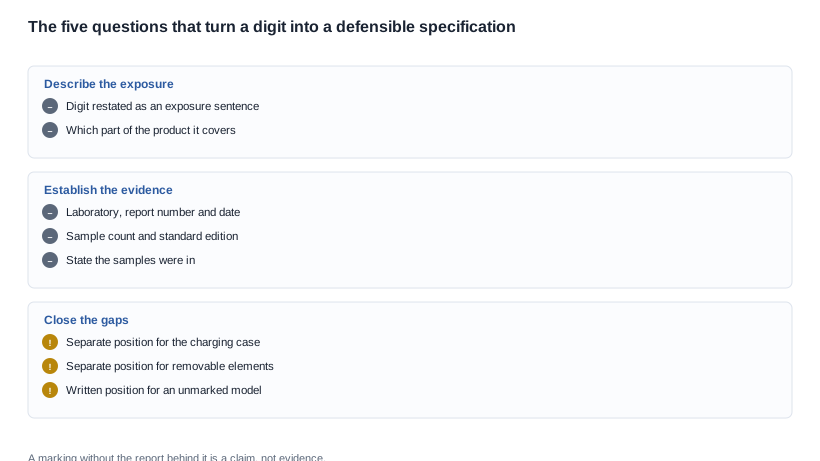
A marking is most useful when it is converted into the set of questions it raises, because those questions are the ones a buyer can actually put to a supplier. Five questions do most of the work, and each of them asks for something the digit itself cannot supply.
- What exposure does the marking describe in words, and on which part of the product? Ask for the digit as a sentence — splash from any direction — and for the part it was assessed on: the glasses body, the assembled product, the charging case, or each of them.
- What was the state of the sample? Ask whether the removable inner frame was fitted, whether the case was attached, whether the unit was running, and what charge state it carried. An assessment on a powered-down, frame-only unit in a laboratory is a different statement from an assessment on a working product in its shipping configuration.
- What is the report behind the marking? Ask for the laboratory, the report number, the date, the standard edition and the number of samples. A marking without that document is a claim; with it, it is evidence.
- Does the marking cover the charging case, and separately the removable elements? Ask whether the case has its own assessment and at what digit, and the same for any detachable inner frame or temple. A body marking leaves the case, where the cell is, entirely uncovered.
- For the entries with no marking, what is the position? Ask what the exposure position is for that model — in use, in transit, in storage — and whether any assessment exists that is not published. The answer distinguishes a product that was assessed and not marked from one that was never assessed, and the two lead to different product-page wording.
The wording that survives a review follows from the answers rather than from the digit. A product page may state the marking exactly as the catalogue publishes it, on the two entries that publish it, and may describe the exposure it denotes in standard terms. It may not state that a product is waterproof, may not extend the marking to an entry that publishes none, and may not present an unmarked entry as though it were marked, because silence in the catalogue is silence and not a negative finding. Where the catalogue publishes no ingress row for twenty-six entries, the correct statement on a listing is that no ingress marking is published for that model — and the question of what it withstands in service is then a question for the supplier, answered in writing.

Clauses that make an ingress marking defensible
An ingress requirement that is written into an agreement as a digit is a requirement that will be argued about, because a digit is not a specification until the conditions behind it are attached. Four clauses turn the marking into something both sides can work from, and each of them costs nothing to write and a great deal to omit.
The first names the exposure rather than the digit. Instead of requiring IP54, the agreement requires a splash exposure from any direction, assessed on a stated configuration, and requires the marking to be printed only if the assessment supports it. The second names the parts: the glasses body, the removable inner frame and the charging case, each assessed and reported separately, so that a marking cannot be read across a seam. The third is a documentary obligation, requiring the report to be supplied with the goods and to be re-supplied whenever the assessed configuration changes. The fourth is a change rule that puts the same discipline on a future variant that the first three put on the current one, because a variant is the point at which a marking is most likely to be carried across without evidence.
These four clauses do more than protect a buyer. They also protect the supplier, because an exposure-based requirement gives both parties the same reference point when a question arrives from a channel partner, and it removes the argument about what a digit was supposed to mean. A procurement team that writes the requirement this way is also able to evaluate quotations against each other, since every supplier has answered the same four points and the comparison is between answers rather than between marketing. The checklist that supports it is short, and it is worth attaching to the purchase order rather than keeping it in a file.
The trade-off remains, and it is a genuine one rather than a rhetorical device. A requirement written this way is slower to satisfy than a requirement that asks for a digit, because it asks for a document and a configuration statement rather than for a symbol. The offsetting benefit is that the marking on the finished listing survives the first question a retailer's compliance team or a channel partner asks about it, and the second, and the third. In a category where the digit is the single most copied line on a product page, that is the only criterion that separates a durable listing from a temporary one.
What does the second digit mean for a buyer writing a specification
Published: an ingress marking on two entries only — the V06 and the S7, each marked IP54 in its feature rows, with a removable inner frame published for both, four colour options on the V06 and a thirteen-megapixel resolution class on the S7 — and no ingress row at all for the other twenty-six entries. The marking is a catalogue marking, with no third-party test report reference attached anywhere in the published material, and no entry publishes a marking of any form other than IP54. Not published: the exposure conditions behind the marking, the laboratory, the report number, the date, the standard edition, the sample count, the state of the samples, which elements were assessed, whether the charging case was included, whether the removable inner frame was fitted, and any exposure position for the twenty-six entries that publish no ingress row. Ask the supplier: the digit restated as an exposure sentence, the assessed parts and their state, the report behind the marking with its laboratory, number and date, separate positions for the case and for any removable element, and a written exposure position for a model that publishes no marking.
For a procurement team writing an ingress specification, our position is that the second digit is a question rather than a specification, and that the marking earns the right to be printed on a listing only when the report behind it can be produced on request. That position is uncomfortable for a category where the marking is used as a marketing shortcut, because it means declining to print a digit that a competitor prints. It is also the only position that survives a channel partner's compliance review or a market authority's question, since the digit on the page is always going to be asked about, and the answer behind it is either available or it is not.
Related reading
- What the test actually involves — how ingress testing works
- The comparison that decides a choice — IP54 against IP67 and IPX7
- The question a marking never answers — does an IP rating cover the charging case
- The exposure behind the digit in plain terms — can IP54 glasses get wet in the rain
- The limit that a digit does not describe — can I swim with IP54 glasses
Ask for the report behind the marking, for the parts it covers and for the state the samples were in, and the second digit can be written into a specification that someone else can defend.


