

Smart glasses for outdoor is a decision about which single claim the configuration can carry, because in this catalogue the three claims an outdoor buyer wants do not sit on the same model. The ingress marking appears on exactly two models in the whole range. The charging case that extends a day outdoors appears on none of those two. The roughly one-hour recharge appears on two sport models that carry neither an ingress marking nor a camera. A buyer who wants all three is not short of options; a buyer who wants all three is asking for a product this catalogue does not have, and the useful work is deciding which one of the three to build the programme around.
Smart glasses for outdoor: which single claim to build the programme around
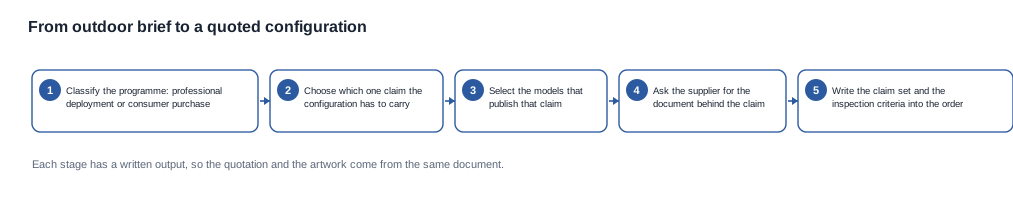
Two outdoor purchases get filed under one heading, and they have almost nothing in common operationally. Outdoor work is a professional deployment: the device is issued, charged at a known point, wiped down between users, and expected to survive dust, water and vibration across a schedule. Outdoor play is a consumer purchase: the device is carried, charged wherever a socket appears, and judged on whether it survived the trip.
The difference matters commercially because the two buyers pay for different things and both of them eventually blame the model. A professional buyer pays for documentation and for a replacement path, and the failure arrives as a report about a specification that was never written down. A consumer buyer pays for a claim they can believe, and the failure arrives as a public review that the channel cannot contest.
The catalogue makes the outdoor decision unusually legible, and that is the reason it is worth reading carefully before a quotation is requested. Three published facts define the outdoor shortlist, and they do not overlap.
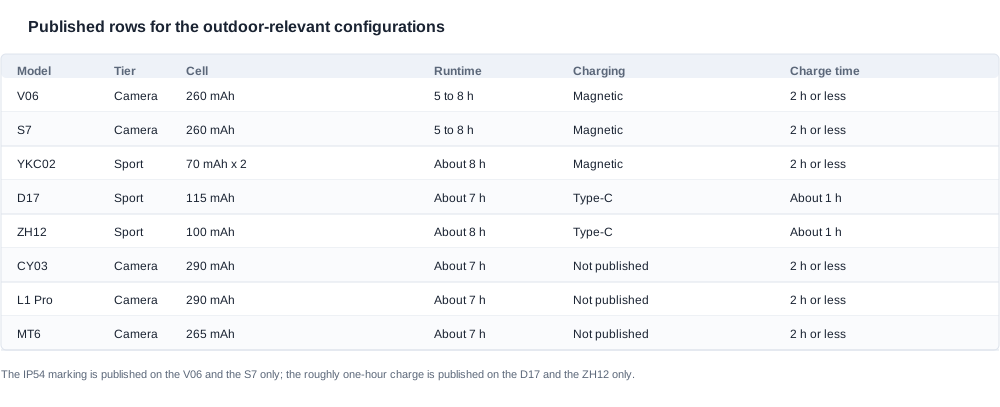
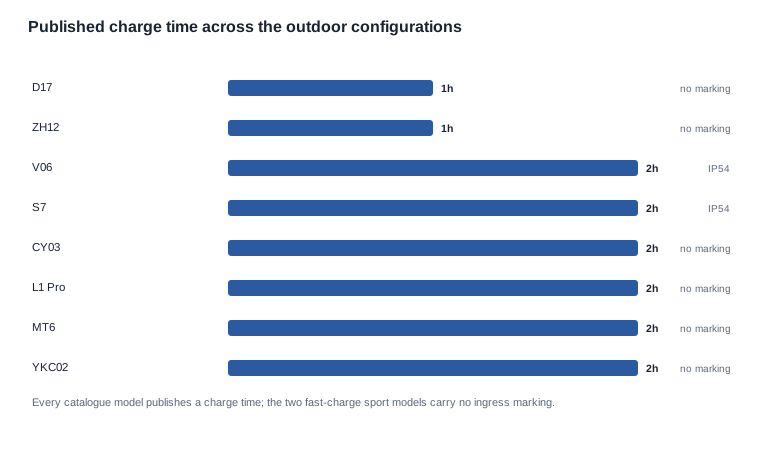
The ingress marking is on two models. The IP54 marking is published on the V06 and the S7, and on no other model in the catalogue. It is not a tier attribute, it is not a family attribute and it does not extend to the audio models, to the sport models, or to the other nine camera models. A buyer who has seen "IP54" attached to one product page and assumed it describes the outdoor range is working from an inference that the catalogue does not support.
Neither ingress-marked model has a published charging case. The V03 Pro is published explicitly as having no charging case, and the V03 and the S7, and the V06 have no charging-case row at all. The cases sit on the L2 Utral and the KY06, the CY03 and the L1 Pro, and the MT5 and the MT6, and the CY05 — a different part of the range, and none of them carries an ingress marking.
The only fast-charge configurations are sport models. Every model in the catalogue publishes a charge time, and twenty-six of the twenty-eight publish two hours or less. The D17 and the ZH12 publish roughly one hour. Both are sport models with a Type-C interface, neither publishes a case, and neither carries an ingress marking or a camera.
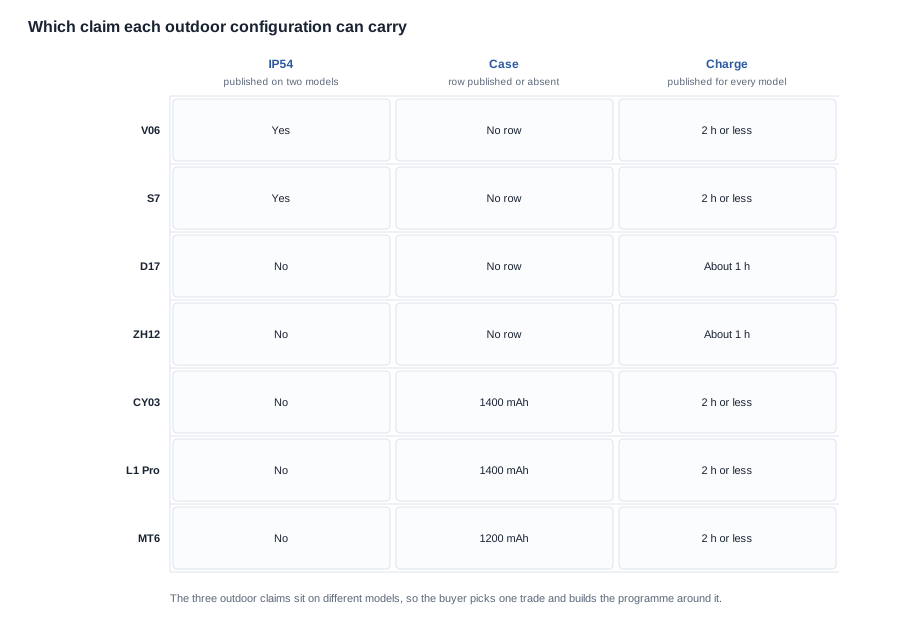
That is the whole constraint map, and it is more useful than a feature comparison because it tells a buyer which trade has to be made deliberately. The professional deployment that needs an ingress marking accepts two models and gives up the case. The consumer line that wants a day of endurance with a case in the box accepts no ingress marking at all. The tour or field team that wants a unit back in service within an hour accepts a sport model with no camera and no marking.
Who is buying, and which of the two programmes this is
A brand owner is deciding which of those three trades to build a price ladder around, and what the listing is permitted to say at each rung.
A procurement manager is deciding which published rows are enough to write a specification against, and which need a supplier document before the order can proceed.
A channel buyer is deciding which claim the outdoor listing carries and which claims it leaves out, because the customer who believes the listing and then has it fail in the rain is a customer who does not come back.
The fear underneath the enquiry is not a bad price. It is a listing that promised more than the documentation supports, discovered in a customer review, on a channel where the reviews are the only marketing the product has.
The two ingress-marked models and what they are
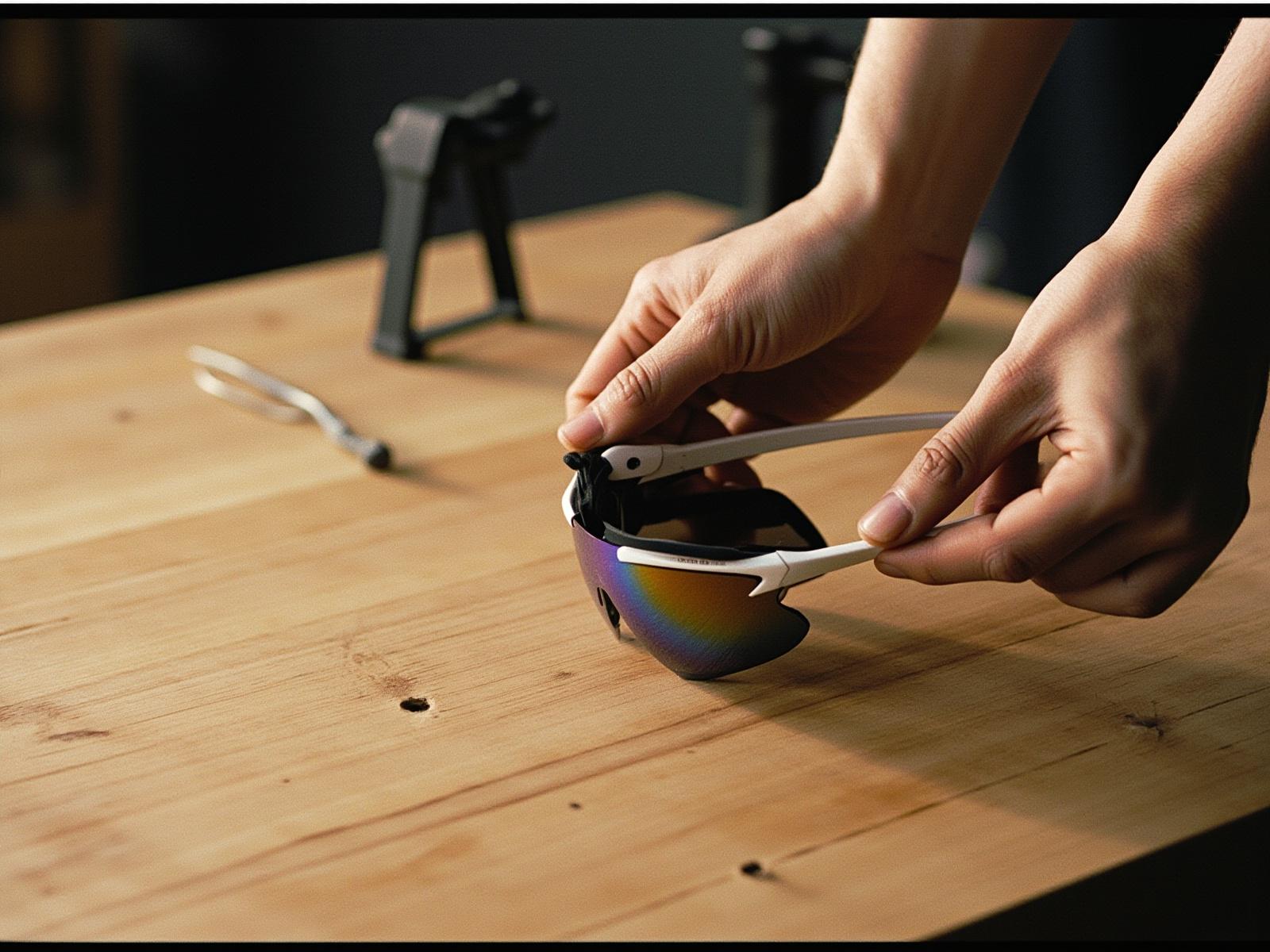
The V06 and the S7 are the only two models in the catalogue with an IP54 marking, and they are a well-matched pair with one meaningful difference between them.
Both publish a 260 mAh cell, a rated use of five to eight hours, magnetic charging, a charge time of two hours or less, an ergonomic design, and a detachable inner frame. Both are camera models, and both have no charging-case row in the catalogue.
The difference is the pixel tier and the colour availability. The V06 publishes 8 megapixels and four published colours — orange, ice blue, black and a black-ice-blue option. The S7 publishes 13 megapixels and no colour row at all in the catalogue text. For a buyer building a retail ladder, that is a clean structure: one configuration with a merchandising colour range and one without, sitting at opposite ends of the resolution tier, both carrying the same ingress marking and the same power row.
The detachable inner frame is the other published structural feature and it is worth more attention than it usually gets in an outdoor brief. A removable inner frame is a size-range mechanism: it lets one SKU cover a wider range of head sizes, and in a professional deployment it reduces the number of spare units the site has to hold. It is a structural row, not a performance claim, and it belongs in the specification as a feature name rather than as a comfort promise.
What the two models do not publish is as important. There is no ingress test report behind either marking — no institution, no report number, no standard reference and no date. There is no field of view, no video resolution, no frame rate, no sensor model, no low-light behaviour and no storage or overwrite behaviour. There is no published weight for either of them; the single published weight in the catalogue is 158 grams for the MT6 camera glasses body, excluding its foldable case, and that model has neither an ingress marking nor anything else in common with these two.
The marking itself is a catalogue attribute and has to be described as one. The digit reading is at what does the second digit mean, and the honest commercial position is that a listing may state the marking as published and may not state a waterproof performance, because a marking with no published report behind it is not a verified rating.
The sport models and the only fast-charge configurations in the catalogue
The D17 and the ZH12 are the two models in the whole catalogue that publish a charge time of roughly one hour rather than two hours or less. Both publish a Type-C charging interface, a Bluetooth 5.4 radio, and surround sound. The D17 publishes 115 mAh and a rated runtime of about seven hours; the ZH12 publishes 100 mAh and about eight hours. The D17 publishes a remote-control photo feature, and the ZH12 publishes remote photo and a surround-sound configuration.
For an outdoor programme this is a genuinely useful and genuinely narrow capability, and its narrowness is the point. These two are the only configurations that can be returned to service inside a break rather than at the end of a shift, which is the difference between a device that is charged in a vehicle and a device that is charged in a locker. That matters for professional work sites, for rental and fleet operations, and for any consumer channel whose marketing is built around being out for a day.
What they do not offer is equally clear. Neither publishes an ingress marking. Neither publishes a camera. Neither publishes a charging case. So a configuration chosen for turnaround speed is an audio configuration in a market where the customer may have been sold on the ability to record.
There is also a comparison trap here that the catalogue itself creates. The YKC02 publishes 70 mAh × 2, about eight hours, magnetic charging and a two-hour-or-less charge time, with a surround-sound and long-battery feature row. The D17 publishes a smaller cell than the YKC02 in a single-cell arrangement and a shorter rated runtime, but a materially faster charge. A buyer comparing "battery life" as a single figure will rank the YKC02 first, and a buyer comparing turnaround per unit of downtime will rank the D17 first, and the two rankings produce different configurations. The figures are published; the condition behind them is not, so the comparison has to be made against the working pattern rather than on a spec sheet.
Building the outdoor claim set without overstating the marking
An outdoor listing has three possible claims and each one has a different evidence requirement. Confusing them is the most common source of a return in this segment, because the seller makes the strongest claim the market expects and the documentation supports only the weakest one the customer reads.
The marking claim. The listing may state that the model carries an IP54 marking, naming the V06 or the S7, and may describe the published feature rows — the detachable inner frame, the ergonomic design, the published colours on the V06. It may not state a waterproof performance, a submersion tolerance, a dust-tightness rating beyond the marking, or a verified test result, because no report is published. This is not a limitation being worked around; it is the correct wording, and a listing written this way survives a customer standing in the rain.
The endurance claim. The listing may state the rated runtime with the model's name attached, and it should not convert a five-to-eight-hour band into a day. No runtime in this catalogue carries its test condition, so the endurance statement is a rating and the listing should say so. The charging plan for a trip is at charging for outdoor trips, and the deeper battery treatment is at battery life.
The recording claim. The listing may state the pixel tier for a camera model, and it may not convert it into a video specification, because no video resolution, frame rate or field of view is published for any camera model. For an outdoor listing this is the claim most likely to be overreached, because a customer outdoors is filming while moving, and a stills figure says nothing about what the customer will actually get.
Professional wording and consumer wording are different documents
A professional buyer wants the marking, the documents behind it and the replacement path. A consumer buyer wants the marking, the colours and the case. Writing one listing for both is how a programme ends up with a claim the professional channel cannot evidence and a merchandising story the professional channel does not need.
The practical consequence for a buyer running two channels from one platform is that the model does not have to change, but the artwork, the claim set and the accessory set do. That is a packaging question rather than a product question, and it is worth more to the channel than a unit price negotiation because it decides how many stock-keeping units the operation carries.
The supplier documents an outdoor order cannot proceed without
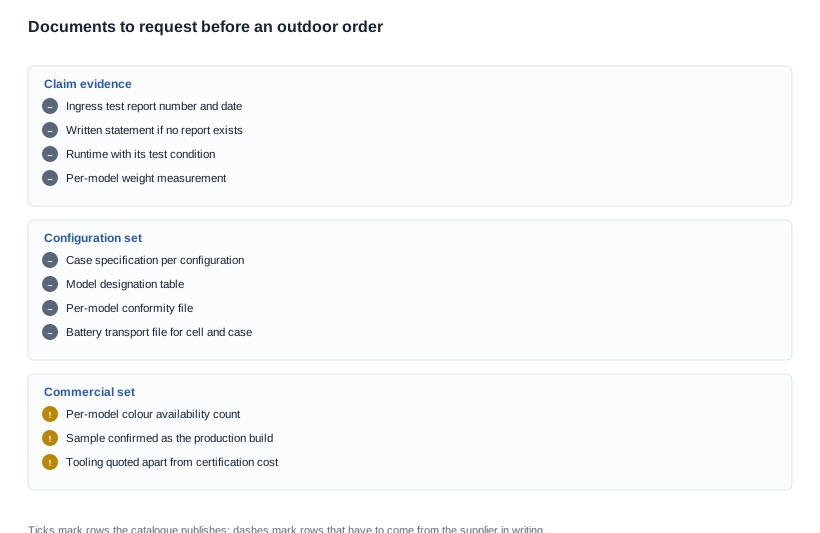
Seven documents, and each of them closes a specific gap that the catalogue leaves open.
- The ingress test report, or a written statement that none exists. Institution, report number, standard and date. The listing claim is written to match whichever answer arrives, and that is a clause worth having before the artwork goes to print.
- The runtime with its test condition, per model, because a five-to-eight-hour band and a roughly seven-hour figure are not interchangeable and neither is a working day.
- The per-model weight, since no weight is published for the ingress-marked pair and it is the first figure a consumer listing is judged on.
- The case specification per configuration, because the presence or absence of a case row is what separates the two ingress-marked models from the camera models that ship with one.
- The model designation table, so the quotation, the artwork, the inspection criteria and the returned unit all refer to the same code.
- The per-model conformity file, checked against the issuing body's public register at certification checklist. The catalogue contains no CE, no FCC and no RoHS text at all and no per-model certification row, so this evidence comes entirely from the supplier and has to be scoped to the model and the configuration.
- The battery transport file for the exact cells and any case shipped, at battery transport, and confirmation that the sample is the production configuration at samples.
For clause language go to contract terms, and for the commercial structure of a first order go to pricing.
Most of that list can be built from four first-enquiry questions alone. Which model designation is quoted here, and what the published row for that model records. Does the configuration carry an ingress marking, and what document stands behind it. Does the configuration ship with a charging case, and at what published capacity. What is the published charge time, and what is the start state and the end point that make it meaningful.
The red flags in this segment are all cheap to catch early. A quotation that describes an outdoor range as IP54 without naming the two models that carry the marking. A listing that says waterproof. A specification that promises a charging case for a model with no case row, or treats the V03 Pro's explicit no-case position as the same thing. A runtime quoted as a working day. A weight carried across from the MT6 to a model that has no published weight.
Where the commercial value sits in an outdoor order
Outdoor orders are negotiated on the same commercial terms as the rest of the range, but two blocks behave differently here and are worth more of the negotiation time.
The ingress-marked pair is scarce and should not be split. Two models out of twenty-eight carry the marking, and they carry the same cell, the same runtime band, the same interface and the same structural feature. That makes them a natural two-rung ladder with a shared specification file, and it makes splitting them across two channels expensive, because each channel then has a single SKU rather than a pair with a shared document set.
The case is the cheapest way to build a second price point. The 1400 mAh case on the CY05 and the L1 Pro, and the CY03, the choice of 900 or 1400 mAh on the L2 Utral, and the 1200 mAh foldable case on the MT6 all come from camera models that carry no ingress marking, which means the case-led ladder and the marking-led ladder are separate products rather than variants of one. A buyer who wants both in the same channel is buying two platforms.
The fast-charge option is worth negotiating explicitly. The roughly one-hour charge on the D17 and the ZH12 is the only published turnaround advantage in the catalogue, and it is a selling point for fleet and rental operators. It is also the option with the smallest published cell, so the buyer who wants it should ask what the runtime figure becomes under the real working pattern.
Tooling and certification are quoted apart. Tooling is amortised across the first order; certification cost and lead time are dictated by the process and by whoever certifies the build. The two are frequently bundled into a single line that hides which is which, and the buyer who cannot see the split cannot model the break-even volume.
We publish the rated runtimes, the case capacities, the charging interfaces, the cell capacities, the structural feature rows, the resolution tiers, the charge times and the colour availability exactly as the catalogue states them, and we publish the absence of an ingress test report, a runtime test condition, a per-model weight, a field of view and a video specification with the same prominence. We will not state that any product is tested to IP54, we will not extend the marking beyond the two models that carry it, and we will not present a rating as an endurance guarantee.
What we will do is take the outdoor brief — professional or consumer, recorded or not, the season, the session length, the channel and the price band — and narrow the range to the two or three models that fit, state which claims the documentation supports for each one, and list the documents to obtain before the order. The product families are at sport smart glasses and AI camera glasses, and the scenario entry point is outdoor.
What to send us. Send whether the use is professional or personal, whether the activity is recorded, the session length, the channel and the price band, and we will return the shortlist with the claim set each configuration can carry.
Related reading
- The opening point of the scenario — outdoor
- The model families — sport smart glasses and AI camera glasses
- The ingress marking — what does the second digit mean
- How charging works — charging for outdoor trips
Tell us whether the use is professional or personal, and we will narrow the range and the claims.


