
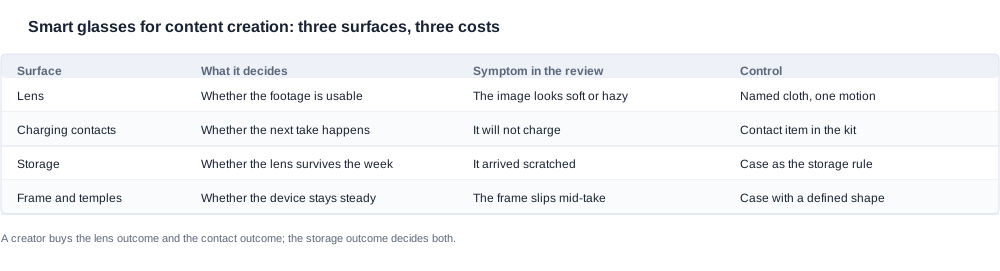
Smart glasses for content creation put the lens inside the deliverable, which changes the decision a buyer makes. A haze on a lens is not a cosmetic blemish; it is a defect inside the footage, and the customer cannot tell it apart from a weak sensor. The lens material, the coating and any abrasion figure are not published for any model in our range, so the routine a creator follows is currently whatever a sleeve does. For a buyer, that is a claim risk that arrives as a review rather than a return, and the only defence is a supplied consumable, a one-motion instruction and a written surface specification obtained before the insert is printed.
Smart glasses for content creation: the surface is inside the deliverable
The buying task behind this article. The reader is a buyer at the brand, a channel buyer or a product manager specifying a first-person camera product for a creator channel, a video team or a reseller who supplies small production units. The task is to decide where the maintenance step sits in the creator's workflow, what it costs the creator, and what it costs the buyer when it is skipped. The commercial risk being managed is a review feed full of "the image came out soft", which reads as a product weakness to every reader and to the platform ranking the video.
What our published position settles, and what it does not. For the camera tier we publish a resolution class, a cell capacity, a charge time, a rated runtime, a charging interface, a colour count, and a charging-case capacity on seven of the eleven camera models. The published cell capacities run from 220 mAh on the V03 Pro and the MT5, and the V03, through 260 mAh on the V06 and the KY06, and the S7, 265 mAh on the MT6, to 290 mAh on the L2 Utral and the CY03, and the L1 Pro and the CY05. The rated runtimes sit at roughly seven hours for that last group, six to eight hours on the KY06 and the MT5, and five to eight hours on the S7 and the V03, and the V06 and the V03 Pro. Not published for any model: the lens material, the coating, the surface treatment, any abrasion or chemical resistance figure, a per-model weight beyond the single 158 g whole-unit figure for the MT6, the field of view and the video specification.
Why a creator's surface problem reads as a product problem. The person writing the review is looking at a soft image in a finished video and has no way to separate a smeared lens from a weak camera. A creator who has just spent a day on footage will not spend an hour isolating a haze; they will publish the review. That single behaviour converts a routine failure into a product-level rating, and it is the reason the routine has to be preventive rather than corrective. A corrective routine depends on the customer noticing and acting; a preventive routine is in the box, on the desk, and used before the shoot rather than after the review.
The difference between a one-minute fix and a one-hour investigation. A haze that appeared at the end of a shoot is a retake. A haze that appeared in the published video is a credibility problem, because the audience can see it and because the creator has already decided the device is faulty. The commercial distance between those two states is enormous and it is the whole reason the consumable belongs in the box. The cost of a cloth item is a fraction of a cent per unit. The cost of one creator's evening is the price of a unit's lifetime value.

A second surface decides whether the next take happens at all. The charging contacts on a camera model collect the film that a hand leaves behind, and a unit that will not charge after a shoot is a fault claim in the returns system, not a review. The interface published for the camera tier is magnetic on the KY06 and the S7, and the MT5 and the V03, and the V06, and Type-C on the V03 Pro and the L2 Utral, while the CY05, the CY03 and the MT6, and the L1 Pro publish no charging-method row at all. A buyer who writes a routine that says "wipe the contacts before charging" is writing something that only makes sense for the magnetic group, and that is worth saying explicitly on the insert rather than leaving to a general instruction.
Smart glasses for content creation: where the break has to hold the wipe-down
A creator session has a natural break in it, and the routine either fits that break or does not happen. The break is where the kit is put down, where the battery question is answered and where the device goes back into storage. A maintenance step that has to be found, unfolded and applied with two hands does not survive a ten-minute gap between blocks of footage. The instruction that survives is one item, one motion, and it is triggered by putting the device away rather than by remembering to service it.
The trigger matters more than the technique. A routine attached to an intention is skipped; a routine attached to a moment the creator already has — the device going back into its case — is performed. This is why the consumable belongs at the desk rather than in the bag, and why the case is part of the routine rather than an accessory. The kit decision for this scenario is at content creation accessories, and the lens-side treatment in more detail is at cleaning lenses for content creation.
The size of the consumable is set by the break, not by the chemistry. If the break is five minutes and the kit is a spray and a stack of wipes, the stack stays in the bag and the spray ends up on a desk where somebody else uses it. A single-use item, in a quantity that matches the number of shoots a creator runs in a week, is the format that survives. The number of shoots is not a guess — it is a fact the brand can collect from the creator programme it is already running, and it should be collected before the first order rather than after the first reorder.
The instruction has to be written for a stranger. The insert is read once, by a creator who has just opened a box and is about to start a shoot. It cannot assume knowledge of the coating, cannot branch on a condition the reader cannot assess, and cannot ask for a judgement the creator is not qualified to make. One line, one item, one moment. A creator who reads a two-branch instruction will pick the branch that is shorter and hope for the best.
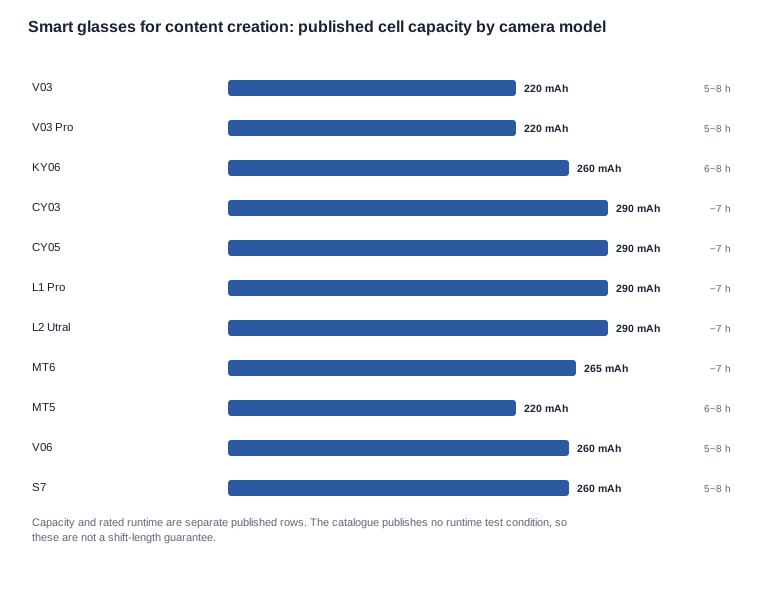
The runtime sets the shape of the break. The published runtimes for the camera tier run from roughly seven hours on the CY03 and the L2 Utral, and the CY05 and the MT6, and the L1 Pro, through six to eight hours on the KY06 and the MT5, to five to eight hours on the V03 and the S7, and the V06 and the V03 Pro. A creator shooting a full day needs a charge between blocks, and the charge has to happen in the same break as the wipe-down if the break is the only gap that exists. That is a planning constraint on the accessory kit as much as on the unit: the case that holds the spare charge, the contact item that keeps the magnetic group working, and the cloth that keeps the lens out of the footage.
The rows a creator's brief actually needs are these, and they differ between models in a way that decides which accessory each one needs.
| Model | Rated runtime | Charging interface | Charging case published |
|---|---|---|---|
| V03 Pro | 5~8 h | Type C | No charging-case row published |
| V03 | 5~8 h | Magnetic | No row published |
| L2 Utral | ~7 h | Type C | 900 mAh or 1400 mAh |
| MT6 | ~7 h | Not published | 1200 mAh, foldable |
| S7 | 5~8 h | Magnetic | No row published |

Smart glasses for content creation: the document a haze complaint is settled against
Four failures, and only one of them is what the customer complains about. The lens is what a creator notices and describes. The charging contact is what actually stops the session. The storage surface is what decides whether the lens is scratched at all. The frame is what decides whether the unit stays still on the head during a take. A buyer who treats "the device" as one object will optimise the wrong consumable, and the returns data will show the waste.
Attribution is the part that changes the commercial outcome. When a creator publishes a soft image, the natural reading is that the camera is weak, and a buyer who cannot produce a surface specification cannot argue the point. The defence is documentary and it has to exist before the review appears: a coating statement per model, an instruction test record on a sample unit, and a return condition standard that distinguishes a scratched lens from a working one. Without those, every haze complaint is settled by the customer because there is nothing to settle it against.
The coating specification is the document that does the arguing. We do not publish lens material or coating for any model, which means we cannot print a material name or a scratch-resistance figure on a listing or an insert, and we will not supply one. The buyer obtains it in writing from the factory, and that document becomes the artefact that supports a dispute with a marketplace or a platform. That is the practical reason to ask for it early: its value is realised at the moment of the claim, not at the moment of the order.
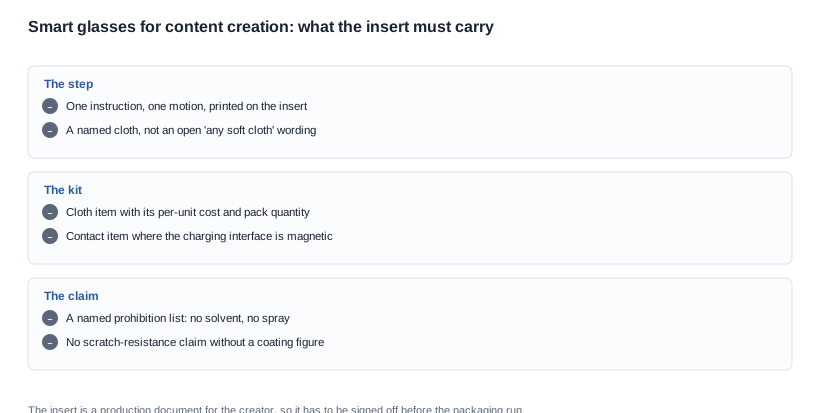
The prohibition list is what prevents the mistake rather than the claim. A creator who has a screen-cleaning spray on the desk will use it on a lens, because nothing tells them not to and the spray is the obvious tool for a smeared screen. A named prohibition — no solvent, no spray, no alcohol wipe — is the cheapest line on the insert and the one with the highest chance of being read, because it is the first thing a creator checks when they have already smeared something.
A reflex wipe with a sleeve is the habit that creates the claim. A creator's T-shirt is the most available cloth in the building, and a coating that has not been characterised is not something to recommend a T-shirt against. Supplying the right item is not a courtesy to the creator; it is the mechanism that breaks the habit, and the habit is what the returns data ultimately measures.

Smart glasses for content creation: the source of what the insert must carry
The insert for this scenario is a production document, and it is signed off like one. It is read by the person who will run the shoot, it is printed in one language per market, and it carries a prohibition list, a storage rule and a statement of what is not permitted on the lens. It should be reviewed by whoever supervises the shoot, not only by the packaging team, and a supplier who has not read it is a supplier who has not tested it.
Six requests that have to be closed before the packaging run.
- The lens material and coating statement, per model, in writing. Ask for it per model, not per family, because the range includes a photochromic lens configuration on the V03 Pro and a different surface specification means a different instruction. The photochromic question is at photochromic lens and the general material background is at materials and ergonomics.
- A one-step instruction test on a sample, run by somebody who has not seen the product. Follow only the printed insert, then check whether the image is visibly affected afterwards. The buyer who knows the coating is not a good tester of the instruction.
- A charging behaviour test after a session, with the contacts in the state a creator leaves them in. This is the failure that stops the take and the one that turns into a fault claim rather than a review.
- The factory-applied protective film question. Ask whether a film is available, at what per-unit cost, and whether it is applied before the unit reaches the buyer. On a product where a scratch becomes a published video, a factory-applied film is usually the cheapest reduction in the claim rate available anywhere in the bill of materials.
- The return condition standard and the refurbishment checklist, in writing, with a visual reference and a stated price per unit. The price is the number that normally goes missing, and its absence is why refurbishment cost turns up in the margin instead of in the quotation.
- The model designation table and the certificate register. The catalogue carries a company-level export page and publishes no per-model certification row; the document text contains no CE, FCC or RoHS marking. Certificate numbers a buyer relies on have to come from the supplier and be checked in the issuing body's public register, which is at certification checklist, and the battery transport file for the shipped configuration is at battery transport.
The document set the order should carry. The lens material and coating statement per model, the prohibited-agents list, the kit contents list with the per-unit consumable cost, the insert artwork, the return condition standard, the refurbishment checklist and its price, the model designation table, the certificate register and the agreed incoming inspection criteria. The clause language sits at contract terms, and the commercial structure of a first order sits at pricing.
Smart glasses for content creation: pricing the interruption rather than the parcel
A creator channel pays for the device twice. Once in the unit price and once in the cost of the interruptions that a poorly maintained unit creates — a retake, a lost hour, a review that ranks badly. The second cost is never on a purchase order and is usually invisible in the accounts, which is why a creator-facing programme is often defended on unit economics alone and then loses margin to a problem nobody budgeted for.
The parts of the cost that move inside the order. The kit contents and their per-unit cost are the cheapest available reduction in the claim rate, and the quantity to negotiate is the quantity per device and the resupply interval rather than whether the item is included. Whether a protective film ships and whether it is factory-applied is the single largest lever on the scratch share of the returns. Whether the insert artwork is produced and reviewed by the supplier is worth more than it looks, because an insert written by a factory that has tested the instruction behaves differently from an insert written by a packaging vendor that has not. The wording of the return condition standard is a negotiation between two parties who both prefer to avoid the argument later. Whether the refurbishment checklist is the supplier's or the buyer's, and whether a refurbishment partner is trained on it, changes the cost of every unit that comes back.
The parts that do not move. The lens material and the coating, and therefore the instruction that can safely be printed on the insert. The camera hardware, and therefore the ceiling on image quality that no consumable can raise. The certification cost and lead time. Tooling, amortised across the first order and quoted as a separate line rather than folded into the unit price, because folding it in hides it from the comparison.
Minimum order quantities and staged deliveries are the two levers that matter most in this channel. A creator programme usually starts with a small group of testers and grows quickly, which means the share of units taken at a pilot tier rather than a run tier is where the commercial room sits, because it is the factory's own risk exposure. Releasing the opening order in two batches, with the balance held until the first batch passes inspection, is the arrangement a channel that is still assembling its volume needs, and where two models ride on one purchase order it is worth asking how small the volume really is.
What follows is worked through as a scenario rather than a client account. Assume a brand supplying a creator channel through a reseller, listing one camera model with a magnetic interface at a mid price band. The first decision is the consumable format: single-use items in a weekly quantity taken from the brand's own creator programme, so the kit matches the number of shoots rather than an arbitrary figure. The second is the film, which is factory-applied and priced as a line in the bill of materials, because a scratch that reaches a published video costs more than the film does. The third is the insert, which names the prohibited agents, attaches the wipe-down to the moment the device goes back into its case, and states that no solvent or spray goes on the lens. The fourth is the documentation, which covers the coating statement per model, the return condition standard with a visual reference, the refurbishment checklist with its price, the designation table and the certificate register. The outcome is a kit whose per-unit cost is visible and small, an insert that a creator follows without being told twice, and a returns reserve that is priced rather than discovered.
Our position and the boundary of it. We publish the camera tier's resolution tiers, charge times, cell capacities, rated runtimes, charging interfaces, colour availability and case capacities exactly as the catalogue states them, and we publish the absence of lens material, coating specification, abrasion and chemical resistance data, a per-model weight beyond the single 158 g whole-unit figure for the MT6, the field of view and the video specification with the same prominence. We will not publish a cleaning recommendation for a lens whose material and coating we have not been given, and we will not state a refurbishment standard we have not seen. We will also not state that any model in our range is tested to IP54, because no test report sits behind that marking.
What to send us next. Send the channel, the platforms, the price band, the annual volume and the number of shoots a creator runs in a week, and we will return which published rows apply, what the kit and the insert should carry, which claims your configuration can support, and which documents have to be settled before the packaging is signed. The product range is at AI camera glasses, the related failure modes are collected at content creation common problems, and the scenario entry point is smart glasses for content creation.
Related reading
- The entry point for this scenario — smart glasses for content creation
- The models in the range — AI camera glasses
- The lens treatment — cleaning lenses for content creation
- The kit decision — content creation accessories
Tell us the channel and the price band, and we will say what the kit and the insert should contain.


