A creator's problems with smart glasses are almost never the device. They are the three junctions the device sits at: the storage it writes to, the phone it transfers through, and the edit it lands in. Each junction has behaviour our catalogue records as not published, and each junction is where a creator's afternoon disappears. This page is written for the buyer supporting a content channel, and it arranges each problem as symptom, cause, first check and fix, because a support script built on the published rows does not work and a support script built on the junctions does.
Smart glasses for content creation: the three junctions behind most support cases
The short answer. Before anything else, decide whether the report is a hardware fault or a junction behaviour, and the way to decide is to work three junctions in a fixed order: storage, then transfer, then format. Seven of the most common problems in this category resolve inside those three steps, and the default action of swapping the unit — which is what happens when a support script is organised around the device — resolves none of them and destroys the evidence that would have closed them. The rest of this page gives the seven problems, the first check for each, and the order in which those checks are run.
Who this is written for and what it has to produce. A brand owner supporting a content channel needs a support script that resolves the common cases without escalating to a firmware question on the first call. A procurement manager is deciding what to put into the specification so that fewer of these problems reach a customer at all, and needs to know which of them are documentation gaps that can be closed at order time. A channel buyer is writing the customer-facing guidance and needs to know which behaviours are documented, which are not, and what a support agent is permitted to promise.
The commercial reason this matters more than it looks. Support cost in a content channel is the largest operating cost after returns, and it is generated at the junctions rather than at the device. A brand that closes the junction rows in the specification turns a recurring support category into a one-off question at order time, and that saving compounds across every unit sold afterwards. The same argument applies to the returns reserve: the problems in the table below are the mechanisms by which a specification gap turns into a refund, and each one can be priced before the order rather than absorbed afterwards.
What the catalogue publishes, and what it does not. The eleven camera models publish a camera tier, a cell capacity from 220 mAh to 290 mAh, a charge time of two hours or less, a rated use between five and eight hours and, on seven of them, a charging method. Published case capacities are 900, 1200 and 1400 mAh on five models, present but unquantified on two, absent as a row on three and explicitly published as not included on one. A unit weight is published for one model only, the MT6 at 158 g, being the glasses body including its cell and camera and excluding the foldable case. Storage capacity, file format, overwrite behaviour, transfer path, application name, application version, firmware version, field of view, video resolution, frame rate, microphone count, pickup distance, thermal behaviour and the runtime test condition are not published for any model. Every one of those is a junction behaviour, and every one of them appears in the table below.

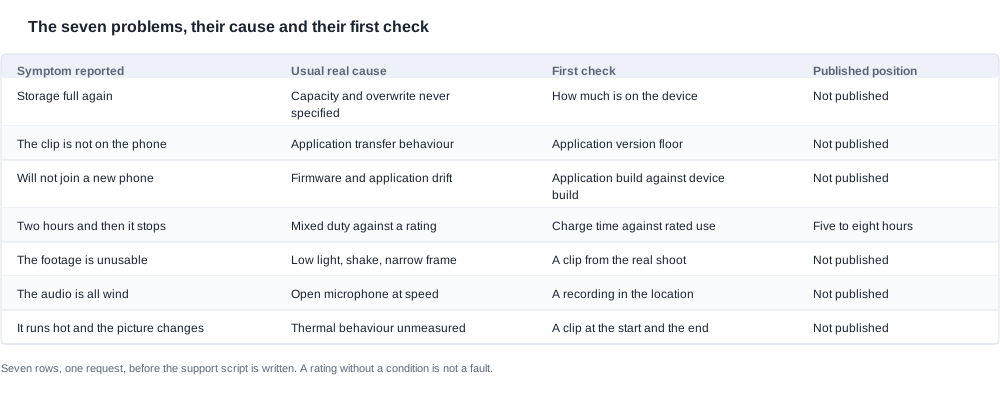
The seven problems, their real cause and their first check
The seven reports, and what is actually behind them. The table sets out each one in four columns: what the creator reports, the real cause, the first check, and the published position. The fourth column is the important one, because it tells the support agent what is a known gap and what would be an anomaly.
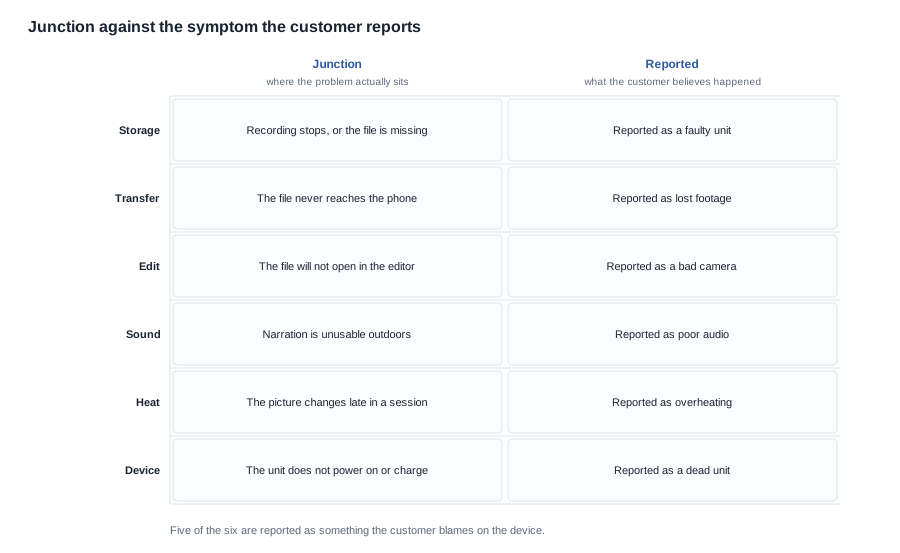
Why the published position column changes the behaviour of a support agent. A row that is not published is not a defect and cannot be a defect, because no specification was ever written for it. An agent who knows that can answer a creator honestly — that behaviour was not specified, here is what we have established, here is the workaround — instead of escalating. A row that is published and is not met is a defect, and the warranty and the quality control process apply. Separating the two categories at order time is what lets a support script be short.
Two of the seven are configuration problems wearing a symptom's clothes. "It will not connect to my new phone" is usually an application version floor rather than a device fault, because the device is fine and the pairing logic has moved on. "It gets hot and the picture changes" is usually a continuous-use limit that nobody measured rather than a defect, because there is no published thermal specification against which a deviation could be claimed. Both are cheap to close in advance and expensive to close afterwards.
One of the seven is a duty-cycle problem rather than a hardware problem. The published band is five to eight hours on the 220 mAh models and about seven on the 290 mAh models, with no test condition attached. A creator who recorded continuously for two hours and expected eight was reading a rating as a session length. The fix is not a replacement unit; it is the accessory plan, because the published case capacities of 900, 1200 and 1400 mAh are the numbers that decide whether a case, a rotation of units or neither answers the segment.
One of the seven is the most expensive, because it destroys the evidence. A device that stops recording when the storage fills loses the take. The first check is five minutes on a sample: fill the storage and record what happens — stop, overwrite, drop, or warn first. A device that warns costs a pause. A device that stops without warning costs a take, and it costs one every time until somebody asks the question.
Working the junctions in order, before the unit is declared faulty
The order is not a preference. Each junction can masquerade as the next one, and a support script that jumps steps will replace a unit that was never broken.

Step one is storage, because everything downstream fails if the device cannot write. Ask how much is on the device, what the format is, and what happens at capacity. The last of those three is the one nobody asks and the one that decides whether a take is recoverable.
Step two is transfer, because a file that has been written and cannot be retrieved is functionally the same as a file that was never written. Does the file reach the phone, over what, at what speed, and what happens to a large file. The application name and the version floor belong in the answer, because the application is the part that changes between shipments and it is the part a creator updates without telling anyone.
Step three is format, because it is the last step before the customer judges the product. Whether the file the creator ends up with is the file the editor can open — the container, the codec, the resolution, the frame rate — decides whether the footage is usable at all. A file that will not open is a total loss for that take and a total loss of credibility for the channel, and no amount of support goodwill recovers it.
Steps four and five are the sound and the heat, and they are where the device itself becomes a possible answer. Was the narration captured in the condition it was shot, and does the picture hold through a long session. Only after those five steps is it legitimate to ask whether the unit is at fault, and at that point the answer is usually that the unit is behaving as an unspecified row.
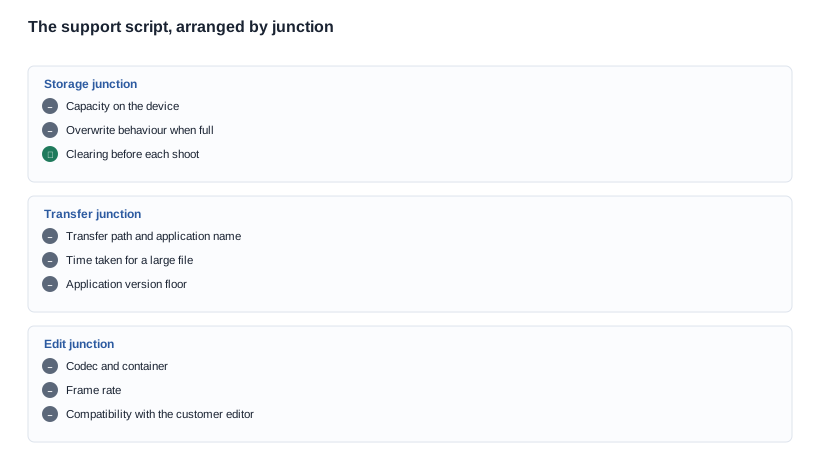
What the script becomes once the junctions are the organising principle. A support agent does not need a device fault tree for this category. What the agent needs is the first check for each junction, in order, and a written statement of which behaviours were never specified. That is a one-page script rather than a troubleshooting manual, and it is the same document for every model in the range, because the published position is the same for all of them.
How the script becomes a specification, which is where the cost saving comes from. Every row the script resolves with a question — the storage capacity, the overwrite behaviour, the transfer path, the application version floor, the runtime condition, the thermal behaviour — becomes a line in the purchase order. The support script then shrinks because fewer cases reach it, and the returns reserve becomes an estimate from real data rather than a guess.

The support script, and what it is worth commercially
The support cost of a content channel is the largest operating cost after returns, and it is generated at the junctions. A brand that closes the seven rows in the specification turns a recurring support category into a one-off question at order time, and the saving compounds across the channel rather than repeating per unit. The same is true of the returns reserve, which is normally set as a percentage of the delivered price precisely because the underlying defect rate is unknown, and which becomes a measurable number as soon as the junction behaviours are established.
The commercial terms worth putting in the enquiry, because each one changes the price or the schedule. Unit price and volume tiers. The accessory and spare set with its own minimum order quantities, asked separately from the device minimum, because the spare device and the spare cable are frequently what decides whether a channel can run a rotation of units instead of a charging case in every box. Packaging specification. Delivery splitting. Payment nodes against inspection rather than against production. The warranty period with a stated response time for a unit that fails during a publishing week, and the return terms for a unit that arrives in a condition the listing did not describe. The warranty and returns article covers the structure of both.
Two quoted items, and the reason to ask which is which. The cost of a certification and the time it takes are fixed by the programme and by whoever certifies the build, and tooling is often amortised across the first order while certification is a per-programme cost. The two are frequently bundled into a single line on a quotation, so ask which one is being quoted whenever they appear together. The clause language for both is at contract terms.
How to evaluate a supplier's support commitment before you order. Five questions, asked in this order, separate a supplier who has closed the junction rows from one who intends to. First, ask for the storage capacity, the overwrite behaviour and the transfer path for the exact configuration, and see whether the answer names the model. Second, ask what the application is called and what the version floor is, and whether that floor is a commitment or a courtesy. Third, ask what the runtime was measured under, and whether the answer includes the recording load. Fourth, ask how a unit that fails during a publishing week is handled, and whether the response time is written down. Fifth, ask for the last three support cases the supplier has handled in this category and what the root cause turned out to be; the answer separates a supplier who has run the junction triage from one who has run a fault tree. The first four questions are due diligence on documentation. The fifth is due diligence on process, and it is the one most often skipped because it sounds like a request for somebody else's history rather than for a fact about the product. It is the question that tells you whether the remaining rows will ever arrive.
How to assess two quotations against each other on support. The total cost of a content channel includes the support cost, and a quotation that looks cheaper at the unit price can be more expensive once the support terms are read. Put both quotations on the same sheet and compare five lines: the warranty period, the stated response time, whether spares and cables are available at a stated price, whether a rotation of units is possible, and whether the accessory minimum constrains the first order. Where one quotation is silent on a line and the other answers it, the silence is not free — it means the channel carries that cost itself. This is a trade-off worth making deliberately: a supplier who commits to a response time has priced the obligation into the unit price, and a supplier who does not has simply moved it to you.
The clauses the order needs, in this order. The published rows for the configuration ordered. The seven junction rows once they have been established, each with the measurement condition attached. The measured runtime and the measured recharge count. The accessory and spare set with its minimum order quantities. The warranty period with a stated response. The order of those five is not arbitrary: the first two are what the factory is committing to build, the third and fourth are what the channel is committing to carry, and the fifth is what the customer is entitled to expect.
What to leave out of it, deliberately. Any support commitment built on a behaviour that has not been established, and any runtime claim quoted without its condition. A commitment the factory cannot demonstrate is a commitment the channel will have to honour in the field, from its own margin, at a moment when the customer is watching.
The three support metrics worth tracking from the first order. They are all derivable from the case records the script already produces, and all three are red flags when they move in the wrong direction. The first is the share of cases resolved at the junction rather than by replacement: a rising share of replacements means the script is being skipped, because a replacement is the action taken when the junction triage has not produced an answer. The second is the repeat rate per customer, which separates a workflow problem from a product problem, because a customer who reports the same symptom twice is telling you the first case was closed with a workaround rather than an answer. The third is the time from report to resolution, which is the number the warranty response time is supposed to govern. None of these three requires a defect-rate figure from the factory, and all three can be maintained from the same case log the support script produces.
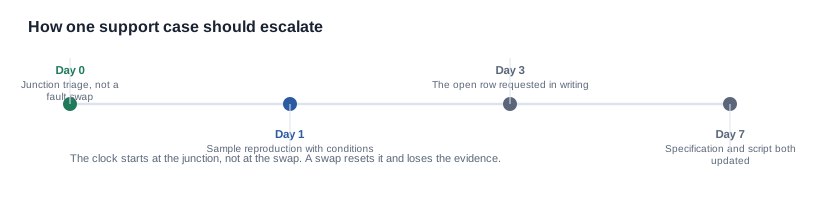
Why the escalation clock starts at the junction. The timeline above starts the clock at triage on day zero and not at the replacement. A swap resets the clock and removes the sample that would have reproduced the behaviour, so the next customer sees the same problem and the factory never sees the evidence. The case only closes when the specification and the script have both been updated, which is why the last step is a document change rather than a dispatch.

What the published rows can and cannot settle in a support case
The boundary we hold: the common problems in this category are documentation gaps at three junctions, and a channel which closes them in the specification will spend less on support than one which closes them in a script. We will not publish a storage capacity, a file format, an overwrite behaviour, an application name, a transfer path, a firmware version, a field of view, a video resolution, a frame rate, a microphone count, a pickup distance, a thermal behaviour or a runtime condition for a model where the manufacturer has not provided one, and we will not fill a gap with a typical value from the industry, because a typical value becomes an expectation and an expectation becomes a return.
What we will publish is the hardware side, in full and without exaggeration: the charge times, the rated runtimes, the published structural features, the cell capacities, the camera tiers, the published case capacities and the charging interfaces and the single published unit weight of 158 g on the MT6, which belongs to that model and its platform and transfers to nothing else.
What we will do is give you the seven problems, the first check for each, the order in which to run them and the list of rows to request. The models and their published rows are listed at the AI camera glasses range, the selection side is at choosing between camera models, and the deployment view is at long-term use for content creators.
Sending the channel, the models and the support script
- The channel, the content type and the models you are supporting.
- The three junction behaviours you have established, with their conditions.
- The support script you have written, if you have one, so the open rows can be marked against it.
We will return the seven rows marked against what the documentation closes and what your specification still has to close, and we will say plainly where a problem is a documentation gap rather than a defect, because that distinction is what keeps a support script short.
Related reading
- The models and what the catalogue says about them — AI camera glasses range
- The selection side — Choosing smart glasses for content creation
- What a long deployment shows — Long-term use for content creators
Tell us the channel, the content type and the models you are supporting, and we will tell you which rows are documented and which the specification has to close.