

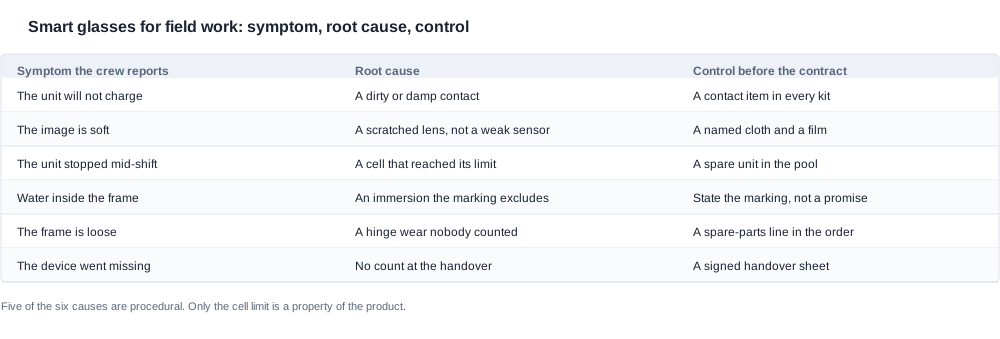
Smart glasses for field work are bought against a service commitment, and the maintenance position has to be sized to that commitment rather than to the device. A scratched lens is a cosmetic event inside an operational one; a unit that will not charge at the start of a shift is a crew standing idle, and the two are priced in completely different currencies. Our catalogue publishes the cell capacity, the charge time and the rated runtime for every model, and the charging interface for twenty-four of the twenty-eight, and it publishes no lens material, no coating, no ingress test report and no runtime test condition. The consequence for a buyer is specific: the cheap control in this category is the one that keeps a surface defect from becoming a service event, and it has to be written into the contract rather than left to the crew.
Smart glasses for field work: the condition that prices downtime, not a scratch
The buying task behind this article. The reader is a brand buyer, a channel buyer or a solution architect specifying devices for a crew that works on sites, in vehicles or outdoors, and who will be held to a service level rather than to a delivery date. The task is to build the maintenance and refurbishment position into the product and into the contract, and to cost the returns it prevents. The commercial risk being managed is a service cost nobody planned for: a fleet that loses units to faults which were actually routine failures, with a refurbishment bench and a spare pool sized by assumption.
What the published rows settle for a fleet buyer. The sport camera models carry the published ingress marking: the V06 publishes a 260 mAh cell, a five-to-eight-hour rated runtime, magnetic charging, an 8 MP camera and a removable inner frame, and the S7 publishes a 260 mAh cell, the same runtime, magnetic charging, a 13 MP camera and a removable inner frame. Both carry the IP54 marking. The audio side of the range publishes Bluetooth V5.3 on the K01 and the K02 and V5.4 on the rest, cell configurations of 55 mAh twice, 70 mAh twice, 90 mAh twice or a single 100 mAh cell, charge times of two hours or less, rated runtimes of roughly six to eight hours and magnetic or Type-C charging. Not published for any model: the lens material, the coating, the surface treatment, any abrasion or chemical resistance figure, an ingress test report, a per-model weight beyond the single 158 g whole-unit figure for the MT6, the field of view and the runtime test condition.
The asymmetry is the argument. A surface defect on one unit in a fleet of forty costs a wipe, a line on a log and possibly a refurbishment slot at the end of a cycle. A unit that will not start a shift costs a crew's time, a supervisor's time, a replacement unit and a log entry explaining why. The second event is two orders of magnitude more expensive, and it is the event that a maintenance routine actually prevents. A buyer who negotiates the routine as a cheap consumable line and negotiates the service level separately is optimising the wrong number, because most of the service events in this category originate as routine failures that were never serviced.
Five of the six causes in that table are procedural, and only one is a property of the product. That is the finding that changes how a fleet contract is written. A dirty or damp contact, a scratched lens mistaken for a weak sensor, an immersion the marking excludes, a hinge nobody counted and a device with no handover count are all consequences of decisions that the buyer can make before the contract starts. The only line in the table that is genuinely about the hardware is the cell reaching its limit, and that one is answered with a spare unit rather than with a wipe.
The removable inner frame is the one published feature that changes the economics of contamination. The V06 and the S7 publish a detachable inner frame, which means the part that carries the most sweat can be separated from the unit and serviced. A part that can be serviced is a part that is replaced at a fraction of the cost of the whole unit, and a buyer who has not noticed that has quietly decided to scrap whole devices. The audio side of the range publishes the same idea on the G07 and the YK12 in the form of ultra-slim and slim detachable temples.
The published rows behind a fleet shortlist are these, and the last column is where the outdoor claim has to be written.
| Model | Published cell | Rated runtime | Charging interface | Ingress marking published |
|---|---|---|---|---|
| V06 | 260 mAh | 5~8 h | Magnetic | IP54 |
| S7 | 260 mAh | 5~8 h | Magnetic | IP54 |
| YKC02 | 70 mAh x 2 | ~8 h | Magnetic | No marking published |
| D17 | 115 mAh | ~7 h | Type C | No marking published |
| ZH12 | 100 mAh | ~8 h | Type C | No marking published |

Smart glasses for field work: the condition that ties pool size to runtime
A fleet's spare pool size is arithmetic, and the arithmetic starts with the published runtime. The camera tier publishes roughly seven hours on the CY05 and the CY03, and the L1 Pro and the L2 Utral, and the MT6, six to eight hours on the KY06 and the MT5, and five to eight hours on the V06 and the V03 Pro, and the V03 and the S7. The audio tier publishes roughly eight hours on the K01, the K02 and the LC-105 pair, roughly seven hours on the D11 and the D12, and roughly six hours on the G07 and the YK12. A shift longer than the lower end of the published range cannot be covered by one unit, which means the spare pool exists before anybody has thought about a surface defect at all.
The published runtime has no test condition behind it, and that is the gap in the arithmetic. The catalogue states a rated runtime for every model in the range and states a charge time for every model — two hours or less for twenty-six of them and about one hour for the D17 and the ZH12 — but it publishes neither the signal conditions nor the start state, nor the point at which a charge is considered complete. A fleet buyer therefore cannot convert the published runtime into a guaranteed shift coverage on the catalogue alone, and the correct response is to ask the supplier for the test condition rather than to assume the most favourable reading of a range.
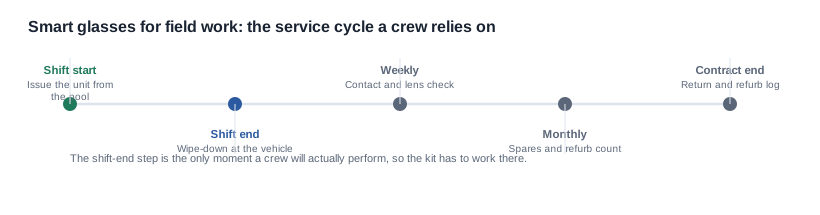
The service cycle above is the sequence a fleet actually operates. The shift-end step is the only moment a crew will perform a maintenance action, because it is the moment the unit is handed back and the crew is already at the vehicle. Everything else in the cycle is a scheduled, counted event owned by a supervisor. The kit therefore has to work outdoors, one-handed, with dirty gloves or dirty hands, and a routine longer than one motion fails at that point in the same way it fails at the end of a ride.
The charge time matters to the pool ratio in a way the runtime does not. A model that charges in about an hour can be returned to service within the same shift window; a model carrying a two-hour charge ceiling cannot, and the spare unit has to cover the gap. That is a difference in fleet size rather than in the device, and it is worth checking before the model is chosen rather than after the fleet is running short.
The consumable rate has to be derived from the roster, not guessed. For a fleet the quantity follows from the number of units, the number of wipe events per unit per shift and the number of shifts per week: units multiplied by wipes per shift multiplied by shifts, with a resupply interval that matches the crew rotation rather than the calendar month. The number of wipe events per unit is the one variable the buyer does not control, because it follows from the frequency the routine specifies, and that frequency is a decision the contract makes. A consumable line quoted as a rate with a first order sized at an assumed rate is a line that can be corrected at the first reorder without renegotiating the unit price.
The handover count is the part of the cycle nobody owns. A device that does not come back is a device that is bought again, which reads as a repeat sale in the accounts and is a loss in reality. The cycle chart shows a signed handover sheet as the control, and that sheet is a procurement artefact rather than an administrative one: it is what the spare pool count is reconciled against, and without it the loss rate is invisible until the budget stops reconciling.

Smart glasses for field work: the condition that decides refurbish, service or replace
The threshold is the whole point, and it is usually left to a judgement made at the vehicle. Somebody hands back a unit at the end of a shift, looks at a marked lens, and decides. Sometimes the decision is generous and sometimes it is not, and neither party can tell in advance whether the same unit would have been accepted yesterday. A contract that names the threshold converts a recurring negotiation into a rule, and the rule is worth more than the refurbishment price because it removes the argument from every single return.
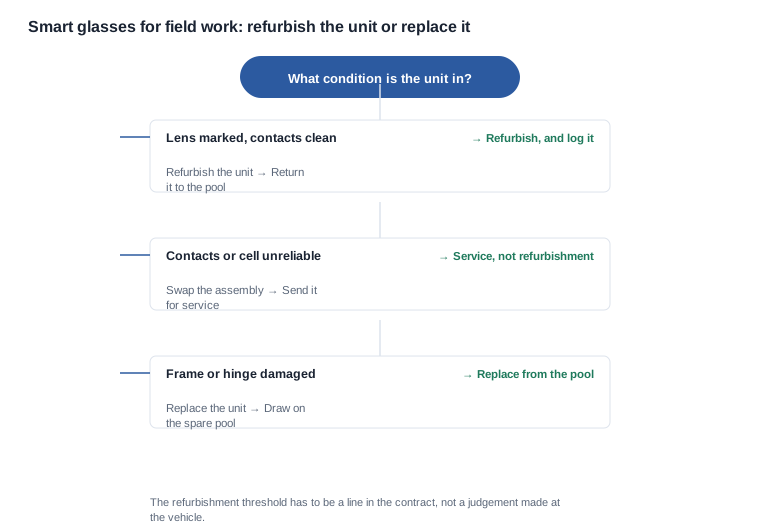
Three branches, three different cost centres. A lens-marked unit with clean contacts is a refurbishment, and it goes back into the pool with a log entry. A unit with unreliable contacts or a suspect cell is a service job, and it does not go back into the pool. A unit with a damaged frame or hinge is a replacement from the spare pool, and the spare pool has to be sized for the expected rate rather than for a hope. A threshold that does not distinguish these three will either return unrepaired units to a crew or remove serviceable ones from the pool.
The surface work is the cheap part of the branch, and that is what makes the threshold affordable. A contact service and a lens service on one unit cost a fraction of the unit price, which is why the branch that keeps a unit in the pool is the one that protects the fleet budget. What has to be priced to make this work is the labour and the turnaround on the bench, not the consumables — and the bench cost is a line the supplier should be quoting, because it is the supplier who knows how long the service takes.
Two failure classes sit outside the threshold and need their own clause. A unit lost rather than damaged is an asset-control problem, and the contract needs a replacement rate and a reporting route rather than a refurbishment price. A unit destroyed by an exposure the ingress marking excludes is a warranty question, and the contract needs the marking stated in it — because the IP54 marking published on the V06 and the S7 covers a dust protection level and protection against splashing water, and it does not cover immersion or a sustained downpour. A contract that says "waterproof" and a contract that says "IP54" produce completely different conversations with a crew that has just seen the unit in a river. The digit-by-digit reading is at IP ratings and the related failure modes are at IP rating problems and fixes.

Smart glasses for field work: the evidence file a multi-site deployment needs
A multi-site deployment is compared against a requirement list, so the evidence file is the quotation. Seven requests, each ending in a document:
- The lens material and coating statement, per model, in writing. Ask separately for the removable inner frame on the V06 and the S7, because a part that can be washed may tolerate a different agent than the lens it sits behind. The general material background is at materials and ergonomics.
- The ingress position, stated as a marking. Ask what the IP54 marking covers on the V06 and the S7, whether a test report exists behind it, and whether that report can be provided. A marking with no published report is still a legitimate catalogue attribute, but it has to be described accurately.
- The charging interface and its cleaning expectation for the exact model. Ask whether the contacts need servicing, how often, and with what item. For the magnetic models the answer is the routine that keeps the fleet out of the service queue.
- The runtime with its test condition, per model. Ask for the signal conditions, the start state and the end criterion for the published charge time. Without them the shift coverage arithmetic stays a range.
- A shift-end observation on a sample unit. Watch somebody perform the routine in the conditions it will meet — outdoors, tired, one hand occupied — and check whether the lens returns to an acceptable state and the image is visibly affected afterwards.
- The refurbishment checklist with its price per unit and its turnaround. Ask for the bench turnaround separately from the consumables, because the turnaround is what drives the spare pool size.
- The designation table, the certificate register and the battery transport file for the shipped configuration. The catalogue's export page is images rather than text, so the catalogue publishes no certification wording on it and no per-model certification row; its document text carries no CE, FCC or RoHS marking either, so certificate numbers have to be supplied and checked in the issuing body's public register, at certification checklist. The transit file is at battery transport.

The document set a fleet order should carry. The lens material and coating statement per model, the prohibited-agents list, the kit contents list per configuration, the maintenance instruction artwork, the storage instruction, the return condition standard, the refurbishment checklist with its price and turnaround, the spare pool ratio and the handover sheet, the model designation table, the certificate register and the agreed incoming inspection criteria. Clause language appears at contract terms, and the commercial structure of a first order appears at pricing.
Smart glasses for field work: the terms that decide a fleet renewal
A fleet is renewed on the service record, not on the unit price. The renewal conversation is about how many units came back, in what condition, how long the bench took and what the fleet cost per month. None of those figures exists unless the contract creates them, which is why the maintenance and refurbishment lines have to be written before the first delivery rather than reconstructed afterwards.
The terms that move inside the order. The kit contents and their per-unit cost, and specifically the quantity per device and the resupply interval. Whether a protective film ships and whether it is factory-applied, because a fleet that loses units to surface damage is losing them from a pool it has already sized. Whether the supplier will train the buyer's refurbishment partner on the checklist instead of leaving the partner to interpret it. Whether the supplier will quote the bench turnaround and the spare pool ratio rather than the refurbishment price alone. Whether the handover sheet is produced by the supplier's asset scheme or by the buyer's own. Minimum order quantity tiers. Splitting a first run into two deliveries against a staged payment, which suits a crew that rolls out by site.
The terms that do not move inside the order. The lens material and the coating, and therefore what the kit can safely contain. The ingress architecture, and therefore the rating the product can carry. The cell configuration, and therefore the runtime ceiling and the charge time. The certification cost and lead time. Tooling, amortised across the first order and quoted as a separate line rather than folded into the unit price.
The scenario worked below is an illustration, not as a client project. Assume a utilities contractor running a six-person crew across three sites on a twelve-hour shift, buying a fleet of twelve sport camera models with the removable inner frame. The first decision is the spare pool, and it comes from the published runtime: the five-to-eight-hour range on the V06 against a twelve-hour shift means one unit cannot cover a shift, so the pool has to cover the gap, and because the V06 charges magnetically with a charge time of two hours or less, the gap is a bench interval rather than an overnight one. The second decision is the ingress wording, which is written into the contract as the IP54 marking with its two digits named, so that a crew member who submerges the unit is told what the marking covers. The third decision is the refurbishment threshold, with the three branches written into the order, a bench turnaround quoted by the supplier and a spare pool ratio set from the expected replacement rate. The fourth is the handover sheet, which is a signed line per unit per shift and the document the pool count reconciles against. The outcome is a fleet whose cost per month can be computed, a service event that is a rule rather than an argument, and a consumable line that is small enough to be irrelevant to the budget and large enough to prevent the argument from starting.
Our position and the boundary of it. We publish the sport family's resolution tiers, charge times, rated runtimes, cell capacities, charging interfaces, structural features and colour availability exactly as the catalogue states them, and we publish the absence of lens material, coating specification, abrasion and chemical resistance data, an ingress test report, a per-model weight beyond the single 158 g whole-unit figure for the MT6 and a runtime test condition with the same prominence. We will not publish a maintenance recommendation for a lens whose material and coating we have not been given, and we will not state that any product in our range is tested to IP54.
What to send us next. Send the environments, the shift length, the fleet size, the number of sites, the channel and the markets, and we will return which published rows apply, what the spare pool ratio implies from the published runtime, what the kit should contain for each configuration, and which questions have to be settled before the order. The product family is at sport smart glasses, the lens-side treatment is at cleaning lenses for field work, and the scenario entry point is smart glasses for field work.
Related reading
- The opening point of the scenario — smart glasses for field work
- The family behind this model — sport smart glasses
- The ingress standard — IP ratings
- The lens-side treatment — cleaning lenses for field work
Tell us the environments and the shift length, and we will say what the kit should contain.


