

Ingress problems usually start from the same place: a buyer who believes the product is waterproof, and a customer who finds out that it is not. IP rating smart glasses problems and fixes is a list of five, and for each one the fix is in the copy, in the interface treatment or in the handling instructions — not in the product, because the product is behaving exactly as its marking says it should.
Our catalogue marks the V06 and the S7 IP54 and publishes no third-party test report number behind that marking. An IP54 marking is a declared rating, and the gap between "declared" and "tested" is the subject of the verification articles in this set rather than of this one. What this article is about is what happens downstream of that gap: the five field problems that a splash-rated wearable generates in a channel where customers wear it outdoors, and the specific action that removes each one.
The commercial framing matters here, because these five problems have a particular property: four of the five fixes are documents. Documents are cheap to specify before launch and expensive to introduce afterwards, which means the entire cost of this category is decided by when you act rather than by what you do.
IP rating problems: five faults, rarely the product
The short answer, and where the cost actually lands
Under IEC 60529 the first position is solid foreign object protection and the second is water. IP54 means a solids position of 5 — protection against the ingress of dust, with limited ingress permitted — and a water position of 4, which is protection against splashing water from any direction. It does not cover immersion, it does not cover water jets, and it is not a lifetime guarantee.
Every one of the five problems below follows from a gap between that definition and something a customer or a buyer assumed, and the assumption almost never comes from the factory. It comes from the listing, the packaging, or the copy that a marketing team wrote on a Friday. That is good news commercially, because it means the fixes are owned by the buyer, and a buyer who fixes them before launch does not have to ask the factory for anything at all.
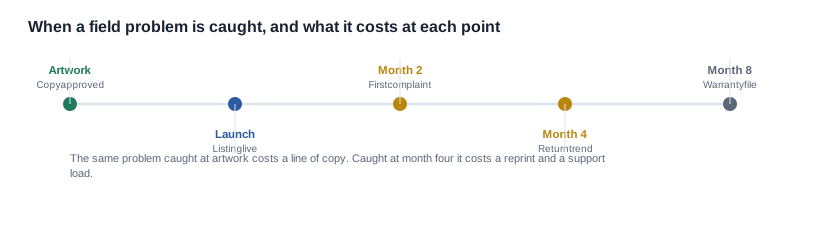
The cost lands in four places, and they are worth ranking. The most expensive is the return, because it is a unit, a reverse logistics movement, a refund and a restocking activity, multiplied by every affected customer. The second is the support contact, which is cheaper per incident but arrives at a scale that makes it the first thing a support team notices. The third is the copy correction, which touches the packaging, the documentation, the listing and the support script simultaneously. The fourth is the warranty dispute, which is the most expensive per case and the slowest, because it involves an argument about what the marking meant.
The buyer handling a complaint trend
The buyer dealing with these problems is usually handling a complaint trend, a retailer question or an open warranty file, and is holding the published marking, the instructions and the customer service script. What they will not be holding is the customer's mental model, and that mental model is the variable that actually drives the returns.
The pattern is consistent enough to name as a cycle. The customer bought on a promise the copy made. The copy made it because nobody wrote the exclusions down. The product then performed correctly against its marking. The customer is now returning a product that is working as designed, and the buyer is absorbing a cost that was created by a sentence.
The four outcomes the buyer is trying to avoid
A copy that says waterproof. A product described as waterproof and a product marked IP54 are different claims, and the second one is bounded. A buyer in a coastal market, a sport brand or a channel selling to cyclists will be asked about heavy rain, and the correct answer is that the marking does not cover it.
Corrosion in the charging interface. A frame is a closed shell with one deliberate opening, and that opening is the charging interface. That is where water goes, and it is where the corrosion starts — after the water, not before it.
Damage from powering on a wet device. This is a handling issue with a documented fix, and it is the one that most often appears in a warranty file as an unexplained failure that nobody can argue about.
A warranty argument that could have been settled by the instructions. Record the incident, the condition and the timeline, and let the marking settle the question rather than the customer's expectation.

How an ingress complaint is actually generated
The four stages between a marking and a return
A complaint about water ingress in a splash-rated product is not a random event. It has four stages, and each one is a decision somebody made.
The first stage is the requirement. The product was specified with a splash rating rather than a higher one, which is usually correct — the channel did not need more. If the requirement was right, there is no defect and there will not be a recall. The second stage is the claim, where the code was converted into a sentence, and where the sentence may have widened. The third stage is the customer, who read the sentence, formed an expectation, and acted on it in a way that exceeded the marking — a wash under a tap, a downpour, a swim. The fourth stage is the return, which is where the buyer discovers the sequence and can only reconstruct it from the incident record.
Most programmes only ever look at the fourth stage, which is why the same complaint regenerates. Looking at stage two is where the fix is cheapest, because stage two is a sentence in a document the buyer controls.
The three questions that settle a wet-unit incident
Three questions settle almost every wet-unit incident, and they need to be written into the support script so that the answers are recorded consistently.
The first is what the customer did with the unit before it failed. Powered on while wet, charged while wet, washed under a tap, or submerged — these are four different incidents with four different causes, and they are recorded in the same field of most support forms. The second is what the water was. Salt water, chlorine, fresh water and a sweetened drink are four different exposures with four different consequences, and a sweetened drink is a chemistry problem rather than an ingress problem. The third is how the unit was stored before it arrived at the service bench, because a unit that has been sitting wet in a bag for a week presents differently from one that arrived immediately.
If the support script captures those three answers on the first contact, the incident record settles the warranty question without escalation. If it does not, the warranty question escalates by default, because the buyer has nothing else to decide it on.
Where the interface becomes the failure point
The charging interface is the designed opening in the enclosure, and it is the point of failure in every wet-unit incident. A Type-C port on some configurations and a magnetic contact on others are both paths into the interior, and corrosion starts there.
Two things have to be true for that to be manageable. The first is that the protection method is known and documented — how the interface is sealed, whether the seal is replaceable, and whether it can be inspected. The second is that the customer is told what to do with it, which is a care instruction rather than a hardware change. We publish no interface protection method and no seal service life for our range, and we will not guess at either, so the question belongs in the qualification conversation with the supplier rather than in a product page.
The support-readiness rows a supplier has to supply before you order
The request list, and what each row is worth
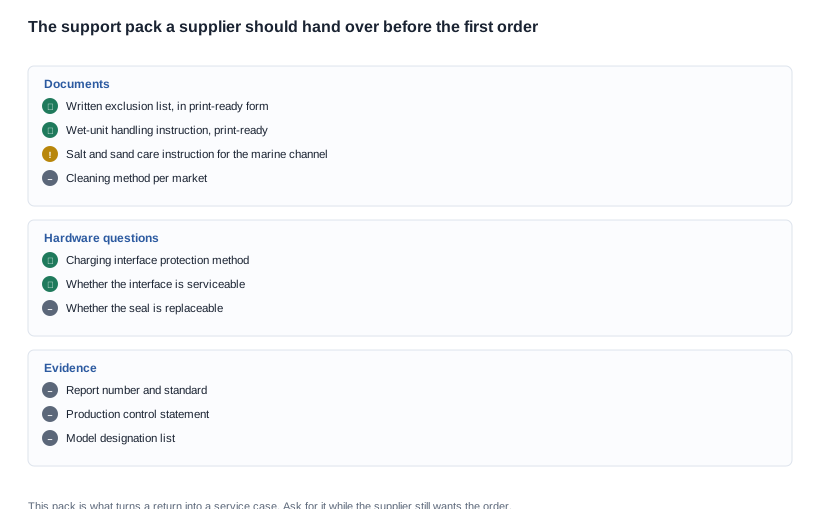
The table below is the support-readiness request. The right-hand column separates a supplier who has an answer from a supplier who has a phrase, and each row has a commercial value that is worth naming.
| What to ask the supplier for | The pass line | What a soft answer sounds like |
|---|---|---|
| The exclusion list, in print-ready form | Immersion, jets, salt spray, ageing and temperature extremes stated | It handles water well |
| The wet-unit handling instruction | A written procedure: do not power on, dry fully before charging | Not offered |
| The charging interface protection method | Named, with how it is maintained | Sealed design |
| The care and cleaning instruction | A written instruction, per market | Not offered |
| The service procedure for a wet unit | Whether it is serviceable and what the service checks | No repair |
| The seal material and service life | The material, whether it is replaceable, and the life | High quality seals |
| The report number | A number checkable later by a third party | A PDF with no number |
| The model designation | A published designation for the exact configuration | A series name only |
The criterion for accepting any of these rows is that it arrives in a form you can print. A care instruction that exists only as a paragraph in a quotation email will not survive the artwork deadline, and a wet-unit handling instruction that only exists as a concept will not be in the box.
The thresholds that decide whether a problem is a return or a repair
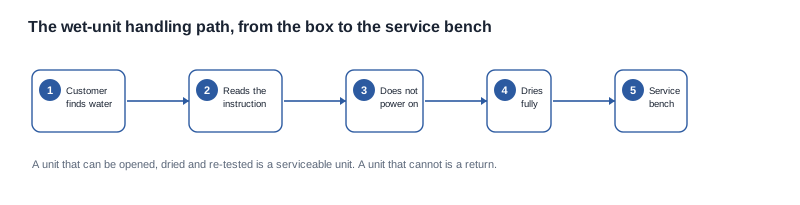
The most consequential threshold in this category is the serviceability threshold, because it determines whether a wet unit is a repair cost or a refund cost. A unit that can be opened, dried, re-sealed and tested is a serviceable unit, and the repair cost is a fraction of the replacement cost plus the reverse logistics. A unit that cannot be opened is a return, and the return rate is a cost line that compounds with volume.
The second threshold is the saltwater threshold. Salt water is more conductive than fresh water, more corrosive, and it dries to a residue that keeps working after the water has gone. A care instruction that covers "do not charge until dry" without covering salt is incomplete, and the marine channel is where that incompleteness shows up.
The third threshold is the temperature threshold, and it is the one most often forgotten. A unit that has been sitting on a hot car seat has an interior that is well above the temperature at which it was tested, and the seal is under a different stress condition than the laboratory applied. If your channel includes hot vehicles — which outdoor and delivery channels both do — the care instruction should say something about not leaving the product in a hot vehicle, and the question of whether the product is rated for that condition belongs in the supplier qualification.
What to ask, and in what order
The sequence is worth following because the first question can disqualify the rest. Ask first whether the product is serviceable when it arrives wet, because a supplier who will not open a unit cannot give you a care instruction that matches their own process. Then ask for the print-ready care instruction and the print-ready wet-unit instruction, and check that the two agree. Then ask for the interface protection method and the seal service life.
A complete answer to that sequence tells you what your support team will be doing for the next three years, and it is available before the first order if you ask for it before the first order.

The wet-unit path, from the box to the service bench
The instruction, and why it belongs in three documents
The wet-unit handling instruction is short: do not power on a wet unit, dry it fully before charging. It is also, in our view, the single most effective thing a brand can do about a wet-unit warranty file, and it costs one paragraph.
It has to appear in three places, and the reason is that the three audiences arrive at different points. The quick start guide is read by the customer who has just opened the box and may not have read the listing carefully. The care instruction is read by the customer who has already had an incident, and it is where the full procedure belongs. The customer service script is read by the agent who is handling the return, and it is where the instruction has to exist as a decision rather than as advice, because the agent needs to know whether to accept the unit, what to ask the customer, and whether the unit can be dried and returned.
When the instruction exists only in the quick start guide, the agent has nothing to hold, and the default becomes a refund. When it exists in all three, the agent has a procedure and the customer has a reason to dry the unit before sending it back.
The incident record, and why the timeline is the field that matters
The second half of the fix is recording the incident with its condition and its timeline, and the timeline is the field that carries the argument. A unit that was left on a wet car seat for six hours in July and failed a week later is a different incident from a unit that was dropped into a sink and failed immediately, and only the first can be attributed to the marking's boundary.
The criteria for a useful record are small: the exposure, the duration, what the customer did next, the condition on arrival, and the service outcome. Five fields, and they can be added to an existing support form without changing the workflow.
The four cross-document checks before the artwork is approved
The last verification step is a cross-check, and it is cheap. The same exclusion sentence should appear, in the same words, on the product page, on the packaging artwork, in the documentation and in the listing. Where they differ, the artwork is usually the outlier, because the packaging was approved first and reused longest.
The four checks are worth running as a single afternoon before any artwork sign-off, and they are the check that catches the copy correction before it becomes a reprint. Comparing the wording on the packaging proof against the wording on the live listing, comparing both against the wording in the quick start guide, and comparing all three against the wording in the support script.

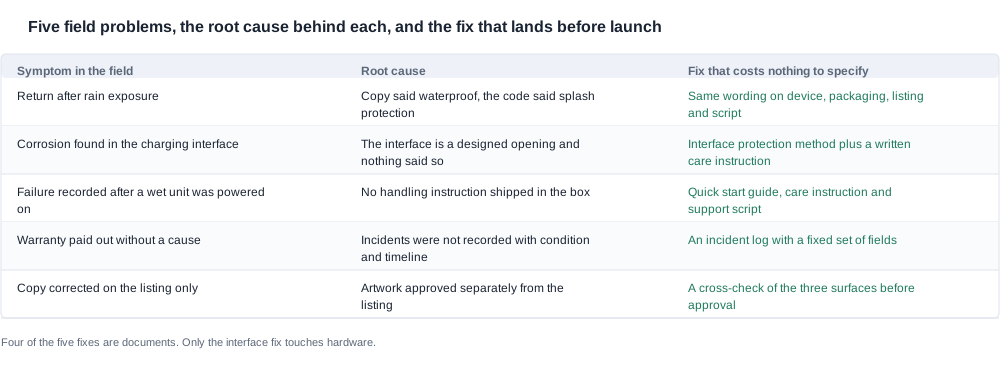
Five programmes that lost money in the field
The customer returns the product after rain and the supplier says the rating was misread. The symptom is a dispute about the meaning of a code, which is a dispute nobody can win, because the code has one meaning and the customer read another. The root cause is that the copy said waterproof. The prevention is to fix the copy in the same words everywhere and to add the exclusions.
A unit is returned with corrosion in the charging contacts and the cause is never established. The symptom is a returns cluster with no explanation and therefore no remedy. The root cause is that the interface is a designed opening and nobody wrote down what happens to it. The prevention is the care instruction, the service procedure, and a physical look at the interface on every returned unit so the pattern becomes visible.
A customer powers on a wet unit and the failure is recorded as a manufacturing defect. The symptom is a warranty file with an unexplained failure that is then counted against the supplier's defect rate. The root cause is that the handling instruction was not in the box. The prevention is to put it in the quick start guide, in the care instruction and in the support script, and to log the incident against the handling instruction so the pattern is visible in the data.
A warranty claim is settled by paying out because nobody kept the evidence. The symptom is a rising payout rate with no trend analysis behind it. The root cause is that the incident was not recorded with its condition and timeline. The prevention is to record every wet-unit incident on the day it arrives, with the five fields above.
The copy is corrected on the listing but not on the packaging. The symptom is a channel that has two different products with the same name and the same colour. The root cause is that the artwork was approved separately from the listing. The prevention is the four cross-document checks, before any of the four surfaces is approved rather than after.
What we can supply, and what only your own testing can establish
The commercial terms that apply to a support-readiness programme
The commercial negotiation for this category is mostly about documentation, and the term worth pulling is the retention. A deposit, a balance on inspection before shipment, and a retention held against the documentation package protect the buyer on the failure that costs most, which is a product that arrives with a marking nobody can evidence — and the same failure generates the field problems described above, because nobody can tell the customer which behaviour was expected.
The per-variant cost of a documentation-only change is usually negotiable, since no hardware is touched, and in this category the documentation changes are exactly the ones that pay for themselves. The number of units per variant is negotiable, and more so on a repeat order. Delivery splitting against a documentation-review milestone is often granted more easily than a price concession.
What cannot be negotiated is the certification cost and the certification time, which are a per-configuration cost and a laboratory queue respectively. The tooling charge is a one-off normally spread across the first order, and the two negotiation points worth settling are the volume it is spread over, plus where the tooling and the sealing tooling would be left if the programme were stopped. And the seal and the interface are not negotiable either: a supplier who will not change the seal material, the port design or the charging contacts is telling you that the ingress performance is fixed, and with it the failure mode.
A worked scenario: a returns cluster traced to one sentence
This is a hypothetical case rather than a client project, and it is here to show how the order of the fixes changes the outcome.
Assume a channel buyer who has taken on a sport glasses line and who discovers, in the first month, that returns are clustering around a single description: the customer says the product is not waterproof. The buyer's instinct is to investigate the product. The more useful instinct is to read the listing.
The listing says, next to a code that is presumably IP54, the word "waterproof". That is the whole of the problem, and it is a sentence that a marketing agency wrote from a catalogue line. The root cause is identified in ten minutes, and the question becomes whether the product has a problem, which it does not.
The second decision is the incident record. The buyer asks the support team for the last thirty returns, and finds that the team has not been capturing the exposure, the duration or the condition on arrival, because the support form has no fields for them. So the buyer adds five fields and asks the team to backfill thirty days from the ticket notes, which is tedious and takes a week. The third decision is the artwork. The packaging is still in production, so the correction goes into the next print run at a plate charge rather than as a full reprint, and the decision to hold the run for one week is the difference between a plate charge and a destroyed packaging inventory.
The fourth decision is the wet-unit instruction. It goes into the quick start guide, the care instruction and the support script in one pass, and the support script now asks two additional questions that change the classification of every future incident. The fifth decision is the commercial one: the buyer asks the supplier for the print-ready exclusion list and the print-ready care instruction, and adds a retention against the documentation package to the next order.
The result is a channel whose return rate falls over the following two quarters, not because the product changed, but because the buyer established what the product was promised to do and started recording what happened when it was used as though it had been promised something else.
What our catalogue can and cannot answer
The short answer: we publish the IP54 marking exactly as our catalogue states it, and we publish alongside it that no third-party test report number supports it. We will not upgrade a marking into a claim, and we will not describe a splash-protected product as waterproof, because the difference between those two words is the whole of this article.
We will also say plainly that most of these five problems are fixed with a paragraph. The exclusion list, the wet-unit handling instruction and the saltwater care instruction are documents, and they cost a fraction of what a return costs. A buyer who is about to publish a splash rating without them is buying a warranty file.
We publish no interface protection method, no seal material, no seal service life and no service procedure, because the company has not confirmed them to us, and a buyer who needs them should get them from the supplier as part of the qualification rather than infer them from a product page. The models that carry the marking are the V06 and the S7, and no charging case in our range carries an ingress rating of its own.
Four requests to make before the first order in a support-led programme
Ask for the exclusion list in print-ready form, and for the wet-unit handling instruction in print-ready form, and check that the two agree. Ask whether a unit that arrives wet can be opened, dried and re-tested, because that answer decides whether your wet-unit incidents are repairs or refunds.
Add the five incident fields to your support form, and backfill the last thirty returns while the context is still fresh. And check the four surfaces — page, packaging, documentation, script — against each other before any of them is approved.
What we can do is give you the exclusion list in the wording we would accept, and tell you which of the five problems each of your channels is most likely to generate. The background is under IP ratings and durability, the boundaries are in IP rating key specifications, the verification is in how to measure and verify an IP rating, the pre-order checks are in how to test before ordering, and the range is sport smart glasses.
Where the fixes come from
Tell us which channels you sell into and we will tell you which of the five problems each one will generate.


