

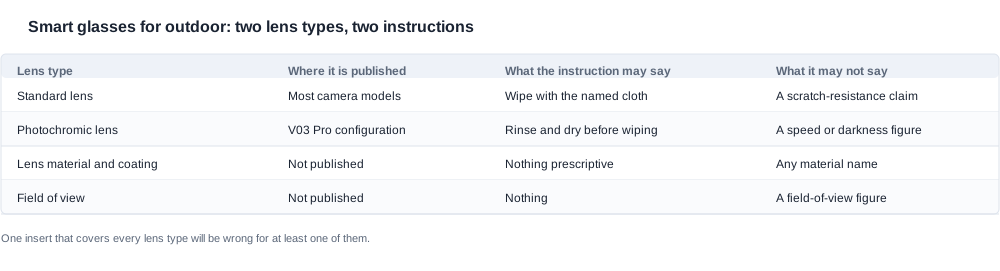
Smart glasses for outdoor come in two kinds of purchase, and they are not the same product: a day session that is serviced the same evening, and a multi-day trip that is serviced three days late, in a hurry, with whatever is to hand. The decisive fact for a buyer is neither of those. It is that the range publishes two different lens surfaces — a standard lens and a photochromic lens configuration on the V03 Pro — and that one insert cannot be correct for both. The lens material, the coating and the surface treatment are not published for any model, so the routine for an outdoor line has to be split by lens type, sized by trip length, and written from a specification the supplier provides in writing.
Smart glasses for outdoor: one insert cannot cover two lens types
The buying task behind this article. The reader is an in-house buyer, a channel buyer or a product manager specifying an outdoor line for a consumer channel or a professional deployment. The task is to build the maintenance and refurbishment position into the product and to cost the returns it prevents. The commercial risk being managed is a channel whose most common complaint is a scratch or a haze claim, and in outdoor specifically a claim that arrives at the end of a trip, when the customer is no longer in the market and will not buy again.
What the published rows settle for an outdoor buyer. The sport family publishes three models. The YKC02 carries two 70 mAh cells, a rated runtime of roughly eight hours, magnetic charging and a charge time of two hours or less. The D17 carries a single 115 mAh cell, a rated runtime of roughly seven hours, a Type-C interface and a charge time of about one hour. The ZH12 carries a single 100 mAh cell, a rated runtime of roughly eight hours, a Type-C interface and the same roughly one-hour charge time. The sport camera models publish a 260 mAh cell, a five-to-eight-hour runtime and magnetic charging, with an 8 MP camera on the V06 and a 13 MP camera on the S7, both with a removable inner frame and both carrying the IP54 marking. The catalogue also carries an AI electrochromic smart glasses entry with no model designation, published at 100 mAh, roughly seven hours, magnetic charging and Bluetooth V5.4.
The published rows behind that decision are these, and the last column is where an outdoor kit has to be split.
| Model | Published cell | Rated runtime | Charge time | Kit consequence |
|---|---|---|---|---|
| YKC02 | 70 mAh x 2 | ~8 h | 2 h or less | Magnetic, so a dock or a case travels |
| D17 | 115 mAh | ~7 h | About 1 h | Type C, so one cable is enough |
| ZH12 | 100 mAh | ~8 h | About 1 h | Type C, so one cable is enough |
| V06 | 260 mAh | 5~8 h | 2 h or less | Removable inner frame, so contamination is serviceable |
| S7 | 260 mAh | 5~8 h | 2 h or less | Removable inner frame, so contamination is serviceable |
The lens type is the first decision, because it decides what the insert may say. The V03 Pro is published with a photochromic lens configuration, and a photochromic surface is a different surface with different constraints from a standard lens. The photochromic technology and its characteristics are at photochromic lens and the general material background is at materials and ergonomics. An insert that tells a customer to wipe a standard lens with a dry cloth and to wipe a photochromic lens the same way is wrong for at least one of them, and the person who finds out is the customer.
The table above is the split, and it is deliberately conservative. Where a row says the material is not published, the instruction that follows from it is "nothing prescriptive" rather than a plausible-sounding step. That is the honest position: an instruction for a surface nobody has characterised is a liability, and in outdoor the liability is triggered by an unfamiliar situation, which is the defining feature of the scenario.
Two claims have to stay out of the listing. The first is a scratch-resistance claim, which needs a coating figure that is not published for any model. The second is a photochromic performance claim — a speed or a darkness figure — because no such figure appears in the catalogue for the V03 Pro configuration or for the electrochromic entry. A listing that says the lens "adapts instantly" states something our documentation does not support, and the customer tests it on a cold morning.
The camera resolution tier is the third, and it is a claim an outdoor listing makes by accident. Eight of the eleven camera models publish an 8 MP camera — the V03 and the KY06, the CY03 and the CY05, and the MT5 and the V06, and the V03 Pro and the MT6 — and three publish a 13 MP camera: the S7 and the L2 Utral, and the L1 Pro. An outdoor listing that carries "13 MP" because the model was copied from a sibling describes a product the buyer did not order.

Smart glasses for outdoor: the condition that separates trip from session agents
A session and a trip are different purchases with different kit sizes and different agents. A day session is serviced at the end of it, with the kit to hand and the car boot open. A trip is serviced three days late, in a hurry, in a hotel room, and the agent that does the damage is the one the traveller already carries: sunscreen, insect repellent, salt spray, and the dust of a vehicle or a trail. The prohibition list has to name them, and the kit has to be sized for the trip rather than for the session.
Sunscreen is oil-based and it sits. Water alone will not carry it off, and rubbing a dry cloth across an oily lens is how a particle ends up ground into a coating. The safe sequence given an unpublished surface is restrictive: rinse with clean water first, then wipe with the supplied cloth, never a solvent and never a spray. Whether a stronger sequence is defensible depends on the coating specification, and that specification has to arrive in writing before the insert is written.
Salt spray and grit invert the usual order. On a dusty lens the reflex is a dry buff, and a dry buff with grit on the surface is the fastest route to a scratch. The correct sequence is to lift the loose material first and to dampen the cloth, never to rub dry. That is one sentence on the insert, and it is the sentence that prevents the most expensive claim in this category.
The insect repellent is the agent that gets forgotten. A traveller reaches for it without thinking, often with sand or dust still on their hands, and applies it to a surface they have just handled. It is not a laboratory hazard; it is a substance in the pocket, and a prohibition list that does not name it does not interrupt the habit.
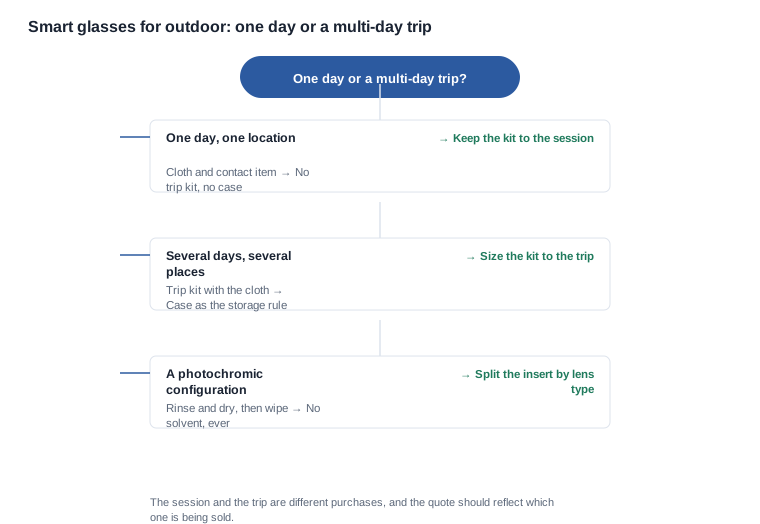
The kit size follows the trip, and the quote should show the trip. The decision tree above separates a one-day session from a multi-day trip and from a photochromic configuration, because each of the three produces a different bill of materials. A session carries a cloth and a contact item. A trip carries a kit sized for the number of days, plus a storage rule. A photochromic configuration carries an instruction that starts with a rinse. Quoting one kit for all three is how a channel ends up with an insert that is wrong for the product it ships with.
The charge time is the outdoor number that matters, and it differs by model. Twenty-six models in the range publish a charge time of two hours or less, and the D17 and the ZH12 publish about one hour. An hour is short enough to fit a lunch stop in a vehicle, which is exactly the window an outdoor customer has, and that is a real difference in how a trip is planned rather than a line in a datasheet. The same two models charge over Type-C, so a trip kit built around them needs one cable, and the catalogue publishes no charging-case row for either model.

Smart glasses for outdoor: the storage position that prevents most damage
A lens is damaged as often by what it rests against as by what is used on it. An outdoor product is put down on a car roof, a picnic table, a trail wall, a tent floor and a gate, dozens of times a trip. A lens placed face-down on any of those is abraded by contact alone, with no agent involved and no mistake by the customer. The answer is a storage position rather than another instruction, and it is a packaging decision: the case makes the rule enforceable, and the absence of a case makes it a hope.

The sequence above is fixed because the surface specification is not published. Only the safest steps are given, and the sequence is written to survive a tired traveller with dirty hands at the end of a day. The one step that has no substitute is the first one — lifting loose grit without rubbing — because it is the step that prevents the scratch rather than the one that removes it.
The case is the mechanism, and its published capacities differ by configuration. The camera range publishes 1400 mAh on the CY05 and the CY03, and the L1 Pro, 900 mAh or 1400 mAh as a configuration choice on the L2 Utral, and 1200 mAh on the MT6's foldable case. The KY06 and the MT5 are shipped with a case whose capacity is not published. The catalogue publishes no charging-case row at all for the V06 and the V03 Pro, and the V03 or the S7. An outdoor kit that assumes a case is a kit that is wrong for part of the range, and the case is also a second lithium cell to declare, with the requirement at battery transport.
The ingress position belongs in the same document as the routine. The IP54 marking is published on the V06 and the S7 and covers a dust protection level and protection against splashing water; it does not cover immersion and it does not cover a sustained downpour, and no third-party test report behind the marking is published. A listing that says "waterproof" on the strength of that marking invites exactly the rain test that produces the complaint. The digit-by-digit reading is at IP ratings, and the professional-deployment comparison is at cleaning smart glasses for field work.
Smart glasses for outdoor: the trip kit and the evidence to request
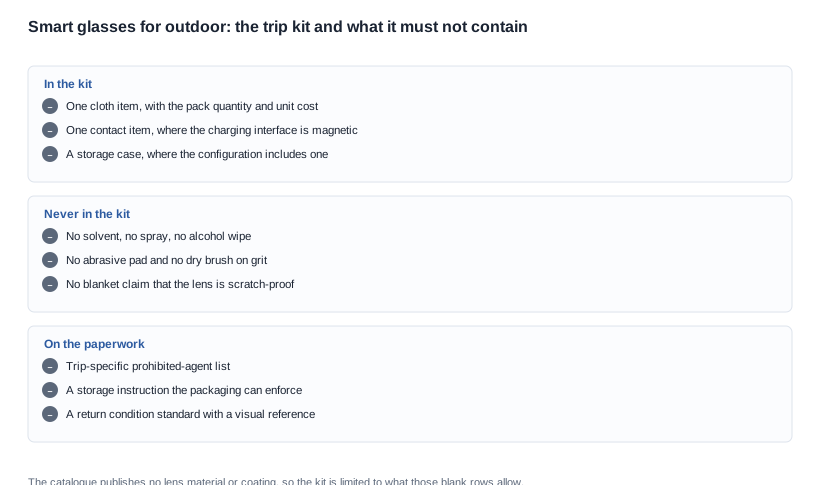
The kit is deliberately short, and the exclusions matter more than the inclusions. A single cloth item with a stated pack quantity and unit cost, one contact item where the charging interface is magnetic, and a storage case where the configuration includes one. On the other side, no solvent, no spray, no alcohol wipe, no abrasive pad and no dry brush, and no blanket claim that the lens is scratch-proof. The last exclusion is the one that costs a competitor nothing and a brand a review.
Six requests close the file for an outdoor line.
- The lens material and coating statement, per model, in writing. Ask for it per lens type rather than per family, because the photochromic configuration on the V03 Pro and the electrochromic entry are different surfaces from the standard lens.
- A test of the printed instruction in the conditions it will meet, by somebody who has not seen the product, checking both that the lens returns to an acceptable state and that the image is visibly affected afterwards.
- The storage position confirmed against the packaging. A rule the packaging cannot enforce is a rule that is not followed, and this is the cheapest control in the category.
- The factory-applied film question. Ask whether a film is available, at what per-unit cost, and whether it is applied before the unit reaches the buyer.
- The return condition standard with a visual reference, and the refurbishment checklist with its price per unit. The refurbishment cost is the number that is normally missing, and its absence is why an outdoor programme carries it in the margin and discovers it in the worst month.
- The designation table, the certificate register and the battery transport file for the shipped configuration. The catalogue's export page is an image page, so the only thing a buyer can take from it is the patent-certificate images themselves; the catalogue publishes no per-model certification row, and its document text carries no CE, FCC or RoHS marking, so certificate numbers have to be supplied and checked in the issuing body's public register, at certification checklist.
The document set an outdoor order should carry. The lens material and coating statement per model and per lens type, the trip-specific prohibited-agent list, the kit contents list with the per-unit consumable cost, the maintenance instruction artwork, the storage instruction, the return condition standard, the refurbishment checklist and its price, the model designation table, the certificate register and the agreed incoming inspection criteria. Look for the clause language at contract terms and for the commercial structure of a first order at pricing.
Smart glasses for outdoor: how the trip length changes the quote
The trip length is a commercial variable, not a packaging detail. A session product and a trip product differ in the consumable rate, in whether a case is included, in the length of the insert, in the number of languages the insert has to be printed in, and in the volume at which the order is placed. A quote that carries one configuration for both is a quote that will have to be reopened after the first shipment, when the returns from trip customers turn out not to match the returns from session customers.
An outdoor programme has a seasonal shape that changes when the returns arrive. The demand for this category concentrates into a short window, and the claims it generates arrive weeks later, after the season. That gap is a cash-flow question rather than a product question, and the buyer who has sized the reserve against the wrong month discovers it in the quiet period. Two things follow. The reserve has to be funded against the peak rather than against the average, and the first returns set has to be read and coded during the season rather than filed until the following one, because the pattern of trip claims only becomes visible while the season is still running. The measurement is the same one a buyer in any other channel would make — of the units that came back, how many were returned for a scratch or a haze, and how many of those had the storage position and the maintenance item in place — but the calendar on which it has to be read is the outdoor calendar.
The reseller's exposure is different from the brand's. A channel partner holding inventory across the seasonal boundary is carrying the risk on the units that have not sold, and the refurbishment cost of those units is the partner's problem until the season turns. That is an argument for a terms structure that separates the inventory from the refurbishment risk, and it is worth raising in the first negotiation rather than at the renewal.
The terms that move inside the order. The kit contents and their per-unit cost, and the quantity per device for a trip rather than for a session. Whether a film ships with the unit, and whether the factory fits it. Whether a case ships, and whether the storage rule follows from it. Whether the insert is split by lens type and whether the artwork is produced by the supplier and reviewed by them. The wording of the return condition standard. Whether the refurbishment checklist is the supplier's or the buyer's, and whether a refurbishment partner is trained on it. Minimum order quantity tiers. Colour, logo, lens tint and packaging. Splitting a first run into two deliveries against a staged payment, which suits a channel that is being built in stages.
The terms that do not move. The lens material and the coating, and therefore what the kit can safely contain. The ingress architecture, and therefore the rating the product can carry. The certification cost and lead time. Tooling, amortised across the first order and quoted as a separate line rather than folded into the unit price.
The passage below is worked through as a scenario rather than as a client project. Assume an outdoor brand listing a sport camera model with the removable inner frame and a photochromic configuration for a second market. The first decision is the lens split, because the insert is written twice and the prohibition lists differ. The second is the trip, because the trip kit carries the cloth, the contact item and the case, and the session kit carries the first two only. The third is the charge window, which the about-one-hour published charge time on the D17 and the ZH12 makes a usable lunch stop and the two-hour charge ceiling elsewhere does not, and that decides whether a case is worth its freight weight. The fourth is the film, factory-applied, because a scratch that reaches a customer at the end of a trip becomes a review on a listing that was already carrying a seasonal peak. The fifth is the documentation, covering the coating statement per lens type, the storage instruction the packaging can enforce, the return condition standard and the refurbishment price. The outcome is two configurations that each carry an insert their users can follow, and a returns reserve that was priced against the right customer.
Our position and the boundary of it. We publish the sport family's resolution tiers, charge times, charging interfaces, rated runtimes, cell capacities, structural features and colour availability exactly as the catalogue states them, and we publish the absence of lens material, coating specification, abrasion and chemical resistance data, an ingress test report, a per-model weight beyond the single 158 g whole-unit figure for the MT6 and a runtime test condition with the same prominence. We will not publish a maintenance recommendation for a lens whose material and coating we have not been given, we will not state that any product in our range is tested to IP54, and we will not publish a photochromic performance figure that the catalogue does not state.
What to send us next. Send the trip profiles, the channel, the price band, the markets and the lens types you are planning to offer, and we will return which published rows apply, how the kit should be split by lens type and by trip length, which claims the listing can support without overreaching, and which documents have to be settled before the artwork is released. The scenario entry point is outdoor.
Related reading
- The scenario entry point — outdoor
- The product family — sport smart glasses
- The ingress standard — IP ratings
- The professional comparison — cleaning smart glasses for field work
Tell us the trip profiles and the channel, and we will say what the kit and the storage position should be.


