

Bone conduction glasses technology: the category before the decibels
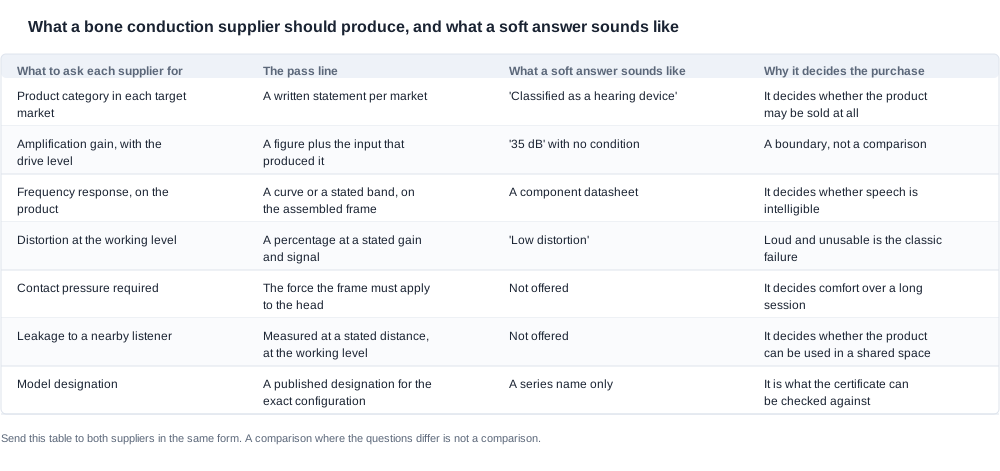
If you are comparing two bone conduction products, ignore the gain figure in decibels and compare four rows instead: frequency response, distortion at the level you would actually use, the pressure the frame must apply to deliver sound, and leakage to a nearby person. A gain figure is a statement about how much a signal is boosted and nothing else, and two products carrying identical gain figures can differ by an enormous margin in usefulness.
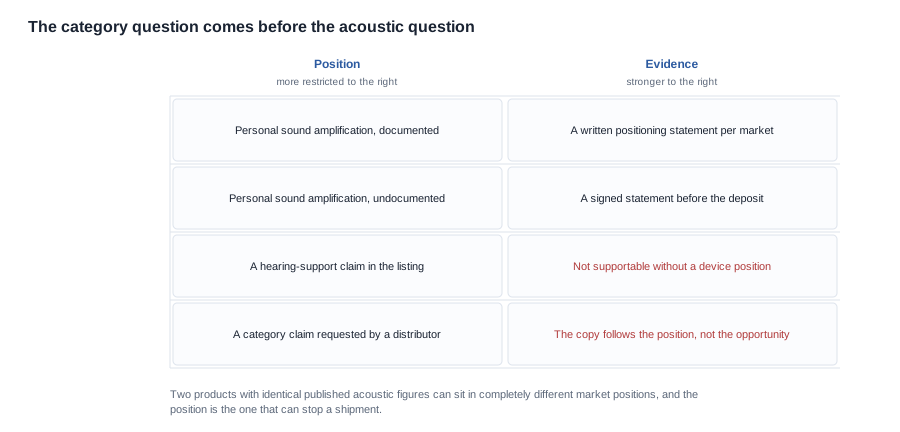
But before any of those four, there is a row that decides whether the product may be sold at all: the product category the supplier places it in, per market. In the United States, the regulation at 21 CFR 800.30 defines an over-the-counter hearing aid as an air-conduction device intended for a person aged eighteen or older. A bone conduction product is neither air-conduction nor a hearing aid, and it cannot be sold in that category. The legitimate positioning is a personal sound amplification product, a non-device category the regulation distinguishes deliberately. A product that cannot be sold in your market is not cheaper for having better rows.
So the order is: category first, then the four acoustic rows, then the measurement. Everything in this page follows that order, because a comparison that starts with the acoustic rows spends the buyer's most expensive resource — samples, protocol time, supplier relationship — on a product that may not be sellable.
The buyer with a bone conduction line to launch, and the two risks
The answer in three sentences, and why the answer is not acoustic
Bone conduction glasses technology smart glasses how to compare is a four-row acoustic comparison, gated by a category check, and the comparison is only valid if the two products are driven with the same script, at the same output level, in the same two environments. Ask the far end of the call to score intelligibility, because intelligibility is what a buyer is buying and volume is not. If the category check fails for either product, the acoustic work has no value and should not be commissioned.
What the buyer already holds, and what is missing
A buyer in this category is usually selecting a product for a channel with a specific customer: outdoor sport, an industrial site, a meeting-heavy business buyer, or a hearing-support audience. They will have two or three candidate models, a target price, a market list, and a clear sense of the regulatory position. What they will not have is an acoustic comparison, because acoustic data in this category is expensive to generate and the supplier-facing version of it is usually a single gain number.
The practical consequence is that the comparison has to be built, not collected. That means writing the test protocol before the samples arrive, running it identically on both products, and accepting the result even where it contradicts what a datasheet suggested.
The two risks the buyer is actually carrying
A product that is loud but unintelligible. A product that reproduces a voice at a high gain with heavy distortion produces a loud, muddy, hard-to-understand sound, and a comparison that only checks whether the sound is audible will select it. This is the most common way a bone conduction programme goes wrong, and it is entirely invisible in the gain figure.
A product that is unusable in the customer's actual environment. A product that works only in a quiet room is not a daily assistance product, and quiet rooms are rare in the channels this category sells into. A distributor selling to a construction crew has already decided the answer; a distributor selling to a meeting room has not, and the protocol has to reflect the channel rather than the ambition.
There is a third risk that is commercial rather than acoustic and arrives first. A distributor asks for a hearing-aid-category claim because that is the larger market and the larger shelf. The cost of that request is not the listing; it is that a category claim that cannot be defended is a product that cannot be shipped, and the discovery arrives at the customs inspection or the marketplace review rather than at the internal review where it could have been caught.
The four acoustic rows and the one regulatory row
The table above is written to be sent to both suppliers identically. A comparison where the questions differ is not a comparison.
The regulatory row, which comes first in a regulated market
The positioning affects the listing copy, the claims, the import route and, in some markets, the certification route. Two products with identical published gain figures can sit in completely different regulatory positions, and a buyer who compares them on the gain number is comparing the wrong thing entirely.
What to ask: a written statement of the product category in each target market, the basis on which the supplier places it there, and confirmation that no health claim is made. The pass line is a statement the supplier will stand behind in a contract, not a sentence in a catalogue. A supplier who answers with "classified as a hearing device" has told you the product cannot be sold in the market in question, and that answer ends the comparison on that market.
The gain figure, which is a boundary rather than a comparison
Decibels are logarithmic, so six decibels is roughly a doubling of sound pressure. A figure in the thirty to forty decibel class is the range generally used for daily assistance with ambient sound, and a figure below that will generally struggle against a noisy background. Above that, the limit is usually the physical one described below rather than the electronics.
The gain figure has exactly one real use in a comparison, and it is that: it establishes whether the product is in the class of device that can work in the target environment at all. It cannot rank two products against each other. Two suppliers quoting the same number at different input levels are quoting different products, so the figure is only usable with the drive level attached — and a supplier who gives the number without the condition has not given you a usable figure.
Our catalogue entry for this category publishes 35 dB of amplification gain, a rated runtime of about seven hours, a 200 mAh cell, Type-C charging and a charge time of two hours or less. The model designation is not published, and neither are the acoustic details behind the figure.
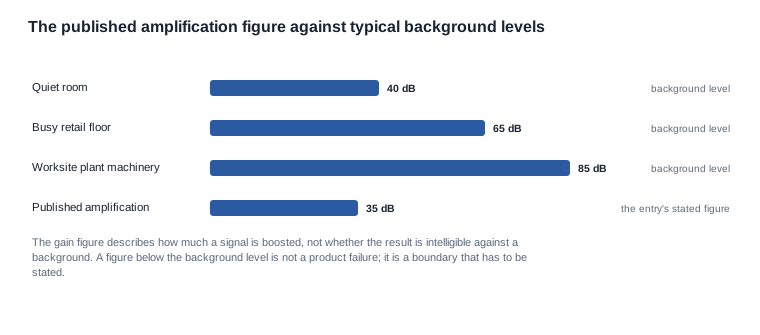
The background levels in that chart are generic references for the kind of environment a product may be used in, not a measurement of any product and not a claim about one. The point it makes is narrow: an amplification figure states how much a signal is boosted, and a boosted signal is not the same thing as a signal that carries speech cleanly against a background. That is why the far end's score, and not the gain figure, is what the comparison has to settle.
Frequency response and distortion at the working level
Frequency response is the row a gain figure stands in for. Which sounds are actually reproduced, measured on the product rather than on a component, determines whether speech is intelligible and whether music is listenable. If a supplier has a component datasheet but not a product-level curve, ask which of the two they are quoting and what it does and does not tell you: a component curve excludes the frame, the transducer seating and the fit, which are exactly the parts that differ between two finished products.
Distortion at the working level is the row that decides whether the gain figure is a benefit or a hazard. A percentage at a stated gain and a stated signal is the pass line. "Low distortion" is not, because it is unfalsifiable and it is exactly the row that determines whether a loud product is usable. A product that is loud and distorted will be returned as broken rather than as quiet, and the returns data will not point at the cause.
Contact pressure and leakage, the two rows that are not measurements of loudness
Contact pressure is not an acoustic measurement at all. A bone conduction transducer has to be held against the skull to transmit, and the frame has to press. A product that needs more pressure to deliver the same result is less comfortable over a long session, and the pressure is the reason a bone conduction frame is not simply an audio frame with a speaker added. This row also decides the commercial question of whether the frame can be styled for a customer at all, because the contact geometry constrains the temple.
Leakage decides whether the product can be used in a shared space. Whether the output is audible to a person nearby depends on the level and on the geometry of the frame against the head, and it varies by head. A privacy claim on a product page should be backed by a measurement at a stated distance. For a channel selling into offices, shared transport or a family environment, this row is a channel gate rather than a preference.
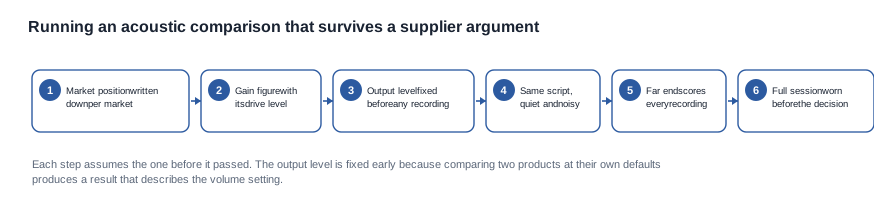
How to run a comparison that survives a supplier argument
Each step assumes the one before it passed, and each step has a completion condition that is written down rather than remembered.
- Get the gain figure with its drive level. Two suppliers quoting the same number at different input levels are quoting different products. Ask what signal produced the figure, and record the answer next to the number.
- Insist on a product-level frequency response, and treat a component curve as a soft answer. It tells you something, but it excludes the frame, the transducer seating and the fit.
- Fix the output level before any recording. Compare the two products at the same level, not at their own defaults. A louder product sounds better and is not better, and a comparison run at two different volume settings produces a result that describes the volume setting.
- Run the same script in a quiet room and in a noisy one. Same script, same distance, same presenter. The noisy condition is the one that reflects the channel, and it has to be in the protocol before the samples arrive.
- Listen for the artefacts, not only for clarity. A gated or compressed signal can be perfectly loud and completely unusable. A trained ear on the far end is the instrument here.
- Have the far end score intelligibility. A simple five-point score, repeated across two environments and two products, is a defensible comparison and one that survives a commercial dispute.
- Wear it for a full session before you decide. The contact pressure question cannot be answered in twenty minutes, and the fit that carries the transducer into effective contact is the variable that decides the result.
Two units of each candidate. A single unit cannot separate a product difference from a unit difference, and the unit difference is what a return rate is made of.
The breakdowns that turn a bone conduction programme into a return
Four failures with root causes
The product is loud and the customer still cannot follow the call. Root cause: the comparison checked audibility rather than intelligibility, and the distortion at the working level was never heard. Prevention: score intelligibility at the far end, in the real environment, and treat distortion at the working level as an acceptance criterion in the purchase order.
The comparison was won on a higher volume setting. Root cause: the two products were compared at their own defaults rather than at the same output level. Prevention: fix the level before the test and record which setting produced it, because otherwise the result is a statement about the louder product.
The product works in the demo room and not on site. Root cause: only a quiet environment was tested, and the quiet environment was the only one the buyer had access to. Prevention: build the noisy environment into the protocol before the samples arrive and require the test to be repeated in it, on the buyer's own recorded background where possible.
A listing makes a health claim the positioning does not support. Root cause: the copy was written from the feature rather than from the category. Prevention: run the copy past someone qualified for the target market before it goes live, and keep the positioning to personal sound amplification.
A fifth failure is worth adding because it is the most expensive and the most common in this category specifically. A product that is comfortable for twenty minutes and abandoned after two hours. The contact pressure row was never measured, the wearing trial was never run for a full session, and the failure appears as a low review score rather than as a return, which means it never reaches the returns analysis at all. It has to be caught in a wearing trial, and the trial has to be longer than a demonstration.
The terms that carry a defensible positioning, and what cannot be traded
The parts that can move, the parts that cannot, and the file to ask for
A bone conduction comparison is usually funded from a small budget, so the commercial terms that matter are the ones that buy evidence and pace risk. The negotiable set is:
- Minimum order quantity.
- Packaging and insert design, including the market labels and the language of the documentation pack, which is a low-cost negotiation that carries no tooling implication.
- Delivery splitting against a sample-approval milestone, which is often granted more easily than a price concession.
- Payment milestones: a deposit on order, a balance once inspection is passed, and a retention against the documents.
- The warranty period with a stated response.
- The terms of a pilot order, which in this category is the only affordable way to buy acoustic evidence.
The acoustic side of the comparison is not a commercial lever at all, and knowing which side you are standing on prevents a wasted argument. Certification cost and certification time are fixed per product family, and the elapsed time is set by the test laboratory and the review queue. A one-off cost usually amortised across the first order is what the tooling line is, so ask what volume carries it and where the tooling stands if the programme is discontinued. In this category there is a third item that is fixed: the acoustic engineering. A supplier who will not change the transducer, the frame geometry or the firmware tuning is telling you the product is fixed, and no commercial term will change that.
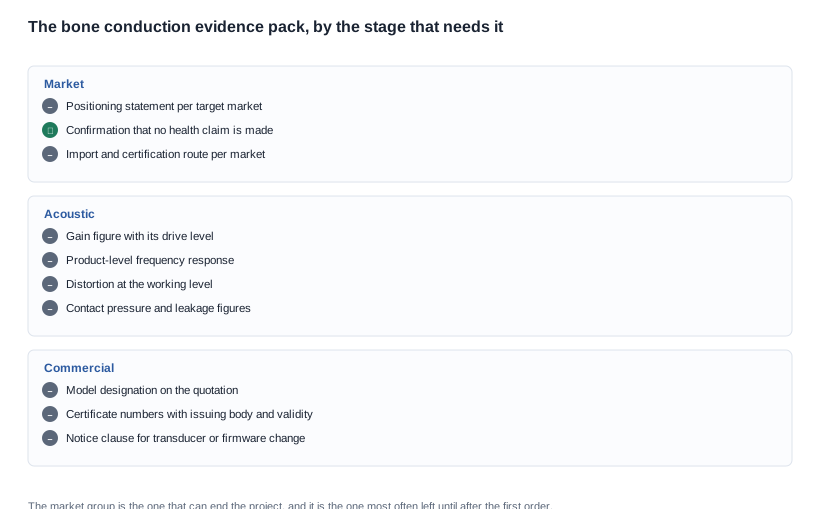
Before the deposit goes out, the file that should be on the table is specific to a bone conduction comparison: the written product-category statement for each target market and the basis for it, the gain figure with its drive level, the frequency response with the method and the date, the distortion figure at the working level with the gain and the signal stated, the contact pressure requirement, the leakage figure with its distance and level, the certificate numbers with the issuing body and the validity dates, and the model designation written on the quotation itself.
The clauses that carry a comparison into production are these: the model designation as a line item, with the certificate numbers attached; the acceptance criteria for the sample, referencing the intelligibility protocol and the two environments; a clause on the regulatory positioning per market, with the buyer holding the right to require the copy be amended; a clause requiring notice before any change of transducer, firmware or frame geometry; and a clause on who bears the cost when the sample does not meet the acceptance criteria.
A worked example: an industrial safety distributor
What follows is a constructed example, included so the comparison order is easy to follow. No customer project is being reported here.
Assume a distributor of industrial safety equipment in a European market, with an existing customer base in fabrication plants. They want to add a communication line because their current headset product is being discontinued by a manufacturer. Two bone conduction candidates are on the table, a distributor customer, and a target price band.
Step one, the category. Before any acoustic work, the distributor asks each supplier for a written statement of the product category in their market. One supplier is comfortable and provides it within a day. The other replies that the category depends on the customer and asks the distributor to decide. The second candidate is set aside for that market, and the distributor has avoided commissioning an acoustic comparison on a product they cannot sell there.
Step two, the channel. The distributor writes down the environment: a fabrication hall, machinery running, hearing protection worn over the frame, and a safety supervisor who needs to hear instructions. Two of those four conditions change the acoustics, and one of them — hearing protection over the temple — is a condition nobody would have thought to test.
Step three, the request. The same seven-row request goes to both candidates. One returns a product-level frequency response with a method and a date, a distortion figure at a stated gain, a contact pressure figure and a leakage figure with a distance. The other returns a component datasheet, a gain figure with no drive level, and a note that the remaining rows are available on request. The first answer is not better acoustics; it is better evidence, and the distributor records it as such.
Step four, the measurement. Two units of each remaining candidate. The output level is fixed before recording. The same script is run in a quiet room and against a recorded machinery background. The far end of the call scores each recording from one to five. The protocol includes the hearing-protection condition, because that is the condition the customer will actually be in.
Step five, the result and the decision. The first candidate scores higher in the quiet room and the difference narrows in the machinery background, but the contact pressure figure means the frame can be worn over hearing protection without losing the transducer contact, and the leakage figure keeps the device usable at a shared workstation. The distributor therefore selects on the contact and leakage rows rather than on the intelligibility score, and the reasoning is written down.
Step six, the commercial structure. Because the acoustic evidence is the product's core value, the distributor negotiates the documentation package into the contract and holds a retention against it. Delivery is split against a pilot order with a small site group, and the warranty is negotiated with a stated response time, which in this category is the term that protects the distributor's own customer relationship.
The result is a line the distributor can defend with data, in a market position it confirmed first, with a decision that was made on the rows nobody publishes rather than on the figure everybody quotes.
What our catalogue publishes for bone conduction, and what it does not
The working rule we apply: we publish the specification we hold and mark the rest as open, and we would rather a buyer establishes the acoustic rows by measurement than accept a gain figure as a proxy.
We publish the 35 dB gain, the 200 mAh cell, the charge time of two hours or less, the roughly seven-hour rated runtime and the Type-C interface. We publish no frequency response, no distortion figure, no leakage figure, no contact pressure figure, no microphone pickup distance, no model designation and no customisation capability for this category, and we will not estimate any of them from typical values, because the whole point of this comparison is that a typical value is a number no test in your programme produced.
We also make no health claim for any of our products, in any market, and we would advise anyone building a listing in this category to run the copy past someone qualified before it goes live. The category background is at bone conduction audio, the alternative form factor is at open-ear audio, and the acceptance side is covered in bone conduction supplier verification.
The request that opens a bone conduction comparison
Send us the two candidates, the market list, the channel and the environment, and we will say three things: which product category the comparison has to respect before any acoustic work starts, which of the four acoustic rows we can answer from our own documentation today, and which have to come from a measurement on your own units. We will also tell you if the candidates turn out to be one product in two casings, because that is more useful than presenting them as a range.


