
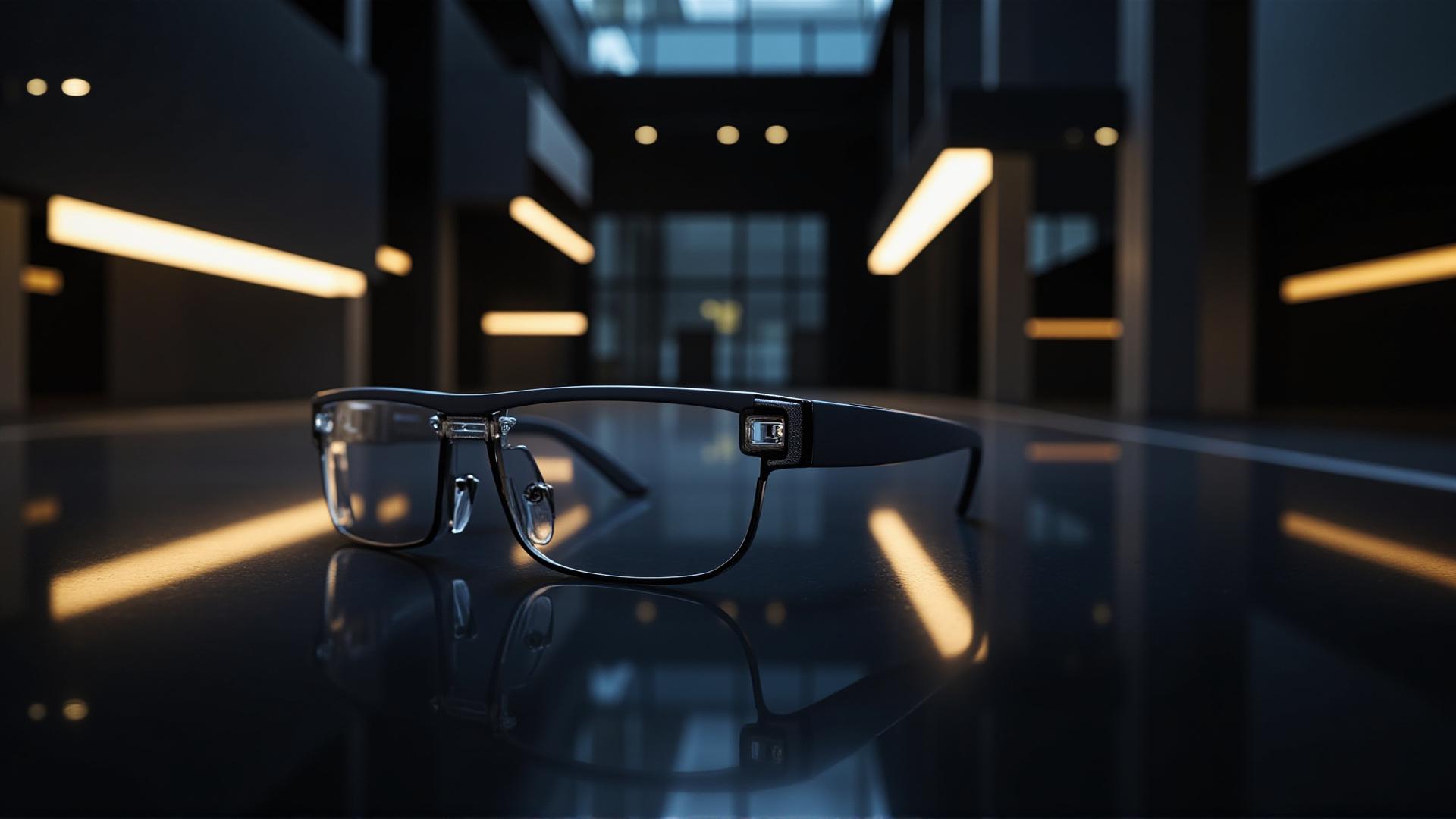
Bone conduction glasses technology: three tiers of verification
Verification of bone conduction suppliers is harder than verification of camera suppliers, and the reason is that the numbers sound more technical than they are. A camera specification can be checked against a sensor datasheet. A gain figure in decibels, stated without a method, cannot be checked against anything — it can only be replicated, or ignored.
Our own catalogue has exactly one bone conduction entry. It publishes a 35 dB amplification gain, a 200 mAh battery, a charge time of two hours or less, roughly seven hours of runtime and Type-C charging. No model designation. No transducer description, no frequency response, no leakage figure, no certification status. When you see how little there is to verify against, it becomes obvious how easy it is for a supplier to sound authoritative here.
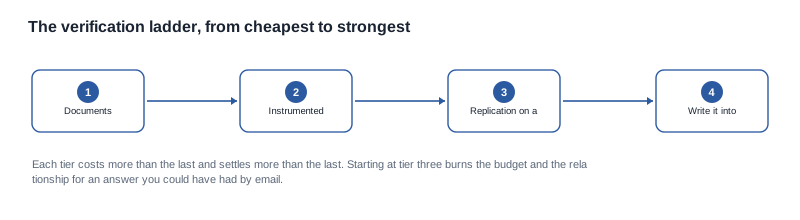
The practical answer is a ladder with three tiers, and the order of the tiers is the whole method. At the bottom of the ladder are the documents a supplier can produce in a day. Above that are the instrumented checks that settle a number on the buyer's own bench. At the top is replication, where the buyer reproduces the claim on a reference unit and compares it with what the supplier said. A programme that starts at the top has spent its budget and its supplier relationship on a question that the bottom two tiers would usually have answered. Knowing which tier a question belongs on is the whole trade-off: the higher the tier, the stronger the evidence and the more it costs in time, in instruments and in supplier goodwill.
The other half of the method is the file. Every tier produces an artefact, and the artefacts together are a qualification file: something a colleague can read, something a retailer can be shown, and something that can be produced two years later when somebody asks why this product was approved. A verification exercise that produces a conclusion but no file has produced a memory, and a memory is not evidence.
For a buyer running several suppliers at once, the ladder is also what tells you how to evaluate a supplier before you commit sample money. The questions to ask at tier one are narrow, the answers are comparable between suppliers, and the comparison is made on method rather than on brochure quality. A shortlist built this way is shorter and more accurate than one built on catalogue depth, which in this category is almost always a misleading criterion.
Tier one: the documents a supplier can produce in a day
Tier one is the cheapest and the most commonly skipped, because a buyer tends to think of documents as administrative rather than as verification. In this category they are the opposite. When the published specification is six rows with no method attached, the documents are the only place where a method can be found.
The first document is the transducer description: where on the frame the transducer sits, what it is made of, and whether the frame's own contribution to the output has been characterised. A supplier that answers this has an engineering conversation behind the product, and a supplier that cannot is reselling somebody else's assembly.
The second is the gain test method: the input reference level, the weighting applied, whether the measurement is on the device output or on the electrical signal, and whether the gain is adjustable. These four answers together turn a number into a measurement. A supplier that gives three of them is nearly as good as one that gives four, and a supplier that gives none has a number rather than a measurement, which is the thing to be careful about.
The third is the compliance file: which model designation appears on each certificate, which issuing body issued each one, the validity dates, and which markets the file covers. This is the document group that most often reveals a stop condition, because the model list on a certificate is where a substitution hides. A family-level document is not coverage for a branded unit, and a document on the factory's own SKU is not a document on yours.
The fourth is the regulatory route in the buyer's own market, in writing. This is a legal question rather than a technical one, and it is the one that should be settled before product work rather than during it, because a route can add cost, add elapsed time and remove claims from the copy at the same moment. It is also the question most often deferred to the brand, and deferral is itself an answer.
A useful test for tier one is the reply test. Send the questions as a list in one message and see what comes back in one reply. A supplier with a documentation habit answers all four groups and the answer is structured. A supplier answering two groups has a gap in a specific place, and that place is worth knowing before anybody spends money.
The criteria for a good tier one reply are worth stating, because a buyer reading a supplier's answers to a long list often cannot tell a complete answer from a confident one. A complete answer names the input, the condition and the reference; a confident answer names the number and a comparison to other products. A complete answer says which model appears on which document; a confident answer says the product is certified. The questions to ask are the same either way, but the two kinds of reply look nothing alike once you have read three of them.
Tier two: the instrumented checks that settle a number
Tier two is where the buyer stops reading and starts measuring, and it is where the cost starts to be real: instrument time, bench time and somebody's attention.
The gain check is the central one. It requires a defined input, a defined coupling, a defined reference point and a defined instrument, and the buyer's job is not to build a laboratory but to insist that the supplier's answer contains all four. Once they do, the buyer's measurement becomes possible: the input is known, the coupling is repeatable, the reference point is stated, and the instrument can be anything with a stated accuracy. A buyer with those four can take a reading, and a reading can be compared with a reading.
The runtime check is simpler and more commonly needed. The published figure of roughly seven hours is a rated runtime with no condition attached, so the check is not a comparison against that figure but a measurement in the condition the channel creates. Record the duty cycle as well as the result, because a bare number cannot be compared with anybody else's bare number, including the supplier's.
The power and charging check is the one that a buyer can do with the equipment already on the bench: a cell capacity check against the published 200 mAh, a charge-time check against the two-hour figure, and confirmation of the Type-C interface. These are the rows where a buyer's own measurement and a supplier's published figure should agree, and the agreement is worth something precisely because the disagreement case is so easy to spot.
Two rules make tier two produce evidence rather than impressions. The measurement is recorded with its condition, every time — an input level, together with a coupling position, a reference point, and a duration And the measurement is taken on the configuration that will ship, because a sample built with a different frame is a different product and a reading from it is not transferable.

Tier three: replication on a reference unit
Tier three is the most expensive tier and the one most programmes try to skip, because it takes days rather than minutes and it needs people rather than instruments. It is also the tier where this category's real answers live, because the two questions that matter most — how the output changes with wear, and how it behaves in a real environment — cannot be answered on a bench at all.
Replication has two parts, and the first is the one that catches the commercial risk. Take a unit the supplier says represents the production configuration, and compare its behaviour with what the supplier claimed. The claim being tested is usually a number, and the comparison is between the number and a reading taken on the buyer's own equipment under the buyer's own condition. If they agree, the claim was conservative and the buyer can use it. If they differ, the difference is information about the method, and the method is the thing the buyer was missing.
The second part is the field replication: the same product, the same protocol, in the environment the product will be sold into, with more than one person. This is the only measurement of the coupling variable, and it is the only one that tells the buyer whether the product performs consistently across a population rather than in one set of hands. A single-unit field test is a demonstration; a multi-unit, multi-wearer field test is a qualification.
The failure mode of tier three is doing it badly rather than not doing it. A protocol with no written pass condition produces a preference, and a preference is not evidence and cannot be used to refuse a lot. A protocol with one wearer produces an anecdote with a table. A protocol run in an office produces a result for an office. Each of those is a decision made without noticing it, and each of them is much more expensive to discover later than to prevent now. The main pitfalls in this tier are all of the same shape: something that looks like rigour and is actually a preference, a sample of one, or the wrong environment.
Who signs the qualification file, and what a file is for
The reader is a sourcing buyer or a product manager who has to decide whether a supplier's technology claims are good enough to build a programme on. The specific difficulty is that the decision has to be made before the product exists in any orderable form, and that the material available for making it is thin.
The qualification file is what the decision is recorded in, and it is worth being precise about its purpose, because "verification" often gets treated as an activity whose output is a yes or a no. The file's real output is three things: a decision, the evidence behind it, and a set of open items that the programme inherits. The third is the one that is usually missing, and it is the one that determines whether a programme that passed its verification will still be healthy in month four.
The ownership question follows from that. Somebody has to sign the file, and that person has to be able to say what they did not verify. A file signed by a buyer who checked a sample and a brochure and nothing else is misleading in a way that is hard to detect, because it looks identical to a file signed by somebody who ran the ladder. The signature line should therefore state the tier reached, not just the outcome.
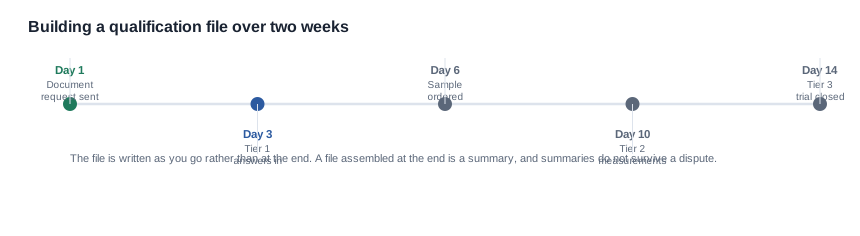
There is a second reason the file has to be written as it goes rather than assembled at the end. Verification findings decay. A measurement taken in week three is a record; the same measurement recalled in week twelve is an impression, and an impression cannot be attached to a document or shown to a retailer. Writing each tier's result into the file on the day it is obtained is what makes the file an artefact rather than a summary.
The market context sets the bar for what a good file looks like. Our catalogue publishes twelve open-ear audio platforms with full electrical detail on each — chip version, cell capacity, rated runtime, charging method — and exactly one bone conduction entry with six rows and no model designation. A buyer arriving from the audio side will find the bone conduction file thin by comparison, and the correct response is not to lower the bar but to change what the file is for: in this category the file is a record of method and condition, not a record of specification.
The questions to ask, grouped by answer type
The questions do most of the work, and they are worth grouping by the type of answer they produce rather than by subject area.
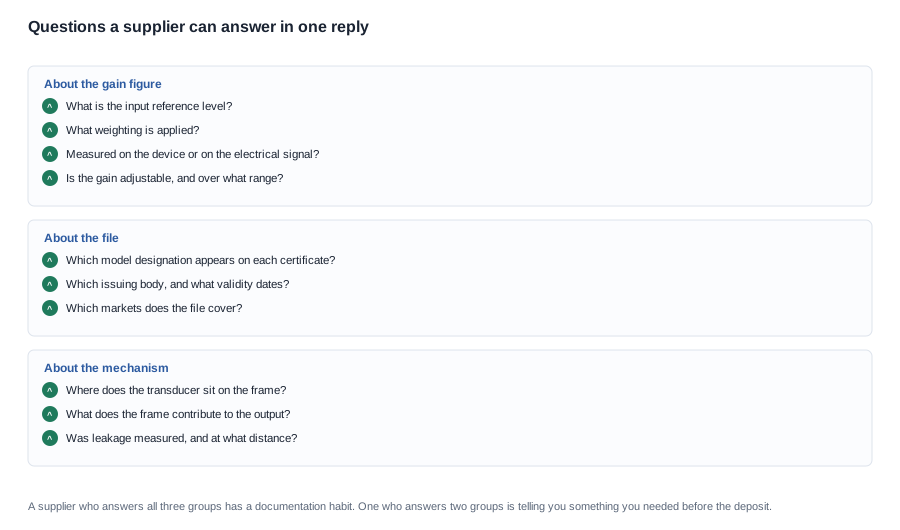
Questions that produce a method. The input reference level behind the gain figure, the weighting applied, whether the measurement is on the device or on the electrical signal, and the range over which the gain is adjustable. All four together convert a number into a measurement. One of them alone does not, which is why they should be sent as a group.
Questions that produce a document. Which model designation appears on each certificate, which issuing body issued it, what the validity dates are, and which markets the file covers. The model comparison is character by character, because a range with similar model names is exactly where a substitution hides.
Questions that produce an answer about the mechanism. Where the transducer sits on the frame, what the frame contributes to the output, and whether leakage was measured and at what distance. These questions are diagnostic: the supplier who has a real answer usually volunteers the condition attached to it, which is the behaviour you are looking for.
There is a fourth group that produces a decision, and it is not a question so much as a request: the route in the buyer's market, in writing. It should be asked first, because it is the one answer that can change the shape of the programme.
A worked example: verifying one gain figure
For clarity, what follows is an example built for this article. It demonstrates the sequence of the checks rather than an outcome.
Assume a buyer evaluating a bone conduction supplier for a workplace channel, with a claim of 35 dB amplification gain on a 200 mAh cell, charging in up to two hours, rated runtime of roughly seven hours and Type-C charging. The supplier's material is clean and the model designation is stated.
Tier one takes a day. The buyer sends the questions as a single list, in the three groups. The reply is prompt: the input reference level and the weighting are given, the measurement is stated to be on the device output, the gain is adjustable over a stated range, and the certificates name the model designation on the order. The route in the buyer's market is confirmed in writing, with the product stated as not presented as a medical device. One thing is missing: the leakage measurement, which the supplier says has not been done.
The decision at the end of tier one is proceed, with one open item. Leakage is not answered, and the buyer records that as an open item rather than closing it. The commercial consequence is small — the copy will not carry a leakage claim — and the technical consequence is that the field protocol has to measure it, because nobody else is going to.
Tier two takes a week. The buyer measures the charge time against the two-hour figure, confirms the interface, and takes a gain reading using the supplier's stated input level, weighting and reference point. The reading is not the same as the published figure, and the difference is the interesting part: the buyer's own reference point is a declared position rather than a calibrated one, so the reading has a larger uncertainty than the supplier's claim. The buyer records the measurement with its uncertainty, rather than as a corrected number, which is the honest form of the result and the one that survives being repeated.
Tier three takes a fortnight and needs people. The field protocol is written before the trial, with a pass condition per test and more than one participant. The trial produces a result that is consistent with the supplier's account of the product and inconsistent with the copy the supplier's own marketing uses about it. The buyer writes that into the file, because it is the finding that determines what the listing can say.
The file, at the end, has four parts. The decision and its date. The evidence, with conditions attached to every measurement. The open items, of which leakage is one, with the decision taken about each. And the conditions that the programme inherits — the artwork hold, the copy constraint, the acceptance criteria for the production lot.
The commercial consequence of the whole exercise is that the buyer now knows two things that matter more than the gain figure: the supplier's method, and the product's real behaviour across several people. Both are transferable to the next programme, and both are worth more than the number that started the enquiry. The total cost of the exercise was two weeks and a small amount of bench time, and what it bought was the criteria on which the production lot will be judged before the order is placed.
What our own documentation can and cannot evidence
Here, we will tell you what our catalogue publishes, which in this category is one gain figure and four electrical parameters, and we will tell you plainly that the rest is a question you have to answer with your own testing. We do not describe the bone conduction model as a hearing aid and we will not make a medical claim about it, because a hearing-related description pulls the product into a framework that a catalogue entry cannot address.
What we can evidence is limited and we would rather list it than imply otherwise. The electrical rows — 200 mAh, a charge time of two hours or less, a rated runtime of roughly seven hours and Type-C charging — are checkable per unit with ordinary equipment, and a buyer who checks them will find them consistent with what we publish. The 35 dB gain figure is the one row we publish that we do not publish a method for, which means a buyer cannot check it against a third party and can only replicate it under the supplier's stated conditions.
We publish no model designation for this entry, no certification status, no transducer description, no acoustic measurement, no leakage figure, no microphone specification, no frame weight and no ingress rating. We will not supply a typical value for any of them, and we would rather say so than quote a figure that cannot be verified. We also will not present the gain as a result a wearer experiences, and we will not repeat a comfort or intelligibility claim that has not been measured.
For the underlying mechanism, our bone conduction audio page sets out how the technology works and where its real limits are, and the structural difference between a factory and a trading company is covered in manufacturer versus trading company.
Actions for the qualification file
Send the tier one questions as one list. One message, grouped, so the reply is a table rather than a paragraph, and so a missing group is obvious on arrival. A buyer who negotiates this first exchange gets a different supplier than a buyer who asks for a price, and the questions to ask are on this page.
Write the field protocol before the trial, not after. A pass condition agreed afterwards is a condition that has already been missed.
Record every measurement with its condition. Input level, coupling position, reference point, duration. A number without its condition cannot be compared with anything, including your own next batch.
Keep the open items in the file, with the decision taken on each. An open item with a decision is manageable; an open item that has been quietly dropped is the one that reappears in month four.
The reading discipline that supports all of this is set out in how to read a datasheet without trusting it, and the test protocols are in how to test before ordering.
Where this comes from
- Bone conduction audio technology and its limits
- Manufacturer versus trading company
- How to read a datasheet without trusting it
- How to test before ordering
- Bone conduction glasses in the range
Tell us the market you are selling into and we will say plainly where this category's compliance position stands.


