

Smart glasses for field work: write the exposure list before the shortlist
Field work puts the device somewhere the user cannot control, and the comparison that most buyers actually need is not a specification table at all. It is a list: what does this device have to survive, for how long, and who answers for it. A general claim of ruggedness cannot be tested against anything, and a differentiator that cannot be quoted is a slogan, so a field-work comparison has to end in a configuration difference with a price attached rather than in a feature list. The first question a buyer should put to a supplier is therefore not "what can your device do" but "list the exposures this device is used in, with a duration for each" — because a supplier who can answer that has done the work, and a supplier who cannot will quote a durability claim that a customer's own site will falsify in week one.
The reason this ordering matters is commercial rather than technical. A device that fails in a field is not a return, and the loss does not show up in a returns rate. It shows up as a person-hour, because the technician who was going to do something else is standing still, and because the job the device was bought for is done differently or not done. That is the number the buyer's customer actually feels, and it is the number that decides whether a replacement commitment is worth negotiating hard or whether a device can simply be replaced from stock. Everything else in this comparison — the ingress marking, the operable set, the retention method — is in service of that one number.
Who is reading this and what they are defending. The reader is a brand-side buyer, a channel buyer or an e-commerce seller supplying a device into a service operation, whether that is utilities, construction, facilities or a fleet maintenance team. The situation is a quotation to compare, a new programme to open or a market to enter, and in each case the same question sits underneath: which of the two or three suppliers in front of you can actually build what you have written down, and what happens to your schedule when they cannot. The fear underneath the enquiry is not a bad price. The failure underneath is a delivery that is not the sample that was approved, a document route that stops the goods at a border, or an opening delivery that becomes a returns burden nobody priced.
Two questions arrive before the specification does. The first is what is being ordered in enough detail to be quoted, because a configuration described in general terms produces a price that cannot be compared with anything. The second is what the programme has to survive, which decides whether field work is a specification exercise or a lesson in finding out later which supplier was right.
What the catalogue publishes for field work. The sport family publishes a resolution class on the two sport camera models, a cell capacity, a charge time, a rated runtime, a charging interface, and a remote capture control on the D17 and the ZH12. The camera tier publishes a resolution class, a cell capacity, a charge time, a rated runtime and a charging interface. The IP54 marking appears on the V06 and the S7 and on no other model, and no third-party test report is published behind it anywhere in the catalogue. Glove-operable controls are not published for any model. Impact, drop and retention figures are not published for any model. The lens material and the coating are not published for any model. A per-model unit weight is published for exactly one model, the MT6, at 158 g for the whole unit including the battery and the camera and excluding the foldable case.
What that absence list means for a comparison. Every environmental question in field work — dust, water, salt, chemicals, mechanical shock, retention under movement, the operative surface with gloves on — is an open row. A comparison that claims to rank field-work devices on environmental fitness is therefore a comparison on two published rows and a set of assertions. The honest method is to write the exposure list, mark which parts of it the published rows can answer, and treat the rest as a specification the buyer writes and the supplier answers in writing.
The rows that decide a smart glasses for field work comparison
The exposure list, with a duration for each
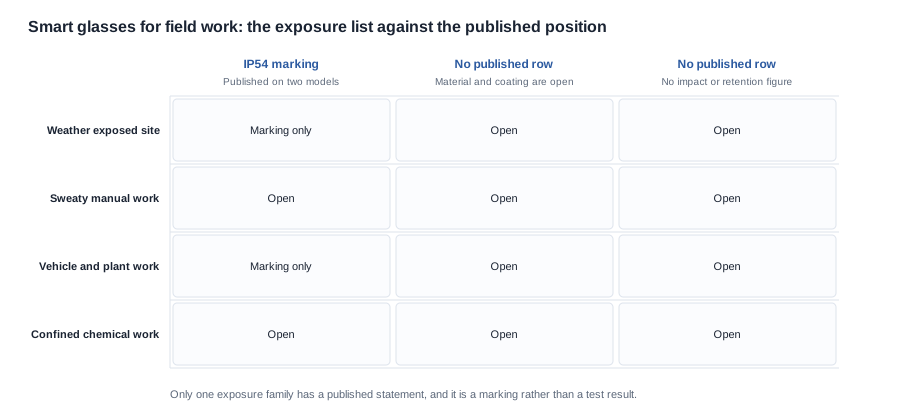
The matrix above is the shape of the problem. Of the three exposure families that decide a field-work comparison, only one has a published statement in the catalogue, and that statement is a marking rather than a test result. Everything else is open, which means it has to be converted into a written requirement or it simply does not get considered.
The exposure list, written in the form a supplier can answer.
- Water and dust. How long is the device in rain, in spray, or in a dusty environment, and is it ever rinsed or hosed? This is the only family with a published statement, and it is the IP54 marking on the V06 and the S7: the first digit is a dust protection level, the second covers splashing water, and the marking covers neither immersion nor a sustained downpour. A supplier who quotes "waterproof" against a marking that says IP54 is quoting a different product.
- Chemicals, salt and biological exposure. What is on the device at the end of a shift — salt, fuel, cleaning agent, agricultural spray, hand sanitiser? The catalogue publishes no material and no coating, so this family cannot be answered from a document and has to be asked in writing, with the answer attached to a specific model.
- Mechanical duty. Drop, impact, vibration, and the retention method that keeps the device on the head during the movements the work involves. Nothing is published. The question to ask is what the retention method is and how it is specified, because "comfortable" is not a specification and "secure" is not a test.
- Operability. What can be operated with gloves on, in movement, without taking the device off? An interface that needs a bare fingertip on a small surface is not an interface in a field, and no model in the range publishes a touch row, which means the question has to be put to the supplier on every entry rather than answered off a table.
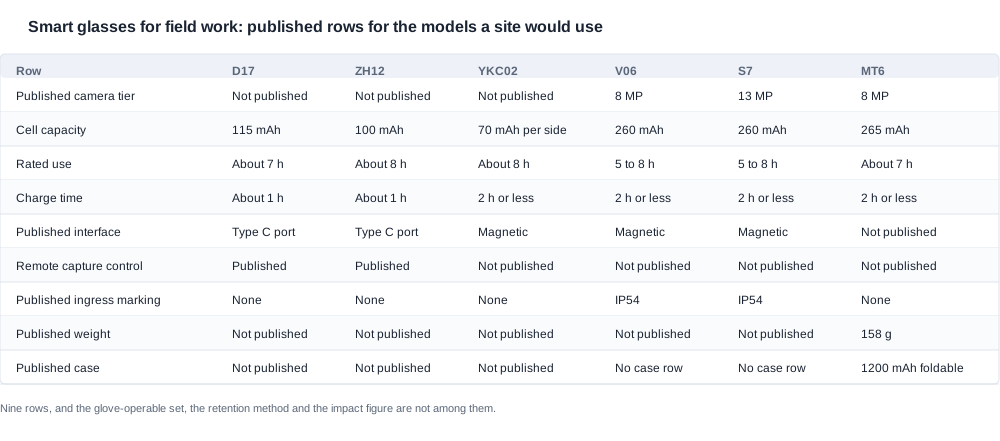
The published rows for the models a site would actually consider.
| Row | D17 | ZH12 | YKC02 | V06 | S7 | MT6 |
|---|---|---|---|---|---|---|
| Published camera tier | Not published | Not published | Not published | 8 MP | 13 MP | 8 MP |
| Cell capacity | 115 mAh | 100 mAh | 70 mAh per side | 260 mAh | 260 mAh | 265 mAh |
| Rated use | About 7 h | About 8 h | About 8 h | 5 to 8 h | 5 to 8 h | About 7 h |
| Charge time | About 1 h | About 1 h | 2 h or less | 2 h or less | 2 h or less | 2 h or less |
| Published interface | Type C port | Type C port | Magnetic | Magnetic | Magnetic | Not published |
| Remote capture control | Published | Published | Not published | Not published | Not published | Not published |
| Published ingress marking | None | None | None | IP54 | IP54 | None |
| Published weight | Not published | Not published | Not published | Not published | Not published | 158 g |
| Published case | Not published | Not published | Not published | No case row | No case row | 1200 mAh foldable |
The row that a field-work buyer should notice first is the roughly one-hour charge time on the D17 and the ZH12. Every model in the range publishes a charge time, and those two publish roughly one hour against two hours or less elsewhere. A site works in blocks between returns to base, and a device that is back on charge within a break is a device that does not need a rotation plan. The caveat is the same caveat that applies to every rated row in the catalogue: the charge time is published without a starting state and without an end criterion, so it cannot be converted into the length of a break. It is a signal, not a schedule.
The second row is the remote capture control, published on exactly two models. On a site, a control that can be triggered without touching the device is worth more than a row about camera resolution, because touching a device on the head means stopping work and possibly removing gloves. It is a small published feature and it is one of the few places in this catalogue where a published row changes the answer.
The third is what is missing from every row in that table. The glove-operable set, the retention method, the ingress test report, the impact figure, the per-model weight, the lens material and the coating. A comparison table with nine rows and nine empty cells is not a weak comparison — it is a specification waiting to be written.
Turning a smart glasses for field work sample into serviceable evidence
A sample settles the rows that a document cannot, and it settles them badly if the test is not designed. The sequence below turns a sample into evidence a customer will accept, and it ends with the one measurement that decides the commercial question.

The sequence, and what each step produces.
- Write the site conditions down before the quotation, as a list of exposures with a duration for each. A supplier can then answer against the list, and a general claim of ruggedness can be tested against it. This is the step that separates a quotation from a guess.
- Test the operable set in the actual conditions, with gloves on, in movement, and record what a user could not do. The list of things that could not be done is the usability specification, and it is the most useful artefact the sample produces.
- Test the retention method against the movement the work involves, not in a static stance. A device that leaves the user's head during the work is a device that comes back in a pocket, and a device that comes back in a pocket is a device whose lens and contacts have been in a pocket.
- Time the replacement cycle with a real failure. Ask how a unit is diagnosed on site, how a replacement reaches the site, and how long the whole cycle takes. Then do it once, with a deliberately broken unit, and write down the elapsed hours.
- Weigh the sample and record the per-model figure in the file, because the published weight belongs to one model on one platform and a site programme is judged on the hours a device is worn.
How to evaluate the answers when they come back. A useful answer names the model, states the exposure it applies to, and distinguishes a published row from a measured one. A soft answer generalises from the family, describes durability as a property of the product rather than of a configuration, or offers a certification reference without a document number. The red flags worth naming in this category are the same three that recur everywhere: a figure with no condition, a specification that names a product family rather than a buildable configuration, and a date with no owner.
The paperwork a site programme cannot do without. The model designation table and the certificate register, so a unit in a van can be traced to a document. The battery transport file for the configuration as shipped, at battery transport. The ingress position in writing — a report number, or a written statement that none exists. The per-model weight. The agreed incoming inspection criteria, with the sampling level and the defect classes to reject on. And the model-specific conformity record, because the catalogue carries a company-level export certification page and no per-model certification row, which means the certification route is at certification checklist and a document to request rather than a row to read. The sample procedure is at samples and the published rows are at battery life.

Where a smart glasses for field work programme loses money
The device that could not be operated with gloves. Symptom: the control set was specified for a bare hand in a still position, and the site worked around it by taking the device off. Root cause: the operable set was never written down. Control: define it with the site conditions in view, test it that way, and treat the list of things that could not be done as part of the specification.
The device that left the user's head. Symptom: a rising rate of devices returned in a pocket rather than issued, and a lens and contact condition nobody logged. Root cause: retention was evaluated while the user was stationary. Control: specify the retention method against the movement the work involves.
The failure that needed a workshop. Symptom: a device out of service for a week because diagnosis required the supplier's equipment. Root cause: there was no field diagnosis path. Control: require a field diagnosis and replacement path with a time commitment, and test it once with a real failure.
The comparison made on the wrong attributes. Symptom: two products compared on headline specification that hides the real difference, and a decision the site cannot explain. Root cause: no exposure list. Control: compare on the configuration attributes that determine the delivered product, against a list the customer wrote.
The differentiator that inherits a custom part. Symptom: a marketing decision that turns into a schedule constraint, because a custom component carries its own minimum order quantity and its own lead time. Root cause: the differentiator was costed as a per-unit feature and not as a supply-chain commitment. Control: ask what the differentiation costs per unit, what it costs to introduce, and what it costs to maintain when a component changes.
The downtime nobody priced. Symptom: the programme's real cost is higher than its quoted cost, and the difference appears as a dispute at renewal. Root cause: a unit out of service was treated as a replacement rather than as lost person-hours. Control: price the replacement cycle, and put a replacement commitment in the contract that carries the risk explicitly.
The model that was right and the accessory that was not. Symptom: a programme with a device that works and a spare part that does not exist, so a broken part is a broken device. Root cause: the spare-parts question was never asked. Control: ask whether removable parts can be bought and replaced separately, and whether a detachable temple is a replaceable part rather than a write-off. A detachable temple is published on the G07 and the YK12, and a spare part that can be bought is a part that does not write off a whole frame.
The identity of the device on site. Symptom: a device that goes missing and is never charged to anyone, because nobody can say which device it was. Root cause: no identity scheme. Control: a device identity scheme and a count, and both are cheap at the factory and expensive without them.

Negotiating a smart glasses for field work replacement commitment
The replacement commitment is the one term worth negotiating hard, and the reason is arithmetic rather than sentiment. In a field-work deployment, a device out of service costs the customer a person-hour, and in a service contract the customer prices that hour. A supplier who takes the risk of fast replacement has priced it into the unit; a supplier who does not has left it in the customer's operating cost, and the buyer will discover that in the first quarter rather than in the quotation.
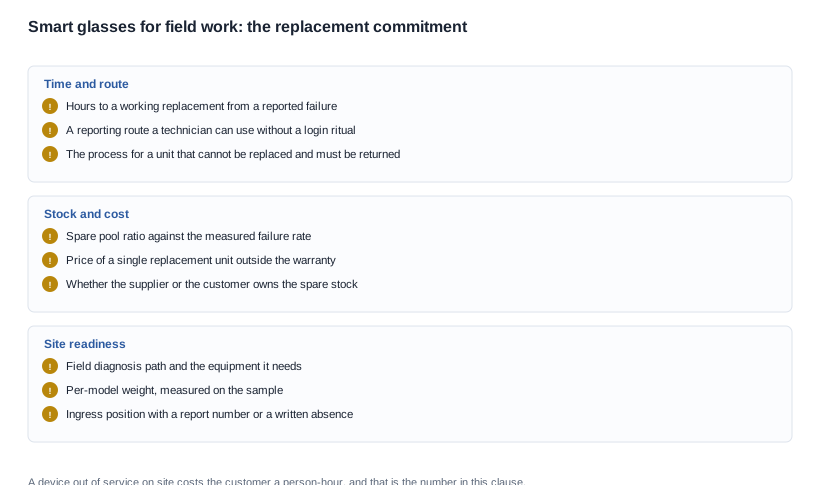
What the clause has to say, and the questions to ask before you order. A useful commitment is a number of hours to a working replacement from the moment a failure is reported, a defined reporting route that a technician can use without a login ritual, a spare pool ratio, and a stated process for a unit that cannot be replaced and has to be returned. The questions worth asking in the first round: how is a failed unit diagnosed on site, and with what equipment; how does a replacement reach the site, and what is the stated cycle time; what is the spare pool ratio against the measured failure rate, and who owns the stock; what is the price of a single replacement unit outside the warranty; and what happens to a device that fails on the last day of a contract.
Questions worth asking about the comparison itself. Which of the shortlisted models share a published platform, and which are genuinely different? What can be operated with gloves on? What is the per-model unit weight, measured on the sample? What is the ingress position with a report number or a written absence? What is the runtime with its condition, and the charge time with its start state and end criterion? And what is the case configuration, because a case is a second lithium cell to declare and a second object to lose in a van.
What is negotiable and worth the negotiation time. The colour and logo treatment, which is cheap between runs and expensive after the artwork is printed. The case configuration, and whether a case ships at all — four camera models publish no charging-case row at all, which on a site is an advantage rather than a gap, because one fewer object has to be carried and one fewer cell has to be declared. The minimum order quantity tiers, and whether two models can share a purchase order and a consolidated shipment. Whether the supplier funds a second sample round for the site testing, which is the one that most often decides whether a field programme works. Splitting a first run into two deliveries against a staged payment, which suits a site rollout in waves. And the pilot tranche of a field order, because that is where the exposure list is put to work.
What is not negotiable and should not be presented as if it were. The camera and audio architecture, the cell, the interface and therefore the charge time and the runtime ceiling. The certification cost and the lead time that follows the testing body. The tooling charge, which is spread across the first order and appears on its own line in the quotation. And the ingress position, which is a catalogue attribute rather than a commercial term — it cannot be improved by negotiation, only evidenced or stated accurately.
The commercial structure of a first order is at pricing and the clause language is at contract terms. The product families are at sport smart glasses and AI camera glasses, the configuration side for this scenario is at product recommendations for field work, and the scenario entry point is smart glasses for field work.
Documented and undocumented rows in smart glasses for field work, and what to send us
Stated plainly: the published material on field work is the part of the specification we can stand behind, and the rest is a question for the supplier's own file. We publish what our documentation states — the resolution class, the cell capacity, the charge time, the rated runtime, the charging interface, the published remote capture control, the published case capacities and the published structural features — and we mark the rows that are open rather than filling them with a typical figure from a supplier's general data. A buyer who builds a claim on an estimated number finds the error on site rather than in the quotation, and the correction is more expensive than the question was.
The rows we do not publish for this configuration are these. Ingress test reports are not published for the sport tier; the IP54 marking on the V06 and the S7 is a catalogue attribute and no third-party test report sits behind it. Camera field of view and video specification are not published for any camera model. The lens material, the coating, and any abrasion or chemical resistance figure are not published for any model. A glove-operable control set, an impact figure, a retention method and a runtime test condition are not published for any model. And a per-model certification row does not exist in our catalogue: what it carries is a company-level export certification page, so model-specific conformity evidence is a document to request from us in writing.
The rows our published data does settle are these. The D17 and the ZH12 publish a 115 mAh and a 100 mAh cell respectively, charging over Type-C in roughly an hour, a rated use of about seven and about eight hours, and a remote capture control. The YKC02 publishes two 70 mAh cells, magnetic charging, a rated use of about eight hours and Bluetooth V5.4. The V06 and the S7 publish 8 and 13 megapixels, a 260 mAh cell, a rated use of five to eight hours, magnetic charging, a detachable inner frame and the IP54 marking. The MT6 publishes 8 megapixels, 265 mAh, about seven hours, a 1200 mAh foldable case, and the only published unit weight in the range at 158 g, which is the whole unit including the battery and the camera and excluding the foldable case.
What we will not do is quote field work from a photograph, restate a marking as a tested certification, or fill a specification gap with a number that cannot be traced to a document. What we will do is take a use case, a configuration, a site condition list and a market, and tell you which parts are settled, which are open, and which have to be answered in writing before the sample order.
What to send us. Send the alternative you are competing against, the attribute you need to win on, the site conditions with a duration for each, and the volume, and we will tell you whether that attribute exists as an orderable configuration, what it changes, and which of the published rows cover it.
Related reading
- The configuration side — product recommendations for field work
- Reading the rated figures — battery life
- The families in the range — sport smart glasses
- Where the scenario starts — smart glasses for field work
Send the site conditions with a duration for each, and we will say which parts of the comparison are settled and which are yours.


