
Smart glasses for kids parenting: the age grade is the comparison
A children's product is not compared the way an adult product is compared, and the reason has nothing to do with the specification. An adult buyer compares capability and price. A buyer in a family compares two much more restrictive things: what the product is allowed to say, and how much of it the child can do without an adult in the room. Those two questions decide more children's listings than any row in a datasheet, and the second one is decided by the packaging and the household routine rather than by the device. So a comparison written for this category has to be built around the age band, the independence boundary and the claim set, and the electrical rows come third.
The claim set is the hard constraint and it is worth being blunt about why. Two of the three models published for children in our catalogue list posture and distance detection, and both list a lens-type electronic atomiser function. Those are feature rows, and the distance between a feature row and a benefit is the place where children's products go wrong. Say that a device "protects eyesight", "reduces eye strain", "supports development" or "improves focus" and the product has made a claim about a child's body. That claim runs into the medical boundary at 21 CFR 800.30 in the United States, and it runs into the children's product conformity requirements — EN 71 in Europe, ASTM F963 in the United States — in every market where the product is sold to children. A claim that is unsupported and unverifiable is also the kind of claim that a parent will test in public, and the test is usually a review.
So the comparison this category needs is not "which model is best". It is: for this age band, in this market, with this claim set, which model can be listed, which model can be shipped, and what does the household do with it on a Tuesday evening? The answer to the last part is the one most catalogues skip, and it is the one that generates the returns.
Who is reading this and what they are defending. The reader is a brand-side buyer, a channel buyer or an e-commerce seller putting a children's model into a category, a marketplace, a pharmacy-adjacent channel or a parent's own basket. The situation is a quotation to compare, a new programme to open or a market to enter, and the question underneath every one of them is the same: which of the two or three suppliers in front of you can build what you have written down, and what happens to your schedule when they cannot. The fear is not a bad price. What breaks first is goods that turn up other than the approved sample, a customs trail that halts the shipment at the frontier, or a first run that becomes a returns issue nobody budgeted.
Two questions arrive before the specification does. The first is what is being ordered in enough detail to be quoted, because a configuration described in general terms produces a price that cannot be compared with anything. The second is what the programme has to survive, which decides whether this is a specification exercise or a lesson in finding out later which supplier was right.

The rows that decide a smart glasses for kids parenting comparison
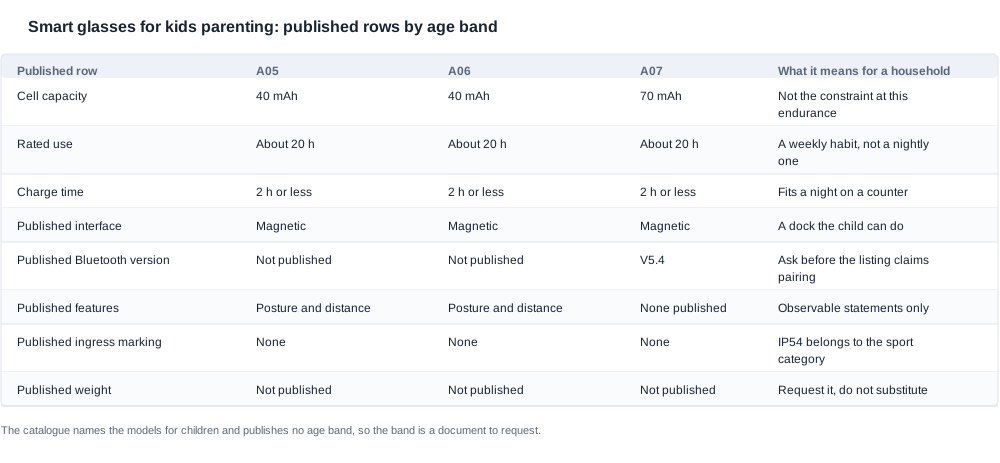
The published rows for the three children's models
| Published row | A05 | A06 | A07 | What it means for a household |
|---|---|---|---|---|
| Cell capacity | 40 mAh | 40 mAh | 70 mAh | Not the constraint at this endurance |
| Rated use | About 20 h | About 20 h | About 20 h | A weekly charging habit rather than a nightly one |
| Charge time | 2 h or less | 2 h or less | 2 h or less | Fits a night on a counter |
| Published interface | Magnetic | Magnetic | Magnetic | A dock the child can do themselves |
| Published Bluetooth version | Not published | Not published | V5.4 | Ask before the listing claims pairing behaviour |
| Published features | Posture and distance detection, lens-type atomiser function | Posture and distance detection, lens-type atomiser function | None published | Observable statements only, no benefit language |
| Published ingress marking | None | None | None | The IP54 marking belongs to the sport category, not to these models |
| Published weight | Not published | Not published | Not published | Request it, and do not substitute a typical value |
The endurance row is the one that changes the household routine, and it is the row a specification-first comparison skips. A rated use of around twenty hours on a 40 mAh or 70 mAh cell with magnetic charging means the device can sit on a counter and be charged once a week rather than every night, and it means a parent is not being asked to plug something in before bed. That is not a small point in a household: the nightly charging of a child's device is one of the routine steps that quietly fails, and a routine that fails produces a device that is flat, uncharged and unused.
The comparison against the other tiers matters more here than in any other category. The camera tier publishes 220 mAh to 290 mAh cells with rated use between five and eight hours, and the audio tier publishes per-cell values from 55 mAh to 100 mAh with rated use between about six and about eight hours. A household running a child on a five-to-eight-hour platform is being asked to manage a charging cycle every other day, on a device the child is more likely to use unsupervised, with a battery that dies mid-week. That is a returns argument and a trust argument, and it is an argument a parent makes without any technical vocabulary at all.
The charging routine a household actually manages
A household routine is a chain of small decisions, and the number of decisions is the number of failure points. The shortest chain this category allows is: put the device on the magnetic dock, notice the indicator, pick it up. The longest is: find the cable, find the right adapter, plug it in, check it is charging, put the device somewhere safe. Every extra step is a step that a tired adult skips, and every skipped step is a flat battery in a child's hands.
That is why the charging interface and the charge time are a household-design question rather than an electrical one, and why a comparison for this category should ask what the routine is, not just what the figures are. It also explains why a 40 mAh cell with a twenty-hour rating is not a weaker product than a 290 mAh cell with a seven-hour rating in this specific context. The published numbers are not comparable as magnitudes; they are comparable as the interval between two charging decisions.
What is not published and therefore cannot be used to select anything. The lens material, the coating, the surface treatment, any abrasion or chemical resistance figure, the per-model unit weight, the field of view, the video specification, the runtime test condition, and the age grading. The absence of an age grading on the published row is the important one: the catalogue names the models for children and publishes no age band, so a buyer who wants an age band on the packaging has to create it and has to have the basis for it in writing. That basis is a document, and the document is a request.
The claim boundary a smart glasses for kids parenting listing has to respect
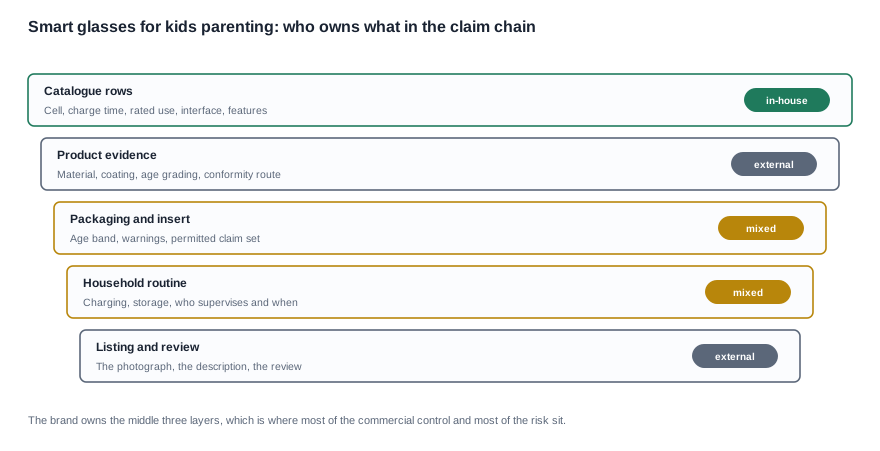
The layers above are the chain a claim travels through, and a mistake in any one of them reaches the parent. The catalogue supplies the bottom layer. The supplier owns the second. The brand owns the third, the fourth and the fifth, which is where most of the risk sits, and which is also where most of the commercial control sits.
Why a camera changes the question entirely in this category. A device worn on the head that records what the wearer sees is a different product in a household, in a school and in a review, and the difference is not technical. It is a question about the people and the rooms around the child, and it is a question that has to be answered before the SKU is listed rather than after the first concerned parent writes in. The camera models publish 8 megapixels on eight models and 13 megapixels on three, and the sensor, the field of view, the video resolution and the frame rate are published for none of them, which means a parent cannot be told what the device records or how wide it is. For a children's listing, the practical consequence is a routing decision: the camera tier is a different product decision with a different market, a different document set and a different risk profile, and it should not be reached by a buyer who is simply looking for the more capable model in the catalogue.
The claim set, written before the assets are made. A usable claim set for a children's product is short, observable and testable. A device detects a posture change. A device measures a distance. A device plays audio. A device records, where that has been decided and disclosed. Each of those is a statement about what the device does, in the same register as the feature rows the catalogue publishes. What the claim set must not contain is any statement about eyesight, hearing, development, focus, posture as a health outcome, or the effect the product has on the child. The set is agreed in writing before the product page, the packaging, the insert, the listing, the support script and the advertisement are produced, and every asset is then reviewed against it. That last step is the one that is skipped, and it is the one that produces a withdrawal.
The regulatory route, and what it means for the buyer's paperwork. In any market where the product is intended for children, the children's product conformity requirements apply — EN 71 in Europe, ASTM F963 in the United States — and a claim about the child's body additionally runs into the medical boundary at 21 CFR 800.30. The route is at the medical boundary, the certification route is at certification checklist, and the general product safety position is at general product safety regulation. What matters commercially is that our catalogue carries a company-level export certification page and no per-model certification row, and the text of the catalogue contains no reference to CE, FCC or RoHS at all. So the model-specific conformity evidence for a children's SKU is a document the buyer requests from the supplier in writing, and a buyer who has not requested it is carrying a gap into a market that will find it.
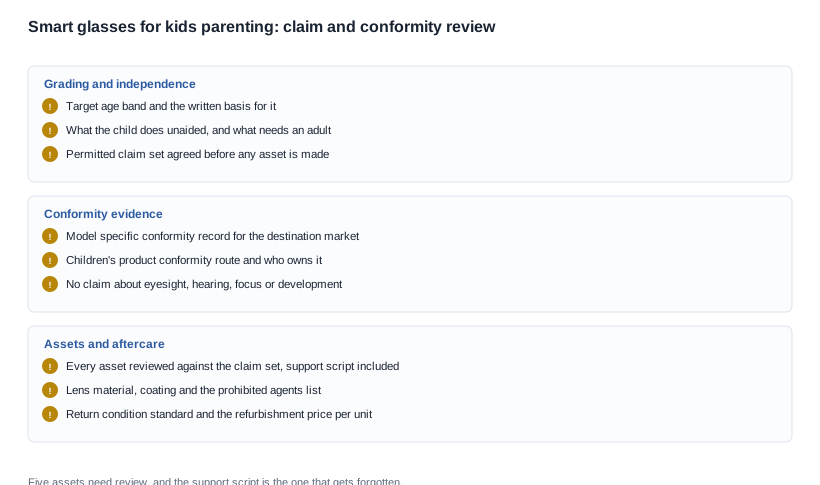
The review that has to happen before a children's SKU goes live. Each line is a question with a document behind it rather than an opinion.
- What age band is the product graded for, and what is the written basis for that band? The catalogue publishes none, so the band is either created by the buyer with a documented basis or omitted entirely, and omitting it is what causes the returns.
- What can the child do unaided, and what requires an adult? The boundary has to be documented and then used consistently in the listing, the packaging and the support script.
- What is the permitted claim set, and has every asset been reviewed against it? The product page, the packaging, the insert, the listing and the support script are five assets, and the fifth is the one that is forgotten.
- What is the model-specific conformity evidence for the destination market, with the issuing body and the document reference, rather than a company-level statement?
- What is the lens material and the coating, and what is the prohibited-agents list, so the household instruction can be restrictive rather than permissive?
- What is the return condition standard, with a visual reference, and what is the refurbishment price per unit?

Handing an unopened smart glasses for kids parenting box to a stranger
The most useful test in this category is not a specification and it is not a sample shoot. It is handing the box to someone who has not seen the product before and asking them to complete the first session unaided, with no help and no instructions beyond what is printed. The gaps are the returns, and they are the parent's confidence at the same time, because the adult who cannot get it working is the adult who doubts the purchase.
What the test exposes, in the order it exposes it. Whether the child can see how to switch the device on without an adult reading the insert. Whether the charging step is a single action or a sequence. Whether the volume or the control set can be operated by a small hand. Whether the storage position is obvious. Whether the insert is written for an adult, for a child, or for a parent, and whether the audience is clear. And whether the device is a toy, a tool or an accessory — because a child who cannot tell will stop using it within a fortnight, and a parent who cannot tell will return it.
How to classify the result. A gap that is closed by better artwork is a packaging fix and it costs a print run. A gap that is closed by a different model is a selection error and it costs a returns wave. A gap that is closed by a claim the product cannot support is a compliance problem and it costs the listing. Sorting the gaps this way, before the first order, is the difference between a product that has a first run and a product that has a second run.
The question of who supervises, and for how long. This is a commercial question disguised as a parenting one. A product that is only usable with an adult present has a much smaller addressable market than a product that a child can use alone within a stated boundary, and the boundary has to be written down and used consistently. Where a feature depends on a camera, a sensor or a connection, the dependency is a supervision requirement, and it belongs in the same document as the claim set. A parent will accept a product that says plainly "an adult must be within earshot for this feature"; they will not accept one that says it and then implies otherwise in the imagery.
What a parent's return actually is. A return made by a parent is usually a decision about trust rather than a comparison of features, and it converts into a public review because a parent who feels misled says so publicly. That is why the claim set is the commercial control and not only the legal one: a product that says exactly what it does can absorb a return, because the parent is not disagreeing with the brand. A product that oversold cannot. The returns position across the range is at after-sales support and preventing returns, and the ownership routine is at maintaining a small cell.

What a smart glasses for kids parenting range costs to support after it ships
In this segment the commercial question is about the position a product can take rather than about the price, because a product placed for children carries documentation obligations and a warranty position that an adult equivalent does not, and both are costs that belong in the quotation rather than in a later amendment. The returns reserve is the block to insist on, because a parent return is usually a trust decision and it converts into a public review.
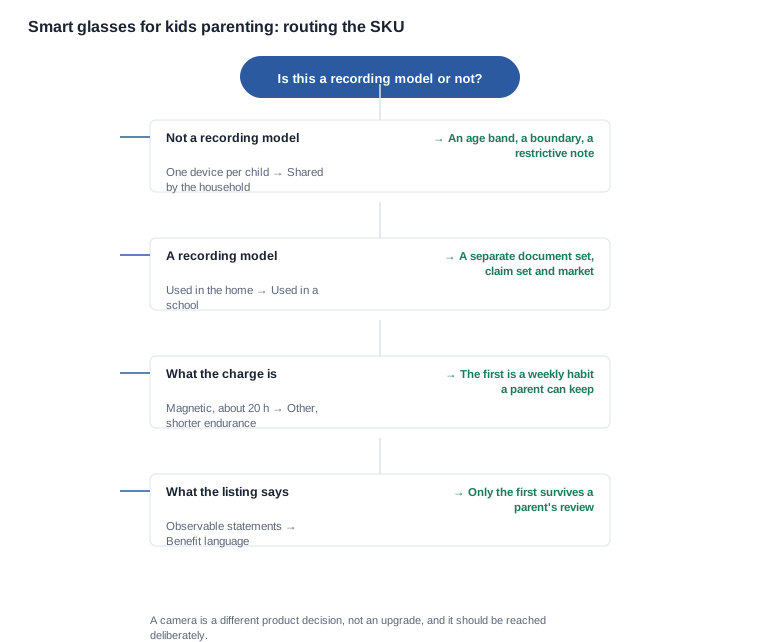
The routing decision, and what each branch costs. The decision tree above is deliberately short, because a children's range is short. A non-recording model with a twenty-hour rated endurance, an age band on the packaging, a documented independence boundary and a restrictive household instruction is a straightforward SKU. A recording model is a different programme with a different document set, a different claim set and a different market, and a buyer who treats it as an upgrade rather than as a separate decision has skipped four pieces of work.
The aftersales terms are the ones a buyer should negotiate hardest and most rarely does. Four different commercial terms, and each removes a category of cost: a warranty that replaces a faulty unit quickly, a claim route a parent can complete without phoning anybody, a spare part that can be bought separately, and a packaging that prevents the fault in the first place. A supplier who prices all four is showing the real cost of the product, and a buyer who treats them as an afterthought discovers that cost in the first quarter rather than in the quotation.
Questions worth putting in the enquiry, because each one changes the price or the schedule. What age band is the product graded for, and what is the written basis for it? What can the user do without an adult, and what requires one? Which claims about the product are permitted in the destination market, and in whose words? What is the per-model conformity evidence and who owns the route? What is the warranty and the returns position for a product in this category, and what is the refurbishment price per unit? Is the charge interface magnetic, and is the rated endurance published with a condition attached? And can a pilot order be placed at a low minimum order quantity so that the age band and the claim set can be tested with real households before the run order is committed.
The commercial structure of a first order. The total cost of a children's programme is the unit price, the returns reserve, the cost of the documentation route, the spare pool and the packaging artwork for the age band and the warnings — five blocks, and the unit price is the smallest of them. Minimum order quantity tiers are worth negotiating hard in this category because a children's programme usually starts small and grows, and a factory minimum that assumes a run order is a commitment the buyer cannot use. Colour and logo treatment, packaging artwork including the age band and the warnings, the insert, and the split of a first run into two deliveries against a staged payment are all negotiable. Clause language is published at contract terms, and the commercial structure of a first order is published at pricing.
The claim and evidence limits for smart glasses for kids parenting, and what to send us
Concretely, the published material on a children's model is the part of the specification we can stand behind, and the rest is a question for the supplier's own file. We publish what our documentation states — the rated runtimes, the charge times, the charging interfaces and the cell capacities, the published Bluetooth version and the published feature rows — and we mark the rows that are open rather than filling them with a typical figure from a supplier's general data. A buyer who builds a claim on an estimated number finds the error in the field rather than in the quotation, and what the correction costs is more than the question was.
The rows we do not publish for this configuration are these. An age band is not published for the A05, the A06 or the A07. Ingress test reports are not published for the sport tier, and the IP54 designation in our documentation belongs to the sport category rather than to the children's models. The lens material, the coating, and any abrasion or chemical resistance figure are not published for any model. A per-model unit weight is not published for the three children's models. The runtime test condition is not published. And a per-model certification row does not exist in our catalogue: what it carries is a company-level export certification page, so any model-specific conformity record is a document to request from us in writing.
The rows our published data does settle are these. The A05 and the A06 share an identical published specification — a 40 mAh cell, a charge time of two hours or less, a rated endurance of around twenty hours, magnetic charging — and both list posture and distance detection and a lens-type electronic atomiser function. The A07 publishes 70 mAh, roughly twenty hours, magnetic charging and Bluetooth V5.4.
What we will not do is quote a children's model from a photograph, describe posture or distance detection as a benefit to a child's eyesight, hearing, focus or development, or fill a specification gap with a number that cannot be traced to a document. What we will do is take a use case, an age band, a configuration and a market, and tell you which parts are settled, which are open, and which have to come from a written request.
What to send us. Send the target age band, the markets, the channels, the volume and the return reasons you have seen, and we will tell you which of them are controlled by the configuration, which by the packaging, and which need a contract term. The published configurations are at kids smart glasses range, the ownership routine is at maintaining a small cell, the compliance route is at the medical boundary, and the scenario entry point is smart glasses for kids and parenting.
Related reading
- The published configurations — kids smart glasses range
- The ownership routine — maintaining a small cell
- The compliance route — the medical boundary
- How to enter the scenario — smart glasses for kids and parenting
Send the target age band, the markets and the return reasons, and we will say which of them the configuration controls and which need a contract term.


