

Smart glasses for kids parenting is not a smaller version of an adult buying decision. Three models in our catalogue are built for a child: the A05, the A06 and the A07. Two of them carry a 40 mAh cell with a rated runtime of about twenty hours, and the third carries 70 mAh with the same rated runtime. That is the complete published electrical story, and it is enough to size the service regime a channel has to support — but it is not enough to support a claim set. Everything else in a children's SKU is a document the buyer has to request: a per-model child-product record, a battery transport file that covers the fitted cell, a cycle-life rating, and the factory's own charging-cycle data for the finished unit rather than for a generic cell. Ask for those in writing before the sample order. A channel that cannot produce a per-model compliance record cannot defend its own listing afterwards, and in this category the listing is where the claims actually live.
Smart glasses for kids parenting: the rows a buyer has to decide on
The reader is a brand owner, a channel buyer or an e-commerce seller deciding whether a children's SKU belongs on the roadmap at all, and if it does, at what claim level and with what service promise. The fear behind the question is specific rather than general: a parent buys, a child uses, and an adult returns. The complaint that reaches the buying desk is therefore written by someone who did not buy the product, and it will be about a promise the catalogue never made. A buyer who treats a children's model as a normal product with a shorter battery eventually learns this from a returns spreadsheet instead of from a supplier.
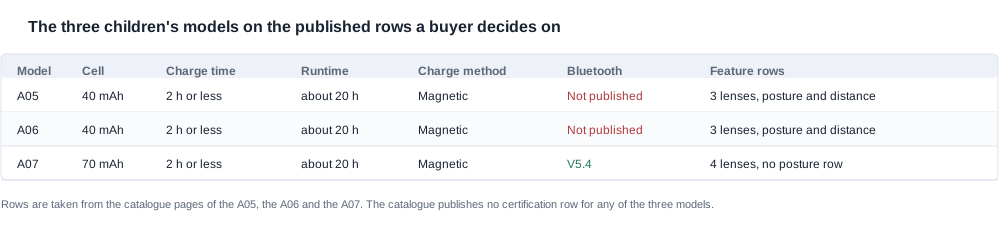
What the catalogue publishes for the children's range is narrow and useful. The A05 and the A06 each carry magnetic charging, a charge time of two hours or less, a 40 mAh cell and a rated runtime of about twenty hours. Both publish three lenses and the feature rows that describe correct versus poor posture and distance and a clear versus a fogged lens. The A07 carries a 70 mAh cell, the same charge time, the same rated runtime, magnetic charging, four lenses, and a Bluetooth V5.4 row — it is the only one of the three with a connectivity row at all, and the only one with no posture and distance rows.
What the catalogue does not publish is as important as what it does. There is no per-model certification row anywhere in the catalogue: the certification page in the front of the document is a company-level export certification page, and it cannot be read across to the A05, the A06 or the A07. The text of the catalogue contains no CE, no FCC and no RoHS reference at all. There is no unit weight, no cycle-life rating, no operating temperature range, no lens material, no coating, no runtime test condition, and no specification of what the device does when the cell reaches the end of its useful life. Every one of those gaps is legitimate for a buyer to close, and none of them can be closed by inference.
That is the whole decision this article has to serve: a children's model is a document-led purchase, not a specification-led one. The electrical rows tell you whether the product can be supported; the missing documents tell you whether it can be sold. The service regime that follows from a 40 mAh cell is the part most channels get wrong, because they copy an adult programme and assume the adults will handle it.

The three children's models on cell, charging, connectivity and lens rows
| Model | Cell | Charge time | Rated runtime | Charge method | Bluetooth row | Feature rows published |
|---|---|---|---|---|---|---|
| A05 | 40 mAh | Two hours or less | About 20 h | Magnetic | Not published | 3 lenses, posture and distance, lens clarity |
| A06 | 40 mAh | Two hours or less | About 20 h | Magnetic | Not published | 3 lenses, posture and distance, lens clarity |
| A07 | 70 mAh | Two hours or less | About 20 h | Magnetic | V5.4 | 4 lenses, no posture row |
The first thing a buyer should take from this table is that the A05 and the A06 are published identically on every row in the document. Nothing in the catalogue separates them, which means a channel that wants two different children's SKUs cannot justify the second one from the catalogue. Either the difference is written into the specification, the sample and the quotation, or the second listing is a duplicate of the first with a different name on it — and duplicate listings in a family category are the fastest way to a channel's own price comparison problem.
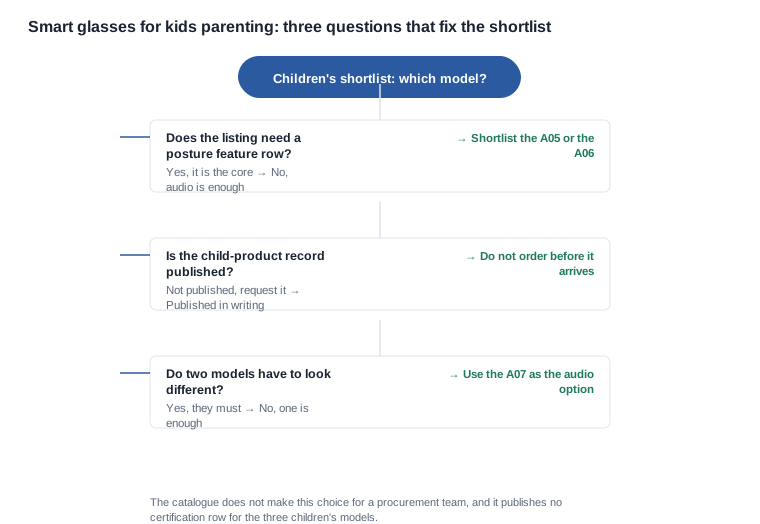
The second thing is that a 70 mAh cell is not a single number across the catalogue. The A07 publishes 70 mAh in a single cell, and the YKC02 sport model publishes 70 mAh in two cells. A buyer comparing a children's model against a sport model on "70 mAh" is comparing two different pieces of hardware, and any endurance conclusion drawn from that comparison is wrong before it starts. The same discipline applies to the charge time: two hours or less is published for all three children's models, but the catalogue does not state the starting state of charge or the point at which charging is considered complete. That means the figure cannot be turned into a downtime number per shift, because the variable part of the cycle is exactly the part that is not published.
The rated runtime of about twenty hours is the third figure that needs care. It is published, but with no test condition attached — no volume, no paired phone state, no ambient temperature, no workload. In an adult product that gap is an inconvenience, because the workload is broadly similar across buyers. In a children's product the workload is the opposite of consistent: the unit is used in short bursts through a day, sits idle on a charger between them, and is carried in a bag or a pocket. A continuous-use runtime is the number the catalogue publishes; the household experiences something quite different. The buyer's question is therefore not "does twenty hours beat six hours" but "what is the interval between charges in this family's routine, and is the answer documented anywhere".
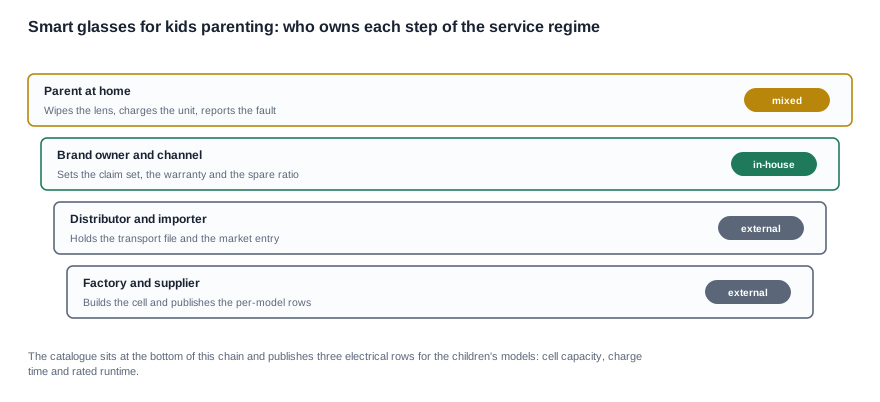
This is where the parent's role becomes a procurement input rather than a customer-service detail. The maintenance instruction for a children's model is a responsibility transfer between the adult who bought it and the child who uses it, and the transfer works only if the instruction survives being read once, months earlier, by someone who did not make the decision. That is a packaging and documentation requirement, and it is where a small cell changes the arithmetic: a 40 mAh unit that lives on a charger in a child's room is cycled far more often than a 100 mAh unit in a desk drawer, and cycle life is not published for any model in the range.
A 40 mAh cell turns maintenance into a handover problem, not a card in the box
The mainstream approach to a service regime is a printed card in the box. For the A05, the A06 and the A07 that card is the weakest link in the chain, because the person who uses the device is not the person who received the instructions and is not the person who will decide what to do when it stops behaving as described. The service regime for a children's SKU has to survive three handovers — factory to distributor, distributor to retailer, retailer to household — and each handover is a point where a published row gets reinterpreted by someone with no access to the documentation behind it.
The procurement consequence is that the buyer has to specify the handover, not just the product. Three questions decide whether the regime will hold. First, what does the household instruction actually say, and who in the factory approved it — because an instruction that describes a posture feature as an eyesight-protection feature has created a claim the documentation does not support. Second, what is the replacement path when the cell ages out, and is it a unit swap or a cell swap; a unit swap at a 40 mAh capacity in a price-led family category is a margin decision that has to be taken before the channel commits. Third, what does the spare-unit ratio look like for a category where the end of the useful life of the product may arrive before the end of the channel's own shelf life.
None of this can be answered from a catalogue page, and none of it is a factory's fault. The supplier's charging-cycle data for the finished unit, its cycle-life rating for the fitted cell, and its written position on the replacement path are three documents a factory either holds or does not hold. A supplier evaluation that asks for them is doing its job; a supplier evaluation that does not ask for them will find out at the returns counter.
The commercial consequence is that the children's SKU carries a service cost that does not appear in the unit price. In an adult category, a poor service experience costs one refund. In this category it costs a review that names the brand, a parent's recommendation not to buy again, and a channel that concludes the whole family is hard. That is the reason the warranty response time, the spare-unit ratio and the returns policy belong in the same conversation as the cell capacity, even though only one of them appears on the datasheet.

Getting the children's documentation in writing before the sample order

A service regime is enforceable only when it is written down, and the writing has to happen before the sample order rather than after the first shipment. Six steps, each with a completion standard that a colleague could check:
- Ask for the per-model rows in writing. Cell capacity, charge time, rated runtime, charge method, Bluetooth version where it is published, lens count and the feature descriptions, for the A05, the A06 and the A07. The completion standard is a written reply per model, not a verbal one and not a catalogue screenshot.
- Ask for the child-product record the sales market requires. In the markets a buyer usually ships into, the two references that get asked for most often are the European toy safety standard EN 71 and the American ASTM F963 child-product standard. The point is not the standard itself but what the report has to name: the model, the factory, the batch and the date. A report that names a family but not a model is not usable for a per-SKU listing.
- Ask for the battery transport file that covers the fitted cell. UN38.3 is the transport test summary that a logistics team and a freight forwarder will ask for, and it has to match the configuration that ships. The requirement is at battery transport. A file that covers a different cell is a shipment problem, not a paperwork problem.
- Run two samples through one protocol. Fix the volume, the paired phone state, the light level, the ambient temperature, the usage pattern and the starting state of charge before the first reading, and repeat it on a second unit from the same batch. Two units are what separate a design characteristic from a unit fault; one unit converts a solvable question into an argument.
- Compare the sample behaviour against the claim set the listing will carry. The claim set is written first, the samples are tested second, and anything the samples contradict comes out of the claim set. The medical boundary note is at medical boundary, and the rule it supports is simple: the published feature rows describe posture, distance and lens clarity, and a listing must not restate them as an eyesight-protection or myopia-control effect.
- Write the acceptance criteria into the purchase order. A measured number with its condition attached, a spare-unit ratio, a warranty response time and a per-model compliance reference. The clause language is at contract terms and the certification evidence list is at certification checklist.
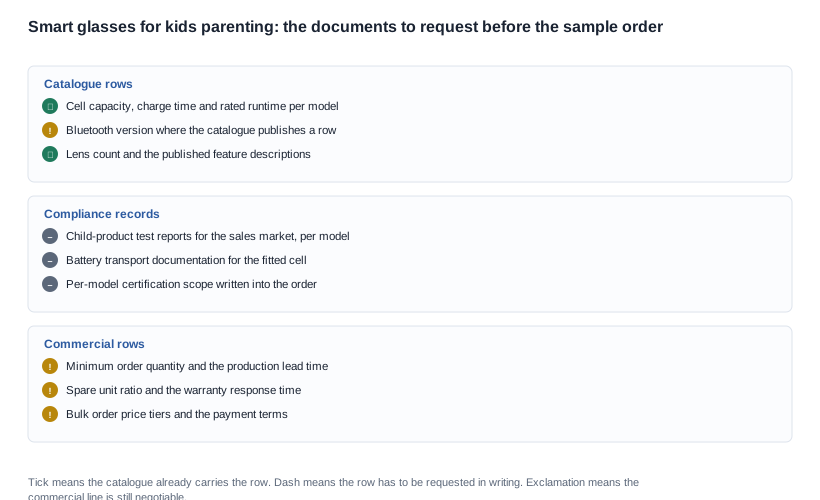
Two things about this sequence are worth stating plainly. First, a written refusal is an answer, and it is an answer that belongs in the shortlist: a supplier who cannot produce a per-model child-product record for the sales market has told you something a catalogue screenshot never would, and you can act on it while the order is still cheap to change. Second, the questions above are the ones to ask the factory, and they belong in the same conversation as the price tiers, the minimum order quantity, the production lead time and the payment terms — a supplier evaluation that keeps the commercial conversation separate from the document conversation gets two different answers and learns about the inconsistency later.

Where a children's programme breaks down commercially
Two models that are published identically. The symptom is a channel that receives two SKUs it cannot tell apart on the shelf, and the root cause is that the catalogue does not separate the A05 from the A06 on any row. The prevention is to require the difference in writing before the sample order, and to price the second SKU against that difference rather than against the first one.
A feature row restated as a health claim. The symptom is a parent expectation that the catalogue never supported and a review that argues with it. The root cause is a posture and distance row read as an eyesight-protection effect. The prevention is a claim set approved before the listing goes live, with the medical boundary note attached to it, and the approval recorded.
A cell that does not survive the family routine. The symptom is returns clustered in the second and third quarter of the channel's life rather than in the first month. The root cause is that cycle life and the runtime condition are both unpublished, so nobody knew which of the two was being assumed. The prevention is to ask for the cycle-life rating and to run a charge-and-runtime protocol before the purchase order is signed.
A sample that is not the production unit. The symptom is that the first shipment behaves differently from the unit that passed the evaluation. The root cause is that the evaluation ran against a promotional batch. The prevention is to confirm the production configuration in the order and to state the sample-confirmation clause in the agreement.
A transport file that does not match the shipped configuration. The symptom is a consignment held or re-routed. The root cause is a UN38.3 summary written for a different cell configuration. The prevention is to make the transport file a delivery condition rather than a document request.
The buyer's own marketing material carrying the claim. The symptom is that the promise was never in the catalogue and never in the purchase order, but it is on the retail listing and in a video. The root cause is that the listing was written by someone who had not seen the claim set. The prevention is a claim approval step that the marketing owner has to sign, which costs an afternoon and removes a category of dispute that no contract clause can fix.
An assumed scenario shows how the sequence works. A channel buyer for a family electronics brand is comparing the A05 and the A07 for a spring range, with a price band that leaves room for one children's SKU and not two. The first move is the claim set, because it decides the range: posture and distance rows for the A05, an audio product with a connectivity row for the A07, and no eyesight language anywhere. The second move is the documents, because the per-model record has to exist before the listing goes live and the freight forwarder has to have the transport file before the container is booked. The third move is the two-unit protocol, which is what tells the buyer whether the published twenty-hour figure describes anything a household will recognise. The fourth is the commercial conversation, in which the spare-unit ratio and the warranty response time are priced against the returns rate the first shipment produces — the only measurement in this category that tells the buyer whether the configuration they chose was the configuration the family needed.
What we publish for the children's range and where we stop
It is worth being precise: we publish the rows a buyer can order from and we do not fill the gaps with figures we cannot verify. For the children's range that means the charge methods, the charge times, the rated runtimes and the cell capacities, the lens counts, the feature rows as the catalogue describes them, and the Bluetooth version on the A07.
We do not publish a per-model certification scope, because the catalogue does not carry one and the certification page in the catalogue is a company-level export certification page rather than a model row. We do not publish unit weight for the A05, the A06 or the A07, and we would rather tell a buyer that than quote a typical figure they cannot check against a document. We do not publish cycle life, operating temperature, lens material, coating or the runtime test condition, and we do not describe the posture, distance and lens-clarity rows as an eyesight-protection or myopia-control effect. The wider camera range publishes a single unit weight — 158 g for the MT6 glasses body including its battery and camera and excluding its folding case — and that figure belongs to that model alone.
What we will do is take your market, your price band, your channel and your volume and tell you which published rows apply to the children's range, which claims the documentation supports, which documents have to be requested from the factory, and which acceptance criteria belong in the purchase order. The product family is at kids smart glasses, the scenario entry point is at parenting, and the model-by-model comparison for the two identical models is at A05 and A06 specification comparison while the certification position for one of them is at A05 certification status. The commercial structure of a first order is at pricing and the sample process is at samples.
What to send us next. Send the models you are comparing, the quantities, the price band and the sales market, and we will return the published rows that cover them, the child-product documents to request before the sample order, the claim set the documentation supports, and the acceptance criteria to write into the purchase order. This article is also the service-regime counterpart to smart glasses for kids parenting in our own library.


