
Most private-label audio projects begin with a photograph of a finished pair and end with a carton that carries a name nobody has tested. The distance between those two points is where programmes actually stall, and this guide is written for the people who have to close it: the buyer, the channel partner and the seller who has promised a brand on the frame. The D12 is one of the models in the catalogue where the published rows are narrow enough to plan around and open enough to demand written answers. Read the sections below as a sequencing document rather than a product pitch. Each one ends with the decision you are being asked to make, the question that closes it, and the evidence you keep on file afterwards.
What the catalogue publishes for this model, and the rows it skips
The catalogue behind this guide is not a short list: 28 models in total, of which 11 are camera glasses, 8 are audio glasses, 3 are sport models, 3 are kids models, and 3 carry no model designation at all, the AR glasses, the electrochromic pair and the bone-conduction pair. Every one of those 28 rows is a table of published values, and the size of that table varies enormously between models. For this one, the published set is short, and the omission is as informative as the content.
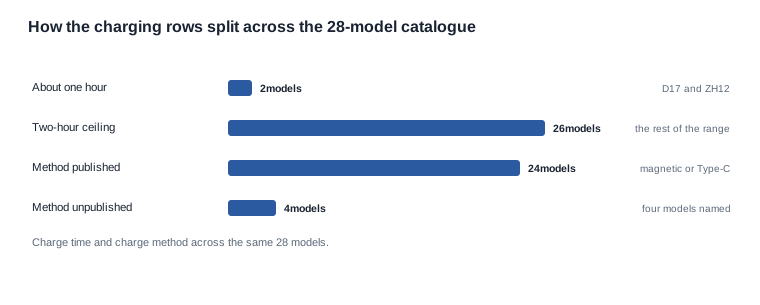
What the catalogue states for the D12 is a battery of 100 mAh, a charging time carried with a 2-hour ceiling, and a charging-method row that exists in some form. Twenty-six of the 28 models in the range carry that 2-hour ceiling; only the D17 and the ZH12 carry an approximately one-hour figure instead. That ratio matters for the way you write a specification line, and it is worth pausing on before moving to the parts the catalogue leaves out.
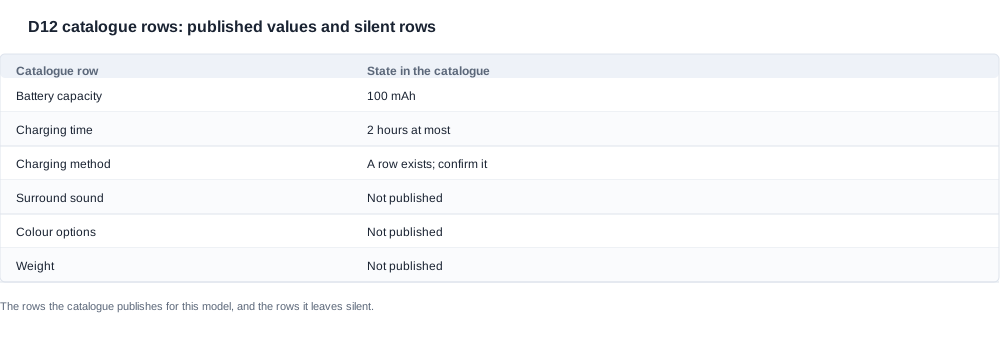
The rows this model does not carry are just as decisive. There is no surround-sound label: the only model in the range publishing surround as such is the D11, and the D17, ZH12 and YK12 carry separate stereo or surround wording of their own. There is no colour row: the two models that publish one are the V03 Pro, with three colours, and the V06, with four. There is no weight row, because only the MT6 publishes a weight at 158 g. There is no camera-resolution row, and that one is structural rather than an omission: resolution is published for eight models at 8MP and three at 13MP, and this is an audio model rather than a camera model.
The charging case is the row people argue about most. Capacity is quoted for 5 models of the whole catalogue, 2 carry a case with no figure attached, 3 have no case line, 1 records explicitly that no case is supplied, and 17 rows never raise the subject. The practical consequence for a programme is simple: a case is never something you can infer from silence. Ask.
Certification works the same way. The catalogue's export certification page is an image page: it presents ten patent certificates, eight of them design patents and two of them utility models, as pictures. There is no CE text, no FCC text and no RoHS text anywhere in the catalogue, so the page answers a different question from the one a buyer usually asks it.
The decision this section leaves you with is about how much of your own specification you are allowed to write before the answers arrive. The rule that keeps programmes out of trouble is short: a row that exists is a row you can plan around, and a row that is missing is a row that has to be closed in writing before it can be planned around at all.
D12 smart glasses how to customize: the rows to close first
Customisation for a model with this many open rows is not a design exercise, it is a closure exercise. The sequence below is ordered deliberately, because each closure depends on the one before it, and the order protects the expensive work — the artwork and the packaging — from having to be redone.
- The electrical core. The battery is 100 mAh and the charging time is carried with a 2-hour ceiling. Ask what state the cell starts from when that figure is measured, what power source is assumed, and whether the ceiling refers to the headset alone. The artefact that closes this row is a written specification naming the model, with the conditions attached to the number.
- The acoustic configuration. The catalogue carries no surround-sound label for this model, which means the audio row is open rather than negative. Ask what the driver and amplification configuration actually is and what the supplier will put in writing. If your listing copy depends on a surround claim, note now that the catalogue does not carry one for this model, so the claim needs its own written basis.
- The retail set. Decide whether the programme ships with a case at all. Ask whether a case is available for this model, how it charges the pair, and whether it is a magnetic-contact unit or a cabled one. Only five models in the range publish a case capacity value, so this is exactly the kind of number that cannot be assumed.
- The physical brand surfaces. Work through the front face, the temples, the hinge area, the port area and the control buttons. Ask which print or engraving methods are available for each surface, what the minimum run per method is, and how the mark behaves after handling. Note that the range publishes no capacitive touch, gesture or swipe control row anywhere, so a specification sheet that says "touch control" for this model is describing a feature that has no published row behind it.
- The naming layer. Fix one name, one spelling and one case style for the device, the paired app entry, the retail carton, the instruction leaflet and the inspection sheet. Do this after the hardware questions, not before, because the method of marking the shell can depend on what the shell is.
- The compliance pack. Request the documents the destination market requires, as documents with reference numbers and dates, rather than as a page on a website. A catalogue page of patent certificates is a different artefact and will not satisfy a compliance reviewer.

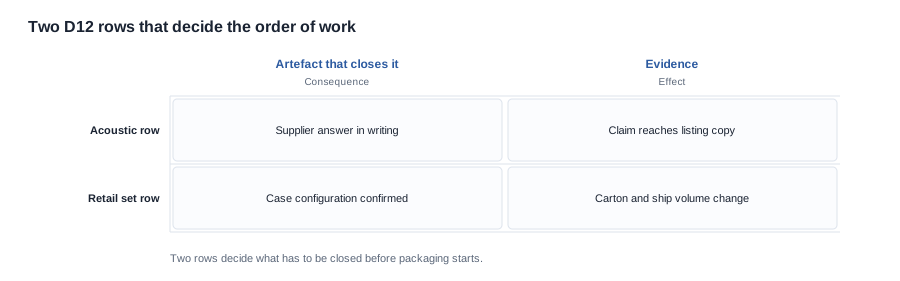
When the schedule compresses and every row cannot be closed in full, close them in this order: electrical, acoustic, retail set, brand surfaces, naming, compliance. The reason is the cost of an open row, and the order of that cost is not the order of the list above. The acoustic row is the most expensive to leave open, because it is the row that ends up in listing copy and in the marketing you cannot retract. The retail-set row is next, because a case decision changes the carton, the insert tray and the ship volume. The naming row is third, because it is printed on both the device and the packaging and a mismatch is caught by an incoming inspector rather than by you.
The battery and charging rows behind a D12 purchase decision
Two numbers do most of the work in the electrical row: 100 mAh, and a charging time carried with a 2-hour ceiling. Both need a condition attached before they are allowed into a specification sheet, and the discipline is worth stating plainly because it is the easiest place for a catalogue value to be turned into a marketing claim by accident.
A ceiling is not a typical figure. Twenty-six models in the range carry the same 2-hour ceiling, and only the D17 and the ZH12 publish an approximately one-hour charge instead. That pattern tells you the catalogue is publishing a maximum rather than a benchmark, so a sentence written as "charges in under two hours" is not what the row says — it is a claim the row does not support, because the row states a limit of 2 hours and says nothing about how long a typical charge takes. If the line on your product page needs to describe charging, the honest wording keeps the ceiling and adds the condition the supplier gives you.
The conditions worth asking for are short and specific. From what state does the figure start, and to what state does it end. At what ambient temperature. From what kind of power source. Does the figure describe the headset alone or the headset in its case. And separately from the timing: what connector standard applies, and does the unit ship with a cable and a plug. The range publishes two charging methods overall — magnetic contacts and Type-C — and only four models leave the method unpublished, the L1 Pro and the CY03, and the MT6 and the CY05, so twenty-four of the twenty-eight models carry a method row and this model's row exists and can be confirmed rather than guessed.
The case interacts with all of this, so it is worth deciding early whether the programme includes one. If it does, the case needs its own row: whether the case charges the pair by magnetic contact or by a cable, whether the case is itself rechargeable, and what capacity, if any, is published for it. Only five models in the range publish a case capacity value, two publish a case without one, and the remaining rows are silent or explicit in their own way. A programme that specifies a case without specifying the case's charging behaviour inherits that gap into the carton and into the after-sales conversation.
Written properly, the electrical line is short and conditional: the cell value as published, the charging ceiling as published, the conditions the supplier has confirmed, and nothing else. The shape of it is a line that states the published cell figure, states the charging ceiling rather than a typical duration, and appends the measurement condition the supplier has given in writing. No derived endurance figure, no comparison with another model in the range, no claim that the device charges faster than something else. Buyers who receive a specification written in that form tend to skip the second round of questions, and that is the practical return on closing this row properly.
The second decision here is a trade-off between asking and waiting. Every condition you request adds days to the programme before the specification can be finalised, and every condition you skip moves the uncertainty into the stage where it is most expensive, which is the listing copy and the carton. The rule that holds up in practice is to ask in writing for the conditions a customer will ask about later, and to accept that some of them may never be answered.
Endurance is a separate line and deserves its own treatment. Buyers ask about running time more often than any other specification, and the honest answer is a condition rather than a number: the supplier's own statement of what is measured, from what state, at what volume level, with what content playing. Ask for that statement in writing, and write the condition next to the figure on your listing. The decision you are making at this point is whether the programme needs a running-time claim in its copy at all. If it does, it needs a written condition before the claim ships; if it does not, the specification sheet should stay silent rather than borrow a figure from another model in the range.

Putting the D12 name on the purchase order and the inspection sheet
Naming is the least glamorous part of a private-label programme and the one most likely to be missed, because nothing goes wrong on the day the samples arrive. It goes wrong at the carton, in the channel, when a customer opens a box that says one thing while the product inside says another.
The model designation and the brand are not the same thing, and the confusion between them is worth naming precisely. The designation is the internal code that ties a unit to a supplier's catalogue row, a purchase order line and an inspection record. The brand name is what the end customer sees, and it is the only part most programmes are trying to change. Both have to appear, they have to be traceable to each other, and they have to be spelled the same way on every surface that carries either one. The surfaces are the device shell, the paired entry in the app, the retail carton, the instruction leaflet and the inspection sheet that accompanies the shipment.
The inspection sheet is where naming becomes enforceable, and it is worth building it as a set of pass or fail lines rather than a description. A workable sheet for this model covers the following checks, and each line should have a named owner on the incoming side:
- The mark on the shell is legible, correctly placed and free of smudging or cut-through.
- The mark survives the agreed handling test rather than only the sample unit.
- The charge indicator behaves as expected at plug-in and at the end of the cycle.
- Sound output and the call function work on the sample as they will in the field.
- The control buttons respond, and no listing claim depends on a touch or gesture surface.
- The carton artwork matches the approved proof version, down to the spelling of the name.
The ordering rule matters as much as the checklist. Approve the device mark first, then approve the carton artwork against that same proof, then release the inspection sheet. The reverse order is the common failure, and it is expensive: a carton printed against a name that later changes cannot be reprinted without scrapping the print run, while a device mark that changes afterwards can still be corrected at the assembly stage. Two red flags are worth naming for buyers who have seen them before. The first is a supplier artwork file that arrives with a different brand name in it from the one in the purchase order. The second is a listing that has already gone live with copy that describes features the catalogue rows never published for this model.
The decision this section leaves you with is a signature. Someone has to sign the inspection sheet against the approved proof, and someone has to be accountable for the spelling. In a small team that is the same person; in a larger operation it is usually the person who approved the artwork, because that is where the knowledge sits.
Building the D12 evidence file before a first bulk order
An evidence file is not a folder of photographs. It is a set of rows that have been closed in a way that survives a new person joining the project in six months. The rule that makes it work is narrow and absolute: nothing counts as settled until a dated written document names the model and states the answer in words a specification sheet can quote.
The file for a programme built on this model has six parts, and the order in which you fill them is the order of how fast they decay.
- The catalogue extract. A dated snapshot of the rows as they stand, with the reference to where each one is published. It is the baseline against which every later answer is checked, and it costs minutes to keep.
- The written answers. The supplier's answers, in email or on a signed specification sheet, each one naming the model. This is the part that decays fastest, which is why it comes first when time is short: a verbal answer leaves the project when the person leaves the call.
- The sample record. Photographs of the sample units, the marks, the packaging, and dated notes on what was tested and what was observed. One sample, photographed well, settles more arguments than three samples described from memory.
- The artwork proofs. Versioned proofs with approval dates and a named approver, so that the carton in the channel can be traced back to the file that authorised it.
- The market documents. The certificates and declarations the destination market requires, filed with the reference numbers and issue dates that the supplier quoted.
- The inspection sheet. The signed acceptance record, attached to the shipment it covers, so that a later dispute is a comparison of two documents rather than two memories.
The priority order matters when the schedule will not allow all six. Written answers first, because they are the only part that evaporates; the sample record second, because it settles the observations; the catalogue extract third, because it can be rebuilt in minutes; artwork proofs and market documents follow, because they are produced as part of the production process itself.
The cost of leaving a row open at the wrong moment is the thing to guard against. An open row in the file is harmless. An open row that has already been copied into listing copy, into a carton artwork file or into a trade-show sheet is a liability with a print run attached. The decision to make is blunt and needs no committee: every claim that appears in a customer-facing document must map to a row in the file, and every row in the file that has no answer must map to a sentence that has been removed from the customer-facing document.
One page is enough to hold this, and one page is what a buyer can actually keep current. A short checklist of the open rows, with the artefact that closes each one and a named owner against each line, sits at the front of the file and is the only page that goes to the meeting. The total cost of a row that stays open is easy to underestimate and easy to state: it is the rework at incoming inspection, the reprint of a carton that carried the wrong name, and the delay to a listing that waits for a claim nobody has confirmed. Before you order anything on this model, run the due diligence once against that page. The questions to ask are short, the red flags are obvious, and the criteria are the ones set out above.
Where CYNRIN stands on the D12's open rows
Where CYNRIN stands on the D12's open rows. We do not publish capacity figures, weights, colour options or certification references for this model that the catalogue does not carry, and we will not fill a silence with an estimate that reads like a fact. We will send the catalogue rows as they stand, with the date on them, and we will answer the specification questions on paper so that your evidence file and ours say the same thing. Where the catalogue is silent, our answer is the question to send, not a number to guess.
That position leaves the decision where it belongs, with you, and it is a sequencing decision rather than a verdict on the model. If your brief needs a published surround-sound label, the D12's rows do not carry one and the honest move is either to obtain a written answer from the supplier or to screen for a model whose published rows match the brief. If your brief needs a charging case, the catalogue does not settle the question for this model, so it becomes a question to ask rather than a feature to promise. If your brief needs a roughly one-hour charge, this model is not among the two that publish it, and that is a reason to send the question early or to change the brief. None of those three outcomes is a judgement about the product; each one is a description of where the published evidence ends and where your file has to take over.
The two pieces of related reading below go further on the two questions buyers raise most often after the specification stage. The D12 fit guide works through the working conditions this model is screened against, which is a faster way to decide whether it belongs on a shortlist at all. The D12 limitations article collects the friction that shows up once a programme is running, and it is worth reading before the first order rather than after it. The line of models this one sits within is on the Bluetooth audio glasses page, if you want to see the range it is being judged against.
Send the specification questions first. The order sheet should follow the answers, not the other way round.


