
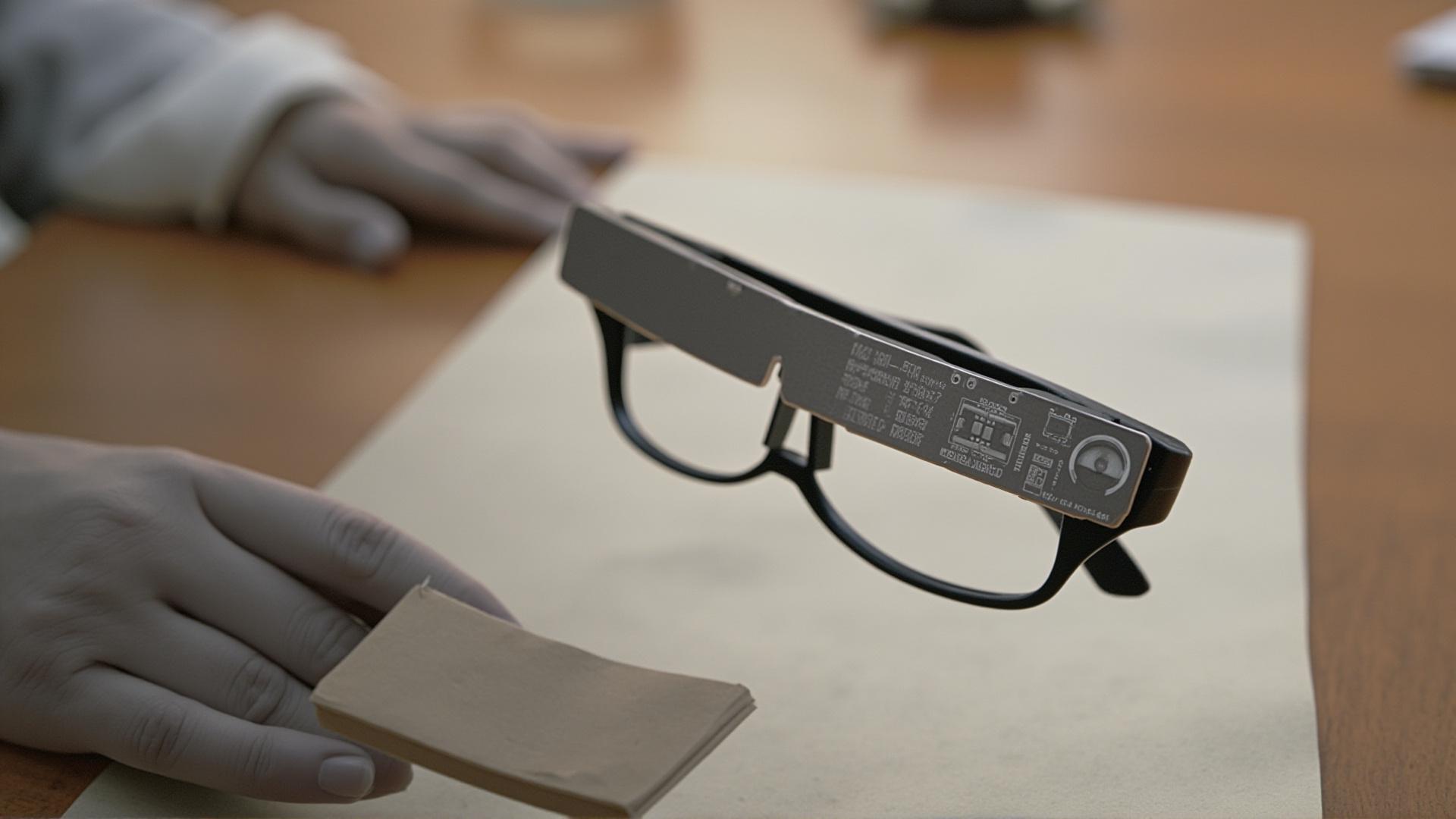
The D12 publishes five rows: Bluetooth V5.4, a 100 mAh cell, a charge time of two hours or less, about seven hours of rated use and Type-C charging. It publishes no acoustic descriptor at all — no surround-sound row, no driver figure, no frequency response — and it is the only model in its own 100 mAh group without one. Eight further rows that a buyer would reasonably expect are missing, and one of them is more consequential here than on any neighbouring model: the frame weight.
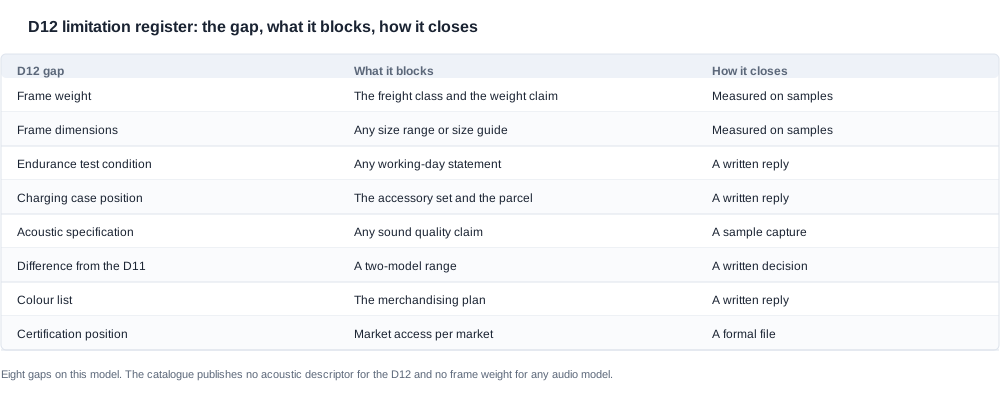
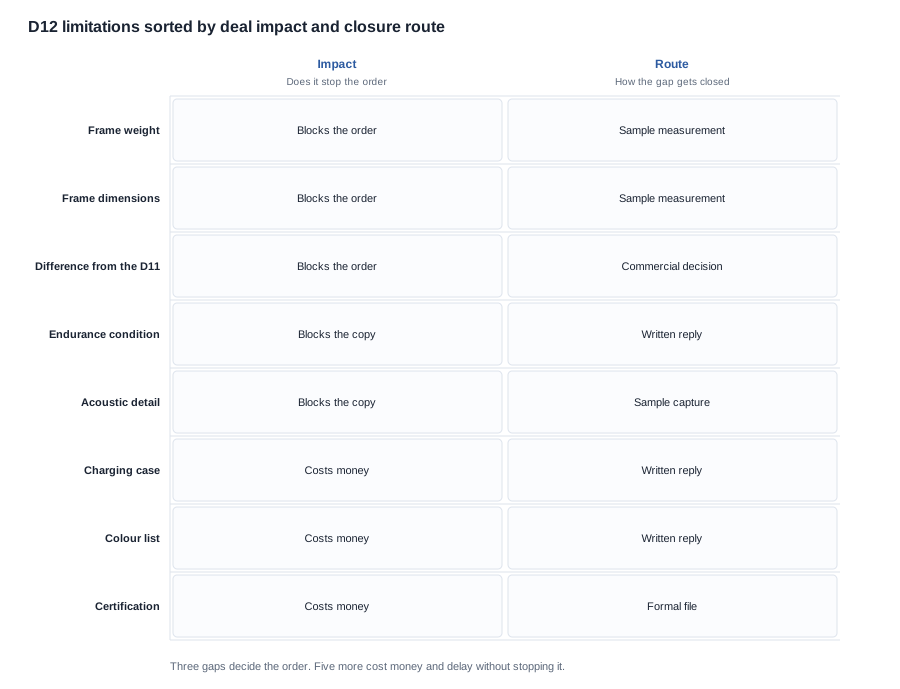
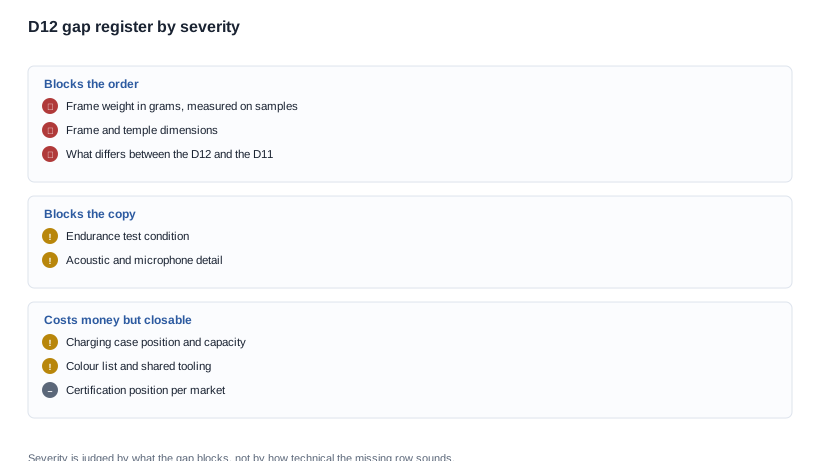
The useful way to read a limitation list is not as a list of complaints but as a register of decisions. For each missing row, ask one question: what does this gap actually prevent? Three of the D12 gaps prevent a decision being taken at all. Five of them cost money and delay without preventing the order. And one of them — the certification position — is a programme item with the longest timeline in the list, and it should be started earlier than the others rather than later.
D12 limitations: the gap register and why the weight comes first
No frame weight is published for the D12, and no frame weight is published for any audio model in this catalogue. The only frame weight our documentation holds anywhere belongs to the MT6 — the glasses body including its battery and camera, excluding its folding charging case — which is a camera model on a different platform with a different cell, and it cannot be borrowed for an audio frame.
That absence is cheap to close and expensive to leave open. It is a fifteen-minute job with a scale, and it decides three things at once: whether the product can be described with a figure rather than an adjective, the freight class of every shipped unit, and the return exposure that follows from a frame nobody can size. The weight comparison across the audio range sets out why the published figure in this catalogue does not transfer, and the cheapest item on the whole register is weighing three samples.
Why it comes first rather than fourth. A buyer who closes the weight gap after the artwork is committed has already decided the copy. A buyer who closes it first can write the specification line, set the freight assumption and set the acceptance criterion together, and the rest of the programme inherits a settled number rather than a placeholder. The other seven gaps can all be closed in parallel; this one cannot be closed in parallel with anything that depends on it.
The register in priority order, and what each closure buys you
A register is more useful when it is ordered, and the ordering is not the same as the order in which the gaps are usually noticed. This is the sequence we would work to, and the reason for each step.
First, the weight and the dimensions. These come from the same three sample units in the same session, so closing them together costs one handling event rather than two. What the closure buys is the freight assumption, the acceptance criterion and the ability to write a specification line — three things that everything downstream inherits.
Second, the difference from the D11. Not because it is harder, but because it changes the size of the order rather than its description. If the answer is that nothing differs, the buyer's range plan has one fewer line and the packaging artwork has one fewer version. That decision is cheaper to take before the artwork than after it.
Third, the endurance condition and the acoustic detail. Both are asked in the same message, because both are answers that exist in the factory's records and neither needs a sample. What they buy is the copy: without the condition the seven-hour figure stays a rating, and without the acoustic detail the product page has no sound claim to make.
Fourth, the charging case position and the colour list. These are accessory and merchandising questions that carry lead time rather than risk. What they buy is a carton specification and a date.
Last, the certification position. It is last in priority and first in calendar time, because its timeline belongs to a testing body and to a destination market rather than to the supplier's reply speed. Start it in week one; close it wherever it falls in the list.
The trade-offs are real, and so is the priority order. Every hour spent on a documentation gap is an hour not spent qualifying the channel, and the temptation in a range programme is to close the paperwork before the product is right. The rule that survives is simple: close the gaps that change what you order before the gaps that change what you write, and start the timeline you cannot compress before the ones you can.
The seven D12 gaps that follow the weight
Frame dimensions and temple length. Not published, so a size guide cannot be written and a size range cannot be built. The geometry analysis for open-ear frames covers why the geometry of an open-ear frame decides whether the audio is acceptable at all, and it is the second item to close for the same reason as the weight — both come from the same three sample units in the same session.
The endurance test condition. About seven hours, with no condition published. The condition is not a footnote on any product, and on this one it also decides whether the rated figure can be compared with the ratings on the two-cell models at all. The D12 battery life analysis covers this in more detail.
The charging case. No charging-case capacity is published for the D12, so whether a case exists and what it holds are both open. The charging options analysis covers the accessory economics, and the shipping weight analysis covers how to establish the parcel number once the accessory question is answered.
The acoustic and microphone detail. No driver size, no frequency response, no sound-field description, no leakage figure and no microphone pickup distance — and no surround-sound row, where the D11 publishes one. On a model whose published feature set is otherwise empty, this is the gap that stops a product page from making any sound claim at all.
The difference from the D11. The two models publish identical rows apart from the acoustic descriptor, and our documentation does not state what else separates them. The D11 versus D12 price positioning analysis works through what each possible answer means commercially, and the compliance point matters here too: a certificate that names the D11 does not automatically cover the D12.
The certification numbers. No document in our material names this model, and our catalogue's text contains no reference to CE, FCC or RoHS anywhere. The certification status for this model sets out the items to request.
And the colour list, which nobody raises until the artwork is due and which then becomes a tooling cost and a lead time that was never in the plan.
What the single-cell architecture does and does not tell a buyer
The D12 and the D11 publish a single 100 mAh cell; the other six audio models publish a two-cell configuration. That difference is published, and it is worth being careful about how far it can be taken.
What it does settle. The accessory chain, because a Type-C frame charges over one standard cable and needs no dock in the box. That makes the D12's parcel the simplest in the audio range and removes a whole category of field failure, since a lost cable is replaceable on any street rather than being a reason to return the product.
What it does not settle. The catalogue does not publish where the cell sits in the frame, how the mass is distributed between the temples, or which side the charging port is on. A single-cell architecture is frequently arranged to balance, and it is sometimes not, and our documentation does not say which applies to this model. Any claim that the D12 is balanced or asymmetric would be an engineering assertion the catalogue cannot support, and it is exactly the kind of assertion that a reviewer's hands will disprove in the hand.
So the honest question for a buyer is a measurement question, not an inference. Put three units on a scale. Record the weight, and record it with the cell fitted and the case excluded, so that the figure can be compared against the one published weight in the catalogue on the same convention. Then note where the mass sits when the frame is held, and record that as an observation rather than as a specification.
And the same discipline applies to the comparison with the two-cell models. A single 100 mAh cell against a 90mAh*2 configuration is a comparison of architectures, not of weights, and no weight can be derived from either without measuring. The D12 versus G07 form factor comparison works through the pair where the architecture difference is widest, and the published D12 specification list is the row-level baseline for this model.

What the D12 publishes and what a buyer can build on it
A limitation list that only lists gaps is not usable, because the buyer still has to decide. Here is what the D12 genuinely provides, stated at full strength.
The simplest parcel in the audio range. No published charging case and a standard cable means no proprietary accessory in the box, a smaller carton, no second lithium cell in the parcel unless a case is added, and no dock-loss return reason. For a direct-to-consumer channel that is worth more than most specification rows, because it changes the delivered cost, the carton specification and the after-sales exposure at the same time.
A published radio version and a published interface. Bluetooth V5.4 and Type-C are both published, which means a compatibility statement, a pairing instruction and a support script can be written from the documentation rather than sourced from the factory.
A narrow compliance surface. No camera module is published for this model, so the file that has to be assembled is a radio and battery file rather than anything involving imaging, and the transport paperwork is a single-cell file. That is a materially lighter documentation load than the camera models in the same catalogue.
And a rating that is honest about being a rating. About seven hours, published without a claim attached to it. A rating with no condition is imperfect, but it is also the form in which the figure can be passed around safely, because a rating cannot be disproved by a customer who expected something else.

A shortlist test for whether the D12 is the right model for this brief
How to choose between the D12 and the alternatives comes down to four questions, and they are worth answering before any specification is written rather than after.
Does the channel need a named acoustic feature in the copy? If yes, the D12 is out, because our catalogue publishes no acoustic descriptor for it. If no, the D12 stays in and the acoustic gap stops being a gap.
Does the customer need to be able to replace a charging cable? If yes, the D12's Type-C arrangement is the better answer than any magnetically charging model in the range, because the cable is replaceable anywhere. If the proposition is a dock-led ritual at the desk, the magnetically charging models serve it better.
Does the brief need a rated endurance figure of about eight hours? If yes, the D12 does not meet it on the published row and the question becomes whether its own measured figure closes the gap. If the brief is convenience rather than endurance, the rated seven hours is enough and the D12 stays in.
Does the range need two models, and can it say why? If the answer is that the range will be a volume model and a feature model, then this pair works only if the feature axis is the acoustic descriptor — which the D12 does not carry. If the range will be a volume model and a different-configuration model of the same product, then the terms, not the rows, decide it.
The signs that the D12 is the wrong model are worth naming too. A channel whose listing copy needs an audio claim. A programme that depends on the customer charging at a desk rather than from a cable. A range plan that needs a feature ladder and has only two models in it. And a specification sheet that already carries a weight figure from another model — that figure has to come out before the sheet is issued.

Turning each D12 gap into a purchase order clause
The practical value of a limitation register is what it lets you put in writing. Each gap converts into a clause, and a clause that names a value and a verification method survives the handover from the procurement desk to the quality desk.
For the weight, the clause names a figure and a tolerance. "The frame weight shall be X grams with the cell fitted and the case excluded, verified on three units from the first shipment against a stated tolerance, with a re-weigh right on the first consignment." That is the kind of clause that turns an open row into an acceptance criterion.
For the endurance condition, the clause attaches the workload to the number. "About seven hours of rated use with the camera inactive, radio connected, at the stated volume, or the buyer's own measured figure with the condition attached." A number that travels without its condition is a number that becomes a dispute.
For the acoustic detail, the clause names the sample evidence. A capture under stated conditions, retained as the reference file, rather than a written characterisation that no document supports.
For the D11 difference, the clause records the supplier's answer. Attach it to the product file, reference it from the purchase order, and state what happens if the answer changes before the order is placed.
For certification, the clause records the file per market. The market, the document, the issue date, the validity period and the model designations covered, with the obligation to report any change that invalidates it.
And for the charging case and the colour list, the clauses are about the configuration. Which configuration is ordered, what is in the box, and who owns the artwork if the colourway changes later.
A checklist for the limitations register
The questions on this register are easy to send and easy to answer badly, so the criteria for judging a reply are worth writing down before the replies come in.
- How to evaluate a weight answer: a figure in grams for the frame with the cell fitted and the case excluded, with the number of units measured and the spread across them.
- How to evaluate a dimensions answer: frame width, lens width and height, bridge and temple length, with the temple's adjustment range if the temple adjusts.
- How to evaluate an endurance answer: the workload, the volume, the codec and whether the radio was connected, with the figure given as a mean rather than a best case.
- How to evaluate a case answer: whether a case exists for this model, its capacity, its own weight, its interface and whether it is sold separately.
- How to evaluate an acoustic answer: a capture under stated conditions retained as a reference file, rather than a description of the architecture.
- How to evaluate a D11 answer: the difference in the supplier's own words, and whether it applies to the configuration being quoted.
- How to evaluate a certification answer: the market, the document, the issue date and the model designations covered.
The red flags to watch for are the same across all seven: an answer given for the family rather than for the model designation, a figure with no date, a best case offered where a mean was needed, and a certification answer naming a sibling model. When you assess a reply against a written criterion you can show the reasoning to a colleague, and when you assess it against an impression you cannot.
Sequencing the closure when you cannot close all eight at once
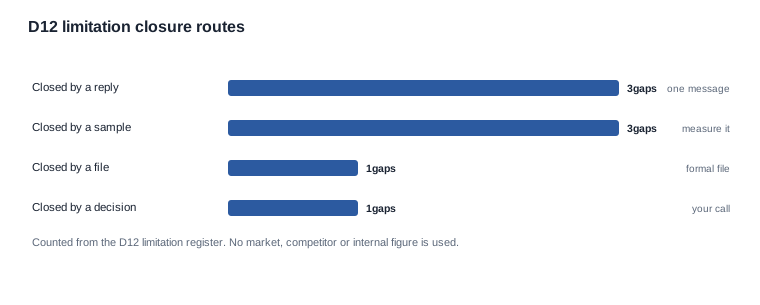
Most procurement conversations do not fail because a supplier refused an answer. They fail because eight open rows arrived at the same time, the programme date did not move, and the team closed the easy ones first. The weight is easy to close because one person with a scale can close it. The acoustic descriptor and the certification file are hard, because they need a document and a named market.
Sequence them by what an answer unlocks rather than by how quickly it can be obtained. The weight unlocks the acceptance criteria for every other row, because a tolerance attached to a figure is what makes that figure usable in a purchase order. The certification scope unlocks the market plan, because a file that does not cover the destination market does not move the product into that market at any price. The D11 difference unlocks the range, because it decides whether the D12 is a standalone line or one half of a ladder.
Three rules keep that sequence honest. First, no row is closed by the buyer's assumption — an assumption is an open row with a deadline attached to it. Second, every closed row carries its condition: the unit count, the workload, the date, the market. A figure without its condition reopens at the first dispute. Third, a row that cannot be closed before the order date is written into the order as an acceptance condition rather than left in the request folder.
Which of the eight gaps matters most depends on how your customer uses the product rather than on the model itself, which is why the application, the expected routine and the target markets are worth more to us as a starting point than a request for a full specification dump.
Where our D12 position on the gap register sits
The D12 is a straightforward product to ship and an awkward one to describe, and the weight gap is the one worth closing first. We will not present the D12 as having a surround-sound feature, because our catalogue publishes no acoustic descriptor for it — and the absence is worth more than a borrowed label would be, because it is the fact that separates this model from the D11 on the published page. We will not present the seven-hour figure as a working day. We will not quote a weight, a frame dimension, a case capacity, a colour list or a certificate number that the documentation does not contain, and we will not use the MT6's published 158 g as a stand-in.
We will also not read engineering conclusions into the single-cell architecture. Where the cell sits and how the mass is distributed are not published, and we would rather ask for the measurement than publish an inference that a reviewer can disprove in a minute.
The published D12 specification list is the honest baseline, and the commercial case for the D12 covers what the published rows are worth once they sit inside a range. Send us the application, the expected routine and the markets, and we will tell you which of these gaps matters most for the way your customer uses the product.
Related reading
- The data published for this model — D12 smart glasses specifications and features
- The commercial grounds — D12 smart glasses best for
- The weight question — bluetooth audio glasses weight comparison
Send us the application, the expected routine and the markets, and we will tell you which of the eight gaps matters most for the way your customer uses the product.


