

The honest answer to a question about which model is best for a given use is that the answer depends on inputs we do not publish, and that any confident verdict offered from a catalogue page is doing something other than reading the catalogue. For the D12, the published record runs to six lines: the radio version is Bluetooth V5.4, the cell is 100 mAh, the charge ceiling is two hours, rated use is about seven hours, charging is Type-C, and there are no feature lines at all. What is missing from that model is most of what a comparison would need: no surround-sound row, no charging-case row, no frame weight, no price, no acoustic or microphone figure, and no per-model certification row. A verdict built on that record would be a verdict built on six rows, five of which describe power and one of which describes a radio. So this page does something different and, we think, more useful: it sets out the evaluation frame that a buyer can run themselves, the four working conditions that decide the D12, the conditions under which the D12 leaves the shortlist before a sample is even ordered, and the questions that have to be answered in writing before any of it becomes a purchasing decision.
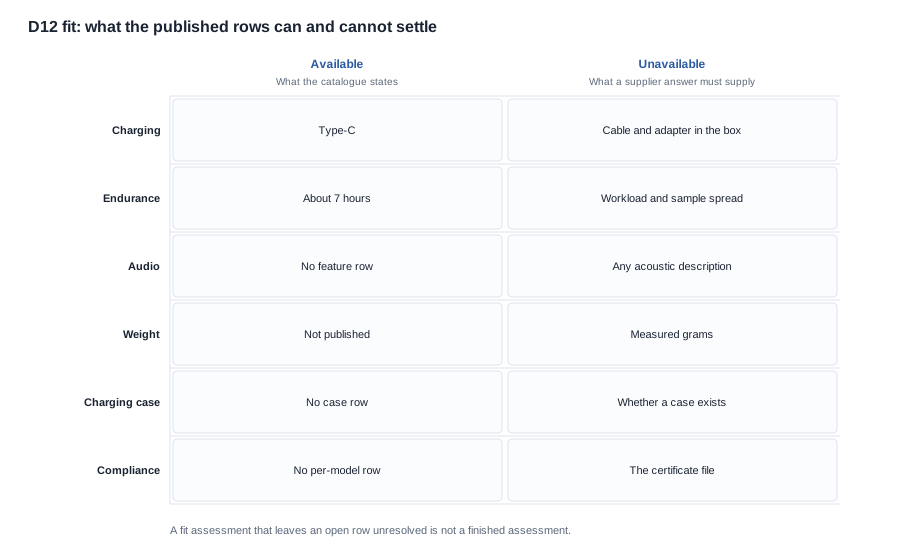
D12 fit: an evaluation frame rather than a verdict
Why the question has to be reframed
The word best is doing two jobs in a question like this, and only one of them is answerable. The first job is identifying the conditions under which a model makes sense, which is a question about the published rows and can be answered. The second job is ranking models against each other inside those conditions, which requires price, cost, demand and the unpublished rows, and cannot.
The frame below separates the two. It starts with the working conditions, scores each of them against the published rows, marks the conditions that no published row can settle, and ends with a written list of what has to be obtained. A buyer who runs that frame gets a defensible shortlist and a documented list of open items. A buyer who wants a single name gets one only from a source that is also willing to publish the numbers behind it.
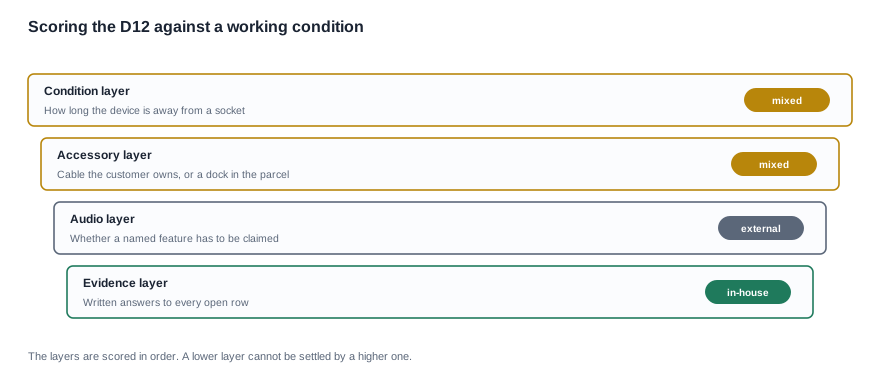
The four layers of the evaluation
The layers are scored in order, because a lower layer cannot be settled by a higher one.
The condition layer. How long the device is away from a socket, how often the customer has to handle it, and whether the charging environment is a desk or a moving site. This layer is scored against the endurance and charging rows, and it is the layer that eliminates models fastest.
The accessory layer. Whether the customer already owns a Type-C cable, whether a cable or dock ships in the box, and what that does to the parcel. This layer is scored against the interface row and the absence of a case row.
The audio layer. Whether the channel's copy has to name a specific audio configuration. The D12 publishes no feature line, so this layer either goes to a written supplier answer or it goes nowhere.
The evidence layer. The documents that have to travel with the product for the target market, and whether they name the exact model designation. This layer is never settled by a catalogue page, because the catalogue publishes no per-model certification row.
What the frame produces at the end
Three outputs, in this order. A statement of which conditions the published rows settle, and what that means for the D12 in each. A statement of which conditions are open, and the written question that closes each one. And a decision on the channel's own requirement set, expressed in conditions rather than in a model name, because the model that satisfies the requirement set may change once the answers arrive.
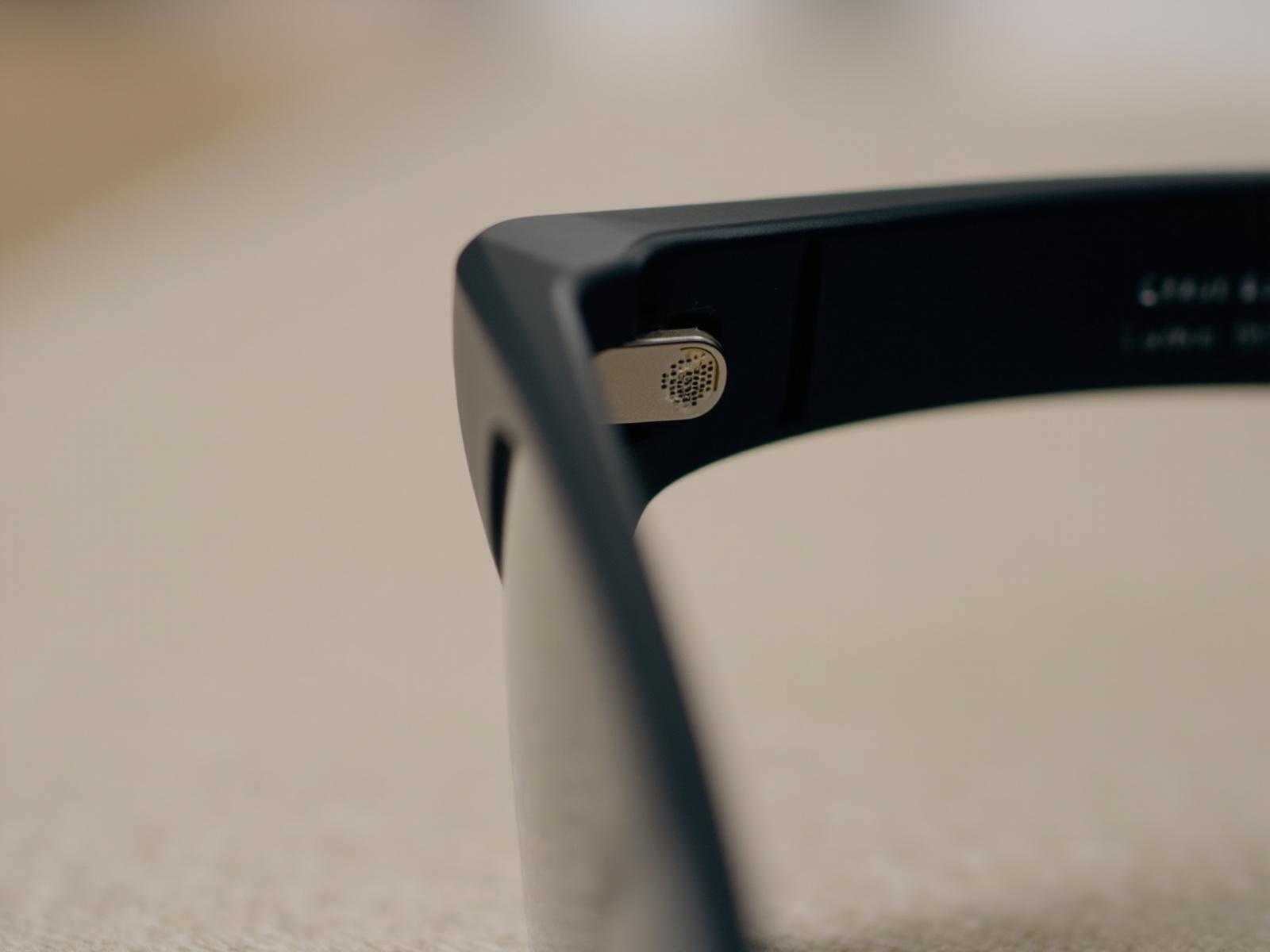
Four working conditions to score the D12 against
Condition one: the charging environment is a desk or a site
This is the condition the D12's published rows speak to most directly, and the answer differs sharply between environments. A Type-C product can be charged from a wall socket, a power bank, a laptop or a phone, and the customer owns the cable in most cases. A product that has to be placed on a dock can only be charged where the dock is.
For a channel whose customers sit at a fixed desk, a fixed point in a warehouse, or a counter in a store, the D12's published rows are sufficient for this condition: a cable is a smaller accessory commitment than a dock, and the parcel stays small. For a channel whose customers move between sites, the same rows mean the charging moment has to be planned, and the question of whether a charging accessory is supplied becomes a commercial term rather than a detail.
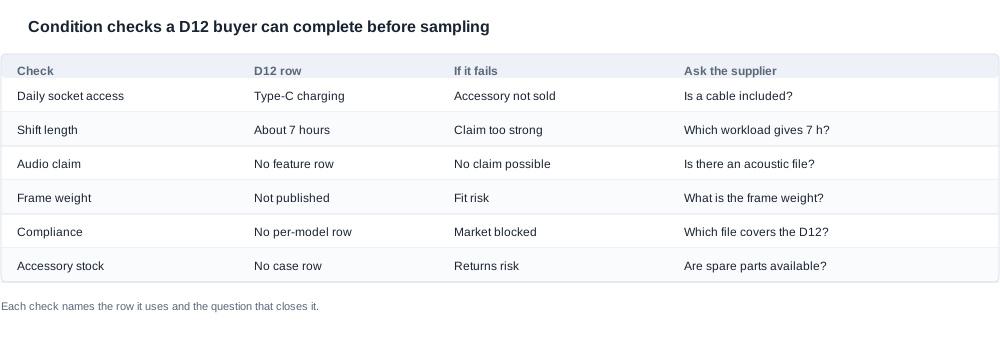
Condition two: the working period is close to the published figure
The D12 publishes about seven hours of rated use. A working period of seven hours or less is compatible with that figure as a rated statement. A working period of eight hours or more is not compatible with it, and no arrangement of the copy changes that, because the figure carries no published workload.
The practical treatment is to treat the D12 as a product for a customer who charges during the working period, and to design the channel around that rather than to argue about the number. Where the working period is longer and cannot be changed, the D12 has to be compared against models that publish a longer figure, and the comparison has to be made on a measured basis rather than on the published rows, because the published runtimes across this range are not comparable with each other.
Condition three: the copy has to name a specific audio configuration
The D12 publishes no feature line. That is the only feature row in the pair, and it matters more in a copy-driven channel than the endurance figure does, because a listing page that says nothing specific about the product is a listing page with no reason to be chosen over a competitor.
So this condition splits three ways. If the channel needs a named configuration, the D12 requires a written acoustic description from the supplier, and until it arrives, the copy has to stay inside what the five published rows support. If the channel can run a specification-led listing with a clear price and a clear charging story, the D12 is not disadvantaged by the absence of a feature line. If the channel has no listing copy at all and sells on a brand relationship, the condition barely applies.
The absence of a feature line is not the absence of a configuration, and the distinction has to be held carefully. The catalogue does not describe the D12's acoustic configuration in either direction, so the only honest statements are that the page carries no such row and that the answer has to come from the supplier.
Condition four: the market requires documentation the catalogue does not contain
One export certification page appears in our catalogue, at company level, and it is pictures rather than text; no CE, FCC or RoHS reference appears in the catalogue text. There is no per-model certification row anywhere, and that page lists ten patent certificates — eight for appearance designs, two for utility models — which is a statement about the company rather than about any model.
For a channel selling into a market that requires a per-model file, this condition decides the timetable before it decides the product, because the document has to be requested, inspected and matched to the exact model designation before a shipment can move. A buyer who discovers that requirement after the packaging is printed has a redesign, not a negotiation.
Where the D12 is ruled out before the sample
Three exclusion conditions
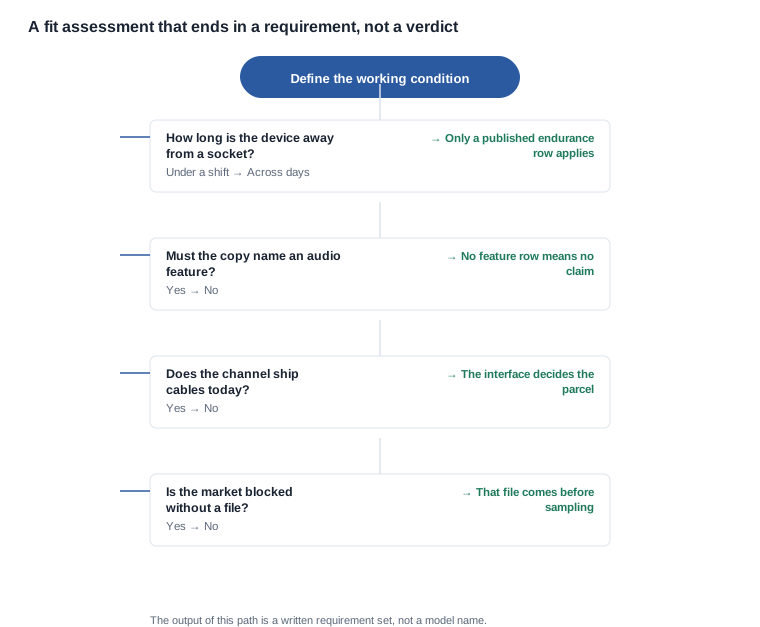
An evaluation frame is only honest if it can produce an exclusion, and for the D12 there are three that apply before anybody touches a sample.
The customer is away from a socket for more than a shift. A single 100 mAh cell publishing about seven hours, with no charging case row published, does not support a multi-day pattern. The models in this range that publish about eight hours do so with paired cells, and none of them publishes a case capacity for the audio models either, so the accessory that would extend the pattern is not documented for any of them. A channel whose customers work away from power for days should treat the audio models as a category with a structural constraint, and should look at a different product category entirely.
The channel requires a named audio configuration in the listing and the supplier cannot document one. This is an exclusion that can be triggered by a refusal as much as by a fact, and it is better to discover it in writing before the packaging is committed.
The target market requires a per-model certification file and the supplier cannot produce one that names the D12. A statement that the product is certified is not a file, and a file for a sibling model with the same specification is not a file for the D12.
The conditions that cannot exclude
Two published facts that buyers sometimes treat as exclusions are not. The absence of a surround-sound line is not a reason to exclude the model from an audio channel, because the absence of a line is a fact about the page. And the about-seven-hour figure is not an exclusion on its own, because it is compatible with a working period of seven hours or less and with a charging moment during the shift.

Comparing the D12 against the published range
Structural position, and what it is worth
Within the audio range, the D12 belongs to the single-cell, Type-C group, and the D11 sits in it too: same cell, same interface, same charge-time ceiling and same rated runtime, with a surround-sound line and a long-battery-life line of its own. The rest of the audio range publishes paired cells, magnetic charging, Bluetooth V5.3 on the K01 and the K02, and Bluetooth V5.4 on the LC-105-1 and the LC-105-2, with the G07 and the YK12 publishing about six hours and the K pair and the LC pair publishing about eight.
What that structural position means is precise and limited. The D12 shares an accessory logic with one sibling model and differs from the rest of the range in the interface, which is the cheapest accessory path in the category. It does not mean the D12 is the newest, the smallest, the lightest or the best value, because the catalogue publishes no weight for it, no price for it and no version history for it.
The comparison criteria worth using
If a buyer wants to compare the D12 against the rest of the audio range, four criteria are defensible and everything else is not.
- The charging interface and its accessory commitment. Published, and the most decisive difference in the range.
- The published endurance figure, as a rating rather than a comparison. Published, and useful for matching a working period, not for ranking.
- The radio version. Published, and a compatibility statement only.
- The documentation position. Identical for every model in the range, and therefore not a differentiator, although it is always an open item.
What is not defensible as a comparison: any ranking by capacity, since the published runtimes show that capacity does not drive them; any ranking by sound, since no acoustic figures are published for any audio model; any ranking by lightness, since no weight is published; and any ranking by value, since no price is published. The battery comparison across the range covers the first of these in detail.

Turning the assessment into a sourcing brief
The brief structure
A sourcing brief that survives a review meeting has five parts, and the D12 assessment feeds the first three directly.
- The conditions. The working environment, the working period, the copy requirement and the market requirement, written as conditions rather than as a model.
- The published rows that apply. The five D12 rows, with the note that two of them are limited in what they can carry, since the charge time is a ceiling and the endurance figure is a rating.
- The open questions. The written requests, each with the condition it closes, in the order they have to be answered.
- The acceptance protocol. The measurement method for the endurance and charge figures, the number of units, and the spread that would be acceptable.
- The commercial terms. The line items, the accessory scope, the documentation scope, the inspection terms and the delivery and payment milestones, all of which have to be quoted rather than assumed.
The request list, in the order it works
- The acoustic configuration, with the documentation behind it, since the page carries no feature line.
- The runtime workload, volume level, connection count and start state behind about seven hours.
- The charge time, tied to the state the battery started from, to the point that counts as charged, and to the charger that did it.
- The cell itself — what it is specified as, how many cycles it is rated for, and how it behaves once it reaches the end of its life.
- The frame weight on a scale, and the weight of the packed box.
- The exact box contents, including whether a cable is supplied.
- The file naming the D12 under its exact model designation for the target market.
- The unit price and the total, itemised, with the minimum quantity, the tooling and packaging charges, the delivery schedule and the payment milestones stated in writing.
The first two questions come first because they determine whether the D12 can be sold with the copy the channel intends, and every later question depends on that answer. Asking everything at once tends to produce a partial answer to a long form, and a partial answer is harder to act on than a complete answer to a short one.
The trade-offs a buyer should write down
The trade-offs here are short enough to fit in a paragraph, which is a sign that the decision is tractable. A single cell with a Type-C interface means a minimal accessory commitment and a scheduled charging moment. A published figure of about seven hours means a working period that has to include a charge. The absence of a feature line means the copy has to be built on the charging story, the interface and the price, unless a supplier can document an acoustic configuration. And the absence of a per-model certification row means the market timetable depends on a document request that has to be made early.
A worked example of running the frame
The following is a constructed situation rather than a customer project, and it is included because the frame is easier to understand when it is seen applied.
A reseller serves two markets. In the first, customers work at a fixed counter and the listings are specification-led. In the second, customers are mobile, the listings are copy-led, and the market requires a per-model compliance file. The channel wants one product line across both markets.
Running the frame on the D12 produces a split decision, which is the most useful kind of output. Against the first market, the condition layer is satisfied by the published rows: a desk-based charging environment, a working period inside the published figure, and a specification-led listing that does not need a named audio configuration. The accessory layer is favourable, because a Type-C product needs no dock. Against the second market, the condition layer fails on two counts: a mobile customer without a fixed charging point, and a working period that runs past the published figure with no charging case row to extend it. The audio layer is an open question in both markets, because the page carries no feature line, and the copy-led market needs one. The evidence layer is a timing constraint rather than a product constraint, because the file has to be requested and matched to the model designation before anything ships.
The output is not a verdict. It is a statement that the published rows support the D12 for a desk-based, specification-led channel, that the mobile channel needs a different product category or a different model, and that the copy requirement in both markets depends on a written answer about the acoustic configuration. It also produces the request list, in the right order, and it identifies the one document that has to be collected first. A buyer who runs the frame has a decision that survives a review, because every line in it points at a published row or at a named question.
What we publish, and what a buyer must obtain
The D12's electrical rows are published in the same form as every other model's: the radio version is Bluetooth V5.4, the cell is 100 mAh, the charge ceiling is two hours, rated use is about seven hours, and charging is Type-C. A price is not published, so this page cannot tell you whether the D12 is the best value in the range, and it will not pretend otherwise — that claim would need figures we do not publish. There is no frame weight either, so nothing here describes how the D12 feels across a working day, and there is no acoustic description: the D12 carries no feature line, and a sibling model's configuration is not this model's specification.
What we will do is run the frame with you. Send us the channel, the customer profile, the target market, the working period and the quantity you are working with, and we will score the D12 against the conditions you describe, tell you which conditions the published rows already settle, which are open, and which would exclude the model outright, and give you the written questions that close the rest. That is a defensible answer to a question about what a model is best for, and it is the same standard we apply to every model in the range. The comfort and sizing material for this category covers the customer-side questions the published rows leave open, and the range buying guide covers how the same conditions apply across the audio family.


