

Most audio glasses are customisable at the front and closed everywhere else: you can change what the face looks like and you can change the box, but the arms are the arms. This model breaks that pattern, because the catalogue publishes a detachable temple, an ultra-slim form and a battery written as two cells rather than one figure. Those three rows make it a mechanical programme rather than a cosmetic one, and they change the order in which a buyer has to work. What follows is arranged for that order: the published rows first, then the temple and the twin-cell row, then a clear separation between what a programme may change and what it may only claim, then the naming and packaging consequences, then the file that has to exist before a bulk order. Read it as a working document for whoever ends up answering the questions: the buyer, the channel partner and the seller behind the listing.
Reading the G07 catalogue rows in the order a buyer needs them
Start with the row that changes everything else: the temple is detachable. That single published line converts a solid object into an assembly, and an assembly has more surfaces, more ways to fail in the box, and more decisions than a sealed pair. It also creates the most interesting branding opportunity in the audio range, because a detachable part can be marked, replaced, or offered on its own — none of which is possible on a fixed temple.
The next row is the form factor. The catalogue describes this model as ultra-slim, and it publishes no dimension behind that description. Ask what is being measured: the height of the front, the thickness of the temple, the depth of the profile, or the overall footprint of the folded pair. Until that answer exists in writing, the slimness is a description that can be used in copy but not in a specification, and it cannot be compared against another model in the range, because the comparison would be between two adjectives rather than two measurements.
The third row is the battery, and it is written differently from most of the range. Instead of a single capacity, the row reads 55 mAh × 2, which is two cells of 55 mAh rather than one combined figure. Added together the two cells account for 110 mAh, and that arithmetic is worth holding on to, because the way a row is written usually reflects how the hardware is arranged: two separate cells means two separate places to charge, two places to indicate state, and a question about whether the pair works with one side empty. Those are engineering questions, and none of them is answered by the catalogue.
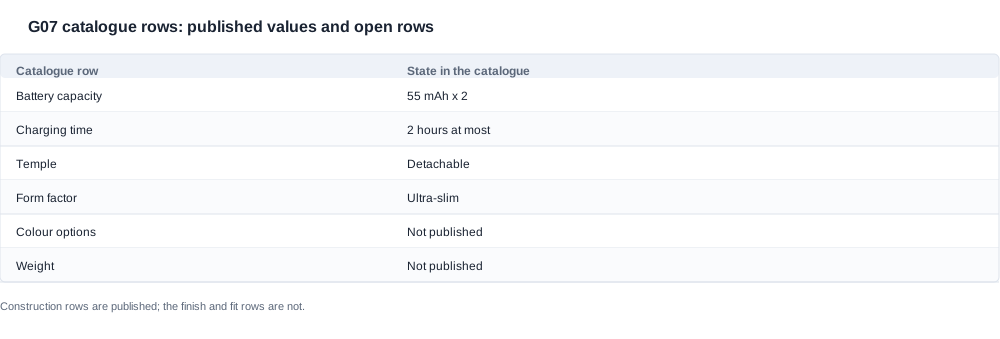
Everything else in the row set is either a gap or a range-level fact that this model sits inside. The charging time is carried with a two-hour ceiling, since this model is not one of the two that publish an approximately one-hour figure. A charge-method row exists here as well. Four entries in the range leave that row blank, and this model is not one of them: the L1 Pro and the MT6, and the CY03 and the CY05. A colour row is absent as well, and only two models in the range publish colours at all. A weight row is absent as well, and the single weight in the whole catalogue belongs to the MT6 at 158 g. A radio version is published for 14 of the 28 models, the K01 and K02 carrying 5.3 and the remaining published rows carrying 5.4, so this model's row is a question to ask rather than a value to borrow.
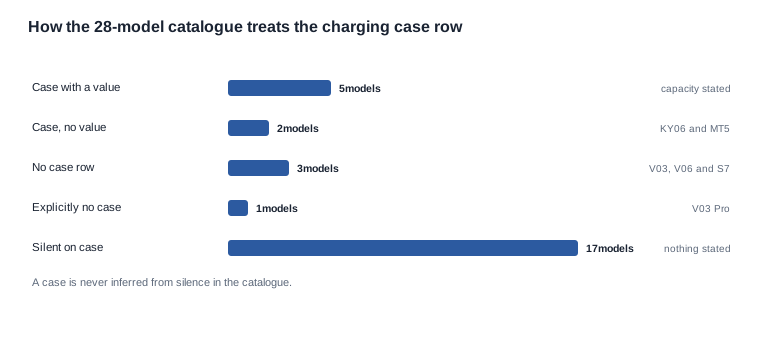
The charging case belongs in the same category, and its spread across the range matters before a question goes out. Capacity is quoted for 5 models, 2 more name a case with no figure attached, 3 carry no case entry, 1 states plainly that none exists, and 17 rows never mention one at all. A detachable temple adds a second question to that one: if the temple travels separately, does it ship in a case, in an insert, or on the frame itself.
The order in which a buyer should read those rows follows their dependency. Form and dimension first, because artwork depends on them. Temple construction second, because it decides the packaging. The twin-cell behaviour third, because it decides what the leaflet has to explain. Everything else can follow.

G07 smart glasses how to customize: the temple and the twin-cell row
The temple is the brand part on this model, and treating it as one requires four separate decisions rather than a single print instruction. The first is the mark. Ask which methods are available on a slim detachable member, whether a mark applied to the temple survives a detach-and-refit cycle, and whether it is applied before or after the temple is joined to the front. The second is the finish. Ask what finishes are available and what each does to the perceived thickness of the part, because a finish that adds bulk works against the ultra-slim description the catalogue publishes. The third is the spare. Ask whether a replacement temple can be supplied on its own, whether a spare can carry the same mark as the original, and whether the mark on a spare is identical in position and size to the mark on a factory unit — because if it is not, a customer who loses a temple in month two sees a different brand on the same pair.
The fourth decision is the one that costs the most when it is left open: whether the temple ships attached or detached. A temple that arrives detached needs a compartment, an insert or a tie-down, it needs a re-attach step in the leaflet, and it needs an inspection line that confirms the part is present and seated. A temple that arrives attached is simpler to pack and simpler to check, but it narrows the customisation story. Neither is obviously correct, and the choice belongs with the programme rather than with the supplier's default.

The twin-cell row raises its own set of questions, and they are worth listing separately because they are easy to overlook once the branding discussion starts:
- Whether each temple carries one cell, and if so where the charging contacts for each cell sit.
- Whether the case, if the programme includes one, charges both cells and how it indicates the state of each.
- What the indicator does when one side is charged and the other is not.
- Whether the pair operates with one side empty, and if it does, what the customer sees.
- What the pair does when the two cells are at different states of charge.
- How a technician should verify both cells during an incoming check.
The closure order that follows from all of this is deliberate. The dimensional answer comes first, because the artwork and the case insert depend on it. The temple mark and finish come second, because they determine what the packaging has to protect. The twin-cell behaviour comes third, because it determines what the leaflet has to explain and what the inspection sheet has to test. The naming rule comes fourth, once the physical surfaces are settled. The radio row, the case row and the market documents come last, because they are the items most likely to be answered in writing without holding anything else up.
What should not happen is the temptation to describe the two cells as a single larger battery. The catalogue publishes 55 mAh × 2 and the programme should publish the same shape, because the two-cell arrangement is what a buyer needs in order to predict charging behaviour, to ask sensible questions about a case, and to write a support article that is still true in a year.
Deciding what the G07 programme can actually change
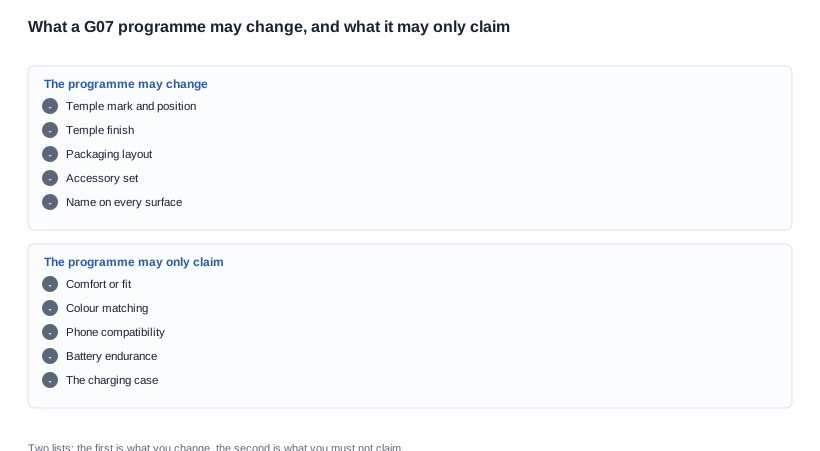
A construction-led model invites a particular kind of over-claiming, because a detachable slim temple looks like an invitation to promise things the rows do not support. The useful discipline is to split the programme into two lists: what the programme may change, and what it may only claim. The first list is where the budget and the effort go. The second list is where the copy goes, and it is short.
What the programme may change on this model is the mark on the temple, the finish of the temple, the presence and layout of the packaging that protects a detached part, the configuration of the accessory set, and the name carried across every surface. All five are within reach of a buyer who closes the right rows, because all five depend on decisions rather than on measurements the catalogue has withheld.
- The mark on a detachable temple: where it sits, how it is applied, and whether it survives refitting.
- The finish of the temple, and what it does to the apparent slimness of the profile.
- The packaging, if the temple travels detached: the compartment, the insert and the re-attach step.
- The accessory set, and whether a replacement temple is offered at all.
- The name, on the shell, on the temple, on the carton, in the leaflet and on the inspection record.
What the programme may only claim is the other half, and it is where most of the risk in a listing lives:
- Nothing about comfort, fit or all-day wear, because no weight row is published for this model and the only weight in the catalogue belongs to a different product.
- Nothing about colour matching, because no colour row is published here — and this is the claim most likely to be attempted, since the detachable temple makes it look obvious.
- Nothing about compatibility with a particular phone, because the radio row has to be asked for rather than assumed from a neighbour.
- Nothing about battery endurance derived from the charging row, because a charge time and a running time are different rows.
- Nothing about the charging case, until the case question has been answered in writing.
Running that review is a meeting with a short agenda and a fixed output. Take the draft listing, the carton copy, the marketplace description and the instruction leaflet, and work through them sentence by sentence against the two lists above. The output is not a rewritten document; it is a decision register with four columns: the sentence, the list it belongs to, the row that would have to be closed to keep it, and the owner who will chase that row. Sentences that fail the test are not deleted on the spot, they are marked, because a sentence that cannot be supported today may become supportable in a week, and deleting it permanently throws away the brief for it. The review has to cover the claims that live outside the written copy as well: the photographs used on the marketplace listing, the short video behind the launch post, and the product title itself, because a title is a claim and it is usually the last thing anyone re-reads before approving it.
The register is then worked again after each batch of closures, because a row that gets answered is the moment a pending sentence moves from the claims list into the changes list. That second pass is the one most programmes skip, and its absence is why a listing keeps advertising something that the file stopped supporting weeks earlier. The person who signs off on the artwork should own the register, since that is the role that already holds the version history and the approval dates. The sentences that survive that pass are the programme itself, and the ones that fail are usually the most attractive ones to read, which is precisely why they need a written row behind them before they ship.

Carrying the G07 name from the purchase order to the retail carton
A detachable part complicates naming in a way that a fixed pair never does. On a sealed pair there is one surface to mark and one place for the name to appear on the product itself. Here there are at least two, and they can be separated in the customer's hands: a shell with the brand and a temple with the brand, which may later be detached and replaced. That separation is the operational fact that a naming rule has to handle, and it is why the rule needs to be written down rather than assumed.
The rule itself is simple and has four parts. The customer-facing name is identical on every surface, with identical spelling and identical capitalisation. The internal designation is recorded against the purchase order line and against the inspection record, so any unit can be traced back to the catalogue row it came from. The mark on a replacement temple matches the mark on an original one, in position and in size, so the product stays visually identical after a part is changed. And the packaging states plainly whether the temple arrives attached or detached, because a customer who opens a box and finds a separate part will assume the worst unless the box tells them otherwise.
The inspection sheet for this model has to cover a detachable assembly, and the lines are not the ones used for a sealed pair:
- The temple is present, correctly seated and secure.
- The shell mark and the temple mark are both legible, in the right position, and match the artwork that was approved.
- The detach-and-refit cycle completes without damage to the mark or the hinge area.
- Both cells are charged, and each side's indicator shows the state the supplier has described.
- The packaging holds the parts in the position shown on the artwork, with the insert or compartment included.
- The carton artwork and the packing list agree with the physical contents, whichever configuration was chosen.
Two red flags are specific to this model. The first is artwork that shows the pair assembled while the packing list treats the temple as an accessory, which is how a customer ends up with a part they were never told about. The second is a spare temple programme launched before anyone has decided how a spare gets the same mark as an original; a spare that carries a different mark converts a helpful accessory into an advertisement for the factory. The decision to make is whether the programme supports replacement parts at all, and if it does, who marks them.

Closing the G07 open rows before a first bulk order
The evidence file for a construction-led model has to carry a different weight of evidence than one for a model whose only customisable surface is a print. Dimensions need drawings, marks need photographs, and a detach-and-refit cycle needs to have been performed and written down by somebody who watched it happen. An assertion that a temple is "easily removable" is not evidence; a note describing how it was removed, what was checked afterwards and what was observed is.
The file has five parts, and they are worth listing in the order in which they should be produced rather than in the order in which they are thought about:
- A dated catalogue extract of the rows as published, with the reference for each one, kept as the baseline every answer is checked against.
- The dimensional answer, including what the slimness description is measured against, in a form that can be drawn to and printed from.
- The temple answers: mark method, finish, mark position, refit behaviour and the spare policy, each confirmed in writing against this model.
- The twin-cell answers, covering the charging contacts, the indicator behaviour per side and the state in which the pair operates.
- The artwork and the evidence pack, including the approved proofs, the packing list, the inspection sheet and the market documents for the destination.
The priority order when the schedule compresses is not the same as the list order. The dimensional answer comes first, because nothing else can be drawn until it exists and because a carton sized wrongly is a print run that cannot be reused. The temple answers come next, because the mark and the finish decide what the packaging protects and how the leaflet's re-attach step reads. The twin-cell answers follow, because they determine what the inspection sheet has to test. The radio row, the case row and the market documents are last, because they are the answers most likely to arrive in writing without holding anything else up.
The rule that keeps the file honest is the one that applies to every model in this range: a row stays open until a dated document names the model and words the answer so that a specification sheet can quote it directly. For this model the test is slightly sharper, because a construction claim can look precise while being unmeasurable. "The temple detaches and refits" is not closed. "The temple detaches and refits, the mark is applied before assembly and is unaffected by refitting, and here is the photograph of the refitted part" is closed.
The buyer's criteria for that test are worth stating in advance, because a construction claim is easy to make and hard to falsify. How to verify a detachable part is simple: put it back, look at the mark, and photograph the result. The pitfalls that arrive late are the ones nobody wrote down — a spare temple that arrives without a mark, a carton whose insert does not hold the part in position, a leaflet step that assumes a tool the customer does not have. Keep them as a checklist of the questions to ask, and settle them before you buy the packaging rather than after.
Where CYNRIN stands on the G07's open rows
Where CYNRIN stands on the G07's open rows. The rows this model carries are the detachable temple, the ultra-slim form, the 55 mAh × 2 battery row and the two-hour charging ceiling, and we will put those in writing whenever a buyer asks for them. Colour, weight, radio version and case capacity are absent from its catalogue entry, and rather than estimate them we will send the question to the factory and return the answer as it comes back. Where a neighbouring model publishes a value, we will point at the row but not transplant it.
The position leaves a screening decision with you, and it can be stated as three conditions. A programme built around a mechanical, serviceable product — one where the temple is a branded part, a spare is offered and the packaging is designed around a removable member — is well matched to the published rows, because this is the model in the range whose construction does that work. A programme that needs a published colour, weight or compatibility figure to write its copy is not served by these rows at all, and the honest route is to ask for a written answer, or to look for a model whose published rows cover what the brief needs. A programme that needs the pair to arrive fully assembled with no loose parts and no assembly step for the customer has a mismatch with this model's construction, and that mismatch is better found during the closure stage than during the first fulfilment.
The published rows also point to where the practical detail sits. The packaging options article sets out what changes when a pair travels in parts, and the charging options guide compares how the audio range states its charging rows, which is useful before the twin-cell questions go out. This model belongs to the range shown on the audio glasses product line.
Start with the dimension and the temple, not with the logo. Everything else in this programme is easier to fix while those two answers are still open.


