
Of the eight Bluetooth audio glasses models in this range, six charge magnetically and two charge over a Type C port, and every one of the eight publishes a charge time of two hours or less. That single row is where the delivered cost of the product is actually decided — not by the cell, and not by the unit price. A magnetically charging frame needs something in the box to charge on, and whether that something is a cable or a second lithium cell is the difference between an accessory line and a transport document. This article works through what the published rows settle, what they leave open, and which questions belong in the quotation before the deposit rather than after the first shipment.
Bluetooth audio glasses charging options: what the eight published rows actually say
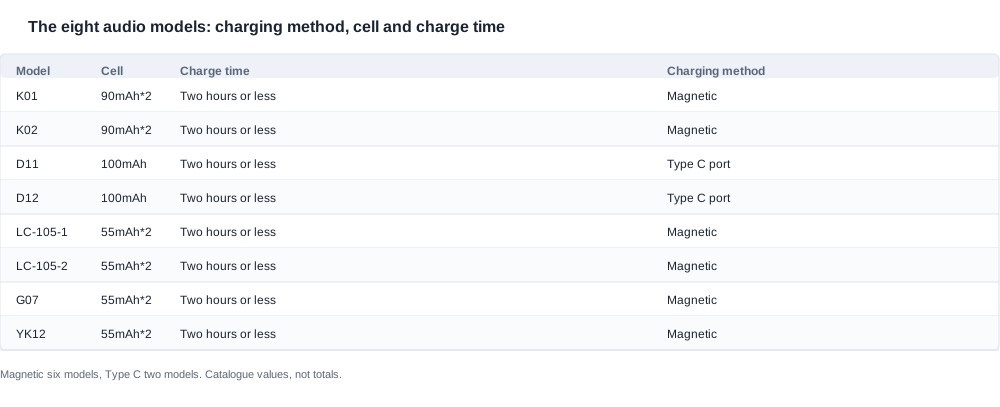
The audio range is small enough to write out in full, and writing it out is more useful than summarising it, because the pattern only becomes visible when all eight rows sit next to each other.
Six of the eight charge magnetically: the K01 and the K02 publish 90mAh*2 with a magnetic method, the LC-105-1 and the LC-105-2 publish 55mAh*2 with a magnetic method, and the G07 and the YK12 publish 55mAh*2 with a magnetic method as well. The remaining two charge over Type C: the D11 and the D12, each publishing a single 100mAh cell. All eight publish a charge time of two hours or less, and the audio range carries no exceptions to that figure.

Two things are worth noticing about that table before drawing any conclusion from it. The first is that the charge-time row is uniform — it does not discriminate between models, so it cannot be used to rank anything. The second is that the charging-method row splits the range almost evenly, six against two, which means a buyer cannot assume their platform choice is representative of the range as a whole. A buyer who qualifies a Type C model because their current programme is Type C has qualified two models out of eight, and they should know that before they treat the sample as the range.
The Bluetooth version travels alongside the charging method and does not align with it. The K01 and the K02 publish Bluetooth 5.3 and charge magnetically; the other six magnetic models publish Bluetooth 5.4; and the two Type C models publish 5.4. So a buyer moving between the K-series and the rest is changing radio generation and changing nothing about the charge path, while a buyer moving to the D-series changes both. That combination is useful when you are writing a configuration, and it is one of the reasons the model designation should be frozen in writing rather than described in prose.
The charge-time row is a ceiling, not a measurement
Every audio model in this range publishes a charge time of two hours or less, and that wording is doing precise work. It is an upper bound. It is not the same claim as a charge time under two hours, because an upper bound of two hours allows a unit that takes exactly two, and a statement about being under two hours does not. Across the whole catalogue the pattern is consistent: twenty-six of the twenty-eight models publish two hours or less, and the only two publishing a different figure — the D17 and the ZH12, both sport models — publish about one hour. Neither of those two is in the audio range, so a buyer working with the eight audio models is working entirely within the two-hour-or-less band.
Two further gaps sit behind that figure, and they are the reason a charge time cannot be turned into an operational number. The catalogue publishes no starting state of charge, so it is not stated whether the two hours begin from an empty cell or from a partially charged one. And it publishes no end-of-test criterion, so it is not stated what level of charge counts as finished. A buyer who wants to know how long a unit is unavailable during a shift cannot derive that from this row, and any supplier who offers a sharper number is offering a figure the catalogue does not contain.
A charging method row does not tell you what is in the carton
This is the gap that matters most commercially, and it is a gap across all eight models rather than a gap in a few. The charging-method row says how a frame takes charge. It does not say whether a pad, a dock, a case or a cable is in the box. Not one of the eight audio models publishes a charging-case row at all — not a capacity, not a weight, not an interface, not an inclusion statement.
It is important to be precise about what that means, because the distinction recurs throughout this article. The catalogue is silent on the subject of a case for these eight models. Silence is not a statement that no case exists. A buyer who reads the absence of a case row as the absence of a case has made an inference the source does not support, and it is the inference most likely to be wrong, because magnetic charging is precisely the configuration in which a case or a pad is the normal accessory.
The same discipline applies to the cell row. Six of the eight models publish two cells and two publish one, and the catalogue publishes the cell value and the cell count as separate facts — 55mAh*2, 90mAh*2 and 100mAh are published values, not the arithmetic totals a buyer might derive from them. A buyer who writes a total capacity into a specification sheet and then compares it against a supplier who wrote the published form is comparing two documents that look different and mean the same thing. Derived totals are legitimate in analysis, but they have to be labelled as derived, and they never belong in the line of a purchase order where the catalogue value is what the factory builds to.
Where the charging method sits against the wider catalogue
The audio range is not the whole catalogue, and the interface distribution across all twenty-eight models is worth stating once so that a buyer benchmarking a platform is not misled by the audio subset. Across the full range, seventeen models charge magnetically, seven charge over Type C, and four publish no charging method at all. Those four are the CY03 and the L1 Pro, and the CY05 and the MT6 — all camera models, and all four of them publish a charging-case capacity even though the method that charges them is not published.
That distribution is the reason a buyer moving between categories should not carry an assumption across. A buyer who works with a magnetic audio model and then evaluates a camera model may land on one of the four where the method row is simply absent, and the correct response to an absent row is a question rather than an assumption. The AI camera glasses selection article works through the camera range on the same routing principle used here.
Bluetooth audio glasses charging: why magnetic versus Type C moves the landed cost
The interface decision is usually treated as a technical detail because both options sound equally convenient. From a procurement position they are not comparable at all, and the difference propagates into the parcel, the freight class, the accessory list, the packaging artwork and the first week of the customer's experience.
The Type C models carry the lightest carton. A D11 or a D12 needs a cable and nothing else, and a cable is light, cheap and universally owned. If a cable is included, the carton holds one powered item. If it is not, the customer already owns what is needed. Either way the parcel is a single-cell product, and the transport file is the simpler of the two.
The magnetic models need an accessory in every unit. A frame that charges by magnet has to meet a pad or a case somewhere. There is no cable to fall back on. That means the carton either contains a passive pad, which is cheap and light, or contains a case with its own cell, which is neither. The commercial consequence is that the magnetic six cannot be quoted until the accessory decision is made, because the accessory is not an add-on — it is the thing that makes the product function.
A case with a cell is a second powered item in the shipment. This is where the decision stops being about the customer and starts being about compliance. A case carrying its own cell changes the declared lithium content, the transport classification, the carton configuration and the set of documents that must travel with the consignment. Every one of those is a file that has to be correct before the goods move, and every one of them is cheaper to get right before the carton is frozen than after.
The landed cost difference is invisible on a product page. Freight scales with packed weight and volume, and the accessory is what moves both. This is the arithmetic behind the shipping weight breakdown, and it is why a buyer who compares unit prices between a magnetic model and a Type C model without comparing packed weights is comparing two different products.
Bluetooth audio glasses case questions: the same open line on six models
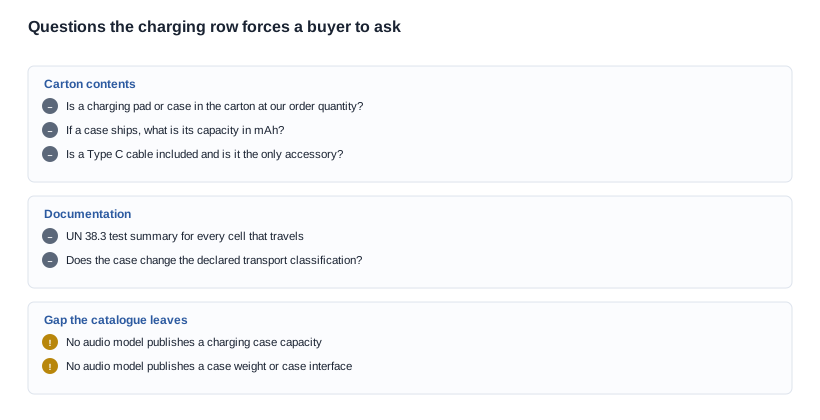
Because six of the eight models charge magnetically, the case question lands on most of the range rather than on a corner of it, and the catalogue leaves it open on all six. The questions below are not a list of things that might be missing; they are the specific lines that have to appear in a quotation before the configuration can be priced.
-
Is a pad, a dock or a case in the carton at our order quantity? Not at the sample quantity and not at the pilot quantity — at the quantity on the order. Accessory inclusion frequently changes with volume, and a carton agreed at sample stage is not binding.
-
If a case ships, what is its capacity in mAh? No audio model publishes this. The capacity determines how many charge cycles the case itself carries, which determines whether the customer can leave the frame off a cable for a week, which is the entire retail argument for a case.
-
How is the case itself charged, and how long does that take? A case that charges the frame and is charged by the same cable is one product. A case that needs its own cable is a second accessory, a second instruction line in the box, and a second support question.
-
What is the case weight and what is the packed unit weight of the assembled carton? Without these two numbers the freight class cannot be determined, and the landed cost per unit cannot be computed. This is the single most consequential missing number in this part of the range.
-
Does the case change the transport classification, and does every cell that travels have a UN 38.3 test summary? A frame and its case are two cells travelling together, and each needs its own documentation. The battery transport compliance checklist covers the documentation set in detail.
-
If a Type C configuration is wanted on a platform that is magnetic, what does that move? This is a reasonable question on the G07, the YK12 and the LC-105 pair, and the answer is a configuration question rather than a technical one — whether a different board, a different housing or a different bill of materials is involved. The catalogue does not answer it.

Bluetooth audio glasses channel fit: three routes, three different priorities
The same interface choice resolves differently depending on where the product is sold, because the parcel, the customer and the merchandising pull in different directions. The structure below is a routing aid for a buyer, not a recommendation of any model, and it does not involve price — we do not publish prices, minimum order quantities or lead times for any model in this range.
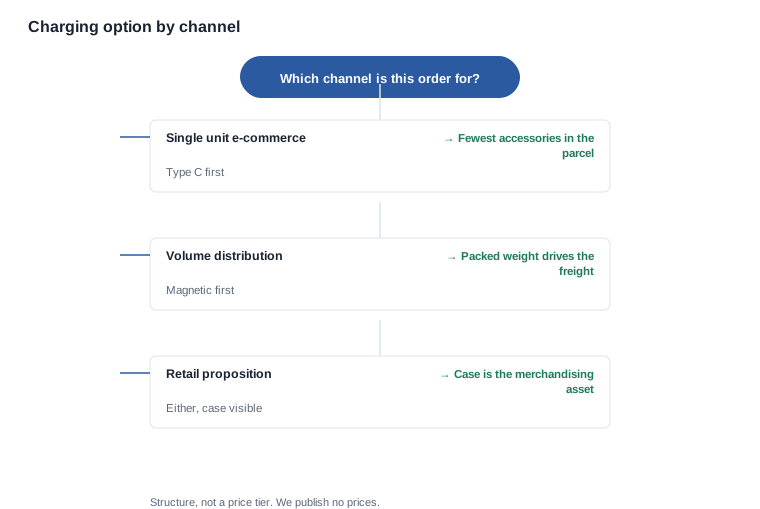
Where the unit is sold on its own, the Type C models have the shortest path to a working product. The customer owns a cable already, so the first-week friction is close to zero and the parcel carries one powered item. The two models that publish this configuration are the D11 and the D12. A buyer who wants that route should still confirm cable inclusion, because a Type C port does not imply a cable in the box.
Where units move in volume through distribution, the packed weight dominates and the interface is decided by freight. The magnetic six can be ordered with a passive pad, which keeps the parcel light, or with a case, which does not. That choice should be made with real packed weights for assembled cartons rather than with an estimate, and it should be made before the retail price is set, because it moves the landed cost per unit directly.
Where the product is sold as a retail proposition with a merchandising story, the case is an asset rather than a cost. A case in the product photograph is the visible reason a customer believes the product lasts. The commercial decision is then whether that freight cost is recovered in the retail price or carried in the model, and that is a channel decision rather than a technical one. The packaging and private label options piece covers the merchandising side.
The failure mode common to all three routes is the same one: the interface is chosen from the specification table early, and the accessory is settled late, after artwork and instructions have been produced. Once the packaging shows a case that is not in the carton, the correction is a reprint rather than an edit.
What a second cell changes beyond the parcel
A case that carries its own cell is easy to treat as an accessory in the quotation and expensive to treat as one in the documentation. The frame and the case are two powered items travelling together, and every downstream artefact has to reflect both of them rather than the frame alone.
The first consequence is the cell count on the bill of materials. A bill that names one cell names half of what is in the carton, and a bill that is wrong about the bill of materials is wrong about the transport classification that follows from it. The second is the documentation set: every distinct cell type that travels needs its own test summary, and a case sourced from a different cell supplier than the frame is a separate cell type with separate documentation. The third is the declared weight and the carton configuration, which have to match what is physically packed rather than what the packing list was drafted to say.
This is the point at which a packing decision becomes a compliance decision, and it is why the battery transport compliance checklist belongs earlier in a programme than most buyers place it. The practical sequencing is straightforward: settle whether a case exists, then freeze the cell list, then write the transport file, and only then release the packaging artwork. Reversing that order means reworking a document set that was already finished, and documentation rework is the slowest part of the programme because it sits outside the factory.
Comparing configurations without comparing the wrong thing
A buyer with a magnetic model and a Type C model on the same shortlist will naturally want to know which is cheaper to land. The honest answer is that the question cannot be answered from the catalogue at all, because the catalogue publishes no price, no packed weight and no freight class for any model in the range. What it can do is tell the buyer which comparison is worth making and what has to be measured first.
The comparison is worth making because the interface determines the accessory, and the accessory determines the parcel. A Type C model has a floor on its carton — the frame plus whatever the customer already owns. A magnetic model has a floor set by the decision to include a pad or a case, and those two options sit at very different weights. So the first measurement a buyer needs is not a unit price; it is the packed unit weight of an assembled carton for each candidate configuration, including the accessory actually chosen.
The second measurement is the freight class that weight implies, and the third is the documentation effort each configuration creates. Only after those three are known does a unit price comparison mean anything. Buyers who skip to the price are, in effect, comparing a single-cell product with a two-cell product and calling the difference a saving, which is the most common arithmetic error in this part of the range.

Where the charging row stops and the supplier has to start
The published rows in this range settle the interface, the cell configuration, the charge-time ceiling and the Bluetooth version. They settle nothing about what accompanies the frame in the carton, and they say nothing at all about a case capacity, a case weight, a case interface or a case charge time for any of the eight models.
That boundary is deliberate on our side, and it is worth being direct about it. We publish the electrical rows because those are the rows the factory builds to and the rows a configuration can be frozen against. We do not publish a case capacity we cannot source, a packed unit weight we have not measured, a price, a minimum order quantity, a lead time, a production capacity or a warranty period. The Bluetooth audio glasses buying guide covers the range decision more broadly, and the bulk ordering article covers the volume mechanics that follow from the accessory decision.
A shortlist built this way is defensible in a specific sense: every exclusion traces either to a published row or to a constraint the buyer set, and every open line has a named owner. Before a deposit is worth discussing, four things should be in writing — the carton contents at the ordered quantity, the packed unit weight of the assembled carton, the transport classification implied by every cell that travels, and the charge-time basis including the starting state and the end-of-test criterion. Where a supplier answers those four in a quotation rather than in a conversation, the charging decision is no longer the largest open item in the programme.
Questions to close before a charging configuration is signed
The following are the lines this range leaves open, and they are listed in the order they tend to surface.
-
Confirm the charging method against the published row for the exact model on the shortlist — magnetic for the LC-105-2 and the YK12, the K01 and the LC-105-1, and the K02 and the G07; a Type C port for the D11 and the D12.
-
Establish the complete carton contents at the ordered quantity, including whether a cable, a pad or a case is present and whether anything else is included.
-
Obtain the packed unit weight and carton dimensions for the assembled carton, not for the frame alone.
-
Get the case capacity, case weight, case interface and case charge time in writing if a case is included, since the catalogue publishes none of the four for any audio model.
-
Confirm the starting state of charge and the end-of-test criterion behind the published two-hours-or-less figure, since the catalogue publishes the ceiling without either.
-
List every cell that travels with the consignment and obtain a UN 38.3 test summary for each.
-
Ask whether the goods-ready milestone, rather than the production-start milestone, is the date written into the order, since the difference between the two is the part of the schedule a buyer does not control.
-
Confirm that the packaging artwork, the instruction leaflet and the retail listing all show the same carton contents that have been agreed, because these three artefacts usually have the longest lead time of anything in the programme.
Related reading
- The range decision — Bluetooth audio glasses buying guide
- The parcel arithmetic — AI camera glasses shipping weight
- The documentation a second cell triggers — battery transport compliance buyer checklist
- The volume mechanics — Bluetooth audio glasses bulk ordering
Send us the models, the channel, the destination country and the order quantity, and we will tell you which charging configurations exist for that platform and which have to be quoted as a separate line.


